


Fractions and decimals are often where math starts to feel different for children. Up until this point, most math involves whole numbers. Once fractions and decimals appear, children are asked to think about quantity in a new way—and that shift can take time.
For many families, this stage raises common questions:
Why does my child suddenly feel stuck? When are these concepts introduced? And how can I help without turning homework into a daily struggle?
Understanding how children typically learn fractions and decimals can make this stage much easier to navigate.
How Children First Encounter Fractions
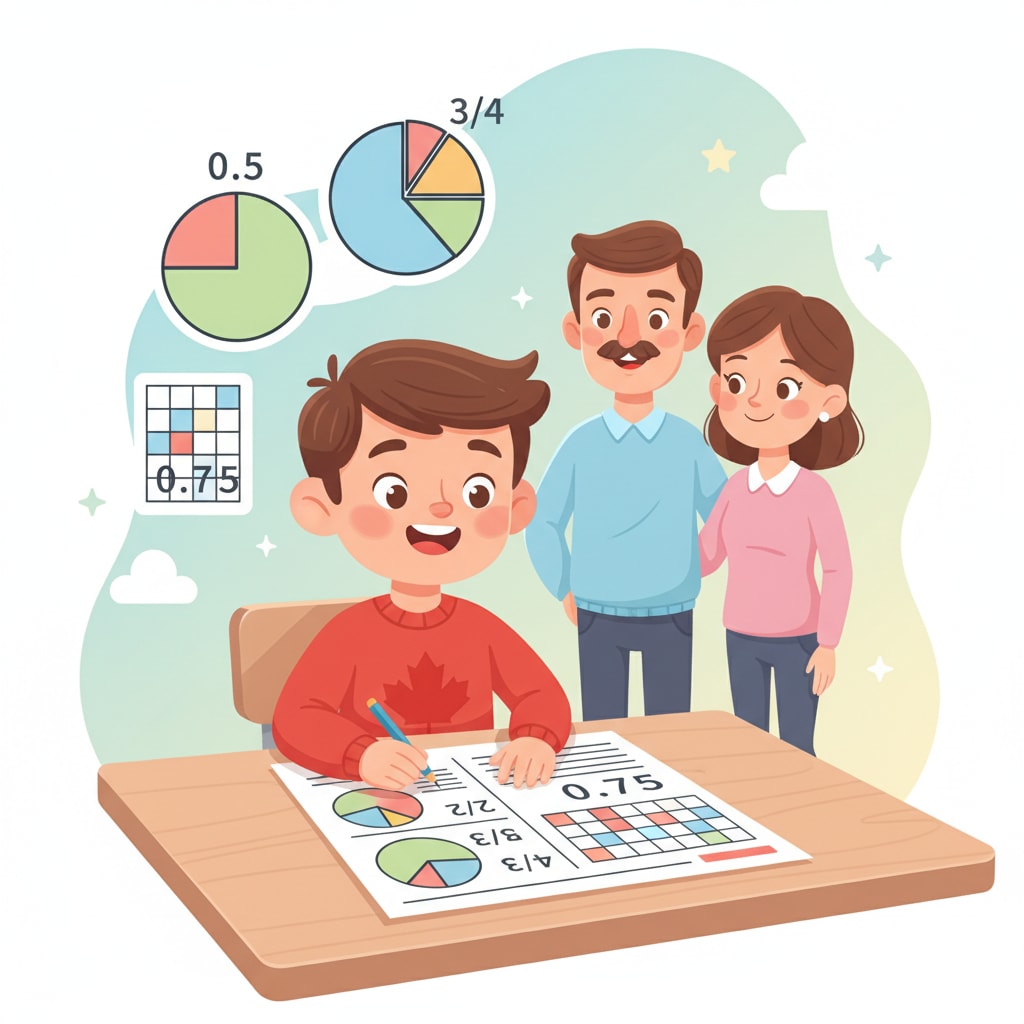
In Canadian elementary classrooms, fractions are usually introduced around Grade 3. At this stage, the focus is not on calculation, but on meaning.
Children learn that:
- A fraction represents part of a whole
- The whole must be divided into equal parts
- The numerator tells how many parts are taken, and the denominator tells how many equal parts make the whole
Teachers often use visuals—such as shapes, paper folding, or food-sharing examples—to help children see what fractions represent. This visual foundation is essential. Without it, fractions can quickly feel abstract and confusing.
As students move into Grades 4 and 5, they begin to:
- Compare fractions
- Recognize equivalent fractions (such as 1/2 and 2/4)
- Add or subtract fractions with the same denominator
Hands-on experiences, like cooking or measuring, reinforce these ideas naturally at home.
When Decimals Are Introduced
Decimals usually appear after children have some experience with fractions, often in Grades 4 or 5. While decimals are also parts of a whole, they are taught through place value, which many children already understand from whole numbers.
Students learn that:
- Tenths, hundredths, and thousandths extend the base-ten system
- The position of a digit after the decimal point determines its value
For example, in 3.25:
- 3 is the whole number
- 2 represents tenths
- 5 represents hundredths
Because decimals connect easily to money and measurement, many children find them more intuitive at first than fractions.
Making the Connection Between Fractions and Decimals
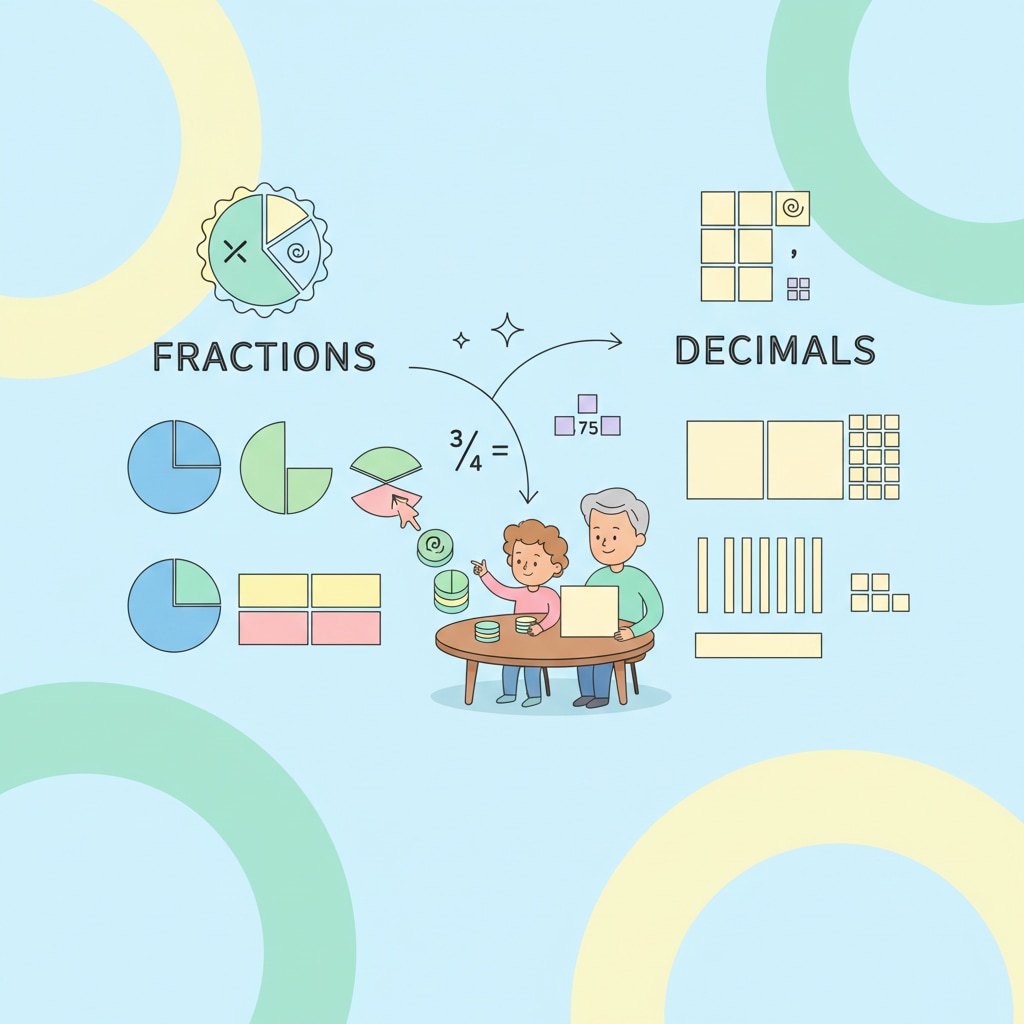
A key learning moment happens when children realize that fractions and decimals can describe the same value. This connection is usually explored in Grades 5 and 6.
Examples include:
- 1/2 = 0.5
- 1/4 = 0.25
- 3/4 = 0.75
This step is important because it shows children that math is flexible. The same quantity can be represented in different ways depending on the situation.
Canadian money is a helpful everyday example:
- 50¢ = 0.50 of a dollar = 1/2 of a dollar
- 25¢ = 0.25 of a dollar = 1/4 of a dollar
Seeing these relationships in daily life helps ideas stick.
Where Children Commonly Struggle—and Why
Struggles with fractions and decimals are very common and usually temporary.
With fractions, children may:
- Have trouble understanding equivalent fractions
- Find it difficult to compare fractions with different denominators
Visual tools—fraction strips, drawings, or area models—often make these ideas clearer.
With decimals, place value beyond the decimal point can be confusing. A common misconception is thinking that 0.5 is smaller than 0.25 because “5 is smaller than 25.” Showing that 0.5 is the same as 0.50 helps correct this misunderstanding.
These challenges are part of learning, not signs that a child is “bad at math.”
How Parents Can Support Learning at Home
Parents don’t need to teach formal lessons to be helpful. Small, consistent actions matter most.
Helpful ways to support learning include:
- Using food, money, or measuring tools to model ideas
- Asking children to explain their thinking rather than rushing to correct answers
- Connecting homework questions to real-life situations
- Keeping practice low-pressure and routine
For families who want to understand grade-level expectations, the Ontario Ministry of Education curriculum outlines when fractions and decimals are introduced and how understanding develops over time. Background explanations from sources like Encyclopaedia Britannica can also help parents feel more confident when supporting learning at home.
Building Confidence Takes Time
Fractions and decimals are not meant to be mastered quickly. Children often move back and forth between understanding and confusion before ideas fully settle.
What helps most is:
- Repeated exposure
- Visual models
- Patience with mistakes
With steady support, confidence grows—and these concepts become a strong foundation for later topics such as percentages, ratios, and algebra.
About Think Academy
Think Academy, part of TAL Education Group, shares education-focused resources to help families understand how children build strong math foundations. Our approach emphasizes conceptual understanding, structured practice, and clear learning routines that support long-term confidence in math.
For families who would like a clearer picture of their child’s current math level, Think Academy provides information about free online math evaluations, which highlight strengths and learning gaps in a structured way. Parents who are curious about how concepts like fractions and decimals are taught in practice can also explore trial class options, offered as optional tools to better understand instructional approach and learning style.
Explore more parent-friendly math and learning resources on the Think Academy Blog.

