If your child can add and subtract but freezes when a worksheet shows a bar graph, you are not alone. In Canadian classrooms, data management and statistics shows up early because it connects math to real life: pets in the class, weather counts, or favourite books. This article breaks down what “data work” looks like from ages 4–12, what skills matter most, and what you can do at home to make graphs and surveys feel manageable.
Intro: What “data” means in early grades
In elementary math, “data” usually means information collected to answer a question. Children might gather it by counting, measuring, or asking classmates in a simple survey (a set of questions used to collect information). They then organize the results and explain what they notice, which builds language, reasoning, and number sense.
Across Canada, provinces publish curriculum expectations that include data-related learning outcomes, although the wording differs by province. For example, you can see how Ontario frames data learning in the Ontario elementary mathematics curriculum hub. If you live elsewhere, your provincial ministry of education website will have a similar curriculum portal.
Learning progression by age: From sorting to interpreting
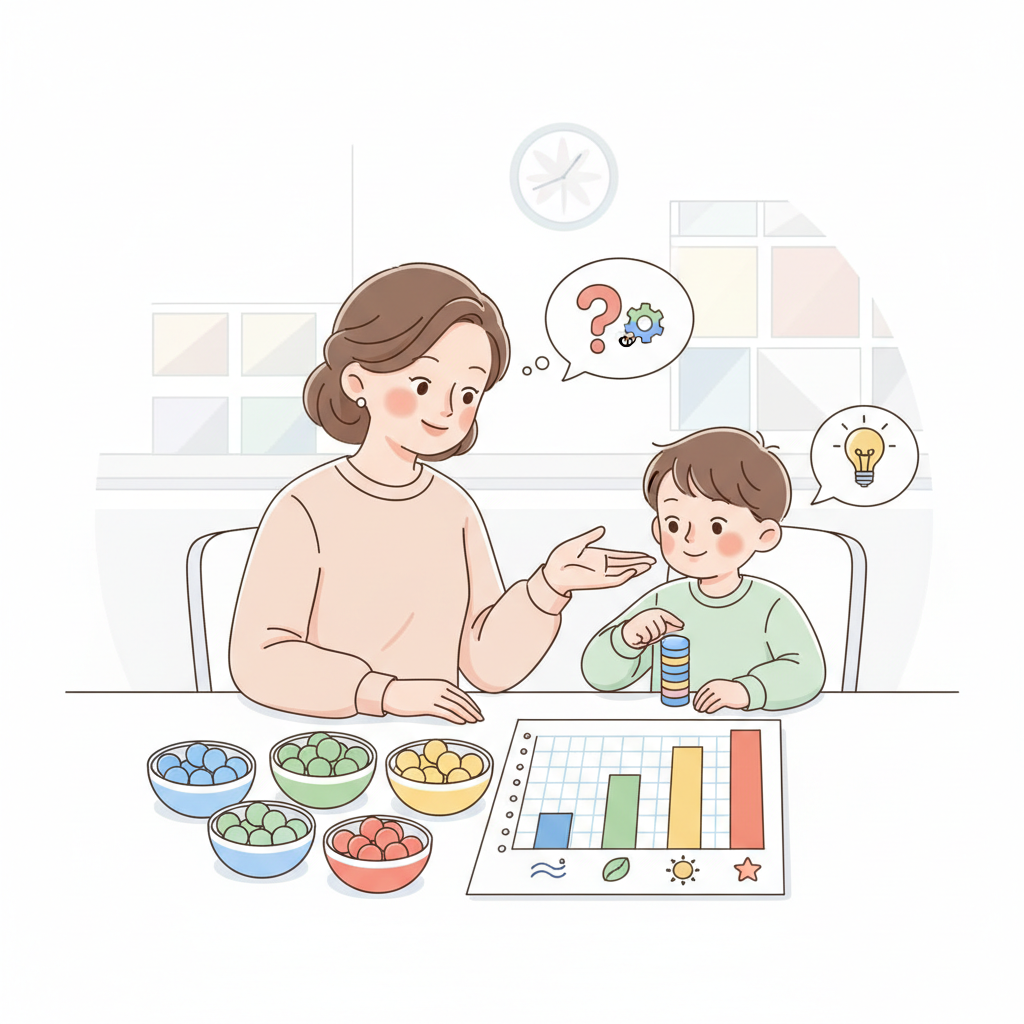
Most children move through a predictable progression: sort and count first, then represent data with pictures, then use graphs, and later interpret and compare results. However, kids do not always learn these skills in a straight line. Therefore, it helps to think in “milestones” rather than expecting perfection in one grade.
Ages 4–6 (Kindergarten to Grade 1): Sorting, counting, and simple displays
At this stage, children learn that data answers a question. For example, “How many toy cars do we have?” They practise sorting objects by one attribute (one feature, such as colour) and counting each group.
- Common classroom tasks: sorting buttons, tally marks (quick counting marks), and picture graphs (graphs that use symbols or pictures)
- What to listen for: your child can say which group has “more,” “less,” or “the same” and explain why
- Home-friendly support: ask one-question polls at dinner, then count and compare results
If your child mixes up categories, simplify the choice. For example, use only two categories first, then add a third once it feels easy.
Ages 6–8 (Grades 2–3): Bar graphs, pictographs, and reading information
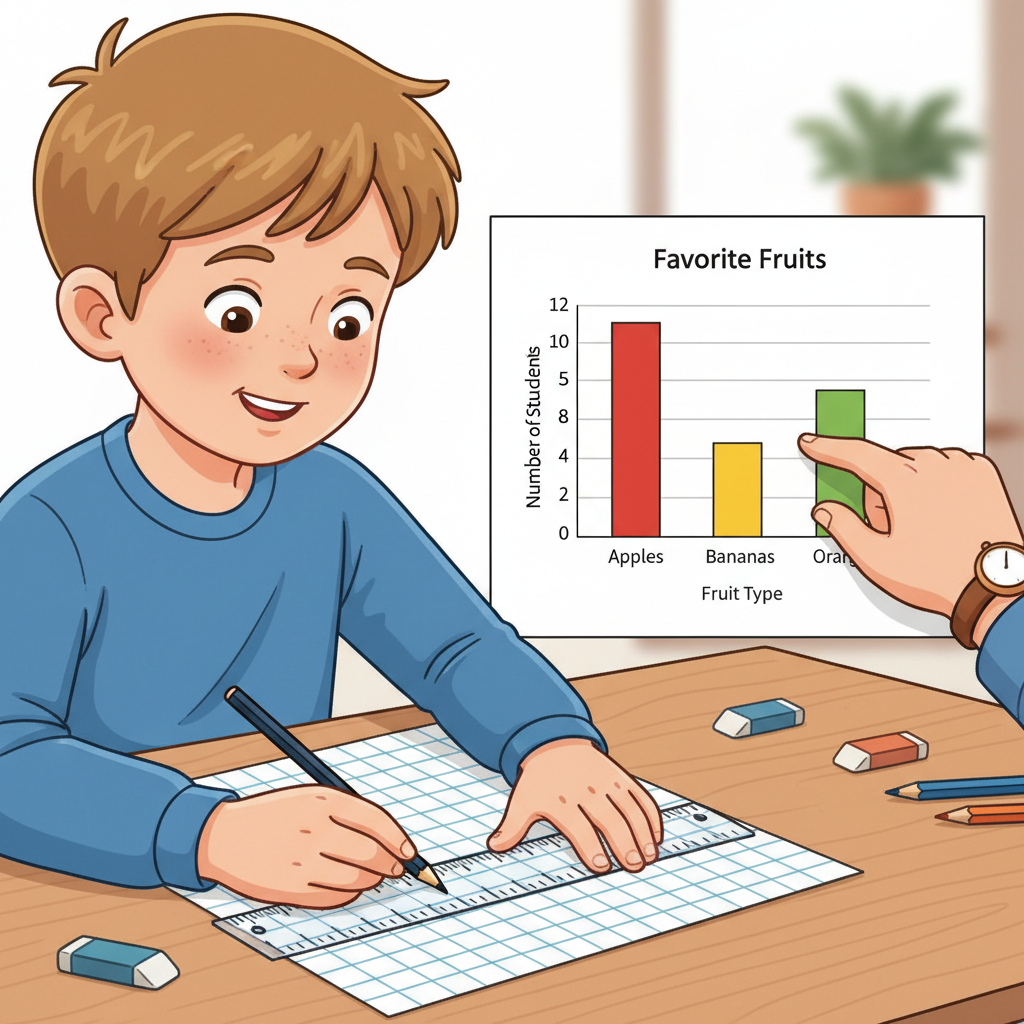
Children start moving from “making” graphs to “reading” them. They learn to label axes (the lines on a graph that show categories and numbers) and use scales (number patterns like 1s, 2s, or 5s). However, scales are a frequent source of errors.
- Common classroom tasks: drawing a bar graph from a tally chart, answering questions like “How many more?”
- Typical challenge: counting the number of bars instead of reading the scale values
- Parent tip: cover the bars and practise reading the numbers on the side first
For clear, kid-friendly definitions of graph types, you can reference Britannica’s overview of bar graphs.
Ages 8–10 (Grades 4–5): Collecting data, comparing categories, and choosing graphs
Now children often collect their own data through surveys and experiments. They also learn that graph choice matters. Therefore, they begin to match the display to the question, such as using a line graph for change over time (data collected at different times).
Many provinces include expectations around creating and interpreting different displays at these grades. You can review broader Canadian curriculum context through reputable summaries such as The Canadian Encyclopedia’s education overview, and then confirm specifics in your provincial curriculum.
- Common classroom tasks: making a class survey, showing results, and writing two observations
- Typical challenge: conclusions that do not match the data shown
- Parent tip: ask, “Where do you see that in the graph?” to connect claim to evidence
Ages 10–12 (Grades 6–7): Mean, median, and describing variability
Older elementary students often meet measures of centre, such as mean (average), median (middle value), and mode (most common value). They also start noticing variability (how spread out the data is). These ideas support later probability and algebra because students learn to generalize from information.
If your child is unsure about “average,” start with small sets they can picture. For example, use five daily temperatures or five game scores, then compare mean versus median and discuss which seems “fairer” in context.
- Common classroom tasks: calculate mean, compare two data sets, interpret line graphs and double-bar graphs
- Typical challenge: mixing up median and mean, especially when numbers are not sorted
- Parent tip: always sort values first when finding median; write them in a row on paper
For a simple, reputable reference on these terms, Wikipedia can help you quickly check definitions, then you can apply them using your child’s actual homework examples.
data management and statistics: What your child should practise at home
You do not need special materials to build strong data habits. Instead, focus on short, repeatable routines that connect to real life. Most importantly, help your child explain what the data shows in words, because communication is a core part of data learning.
| Skill | Quick home activity (10 minutes) | What it builds |
|---|---|---|
| Sorting and counting | Sort snacks, LEGO, or socks by one rule; count each group | Categories, totals, comparing quantities |
| Making a simple graph | Draw a bar graph of “pages read each day this week” | Representation, scale awareness, neat labels |
| Asking and answering questions | Ask 3 questions: “Most?” “Least?” “How many more?” | Interpretation, subtraction as comparison |
| Talking about results | Your child states 2 observations and 1 question for next time | Reasoning, evidence-based explanations |
Common mistakes (and how to fix them calmly)
Graph and data errors often come from rushing, not from a lack of ability. Therefore, a calm checking routine usually helps more than extra worksheets. Aim for one correction at a time.
- Missing labels: Prompt “What does this axis mean?” before they colour anything in.
- Wrong scale: Have them circle the scale numbers and count by that pattern aloud.
- Conclusions not supported by the graph: Ask “Which bar or point proves your answer?”
- Median mistakes: Remind them to sort values first, then find the middle.
Tools & Resources (official and reputable)
Digital tools can make data practice less frustrating, especially when your child can quickly try a new scale or graph type. However, choose tools that are transparent about how they display data and that avoid distracting ads.
- Ontario Ministry of Education: Elementary Mathematics for curriculum-aligned expectations and wording.
- National Council of Teachers of Mathematics (NCTM) for family-friendly math guidance and learning principles.
- Statistics Canada to explore real Canadian data sets in simple charts and tables.
- Desmos for creating and viewing graphs with clear visuals (helpful for older elementary).
- GeoGebra for interactive math visuals, including graphing and data activities.
How to know your child is on track
Progress in data learning often shows up in everyday talk. For example, your child starts using precise language like “more than,” “less than,” “equal,” and “most common.” They also begin to question data quality, such as whether a survey question was clear.
Watch for these signs of growing confidence:
- They can explain a graph without you prompting every step.
- They check labels and scales before answering questions.
- They can give one conclusion and point to evidence in the display.
Concluding Paragraph
When children practise collecting, displaying, and explaining information, they build skills that support science, social studies, and everyday decision-making. Just as importantly, they learn to slow down, check scales, and justify answers with evidence. If you keep practice short and real-life, data management and statistics becomes less like “extra math” and more like a useful way to understand the world.
Take a free Math Evaluation to identify your child’s learning strengths and next steps.
About Think Academy
Think Academy, part of TAL Education Group, helps K–12 students succeed in school today by building strong math foundations and critical thinking skills. At the same time, we focus on the bigger picture—developing learning ability, curiosity, and healthy study habits that inspire a lifelong love of learning. With expert teachers, proven methods, and innovative AI tools, we support every child’s journey from classroom confidence to long-term growth.