


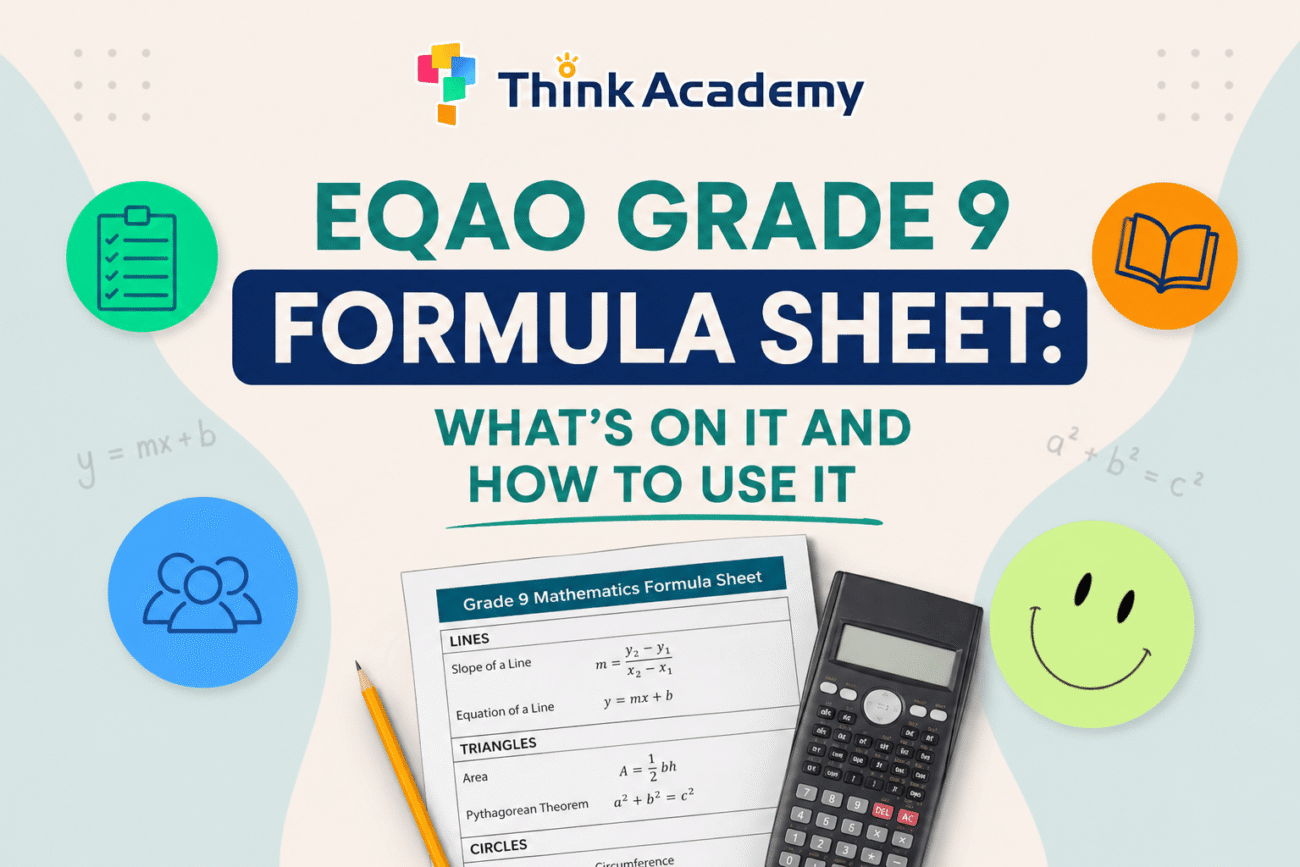
Every Ontario student writing the Grade 9 EQAO assessment gets access to an official formula sheet. It is provided inside the e-assessment platform and as a hard copy on request. Knowing exactly what is on it — and more importantly, knowing how to use it — is one of the clearest advantages your child can walk into that room with. This guide covers every formula on the sheet, what each one is actually tested for, and why the sheet alone is not enough.
For more on the Grade 9 EQAO, check out EQAO Grade 9: A Complete Guide for Ontario Students and Parents.

What is the EQAO Grade 9 formula sheet?
The EQAO Grade 9 formula sheet is an official reference document provided to every student writing the MTH1W assessment. It covers geometry formulas for perimeter, area, surface area, and volume. Students can access it in the Documents tab inside the e-assessment platform at any point during the test, and may also have a printed hard copy on their desk.
The formula sheet does not cover algebra, linear relations, data, or financial literacy. Those strands make up the majority of the assessment and require no formula sheet — they test reasoning and application, not recall.
What changed in 2025-2026
The 2025-2026 version of the formula sheet was updated to include the side-length relationship for right triangles (the Pythagorean theorem). This is the most significant update to the sheet in several years. The latest version is the one available on the EQAO website and inside the e-assessment platform.
Every formula on the EQAO Grade 9 formula sheet
Perimeter formulas
| Shape | Formula |
|---|---|
| Rectangle | P = 2l + 2w |
| Parallelogram | P = 2a + 2b |
| Triangle | P = a + b + c |
| Trapezoid | P = a + b + c + d |
Perimeter questions on EQAO Grade 9 tend to involve composite shapes or missing side lengths. The formula gives students the structure; the test checks whether they can apply it when a shape is irregular or partially labelled.
Area formulas
| Shape | Formula |
|---|---|
| Rectangle | A = lw |
| Parallelogram | A = bh |
| Triangle | A = ½bh |
| Trapezoid | A = ½(b₁ + b₂)h |
| Circle | A = πr² |
The circle formula is worth noting — circumference (C = 2πr) is not always listed separately on older versions of the sheet. Students should know both.
Surface area formulas
| Shape | Formula |
|---|---|
| Cylinder | SA = 2πr² + 2πrh |
| Sphere | SA = 4πr² |
| Cone | SA = πr² + πrl |
| Square-based pyramid | SA = b² + 2bl |
| Rectangular prism | SA = 2(lw + lh + wh) |
| Triangular prism | SA = 2(½bh) + 3 rectangular faces |
Surface area of a cylinder is consistently one of the most tested formulas on Grade 9 EQAO. The total surface area breaks into two circular bases (2πr²) and the lateral surface (2πrh). Students who understand why the formula works — rather than just memorising it — handle variations and composite objects far more reliably.
See Area and Surface Area of a Cylinder: Complete Guide for Grade 9 Students for all cylinder formulas with worked examples and tips.
Volume formulas
| Shape | Formula |
|---|---|
| Prism (any) | V = (area of base) × h |
| Cylinder | V = πr²h |
| Pyramid | V = ⅓(area of base) × h |
| Cone | V = ⅓πr²h |
| Sphere | V = ⁴⁄₃πr³ |
The ‘V = (area of base) × h’ rule for prisms is one of the most useful entries on the sheet. Once a student understands this principle, they can work out the volume of any prism — rectangular, triangular, or otherwise — without needing a separate formula for each.
Right triangle relationship (new for 2025-2026)
| Relationship | Formula |
|---|---|
| Pythagorean theorem | a² + b² = c² |
This was added to the 2025-2026 sheet. On the assessment, Pythagorean theorem questions typically appear inside geometry problems — finding the diagonal of a rectangle, the slant height of a cone, or the missing side in a composite shape. The formula being on the sheet does not mean the question is easy; it means students still need to know which side is the hypotenuse and how to set the equation up correctly.
How the formula sheet works on the actual assessment
The formula sheet is available in the Documents tab inside the e-assessment platform throughout the entire test. Students can open it at any point. A printed hard copy may also be available depending on the school.
Two things this means in practice:
First, students should practise using the digital version before test day. Navigating between the assessment and the Documents tab takes a few seconds, and students who are unfamiliar with the platform waste time on test day. For a complete practice test to try while studying, see EQAO Grade 9 Practice Test: Complete Guide for Ontario Students.
Second, having the formula is not the same as knowing how to use it. Most geometry questions on EQAO Grade 9 require students to identify which formula applies, substitute the correct values, and often rearrange — for example, finding the radius of a cylinder given its volume and height. The formula sheet removes the need to memorise; it does not remove the need to think.
What the formula sheet does not include
This is where many students are caught out. The formula sheet covers geometry only. The following are not on it:
- Linear relations and slope formulas (slope, slope-intercept form, point-slope form)
- Number sense and operations (integer rules, fraction operations, exponent laws)
- Algebra and equation solving
- Data and probability rules
- Financial literacy formulas (simple interest, tax calculations)
These strands make up a substantial portion of the assessment. Students who rely on the formula sheet as a preparation shortcut — assuming the hard parts are covered — are likely to struggle on the non-geometry sections.
The full MTH1W assessment covers five strands: Number, Algebra, Data, Geometry and Measurement, and Financial Literacy. The formula sheet covers one of them.
How to use the formula sheet effectively in preparation
Do not study the formula sheet as a substitute for understanding
The formula sheet tells a student the formula for the surface area of a cylinder. It does not tell them when a problem is asking for surface area versus volume, or what to do when the shape is a composite of a cylinder and a hemisphere. Preparation should focus on applying formulas in context.
Practise with the formula sheet open
Many students prepare by memorising formulas and then discover on test day that having them in front of them actually creates confusion — they second-guess their memory, compare it to the sheet, and lose time. Practise under realistic conditions with the formula sheet available from the start.
Focus preparation on the non-geometry strands
Since the formula sheet covers geometry, strong students use their preparation time on the strands where there is no reference material available. Algebra, linear relations, and financial literacy reward deliberate study and repeated practice in ways that geometry does not.
Know the right-triangle formula and when to use it
The Pythagorean theorem was added to the 2025-2026 sheet but questions involving it tend to be embedded in larger problems. Students should be confident with recognising which problems require it and setting up the equation correctly, including questions where they need to find a leg rather than the hypotenuse.
EQAO Grade 9 formula sheet: what parents ask most
Can my child use the formula sheet on the EQAO Grade 9 assessment?
Yes. The formula sheet is provided to every student inside the e-assessment platform. Students may also have a printed hard copy available during the assessment.
Is the formula sheet the same every year?
The core content has been consistent for several years. The 2025-2026 version added the Pythagorean theorem formula. Students should use the version currently on the EQAO website rather than older printed copies.
Does the EQAO Grade 9 formula sheet cover algebra?
No. The formula sheet covers geometry and measurement only — perimeter, area, surface area, volume, and the Pythagorean theorem. Algebra, linear relations, data, and financial literacy are not covered.
Where can I find the official EQAO Grade 9 formula sheet?
The latest version is available directly on the EQAO website at eqao.com under the Grade 9 mathematics resources section. The sheet is also accessible inside the e-assessment platform during the actual test.
How much of the EQAO Grade 9 assessment is covered by the formula sheet?
The formula sheet covers the Geometry and Measurement strand. The full assessment spans five strands. Geometry and Measurement questions represent roughly one-fifth of the assessment content — the remaining four strands have no formula sheet.
How Think Academy Canada supports Grade 9 EQAO preparation
Think Academy Canada works with high-performing Ontario students from Grade 1 through to high school. For Grade 9 students preparing for the MTH1W assessment, our instructors cover all five curriculum strands — not just the geometry strand covered by the formula sheet.
Our approach starts with a diagnostic. Students complete a short assessment and receive a personalised feedback report showing where they are strong and where gaps exist across the full MTH1W curriculum. For most students, the biggest EQAO risks are not in the formula-sheet sections; they are in algebra and linear relations, where there is no reference material to fall back on.
Preparation with Think Academy Canada is structured, targeted, and run by instructors who know what the assessment tests and how marks are lost.
FAQ
What formulas are on the EQAO Grade 9 formula sheet?
The sheet covers perimeter (rectangle, parallelogram, triangle, trapezoid), area (rectangle, parallelogram, triangle, trapezoid, circle), surface area (cylinder, sphere, cone, square-based pyramid, rectangular prism, triangular prism), volume (prisms, cylinder, pyramid, cone, sphere), and the Pythagorean theorem (added for 2025-2026).
Is the Pythagorean theorem on the EQAO Grade 9 formula sheet?
Yes, as of the 2025-2026 school year. The formula a² + b² = c² was added to the formula sheet for the current assessment cycle. Students should still know how to apply it — the formula being on the sheet does not simplify the geometry problems that use it.
What is not on the EQAO Grade 9 formula sheet?
Algebra, slope formulas, linear equations, exponent rules, integer operations, probability rules, and financial literacy formulas are not included. These strands make up the majority of the assessment.
Can students bring their own formula sheet to EQAO Grade 9?
No. Students must use the official EQAO formula sheet provided in the e-assessment platform. Instructional materials and personal notes cannot be used during the assessment.
How do I access the EQAO formula sheet before test day?
The official formula sheet is available on the EQAO website under the Grade 9 mathematics section. Students should download and practise with it before the assessment so they are familiar with its layout.
Does knowing the formula sheet guarantee a good EQAO result?
No. The formula sheet covers one of five strands. Most marks on the assessment come from algebra, data, number, and financial literacy, where no formula sheet is available. Strong preparation covers all five strands.
When is the EQAO Grade 9 assessment in 2026?
The Semester 2 assessment window runs from 28 May to 24 June 2026, excluding 1 June. Schools choose the exact date within that window. Semester 1 students wrote in January 2026.
Does the EQAO Grade 9 formula sheet work on a computer?
Yes. The assessment is fully digital and the formula sheet is available in the Documents tab inside the e-assessment platform throughout the test. Students can open it at any point.
What is the MTH1W course?
MTH1W is the de-streamed Grade 9 mathematics course in Ontario, introduced under the 2021 curriculum. All Grade 9 students take the same course regardless of academic stream. The EQAO Grade 9 assessment is aligned with this course.
How does the EQAO Grade 9 result affect my child’s mark?
In most Ontario school boards, the EQAO result counts as 10% of the final MTH1W course mark. Some boards weight it differently or report it separately — check with your child’s school for the exact policy.
What are the five strands tested on EQAO Grade 9?
The five strands are: Number, Algebra, Data, Geometry and Measurement, and Financial Literacy. The formula sheet only covers Geometry and Measurement.
Is there a large-print version of the EQAO Grade 9 formula sheet?
Yes. A large-print version is available on the EQAO website and can be used as an accommodation for students who require it.
Can students use a calculator on EQAO Grade 9?
The e-assessment platform includes built-in tools for students. Check the current EQAO user guide or your child’s school for confirmation of which tools are permitted in the current assessment cycle.
What should my child study if they already know the geometry formulas?
Focus on the non-geometry strands: Algebra (equations, polynomials, linear relations), Number (rational numbers, powers, roots), Data (graphs, analysis, probability), and Financial Literacy (taxes, budgeting, simple interest). These strands carry the most marks and have no formula sheet to fall back on.
Where does Think Academy Canada operate in Ontario?
Think Academy Canada serves students across Ontario. Lessons are delivered online, which means students from across the province can access the same instructors and curriculum. The free assessment and feedback report are available to any Ontario student.
About Think Academy Canada
Think Academy Canada is an Canadian K-12 mathematics tutoring programme, part of TAL Education Group. We work with motivated students from Grade 1 through to Grade 12, with a particular focus on EQAO preparation, Ontario curriculum enrichment, and competition mathematics (CEMC and AMC). Follow us on Instagram at @thinkacademyca.


That’s really helpful to know what’s included. It makes studying for the EQAO feel a bit less daunting, especially with all the different formulas.