Why do children study hard for a test, get a great mark, and forget half of it within a month? It’s not laziness or weak intelligence — it’s how human memory works. Cognitive science has known for over a century that knowledge retention isn’t about how hard you study; it’s about when and how often you revisit material. The most effective approach, called spaced repetition, is now used in everything from medical school flashcard systems to the curricula of the top math programs in the world. This guide for Canadian parents explains what cognitive science actually says about how children retain what they learn, why traditional cramming fails, and what parents can do to make learning actually stick.
Why children forget what they learn
If you’ve ever helped your child cram for a test on Sunday night, watched them ace it on Monday, and then realised by Friday they can’t remember a thing — you’ve witnessed the forgetting curve in action.
The forgetting curve is one of the oldest and most replicated findings in psychology. First documented by the German psychologist Hermann Ebbinghaus in the 1880s, it describes how human memory naturally decays over time:
- After 20 minutes, you’ve already forgotten about a third of what you just learned
- After 24 hours, you’ve lost roughly 70% of new information that wasn’t reviewed
- After a week, 90% can be gone if there’s been no review
This isn’t a defect — it’s the brain’s normal operation. Your child’s brain is designed to filter out information that doesn’t seem to matter (defined by the brain as: information that isn’t being revisited regularly). The implication is brutal but useful: learning something once isn’t enough. Cramming the night before a test doesn’t fail because your child didn’t study hard enough. It fails because the brain wasn’t designed to keep information that arrived all at once and was never visited again.
Why memorisation isn’t really the goal
It’s worth being clear about what we mean by “retention.” Cognitive scientists distinguish between:
Short-term retention — being able to reproduce information immediately after learning it. This is what most school tests measure.
Long-term retention — being able to reproduce information weeks, months, or years later. This is what actual learning is.
Transfer — being able to apply what you learned to a new problem or context. This is the highest level, and it’s what determines whether a child can use their math in a real situation rather than just on a worksheet.
A child can have strong short-term retention and almost zero long-term retention or transfer — which is exactly what happens with cramming. The goal of good education isn’t to maximise test scores; it’s to build the kind of learning that actually persists and can be used later.
What is spaced repetition?
Spaced repetition is the cognitive science answer to the forgetting curve. The idea is simple: instead of studying something once for a long time, you study it briefly but revisit it multiple times at increasing intervals.
Imagine your child learns long division on Monday. With traditional study habits, that’s the end of the encounter until the next test. With spaced repetition:
- Monday: initial learning
- Tuesday: brief review (5 minutes)
- Thursday: brief review again
- Following Monday: review
- Two weeks later: review
- One month later: review
Each review takes far less time than the initial learning session — but the result is dramatically stronger long-term retention. After six reviews spread across a month, the child’s brain has classified long division as “important information worth keeping,” and they retain it for years rather than days.
Why spaced repetition works
It exploits two principles of how memory actually functions:
The spacing effect. Memory consolidates more strongly when learning is distributed over time than when it’s concentrated. Two 20-minute sessions a week apart produce more durable learning than a single 40-minute session.
The retrieval effect. The act of recalling information — being asked a question and having to retrieve the answer from memory — strengthens the memory far more than passively re-reading it. Most “studying” children do (re-reading notes, highlighting textbooks) isn’t actually retrieval and is much less effective than active recall.
This is why high-quality educational programs are built around regular review and active problem-solving rather than passive reading. The structure matters as much as the content.
How parents can use spaced repetition at home
You don’t need an app or a system to apply these principles. Some practical approaches:
For elementary-age children
Five-minute reviews instead of long homework battles. Rather than insisting on an hour of homework on Sunday, do five minutes of mental math after dinner every night. Small daily review beats marathon weekend sessions on every measurable metric of retention.
The “yesterday and last week” rule. Once a week, ask your child to do a few problems from what they learned last week — not just what they learned today. This naturally builds in the kind of spacing that makes material stick.
Active retrieval, not passive review. “Show me how you would solve this” is more effective than “let’s read the example again.” Forcing the brain to retrieve information is what strengthens the memory.
For middle and high school students
Use the testing effect deliberately. Self-quizzing is more effective than re-reading notes. Get your child in the habit of closing the textbook and trying to explain the concept from memory before reviewing it.
Schedule reviews of previous units. Most students study only the current unit before a test. Strong students review the previous two or three units regularly. This is hugely time-efficient and dramatically improves cumulative subjects like math.
Sleep matters more than parents realise. Memory consolidation happens during sleep. A child who studies until 11pm and then sleeps poorly will retain less than a child who studies until 9pm and sleeps for 9 hours. The trade-off between extra study time and adequate sleep is almost always wrong-headed.

Why this matters more in math than in other subjects
Mathematics is the subject where retention failures hurt the most, because math is cumulative. A child who forgets fractions in Grade 6 doesn’t just struggle with fractions — they struggle with all the algebra, geometry, and senior math that builds on fractions.
This is why a child can do well on the Grade 6 fractions test in March, do poorly on a related Grade 7 topic six months later, and have their parents wonder what went wrong. Nothing went wrong with the child’s effort. The first round of learning simply wasn’t reinforced through any spaced review, so the foundation underneath the next topic was missing.
The fix isn’t more cramming. The fix is structural — building math practice in a way that naturally revisits earlier topics while introducing new ones.
The spiral curriculum
The best math programs use what’s called a spiral curriculum: topics are revisited at increasing depth across multiple years, rather than taught once and abandoned. A child learning fractions in Grade 4 meets them again in Grade 5 (now with more complex operations), in Grade 6 (now with conversion to decimals and percentages), in Grade 7 (now in algebraic contexts), and so on.
Each revisit is shorter than the original lesson because the brain already has a hook to attach the new material to — but each revisit also strengthens the underlying memory through spaced repetition. This is the structural opposite of how most school math is taught, where each topic is covered for a few weeks and then dropped.
Programs built on the spiral curriculum model — including Think Academy’s — produce dramatically better long-term math retention than traditional one-topic-then-move-on approaches.
What schools could do better — and why year-round schedules matter
The traditional school calendar — 10 months of school, then a long summer break — is genuinely poor from a retention perspective. The 10-week gap between June and September is long enough for substantial forgetting, particularly in math, which is why the first 4–6 weeks of every new school year are typically spent reviewing the previous year’s material.
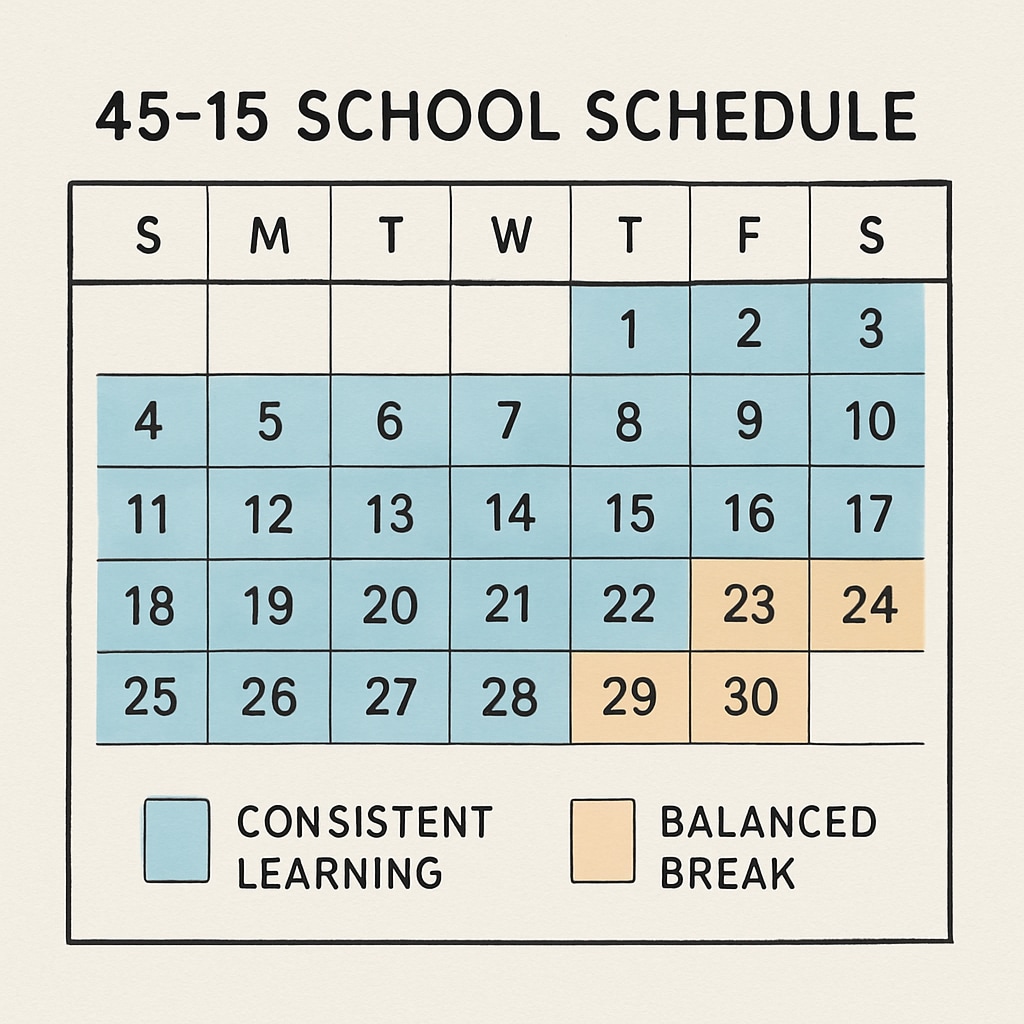
This is one of the arguments for year-round schooling — restructuring the calendar into shorter, more frequent breaks. From a pure retention standpoint, redistributing breaks across the year makes sense. For a deeper look at how year-round schooling works in Canada and whether it actually helps, see our complete guide to year-round schooling for Canadian parents and our summer learning loss guide.
For most Canadian families, year-round schooling isn’t a realistic option — their child’s school uses the traditional calendar. The practical question becomes: how do you bridge the long summer break in a way that preserves retention? The answer is the same answer cognitive science has been giving for a hundred years — small, regular practice over time, not cramming.
How Think Academy Canada is built around retention
Think Academy is the international arm of TAL Education Group, one of the largest education companies in the world. Our Canadian programs are deliberately built around the cognitive science of how children actually retain knowledge.
Spiral curriculum, not unit-and-forget. Our students don’t learn fractions once and move on. They meet fractions, decimals, and proportional reasoning across multiple grades at increasing depth, with each revisit reinforcing the previous one through spaced repetition.
Year-round programs. Unlike school, our math programs run continuously. This means no 10-week summer gap and no forgetting curve effect over the break.
Active problem-solving, not passive video. Our platform is built around the retrieval effect — students actively solving problems rather than passively watching explanations. This is the format cognitive science consistently identifies as the most effective for long-term retention.
Personal teacher feedback on every homework set. Algorithmic grading can tell a child if they got a question right. Real teachers can identify the patterns in their mistakes and target review precisely where retention is weakest.
Free math assessment. Find out how much your child has actually retained — not just what they’ve learned. Our free assessment takes about 20 minutes, gives you a detailed feedback report on strengths and gaps, and includes free practice resources tailored to your child’s level. It’s the fastest way to know whether the material your child studied last term is still actually accessible to them.
Frequently asked questions
What is knowledge retention?
Knowledge retention is the ability to recall and use information weeks, months, or years after first learning it. It’s different from short-term memory — a child can ace a test and still have weak long-term retention if the material wasn’t reinforced through spaced review.
What is the forgetting curve?
The forgetting curve, first documented in the 1880s, describes how human memory naturally decays over time. Without review, people typically forget about 70% of new information within 24 hours and 90% within a week.
What is spaced repetition?
Spaced repetition is a study technique based on reviewing material at increasing intervals — for example, after one day, then three days, then a week, then a month. It exploits how the brain consolidates memories and is one of the most well-evidenced learning strategies in cognitive science.
Does cramming work?
Cramming works for short-term recall — your child can get through a test on Friday after studying Thursday night. But cognitive science consistently finds that crammed material is forgotten within days or weeks. Spaced study produces dramatically stronger long-term retention from the same total amount of study time.
How can I help my child remember what they learn at school?
Short, frequent review beats long study sessions. Five minutes a day reviewing the past few topics is dramatically more effective than two hours on Sunday. Active recall (trying to remember without looking at notes) is more effective than passive re-reading.
Why does my child forget what they learned last year?
Because the brain naturally discards information that isn’t being revisited. Most school curriculums teach a topic for a few weeks and then move on, never returning to it. Without periodic review, even well-learned material decays significantly within months.
What is a spiral curriculum?
A spiral curriculum revisits topics at increasing depth across multiple years instead of teaching them once and moving on. Children meet the same concept several times — each visit shorter than the last — building deeper understanding while naturally applying spaced repetition. It’s used by most of the world’s most effective math education systems.
How does sleep affect learning?
Memory consolidation — the process of moving information from short-term to long-term storage — happens primarily during sleep. A child who sleeps poorly retains significantly less of what they studied. For most school-age children, 9–10 hours of sleep is more important to academic success than the last hour of studying.
About Think Academy Canada
Think Academy Canada, part of TAL Education Group, supports K–12 students with structured math programs built around an online interactive platform, gamified learning, and teachers who personally mark every homework set. Our curriculum uses a spiral progression model designed for long-term retention, runs year-round, and stays ahead of the provincial standards.
🟦 Follow us on Instagram @thinkacademyca for daily Ontario math tips, worked examples, and free resources.