The Canadian Open Mathematics Competition (COMC 2026) is one of the most important mathematics competitions available to Canadian high school students in Grades 9–12. Registration for the 2026 contest opens on September 1, 2026 — marking the start of the preparation window that determines how students perform when the contest is written in late October or early November.
This guide covers everything students and parents need to know before registration opens: what the COMC is, the 2026 dates and registration process, the contest format and scoring, how to prepare effectively, and how the COMC compares to two alternative contests — the Canadian Senior Mathematics Contest (CSMC) and the AMC 10.
What Is the COMC?
The Canadian Open Mathematics Competition is a national mathematics competition organised by the Canadian Mathematical Society (CMS). It is open to all Canadian high school students in Grades 9–12 and is written by students at registered schools across Canada.
Why the COMC matters:
- CMO gateway: Top COMC performers are invited to write the Canadian Mathematical Olympiad — Canada’s most prestigious high school mathematics competition. The COMC is the primary qualification pathway for the CMO.
- University recognition: COMC performance is considered by the University of Waterloo Faculty of Mathematics in admissions and scholarship decisions.
- Skill development: The COMC develops mathematical problem-solving depth at a level beyond any standard curriculum — particularly in the Part C proof-writing that distinguishes it from most competitions.
- National reach: Unlike some competitions, the COMC is available to students across all Canadian provinces and territories through their schools.
For a complete overview of what the COMC involves and what a strong result leads to, see our COMC math contest guide.
COMC 2026: Key Dates
| Event | Date |
|---|---|
| Registration opens | September 1, 2026 |
| Registration deadline | Typically mid-October 2026 (confirm with CMS) |
| Contest date | Late October or early November 2026 (exact date TBC) |
| Results released | Several weeks after contest date |
| CMO invitations | Following results release |
Important: Registration is through schools — individual students cannot register directly. A teacher or school administrator must register the school through the Canadian Mathematical Society at cms.math.ca. If your school has not participated before, contact the CMS before the registration deadline.
Exact dates for 2026 will be confirmed by the Canadian Mathematical Society. Check cms.math.ca for official announcements. The dates above reflect the typical COMC calendar based on previous years.
COMC 2026: Contest Format
The COMC is a 2.5-hour written contest with no calculator permitted.
Part A — Four Questions, 4 Marks Each (Total: 16 marks)
Part A questions are accessible — roughly equivalent to the harder questions on the Cayley or Fermat CEMC contests. Only the final answer is required; no working needs to be shown. A student who has prepared seriously should aim to complete all four Part A questions correctly.
Topic areas: Algebra, basic number theory, counting, geometry, and sequences. Problems are solvable with standard mathematical reasoning — no advanced techniques required.
Part B — Four Questions, 6 Marks Each (Total: 24 marks)
Part B questions are significantly harder. Each has multiple parts, and working through Part B(i) often sets up Part B(ii). Only final answers are required — but working can be shown for partial credit consideration in some administrations.
Topic areas: Number theory, combinatorics, geometry, algebra. Requires recognising which technique to apply, not just executing known procedures.
Part C — Four Questions, 10 Marks Each (Total: 44 marks)
Part C is where the COMC is most distinctive. Full written solutions are required — complete mathematical arguments with all reasoning shown. Partial credit is awarded for meaningful progress, and the 10-mark scale per problem allows fine-grained assessment.
Topic areas: Proof-based problems across number theory, combinatorics, geometry, and algebra. Requires constructing complete proofs using techniques including mathematical induction, the pigeonhole principle, Cauchy-Schwarz and other inequalities, and modular arithmetic.
| Part | Questions | Marks each | Total | Answer format |
|---|---|---|---|---|
| A | 4 | 4 | 16 | Answer only |
| B | 4 | 6 | 24 | Answer only |
| C | 4 | 10 | 44 | Full written solution |
| Total | 12 | 84 |
What Score to Target on COMC 2026
CMO invitation threshold: Typically requires a score in the range of 60–84, placing a student among the top performers nationally. The exact threshold varies by year and is set by the Canadian Mathematical Society after results are tabulated.
Approximate score bands:
| Score | What it signals |
|---|---|
| 70–84 | Exceptional — likely CMO invitation territory |
| 50–69 | Strong — competitive, room to reach CMO level |
| 30–49 | Solid — meaningful competition experience |
| Below 30 | Foundational gaps to address before next contest |
For a student targeting CMO, Part C is where the contest is won — and where preparation time is most valuable.
How to Prepare for COMC 2026
With registration opening September 1, students have the full summer to build foundations before the preparation window officially begins. Here is how to use that time.
Before September: Summer Foundation Work
Focus on Part C techniques. The summer is the ideal time to build proof-writing skills without the pressure of the school year. Core techniques for COMC Part C:
- Mathematical induction — see our math induction proof guide
- Proof by contradiction — see our proof by contradiction guide
- Pigeonhole principle — see our pigeonhole principle guide
- Cauchy-Schwarz and Jensen’s inequalities — see our Cauchy-Schwarz guide and Jensen’s inequality guide
- Fermat’s Little Theorem and modular arithmetic — see our Fermat’s Little Theorem guide
Work through COMC past papers. The CEMC website (cemc.uwaterloo.ca) has COMC past papers and solutions going back many years. Work through papers from the most recent 5 years first. For how to use past papers strategically, see our COMC 2025 guide.
September–October: Targeted Preparation
Diagnostic first. Sit one complete COMC past paper under timed conditions (2.5 hours) at the start of September. Score by part — not just total. Identify where marks are being lost.
Topic-sorted practice. Pull Part B and Part C questions from past papers and group by topic: number theory together, geometry together, inequalities together. Work through grouped problems rather than random full papers.
Proof-writing practice. Write out complete proof arguments for every Part C problem you attempt — even when you could get the answer more informally. Proof-writing is a specific expressive skill that only improves through deliberate practice.
Final weeks: Sit 2–3 full timed past papers. Prioritise Part C(i) problems across all questions — these are often more accessible than Part C(ii) and C(iii) and add significant marks.
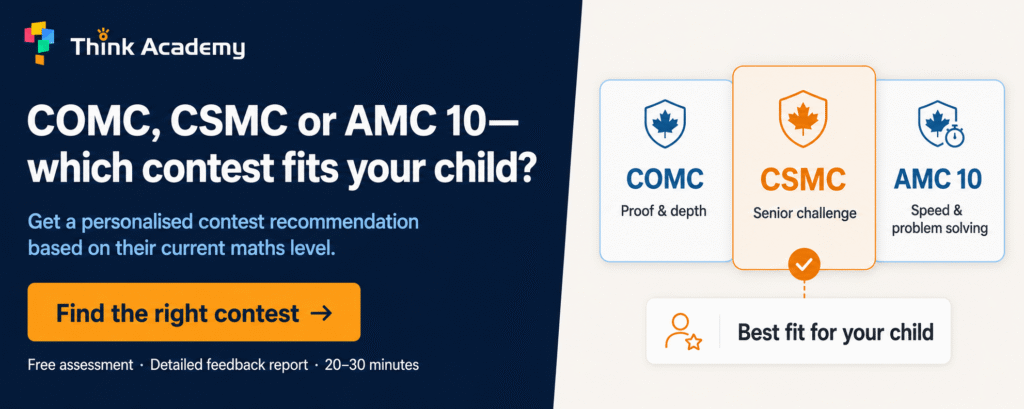
COMC vs CSMC vs AMC 10: Which Contest Is Right for Your Child?
Many families navigating the competition mathematics landscape wonder how the COMC compares to other available contests. Here is a direct comparison.
COMC (Canadian Open Mathematics Competition)
| Feature | Detail |
|---|---|
| Organiser | Canadian Mathematical Society |
| Grades | 9–12 (open to all) |
| Duration | 2.5 hours |
| Format | 12 questions across 3 parts; Part C requires full proofs |
| Calculator | Not permitted |
| Score | Out of 84 |
| Top result | CMO invitation |
| Available | Canada only (through schools) |
| Best for | Students wanting the CMO pathway; strong proof-writers; Grade 11–12 students |
CSMC (Canadian Senior Mathematics Contest)
| Feature | Detail |
|---|---|
| Organiser | CEMC (University of Waterloo) |
| Grades | 11–12 primarily |
| Duration | 2 hours |
| Format | Part A (short answer) + Part B (full solutions, 3 questions) |
| Calculator | Not permitted |
| Score | Out of 60 |
| Top result | Recognition, University of Waterloo admissions consideration |
| Available | Canada and internationally |
| Best for | Grade 11–12 students building toward Euclid; solid but not yet proof-ready |
AMC 10 (American Mathematics Competition 10)
| Feature | Detail |
|---|---|
| Organiser | Mathematical Association of America |
| Grades | Grade 10 and below |
| Duration | 75 minutes |
| Format | 30 multiple choice questions |
| Calculator | Not permitted |
| Score | Out of 150 (6 points per correct, −1.5 per wrong, 0 for blank) |
| Top result | AIME qualification (top ~2.5%); path toward USAMO |
| Available | Canada and US (through schools) |
| Best for | Grades 8–10 students; strong foundational problem-solving; US competition pathway |
Head-to-Head Comparison
| COMC | CSMC | AMC 10 | |
|---|---|---|---|
| Difficulty | High — Part C requires full proofs | Moderate-High | Moderate — multiple choice |
| Proof required | Yes (Part C) | Yes (Part B) | No |
| Grade sweet spot | Grades 11–12 | Grades 11–12 | Grades 9–10 |
| Time pressure | Moderate | Moderate | High (75 min, 30 Qs) |
| Canadian university benefit | Strong (CMO pathway, Waterloo) | Moderate (Waterloo) | Indirect |
| Leads to | CMO | Euclid (separate contest) | AIME → USAMO |
Which Should Your Child Write?
Write the COMC if:
- Your child is in Grade 11 or 12 and has been seriously preparing for competition mathematics
- They are targeting the CMO or university mathematics recognition in Canada
- They have some proof-writing experience and want to develop it further
- They wrote the Euclid last year and want a complementary challenge
Write the CSMC if:
- Your child is in Grade 11 or 12 but is not yet comfortable with full proof-writing
- They want meaningful competition experience that builds toward the Euclid without the full demands of COMC Part C
- They are building toward the COMC in a future year
Write the AMC 10 if:
- Your child is in Grade 9 or 10 (the AMC 10 has a grade limit)
- They are strong at multiple-choice problem-solving and want AIME qualification
- They are interested in the US competition pathway (AIME → USAMO)
- They want a high-intensity 75-minute format that builds speed
Many students write more than one. The AMC 10 (October/November) and COMC (late October/November) overlap in timing — check the specific 2026 dates to confirm whether both are feasible. The CSMC is also in November. A student can reasonably prepare for and write both the AMC 10 and the COMC in the same season if they are in Grade 10 and the dates do not conflict.
For the full Canadian competition landscape, see our math competitions in Canada guide and Canadian Senior Math Contest guide.
How to Register for COMC 2026
Registration opens: September 1, 2026
Step 1: A teacher or school administrator registers the school through the Canadian Mathematical Society portal at cms.math.ca. Individual students cannot register directly.
Step 2: Once the school is registered, students are enrolled by their school contact.
Step 3: The contest is administered at the school on the official contest date.
If your school has never participated: Contact the Canadian Mathematical Society before registration opens. The CMS provides support for schools registering for the first time. If your school is resistant to participation, parents can sometimes arrange for a student to write at a nearby participating school — contact the CMS for options.
Fee: There is a registration fee per student, which varies by school size and prior participation history. Confirm the current fee structure at cms.math.ca.
How Think Academy Supports COMC 2026 Preparation
Think Academy Canada works with students preparing for the COMC at every level — from students targeting strong Part A and B performance to those building toward Part C solutions and CMO qualification.
Diagnostic-led: Every student begins with an assessment identifying specific gaps across Part A, B, and C topic areas. Preparation is targeted at the problems most likely to improve the score — not generic “more practice.”
Proof technique development: Think Academy builds proof-writing as a specific skill — mathematical induction, contradiction, contrapositive, pigeonhole, and inequality techniques that appear most frequently in COMC Part C.
Competition selection guidance: Our assessment also identifies which contest — COMC, CSMC, AMC 10, or multiple — is most appropriate for a student’s current level, so preparation time is directed at the right contest.
The CMO pathway: For students whose performance suggests CMO potential, Think Academy builds the mathematical depth the CMO demands. See our Canadian Mathematical Olympiad guide.
Frequently Asked Questions
When does COMC 2026 registration open? September 1, 2026. Registration is through schools via the Canadian Mathematical Society at cms.math.ca.
Who can write the COMC 2026? Any Canadian high school student in Grades 9–12 whose school registers. The contest is open to all ability levels — Part A is accessible, Part C is very demanding. There is no qualifying requirement.
Is the COMC harder than the AMC 10? Different in character. The AMC 10 is 30 multiple-choice questions in 75 minutes — high speed, no proof required. The COMC is 12 questions over 2.5 hours with Part C requiring complete written proofs. COMC Part C is harder than anything on the AMC 10; COMC Part A is comparable in difficulty.
Can Grade 9 students write the COMC? Yes — the COMC is open to Grades 9–12. Grade 9 students will find Part B and C challenging but can target strong Part A performance as a realistic and valuable goal.
How does COMC performance affect university admissions? The University of Waterloo Faculty of Mathematics explicitly considers COMC performance. CMO invitation (from top COMC scores) is the strongest competition signal available to a Canadian university applicant in mathematics. Other Canadian universities note competition results in context but do not have formal policies.
Should my child write both the COMC and AMC 10? If they are in Grade 10 and the dates don’t conflict, yes — both are valuable. The AMC 10 builds speed and breadth; the COMC builds depth and proof technique. They are complementary, not competing. Check 2026 dates once announced to confirm no overlap.
What is the difference between the COMC and CSMC? Both are for senior high school students. The COMC is run by the Canadian Mathematical Society; the CSMC is run by the CEMC (University of Waterloo). The COMC leads to the CMO; the CSMC is separate and does not have the same CMO pathway. The COMC Part C demands are higher than the CSMC Part B.
See our related guides: COMC math contest guide · COMC 2025 guide · Canadian Mathematical Olympiad guide · Canadian Senior Math Contest guide · AMC 10 guide · Euclid math contest guide · math induction proof guide · pigeonhole principle guide · Cauchy-Schwarz inequality guide · math competitions in Canada
COMC 2026 registration opens September 1. Start preparing now.