


Keeping up with the full Canadian math contests schedule is tough when dates vary by contest, and sign-ups often run through schools. If you are trying to plan ahead for a child aged 4–12, this guide pulls together what is stable year to year, what changes, and where to confirm official dates. You will also get a simple home planning timeline, plus realistic next steps if your child’s school does not host contests.

How math contests fit into Canadian learning (without pressure)
In Canada, most well-known math contests for school-aged children are optional, timed problem-solving events. They are not part of provincial report cards; however, they can motivate practice with number sense, patterns, and logic. Many families use them as a once-a-year “checkpoint” to see how a child handles unfamiliar questions.
Two big organizers come up often. The University of Waterloo’s CEMC (Centre for Education in Mathematics and Computing) runs several Canadian contests, and the MAA (Mathematical Association of America) oversees the AMC series in the U.S. Because hosting is local, your child’s registration path matters as much as the contest itself.

Canadian math contests schedule: what to expect each year
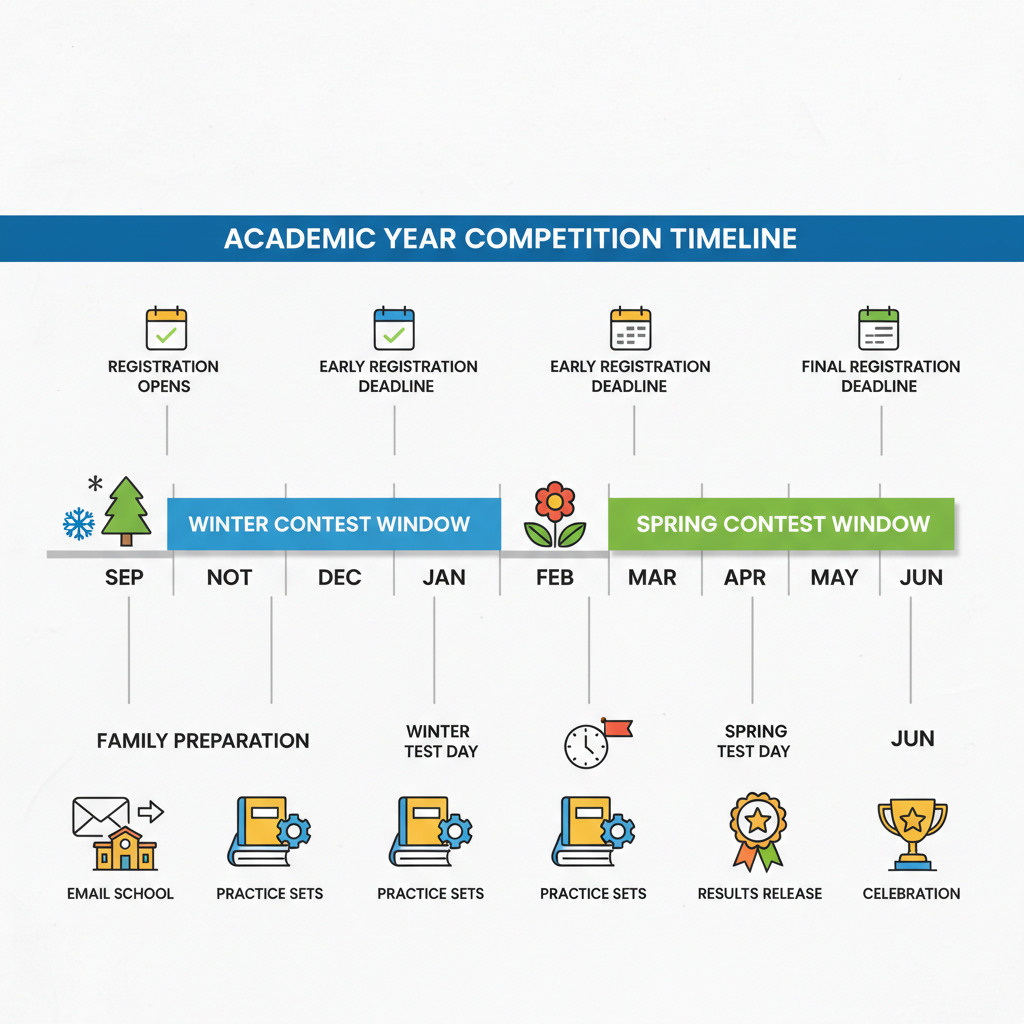
Most contests follow a seasonal rhythm even when exact dates change. Therefore, your best strategy is to learn the usual testing window and then confirm the exact date on the official site as soon as it is posted. For Canadian families, the most commonly discussed contests for elementary ages are the Waterloo CEMC Gauss (Grade 7–8) and, for older siblings, Pascal/Cayley/Fermat (Grades 9–11). For an overview of the full Waterloo competition pathway and how it connects to university admissions, see Waterloo Math Competition: A Canadian Parent’s Complete Guide to CEMC Contests.
For younger children (ages 4–12), contests may not always be grade-matched. However, many Grade 4–6 students still enjoy math leagues, school-board events, or enrichment competitions run locally. If you want an official, widely recognized option, the CEMC pathway becomes clearer starting in Grade 7.
Key official contest hubs to bookmark
- University of Waterloo CEMC contests hub (official dates, contest rules, and school registration information)
- CEMC contest results hub (helps you see typical timelines for results)
- MAA math competitions hub (AMC) (official U.S. contest overview and administration model)
Typical timing and grade targets for math contests
The table below reflects the common pattern families see. However, you should treat it as a planning guide only and verify dates on the official contest sites because schedules can shift.
| Contest (Organizer) | Common grade target | Typical testing window | How it’s usually administered |
|---|---|---|---|
| Gauss (Waterloo CEMC) | Grades 7–8 | Spring (often May) | Through the school (teacher registers school) |
| Pascal / Cayley / Fermat (Waterloo CEMC) | Grades 9 / 10 / 11 | Winter (often February) | Through the school |
| AMC 8 (MAA) | Grades 8 and below (typically age-based eligibility) | Winter (varies) | At a registered school or approved testing site |
Registration in Canada: the detail that surprises many parents
Many Canadian contests are not “parent direct sign-up.” Instead, a teacher or school office registers the school, orders contest papers, and supervises the sitting. Therefore, your first step is often a quick email to the school asking whether they participate and who coordinates math contests.
If your school does not host, you still have options. Some families ask whether another local school hosts a sitting (this depends on the organizer’s rules and the host’s capacity). Others choose a different competition model, such as math circles (enrichment sessions) or online problem-solving programs that do not require school administration.
A simple parent checklist (8 weeks out)
- Ask the school: “Do you register for CEMC contests or AMC?” If yes, ask for the internal deadline.
- Confirm eligibility rules on the organizer’s site (for example, grade target and permitted materials).
- Set a weekly routine: two short sessions are better than one long session.
- Use one set of past papers to learn format, then switch to skill-building practice.
What your child will actually face: format and difficulty
Most mainstream contests use multiple-choice questions and a fixed time limit. The challenge usually comes from unfamiliar wording, multi-step reasoning, and the need to choose an efficient strategy. “Time pressure” matters because even strong students can rush, misread, or skip the easiest marks.
To reduce stress, practise the contest format, not only the content. For example, teach your child to circle key numbers, underline what the question asks, and estimate answers before calculating. These small habits often improve accuracy more than extra worksheets do.
How to tell if a contest is a good fit (ages 4–12)
- Your child enjoys puzzles or “figure it out” questions, even when they are tricky.
- Your child can work independently for 20–40 minutes with short breaks.
- Your child handles mistakes calmly and wants to try again.
If your child is in Grades 1–6, you can still build contest-readiness through Canadian-aligned math goals. For example, Ontario provides a clear public roadmap of expectations by grade in the Ontario curriculum portal. Likewise, Alberta families can reference official grade-level outcomes through Alberta’s K–12 curriculum hub.
Prep without burnout: a realistic 4-week plan
Families often over-focus on “hard questions” and under-focus on consistency. However, short, structured practice builds both speed and confidence. If you only have one month, aim for routine, review, and one timed set per week.
- Week 1: Learn the format. Do a short untimed set and review mistakes.
- Week 2: Target weak areas (fractions, number patterns, basic geometry).
- Week 3: Do one timed practice. Then redo incorrect questions slowly.
- Week 4: Light review, sleep routine, and a calm test-day plan.
Tools & resources you can trust (official sites first)
Use tools that match your goal: practice, explanations, or time management. Therefore, start with official contest materials, then add one high-quality learning platform for skill gaps.
- CEMC past contests hub (official practice materials where available)
- AMC 8 official page (MAA) (format details and administration information)
- Khan Academy Math (free skill practice with videos and exercises)
- Desmos (graphing and visual exploration; useful for older elementary enrichment)
- GeoGebra (interactive geometry and modelling; helpful for visual reasoning)
What “success” can look like for your family
A strong contest experience does not require a top score. Instead, success can mean your child finishes calmly, learns from errors, and feels proud for trying something new. Over time, contests can build resilience because kids practise thinking through uncertainty.
If your child feels anxious, normalize it. Then keep the focus on one controllable goal, such as “read carefully” or “check two answers.” This approach often improves performance and keeps curiosity alive.
Plan ahead, then confirm official dates
If you take only one thing from this guide, let it be this: the Canadian math contests schedule is easiest to manage when you plan by season and then confirm exact dates on official contest hubs as soon as they are published. Start by asking whether your school hosts, bookmark the CEMC and MAA pages, and use a short weekly routine to prepare without stress.
Take our free Math Evaluation to find your child’s current level and next steps.
About Think Academy
Think Academy, part of TAL Education Group, helps K–12 students succeed in school today by building strong math foundations and critical thinking skills. At the same time, we focus on the bigger picture—developing learning ability, curiosity, and healthy study habits that inspire a lifelong love of learning. With expert teachers, proven methods, and innovative AI tools, we support every child’s journey from classroom confidence to long-term growth.


This is really helpful! It’s so overwhelming to juggle all these different dates and registration deadlines for my son.