


The Gauss math contest is Canada’s most widely sat school mathematics competition, run by the Centre for Education in Mathematics and Computing at the University of Waterloo. Open to students in Grade 7 and Grade 8, the Gauss contest introduces students to competition-style problem solving — mathematical reasoning that goes beyond what the school curriculum covers — and serves as the entry point to a structured pathway that runs through the Waterloo contest series all the way to university admissions. This guide covers everything Canadian parents need to know: what the Gauss math contest involves, how it is scored, what a strong result looks like, how the Grade 7 and Grade 8 versions differ, how to prepare effectively, and what the Gauss leads to next.

What is the Gauss math contest?
The Gauss math contest is a multiple choice mathematics competition for Canadian students in Grade 7 and Grade 8, organised by the Centre for Education in Mathematics and Computing — known as CEMC — at the University of Waterloo. It is one of the flagship contests in the CEMC series, which is the most recognised mathematics competition programme in Canada.
The contest is named after Carl Friedrich Gauss, one of the most influential mathematicians in history, known for his contributions to number theory, algebra, and statistics. It has been running for decades and is sat by tens of thousands of Canadian students each year.
Unlike school assessments, the Gauss math contest does not test whether students have memorised curriculum content. It tests mathematical reasoning — the ability to think logically, spot patterns, apply concepts creatively, and solve problems that require more than one step. A student who is strong at school math will find the Gauss challenging without specific competition preparation.
Who organises the Gauss math contest?
The Gauss contest is organised by the CEMC at the University of Waterloo, the largest mathematics outreach organisation of its kind in Canada. The CEMC runs contests for students from Grade 7 through to Grade 12 and provides free preparation materials, past papers, and online courseware for all of them. More than 300,000 students in over 85 countries participate in CEMC contests each year.
When does the Gauss math contest take place?
The Gauss math contest takes place in May each year. For the Gauss math contest 2025, the competition ran in May 2025 alongside the other CEMC spring contests — Pascal, Cayley, and Fermat. The exact date varies slightly each year and is announced by the CEMC in the autumn preceding the contest.
Registration for the Gauss math contest typically opens in the autumn and closes in late winter. Schools register on behalf of their students — individual registration is generally not available directly through the CEMC, though some independent centres offer registration for students whose schools do not participate.
Gauss math contest format
The Gauss math contest is a 25-question multiple choice examination completed in 60 minutes. Both the Grade 7 and Grade 8 versions follow the same format but differ in content difficulty.
Exam structure
| Feature | Detail |
|---|---|
| Number of questions | 25 |
| Time allowed | 60 minutes |
| Format | Multiple choice, 5 options per question |
| Calculator | Not permitted |
| When | May each year |
| Who | Grade 7 (Gauss 7) and Grade 8 (Gauss 8) |
Scoring
The Gauss math contest uses a weighted scoring system where later questions are worth more points than earlier ones.
| Questions | Points each | Total |
|---|---|---|
| Questions 1 to 10 | 5 points | 50 |
| Questions 11 to 20 | 6 points | 60 |
| Questions 21 to 25 | 8 points | 40 |
| Maximum score | 150 |
There is no penalty for wrong answers on the Gauss math contest. Students should attempt every question — leaving a question blank is never better than guessing when there is no negative marking.
What is a good score on the Gauss math contest?
The CEMC does not publish a fixed threshold for recognition — results depend on the cohort each year. Generally:
- Scores in the top 25% earn a Certificate of Distinction
- Scores in the top 10% earn recognition at a higher level
- A perfect score of 150 is rare and represents outstanding performance
The CEMC publishes the results summary each year showing score distributions. Your child’s school will receive their individual result along with how they performed relative to other participants.
Gauss math contest Grade 7 vs Grade 8
There are two versions of the Gauss math contest — one for Grade 7 students and one for Grade 8 students. Both follow the same format and scoring structure but differ in the difficulty and topic coverage of the questions.
Gauss math contest Grade 7
The Gauss math contest Grade 7 version tests mathematical reasoning at a level appropriate for students completing Grade 6 and entering Grade 7. Topics draw from the Ontario and Canadian mathematics curriculum up to that point — number sense, fractions, basic algebra, geometry, measurement, and data management — but questions are designed to challenge students to think beyond standard procedures.
Questions 1 to 10 on the Grade 7 version are accessible for well-prepared students. Questions 21 to 25 are designed to challenge even strong performers and require creative mathematical thinking. The Grade 7 version is a slightly more accessible entry point to competition math than the Grade 8 version.
Gauss math contest Grade 8
The math Gauss contest Grade 8 version is pitched at a higher level than the Grade 7 version, covering more advanced topics including more complex algebraic reasoning, harder geometry problems, and multi-step number theory. Students who have sat the Grade 7 Gauss and are moving into Grade 8 will find the jump in difficulty noticeable.
For students who are genuinely strong mathematically, the Grade 8 version of the Gauss contest is excellent preparation for the Pascal contest in Grade 9 — the next level in the CEMC series.
Can Grade 7 students sit the Grade 8 version?
Technically the contests are designed for their respective grade levels. In practice, a very strong Grade 7 student who has done significant competition math preparation may be encouraged by their teacher to sit the Grade 8 version. This is worth discussing with the school — there is no universal rule but some schools accommodate advanced students in this way.
Gauss math contest topics
The Gauss math contest covers a broad range of mathematical topics, drawn from the junior school curriculum but extended well beyond what is taught in class. Understanding which topics appear most frequently helps focus preparation efficiently.
Primary topic areas
| Topic area | What it includes | Frequency on Gauss |
|---|---|---|
| Number sense and operations | Integers, fractions, decimals, order of operations, divisibility | Very high |
| Algebra and equations | Expressions, solving equations, patterns | High |
| Geometry and measurement | Angles, area, perimeter, triangles, polygons | High |
| Counting and probability | Systematic counting, basic probability, combinations | High |
| Data management | Mean, median, mode, graphs, data interpretation | Moderate |
| Patterning and sequences | Number patterns, rules, sequences | Moderate |
| Ratios and percentages | Equivalent ratios, percent problems, rate problems | Moderate |
What makes Gauss problems different from school math
School mathematics tests whether students can apply a learned procedure correctly. The Gauss math contest tests whether students can figure out which approach to use when no procedure has been taught for that specific situation.
A school question might ask a student to find the area of a rectangle given its length and width. A Gauss question might describe a rectangle whose area and perimeter are both given and ask for its dimensions — requiring the student to set up and solve a system of equations from the context of the problem.
This shift from procedural to reasoning-based problem solving is what makes the Gauss math contest genuinely challenging and genuinely valuable as preparation for higher-level mathematics.
The Gauss math contest pathway — where it leads
The Gauss math contest is not an isolated event. It is the first step in a structured competition pathway that runs from Grade 7 all the way through to the most prestigious mathematics competitions in the world.
The full CEMC contest ladder
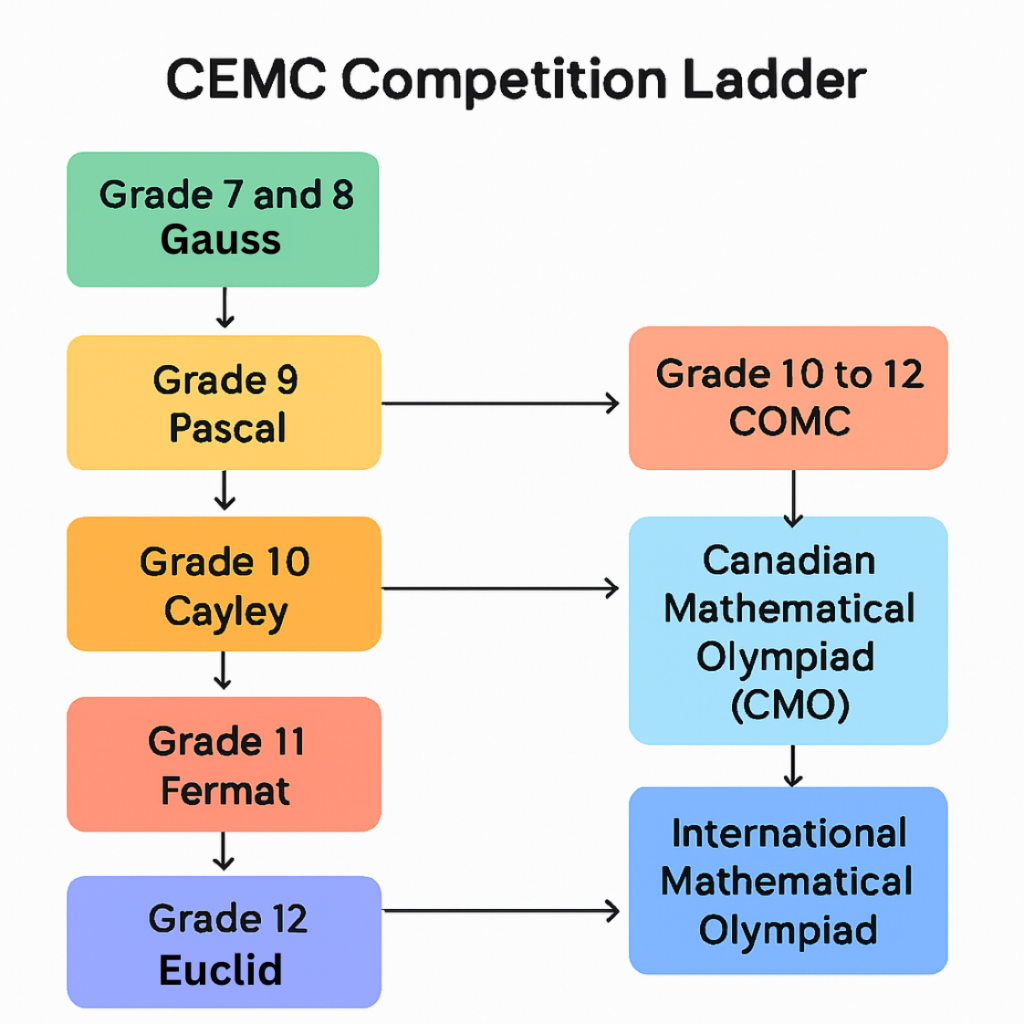
| Contest | Grade | What it leads to |
|---|---|---|
| Gauss | Grade 7 and 8 | Pascal (Grade 9) |
| Pascal | Grade 9 | Cayley (Grade 10) |
| Cayley | Grade 10 | Fermat (Grade 11) |
| Fermat | Grade 11 | Euclid (Grade 12) |
| Euclid | Grade 12 | University admissions, scholarships |
| COMC | Grade 10 to 12 | Canadian Mathematical Olympiad |
| CMO | Invitation only | International Mathematical Olympiad |
Why the Gauss matters for university admissions
The Gauss itself does not carry direct university admissions weight — that comes from the senior contests, particularly the Euclid. But the Gauss matters enormously because it establishes the foundations that make everything above it possible.
A student who begins competition math at the Gauss level in Grade 7 and builds steadily through the ladder arrives at the Euclid in Grade 12 with a depth of mathematical reasoning that a student who only begins preparing in Grade 10 or 11 cannot match. The Euclid contest result is used directly by the University of Waterloo in admissions and scholarship decisions for mathematics, computer science, and engineering — some of the most competitive programmes in Canada. The Gauss is where that journey starts.
The Gauss and the AMC series
Many Canadian students preparing for the Gauss math contest also participate in the American Mathematics Competitions series — particularly the AMC 8 for Grade 7 and 8 students. The two series develop the same underlying problem-solving skills and preparation for one directly benefits performance in the other.
The AMC series is more directly recognised by American and international universities, while the CEMC series carries more weight in Canadian domestic admissions. Students with ambitions beyond Canada benefit from doing both.
For more on the AMC 8, check out: AMC 8 Math Competition: The Complete Guide for Canadian Students.
Read about every math contest in the Waterloo series here at: Waterloo Math Competition: A Canadian Parent’s Complete Guide to CEMC Contests.
Gauss math contest preparation
Preparing specifically for the Gauss math contest — rather than simply doing well in school math — is what separates students who perform in the top 25% from those who find the contest unexpectedly difficult.
Start with past papers
The CEMC publishes free past papers and full solutions for every Gauss math contest going back many years at cemc.uwaterloo.ca. These are the most valuable preparation resource available and they cost nothing.
Work through past papers systematically rather than just completing them. The most effective approach: complete one paper under timed conditions (60 minutes, no calculator), then spend two review sessions going through every question including those answered correctly. For each question identify the topic, the key insight required, and whether a more efficient approach exists than the one you used.
Gauss math contest practice — topic by topic
Past paper review identifies weaknesses but targeted topic practice fixes them. For the Gauss math contest, the topics most worth dedicating focused practice time to are:
Number theory and divisibility — these appear on every Gauss paper and require specific competition math techniques that school curriculum does not develop. Understanding divisibility rules, prime factorisation, and properties of factors and multiples is essential.
While the AMC 8 and Gauss are different competitions, they have some overlap with topics. Read more abou factors here at: Factors of 24 and 45: How to Find All Factors AMC 8 Guide and more about GCF here at: What is the GCF of 75 and 30? How to Find the Greatest Common Factor With Examples.
Counting and probability — systematic counting techniques, the multiplication principle, and basic probability appear on almost every Gauss paper. Students who have not been exposed to competition-style counting problems often underperform on this section relative to their overall ability.
Practice counting and probability using: Mastering Counting and Probability: Key Rules and Real Problems.
Geometry — area, perimeter, angles, and properties of triangles and polygons are tested on every Gauss paper. Students should be comfortable with all standard area formulas and with the Pythagorean theorem.
Algebra — the Gauss tests algebraic reasoning from Grade 7 onward. Being comfortable setting up and solving simple equations from word problem contexts is essential.
How Think Academy prepares students for the Gauss math contest
Think Academy Canada’s competition courses cover the full Gauss math contest curriculum — number theory, algebra, geometry, counting, and probability — in a structured sequence using a spiral advancement model. Key concepts are revisited at increasing depth across the course rather than covered once and moved on from. Classes are live and interactive, homework is marked and returned by teachers, and students have access to past paper practice alongside their structured course work.

Gauss math contest 2025 — what to know
The Gauss math contest 2025 ran in May 2025 alongside the other CEMC spring contests. Results were distributed to schools in the weeks following the contest.
For students who sat the Gauss math contest 2025 and are now reviewing their performance, the most useful next step is to work through the 2025 paper in review mode — not to check the score but to understand every question that was answered incorrectly and identify the topic gaps it reveals.
Past papers including the 2025 version will be published on the CEMC website at cemc.uwaterloo.ca. Check there for the official solutions and score distributions once they are released.
For students who did not sit the 2025 contest and are beginning preparation for the next sitting, using the 2025 paper as one of the first practice papers in a structured preparation plan is recommended — it reflects the most current version of the contest’s style and difficulty.
Frequently Asked Questions
What is the Gauss math contest? The Gauss math contest is a 25-question multiple choice mathematics competition for Grade 7 and Grade 8 students in Canada, organised by the CEMC at the University of Waterloo. It tests mathematical reasoning and problem solving rather than curriculum recall and is the entry point to the Waterloo CEMC contest series. The maximum score is 150 and the contest runs in May each year.
How hard is the Gauss math contest? The Gauss math contest is harder than school curriculum. Questions 1 to 10 are accessible for well-prepared students. Questions 21 to 25 require creative mathematical thinking and are designed to challenge even strong performers. Students who only review school material without specific competition math preparation typically find the later questions significantly harder than expected.
What topics are on the Gauss math contest? The Gauss covers number sense and operations, algebra, geometry and measurement, counting and probability, data management, patterning and sequences, and ratios and percentages. Questions draw from the junior school curriculum but extend well beyond it — the Gauss tests how students think with mathematics, not just what they know.
What is a good score on the Gauss math contest? Scores in the top 25% earn a Certificate of Distinction. Scores in the top 10% earn higher recognition. The maximum score is 150. The CEMC publishes score distributions each year — check the CEMC website for current year thresholds after results are released.
What is the difference between the Grade 7 and Grade 8 Gauss contests? Both versions have the same format — 25 questions in 60 minutes scored out of 150 — but the Grade 8 version covers more advanced topics and is pitched at a higher difficulty level. The Grade 8 version is particularly good preparation for the Pascal contest in Grade 9.
How do I register for the Gauss math contest? Most students register through their school — ask the math teacher or department head in the autumn. If the school does not participate, contact the CEMC at cemc.uwaterloo.ca to ask about registration options. Some independent centres also offer Gauss registration.
Where can I find Gauss math contest past papers? Free past papers and full solutions are available on the CEMC website at cemc.uwaterloo.ca. Papers going back many years are available for both the Grade 7 and Grade 8 versions. The Art of Problem Solving community also hosts discussion of Gauss problems.
What does the Gauss math contest lead to? The Gauss leads to the Pascal contest in Grade 9, then Cayley, Fermat, and Euclid in subsequent years. The Euclid contest in Grade 12 carries direct weight in University of Waterloo admissions and scholarship decisions. Students who begin at Gauss level and build consistently through the series arrive at the Euclid with a significantly stronger mathematical foundation than those who begin preparation later.
How does the Gauss compare to the AMC 8? Both the Gauss and AMC 8 are designed for students in Grade 7 and 8 and test competition-style mathematical reasoning. The Gauss is more directly recognised in Canadian university admissions through the later Waterloo contests. The AMC series carries more weight with American and international universities. Preparation for one directly benefits performance in the other — many strong Canadian students sit both.



Incredible points. Sound arguments. Keep up the
amazing work.