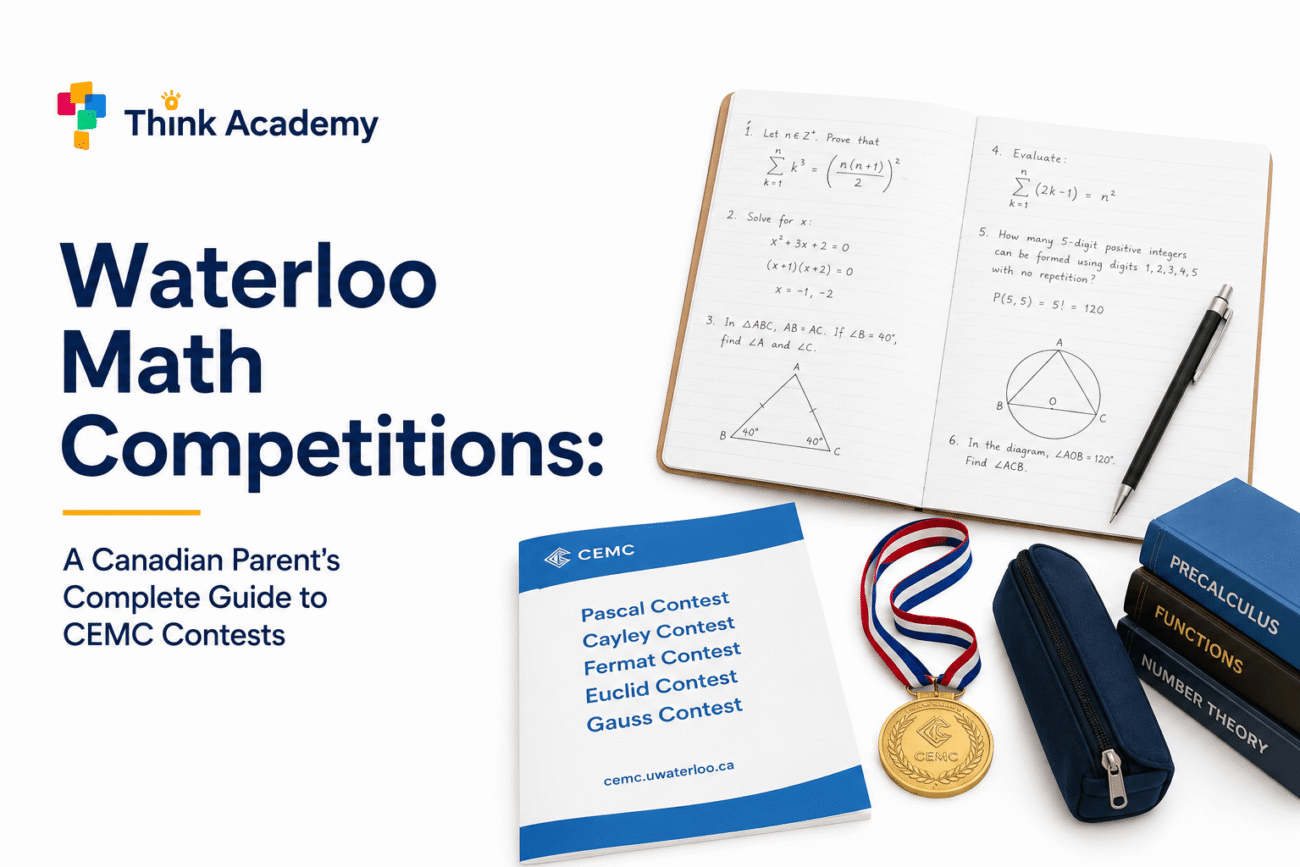
If you have heard the term Waterloo math competition and are not quite sure what it means, you are not alone. The name covers a whole series of contests — Gauss, Pascal, Cayley, Fermat, Euclid — each designed for a different grade level and increasing in difficulty from middle school through to the end of high school. Run by the Centre for Education in Mathematics and Computing at the University of Waterloo, these are the most widely recognised math competitions in Canada and the ones that carry the most weight in university admissions. This guide explains what each contest involves, how to register, and how to prepare your child at every stage of the pathway.

What is the Waterloo math competition?
The Waterloo math competitions are a series of contests organised by the Centre for Education in Mathematics and Computing, known as CEMC, at the University of Waterloo. The CEMC is the largest math and computing outreach organisation of its kind in Canada, with over sixty years of history. Its contests reach more than 300,000 students in over 85 countries each year.
The competitions are designed for students from Grade 7 through to Grade 12 and increase in difficulty at each level. They test mathematical reasoning and problem-solving rather than curriculum recall, which means a student who performs well in school math will still find the contests challenging without specific preparation.
For Canadian families, the Waterloo competitions are the primary competition math pathway. They are more widely recognised by Canadian universities than the American AMC series, and performance in the senior contests — particularly the Euclid — carries direct weight in admissions at Waterloo and UofT.
Who runs the Waterloo math competitions?
The CEMC at the University of Waterloo organises and administers all contests in the series. The CEMC also produces free preparation materials, past papers, and online courseware available to all students. Contests are administered through schools across Canada, though some independent test centres also offer registration for students whose schools do not participate.
The full Waterloo math competition ladder
The CEMC contests are structured as a progression, with each level preparing students for the next. Here is the complete ladder from entry level through to the most advanced competitions.
| Contest | Grade | Time | Questions | Level |
|---|---|---|---|---|
| Gauss | Grade 7 and 8 | 60 minutes | 25 multiple choice | Junior |
| Pascal | Grade 9 | 60 minutes | 25 multiple choice | Junior |
| Cayley | Grade 10 | 60 minutes | 25 multiple choice | Intermediate |
| Fermat | Grade 11 | 60 minutes | 25 multiple choice | Intermediate |
| Euclid | Grade 12 | 150 minutes | 10 full solution | Senior |
| COMC | Grade 10 to 12 | 150 minutes | Mixed | National |
| CMO | Invitation only | 3 hours | Proof-based | National elite |
Each contest is named after a mathematician. The difficulty increases meaningfully at each level — a student who finds the Gauss straightforward will still need significant preparation before attempting the Euclid.
The Gauss contest — entry point for the Waterloo math competition
The Gauss is the starting point for most Canadian students entering the CEMC competition pathway. It is open to Grade 7 and 8 students and is the most widely sat of all the Waterloo contests.
Gauss contest format
The Gauss consists of 25 multiple choice questions to be completed in 60 minutes. Questions are worth different point values — the first ten questions are worth 5 points each, the next ten are worth 6 points each, and the final five are worth 8 points each. The maximum score is 150. Students are not penalised for wrong answers.
Topics covered include number theory, algebra, geometry, counting, and probability at a middle school level. Questions require logical reasoning and creative problem-solving rather than just curriculum recall. Many students find that strong school performance does not fully prepare them for the Gauss — specific competition preparation makes a meaningful difference to results.
What is a good Gauss score?
The Gauss does not publish a simple pass or fail threshold. Strong performance is relative to the cohort each year. Students aiming for recognition should target scores in the upper quartile of participants. The CEMC publishes contest results and certificates to schools after each sitting — students who perform strongly receive recognition certificates.
Starting the Gauss pathway with support
Because the Gauss tests reasoning skills that go beyond the school curriculum, most students benefit from starting contest-specific preparation before their first sitting rather than after. Think Academy Canada’s Gauss preparation stream introduces number theory, counting, and non-routine problem types early, so students build the pathway habit — Gauss, then Pascal, then Cayley — with a solid base rather than catching up later. Try our free diagnostic assessment to see where your child stands before their first contest.
Pascal, Cayley and Fermat — the intermediate Waterloo contests
The three intermediate contests follow the same format as the Gauss but increase in difficulty at each grade level.
Pascal (Grade 9)
The Pascal contest is the natural progression from the Gauss for students entering Grade 9. It covers the same broad topic areas but at a higher level of complexity. Students who prepared seriously for the Gauss and performed well are well positioned for the Pascal with continued preparation.
Cayley (Grade 10)
The Cayley introduces more advanced algebra and geometry. Students at this stage should have a solid foundation in quadratic equations, coordinate geometry, and introductory number theory. Many students begin to find the jump between contests more significant here — the Cayley requires more mathematical sophistication than the Pascal.
Fermat (Grade 11)
The Fermat is the last of the multiple choice Waterloo contests before the Euclid. It covers the full Grade 11 curriculum and beyond, with questions that regularly combine multiple topic areas. Strong Fermat preparation is one of the most effective ways to build readiness for the Euclid.
The Euclid contest — the most important Waterloo math competition
The Euclid is the flagship contest in the CEMC series and the most consequential for Canadian students. Unlike the earlier multiple choice contests, the Euclid requires full written solutions — students must show their working and reasoning, not just select an answer.
Euclid contest format
The Euclid is 150 minutes long and consists of 10 questions, each with multiple parts. Questions increase in difficulty within the paper. Full marks require not just the correct answer but a clearly presented mathematical argument. This format is significantly harder than any of the earlier Waterloo contests and requires specific preparation that goes beyond solving multiple choice problems.
Why the Euclid matters for university admissions
The Euclid contest result is used by the University of Waterloo as part of its admissions and scholarship process for mathematics, computer science, and engineering programmes. A strong Euclid score can directly influence scholarship offers and admissions decisions for some of the most competitive programmes in Canada.
UofT also considers contest performance as part of its assessment for competitive programmes. The Euclid is the single most impactful high school math competition for Canadian university admissions — more so than any level of the AMC series for students applying to Canadian universities.
Students aiming for Waterloo mathematics or computer science should treat the Euclid as a target from Grade 9 onward, not something to begin preparing for in Grade 12.

COMC and CMO — the national pathway
Canadian Open Mathematics Challenge
The Canadian Open Mathematics Challenge, known as the COMC, is run by the Canadian Mathematical Society rather than the CEMC but sits naturally alongside the Waterloo contest pathway. It is open to all Canadian high school students and serves as the qualifier for the Canadian Mathematical Olympiad.
The COMC is a 150-minute contest with a mixed format including short answer and full solution questions. It takes place in October each year. Top COMC performers are invited to the Canadian Mathematical Olympiad, which in turn selects Canada’s team for the International Mathematical Olympiad.
Canadian Mathematical Olympiad
The CMO is the most prestigious math competition in Canada. Participation is by invitation only based on COMC performance. Questions are proof-based and require deep mathematical reasoning. CMO participation is a significant academic credential and a strong signal to universities internationally.
For most students, the pathway looks like this: Gauss in Grade 7 to 8, building through Pascal, Cayley, and Fermat, sitting the Euclid in Grade 12 for university admissions, and the strongest students attempting the COMC to CMO pathway alongside.
How the Waterloo math competition connects to AMC preparation
Many Canadian students preparing for Waterloo contests also sit the AMC series. The two pathways are complementary — AMC preparation and Waterloo contest preparation develop the same underlying problem-solving skills and mathematical reasoning. Students who prepare seriously for AMC 8 and AMC 10 arrive at the Gauss and Euclid with stronger foundations than students who only follow the school curriculum.
The key difference is that Waterloo contests are more directly recognised by Canadian universities in admissions decisions, while AMC and AIME qualification carries more weight with American and international universities. Students with ambitions beyond Canada benefit from doing both.
For more on the AMC, read:
AMC 8 Math Competition: The Complete Guide for Canadian Students
AMC 10 Math Competition: The Complete Guide for Canadian Students
What is the AMC? A Canadian Parent’s Guide to American Math Competitions
Waterloo math competition dates and registration
When do the Waterloo contests take place?
All CEMC contests take place in the spring. The exact dates are published by the CEMC each year in the autumn preceding the contests.
| Contest | Typical timing |
|---|---|
| Gauss, Pascal, Cayley, Fermat | May |
| Euclid | April |
| COMC | October |
How to register for the Waterloo math competition
Most students register through their school. Teachers or math department heads typically submit registrations to the CEMC on behalf of students. If your child’s school does not participate, contact the CEMC directly through their website to ask about individual registration options or find a local centre that administers the contests.
Registration for the spring contests typically opens in the autumn of the preceding year. Check the CEMC website at cemc.uwaterloo.ca for current year dates and registration information.
Is there a cost to enter?
There is a small entry fee per student for most CEMC contests. Schools typically handle this as part of their registration. For individual registrations, the fee is paid directly. The CEMC also offers free preparation materials, past papers, and online courseware regardless of whether a student is registered for a contest — these are available to all students at no cost.
How to prepare for the Waterloo math competition
Start with past papers
The CEMC publishes free past papers and full solutions for every contest going back many years on their website. Working through past papers systematically is the foundation of any preparation plan. Students should work under timed conditions and then review every question carefully — including those answered correctly — to identify the concept being tested and whether a more efficient approach exists.
Build topic foundations deliberately
The Waterloo contests test students on topics that extend beyond the school curriculum, particularly in number theory, combinatorics, and proof-based reasoning at the senior level. Students who only review school material find gaps when they encounter these topics in a contest setting. Specific preparation in these areas — ideally starting a year or more before the contest — makes a significant difference to results.
How Think Academy prepares students for the Waterloo pathway
Think Academy Canada’s competition preparation courses cover the full Waterloo contest curriculum from Gauss through to Euclid level. Think Academy students have a strong track record in Canadian competition math — the same problem-solving skills and spiral curriculum approach that produces over 1,700 AMC 8 medals applies directly to Waterloo contest preparation.
Think Academy Canada runs dedicated preparation streams that follow the CEMC ladder directly, rather than teaching generic enrichment math and hoping it transfers.
What’s covered. Courses map onto each contest stage — Gauss and Pascal foundations for Grades 7–9, Cayley and Fermat for Grades 9–11, and a dedicated Euclid stream for students heading into Grade 12 admissions cycles. Full-solution writing is taught explicitly ahead of the Euclid, since it’s a different skill from multiple-choice test-taking and the jump catches many students off guard.
How it’s taught. Think Academy’s spiral curriculum revisits core topics — number theory, combinatorics, coordinate geometry — with increasing depth across terms, so students meet contest-style reasoning well before the exam rather than cramming it in the final weeks. This is the same approach behind Think Academy’s results in the AMC series, adapted specifically for the Waterloo format and mark scheme.
What you get. Every student starts with a diagnostic assessment against past CEMC papers to identify gaps, followed by a structured term plan building toward their next contest sitting. Parents receive progress updates tied to specific topic areas, not just overall scores.
If your child is preparing for a Waterloo contest this year — or you’re planning ahead for the Euclid — try our free assessment to get a clear starting point.
Frequently Asked Questions
What is the Waterloo math competition? The Waterloo math competition refers to the series of contests run by the Centre for Education in Mathematics and Computing at the University of Waterloo. The main contests are Gauss (Grade 7 to 8), Pascal (Grade 9), Cayley (Grade 10), Fermat (Grade 11), and Euclid (Grade 12). They are the most widely recognised math competitions in Canada and the Euclid result carries direct weight in Waterloo and UofT admissions.
How do I register my child for the Waterloo math competition? Most students register through their school — ask your child’s math teacher in the autumn term. If the school does not participate, contact the CEMC at cemc.uwaterloo.ca to ask about individual registration options. Registration for the spring contests typically opens in the autumn.
What is the Gauss math contest? The Gauss is the entry-level Waterloo math competition for Grade 7 and 8 students. It is a 25-question multiple choice exam completed in 60 minutes, covering number theory, algebra, geometry, counting, and probability. It is the most widely sat CEMC contest and the natural starting point for students entering the competition math pathway.
What is the Euclid contest and why does it matter? The Euclid is the senior-level Waterloo math competition for Grade 12 students. Unlike the earlier multiple choice contests, the Euclid requires full written solutions. A strong Euclid result is used by the University of Waterloo in admissions and scholarship decisions for mathematics, computer science, and engineering programmes — making it the most consequential high school math competition for Canadian university admissions.
How does the Waterloo math competition compare to the AMC? The Waterloo contests and AMC series are complementary. Waterloo contests are more directly recognised by Canadian universities in admissions decisions. AMC and AIME qualification carries more weight with American and international universities. Preparation for either pathway develops the same underlying problem-solving skills, so students preparing for Waterloo contests benefit from AMC preparation and vice versa.
When do the Waterloo math competitions take place? The Gauss, Pascal, Cayley, and Fermat contests take place in May. The Euclid takes place in April. The COMC takes place in October. All dates are published annually by the CEMC and the Canadian Mathematical Society on their respective websites.
What is a good score on the Gauss contest? The Gauss is marked out of 150. Strong performance is relative to the cohort each year — the CEMC does not publish a fixed cutoff. Students who score in the upper quartile receive recognition certificates. Students aiming to progress through the competition pathway should use their Gauss result as a baseline and focus preparation on the areas where they lost the most marks.
Does the Waterloo math competition help with university admissions? Yes, particularly the Euclid. The University of Waterloo uses Euclid contest performance in its admissions and scholarship decisions for competitive programmes including mathematics, computer science, and engineering. UofT also considers competition performance. For students applying to American universities, AIME qualification from the AMC series is additionally recognised internationally.