


Algebra is one of the most consistently tested topic areas on the Gauss math contest, appearing across every difficulty level from the accessible Part A questions through to the challenging Part C problems. These grade 8 algebra worksheets cover everything a student needs to handle the algebraic content on the Gauss contest confidently — simplifying expressions, solving linear equations, working with patterns and sequences, substitution, and multi-step algebraic word problems. Every problem comes with a full worked solution so students understand not just the answer but the reasoning behind it.
Algebra in Grade 8 and the Gauss contest
Grade 8 algebra covers the transition from arithmetic thinking to algebraic thinking — the shift from working with specific numbers to working with unknown quantities and general relationships. This transition is exactly what the Gauss contest tests most heavily at the Grade 8 level.
The Ontario Grade 8 mathematics curriculum covers expressions, equations, linear relations, and patterning. The Gauss contest draws from all of these but presents them in non-routine ways — problems that require setting up algebraic relationships from a word problem context, recognising patterns that are not immediately obvious, or solving equations that arise as part of a larger geometry or number theory problem.
Students who have worked through structured grade 8 algebra worksheets — building from basic expression simplification through to algebraic word problems — are significantly better prepared for the Gauss than students who have only covered these topics in class.
What algebraic skills does the Gauss contest test?
| Skill | How it appears on the Gauss |
|---|---|
| Simplifying expressions | Direct simplification, substitution, evaluating expressions |
| Solving linear equations | One-step, two-step, and multi-step equations |
| Word problems | Setting up equations from context |
| Patterns and sequences | Finding the nth term, identifying rules |
| Substitution | Evaluating expressions for given variable values |
| Simultaneous reasoning | Problems requiring two algebraic relationships |
Find out more about the Gauss competition here at: Gauss Math Contest: The Complete Guide for Canadian Students and Parents.
Before competing, make sure to check out: Gauss Contest: What Canadian Students Need to Know Before They Compete.
Grade 8 algebra worksheets — expressions and substitution
These problems cover simplifying algebraic expressions and evaluating them for given variable values. They are equivalent in difficulty to Part A questions on the Gauss contest.
Problem 1 — simplifying expressions
Simplify: 3x + 5 – 2x + 7
Solution: Collect like terms: 3x – 2x = x
5 + 7 = 12
Simplified: x + 12
Answer: x + 12
Problem 2 — simplifying with brackets
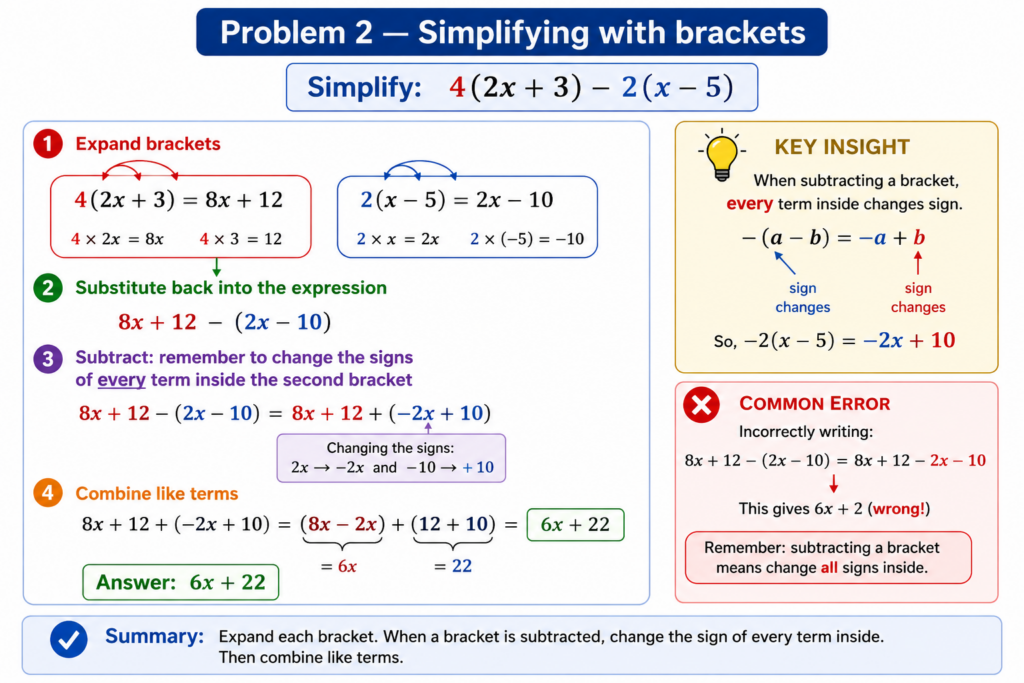
Simplify: 4(2x + 3) – 2(x – 5)
Solution: Expand brackets: 4(2x + 3) = 8x + 12
2(x – 5) = 2x – 10
Subtract: 8x + 12 – 2x + 10 = 6x + 22
Answer: 6x + 22
Key insight: When subtracting a bracket, every term inside changes sign. 2(x – 5) subtracted becomes -2x + 10, not -2x – 10. This is the most common error in bracket expansion.
Problem 3 — substitution
If x = 3 and y = -2, find the value of 2x² – 3y + 1.
Solution: Substitute x = 3 and y = -2: 2(3)² – 3(-2) + 1 = 2(9) + 6 + 1 = 18 + 6 + 1 = 25
Answer: 25
Key insight: Always substitute into the expression before evaluating — do not try to simplify the expression with the numbers in your head simultaneously. Writing out the substitution step clearly prevents sign errors.
Problem 4 — evaluating with fractions
If a = 1/2 and b = 4, find the value of 2a + b/a.
Solution: 2a = 2 x 1/2 = 1 b/a = 4 ÷ 1/2 = 4 x 2 = 8 2a + b/a = 1 + 8 = 9
Answer: 9
Problem 5 — Gauss style expression problem
If 3x + 7 = 22, what is the value of 6x + 5?
Solution: From 3x + 7 = 22: 3x = 15 x = 5
6x + 5 = 6(5) + 5 = 30 + 5 = 35
Alternatively, without finding x: 6x + 5 = 2(3x + 7) – 9 = 2(22) – 9 = 44 – 9 = 35.
Answer: 35
Key insight: The faster solution notices that 6x + 5 can be written in terms of 3x + 7 without finding x. This kind of algebraic shortcut appears regularly on the Gauss contest — recognising when a target expression is a multiple or transformation of a given expression saves significant time.
Grade 8 algebra worksheets — solving linear equations
These algebra worksheets grade 8 problems cover solving equations of increasing complexity. They range from Part A to Part B difficulty on the Gauss contest.
Problem 6 — one-step equation
Solve: x + 13 = 28
Solution: x = 28 – 13 x = 15
Answer: x = 15
Problem 7 — two-step equation
Solve: 3x – 8 = 16
Solution: 3x = 16 + 8 3x = 24 x = 8
Answer: x = 8
Problem 8 — equation with brackets
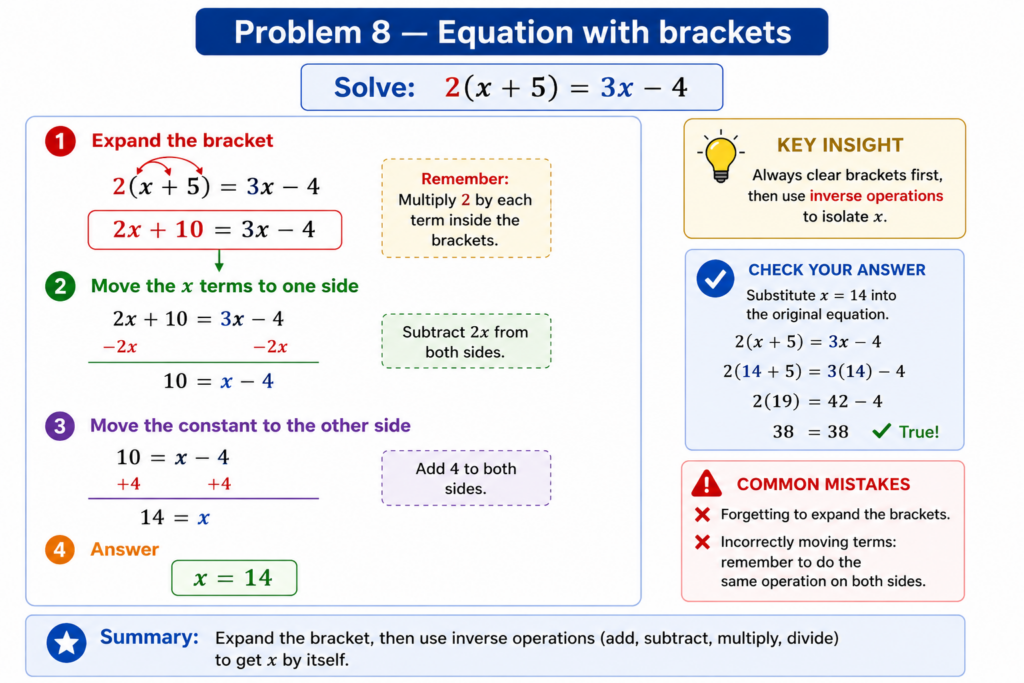
Solve: 2(x + 5) = 3x – 4
Solution: Expand: 2x + 10 = 3x – 4 10 + 4 = 3x – 2x 14 = x
Answer: x = 14
Problem 9 — equation with fractions
Solve: x/3 + 2 = 7
Solution: x/3 = 5 x = 15
Answer: x = 15
Problem 10 — equation with variables on both sides
Solve: 5x + 3 = 2x + 18
Solution: 5x – 2x = 18 – 3 3x = 15 x = 5
Answer: x = 5
Problem 11 — Gauss style equation problem
The average of three consecutive integers is 25. What is the largest of the three integers?
Solution: Let the three consecutive integers be n, n+1, and n+2. Average = (n + n+1 + n+2)/3 = 25 (3n + 3)/3 = 25 3n + 3 = 75 3n = 72 n = 24
The three integers are 24, 25, 26. The largest is 26.
Answer: 26
Key insight: Consecutive integer problems always work cleanly when expressed as n, n+1, n+2. Do not let the word “consecutive” cause hesitation — translate it directly into algebra before solving.
Problem 12 — Gauss style, two equations
Two numbers have a sum of 40 and a difference of 12. What is the larger number?
Solution: Let the numbers be a and b where a > b. a + b = 40 a – b = 12
Add the equations: 2a = 52, so a = 26. Check: b = 40 – 26 = 14. Difference: 26 – 14 = 12 ✓
Answer: 26
Key insight: Adding two equations to eliminate a variable is faster than substitution for this problem type. Recognising when to add or subtract equations is a key algebraic skill tested on the Gauss.
Grade 8 algebra worksheets — patterns and sequences
Patterns and sequences appear on every Gauss contest paper. These algebra grade 8 worksheets problems develop the skill of finding rules and generalising sequences algebraically.
Problem 13 — finding the rule
A pattern produces the sequence 5, 9, 13, 17, 21…
What is the rule for the nth term?
Solution: The sequence increases by 4 each time — it is an arithmetic sequence with common difference 4.
First term = 5. nth term = first term + (n-1) x common difference = 5 + (n-1) x 4 = 5 + 4n – 4 = 4n + 1
Check: n=1: 4(1) + 1 = 5 ✓. n=3: 4(3) + 1 = 13 ✓
Answer: nth term = 4n + 1
Problem 14 — using the rule to find a specific term
Using the sequence from Problem 13, what is the 50th term?
Solution: 50th term = 4(50) + 1 = 200 + 1 = 201
Answer: 201
Problem 15 — finding position from value
Using the same sequence (nth term = 4n + 1), which term in the sequence equals 97?
Solution: 4n + 1 = 97 4n = 96 n = 24
Answer: The 24th term
Problem 16 — Gauss style pattern problem
A pattern of dots is arranged in a sequence. In the first figure there are 3 dots, in the second there are 7, in the third there are 11. If this pattern continues, how many dots are in the 20th figure?
Solution: Sequence: 3, 7, 11… Common difference = 4. nth term = 3 + (n-1) x 4 = 3 + 4n – 4 = 4n – 1
20th term: 4(20) – 1 = 80 – 1 = 79
Answer: 79
Problem 17 — Gauss style, finding a pattern rule
A sequence begins 2, 6, 18, 54… What is the 7th term?
Solution: Each term is multiplied by 3 — this is a geometric sequence with ratio 3.
nth term = 2 x 3^(n-1)
7th term = 2 x 3^6 = 2 x 729 = 1458
Answer: 1458
Key insight: Not all sequences on the Gauss are arithmetic. When the difference between consecutive terms is not constant, check whether the ratio between consecutive terms is constant instead — if so it is a geometric sequence.
Grade 8 algebra worksheets — word problems
Algebraic word problems require setting up an equation from a written context. This is where many students lose marks on the Gauss contest — not because they cannot solve the equation once it is set up, but because they struggle to translate the words into algebra.
A method for every word problem
Step one — identify the unknown and assign it a variable. Write “Let x = …” before doing anything else.
Step two — write an equation that expresses the relationship described in the problem.
Step three — solve the equation.
Step four — check the answer makes sense in the original context.
Problem 18 — basic word problem
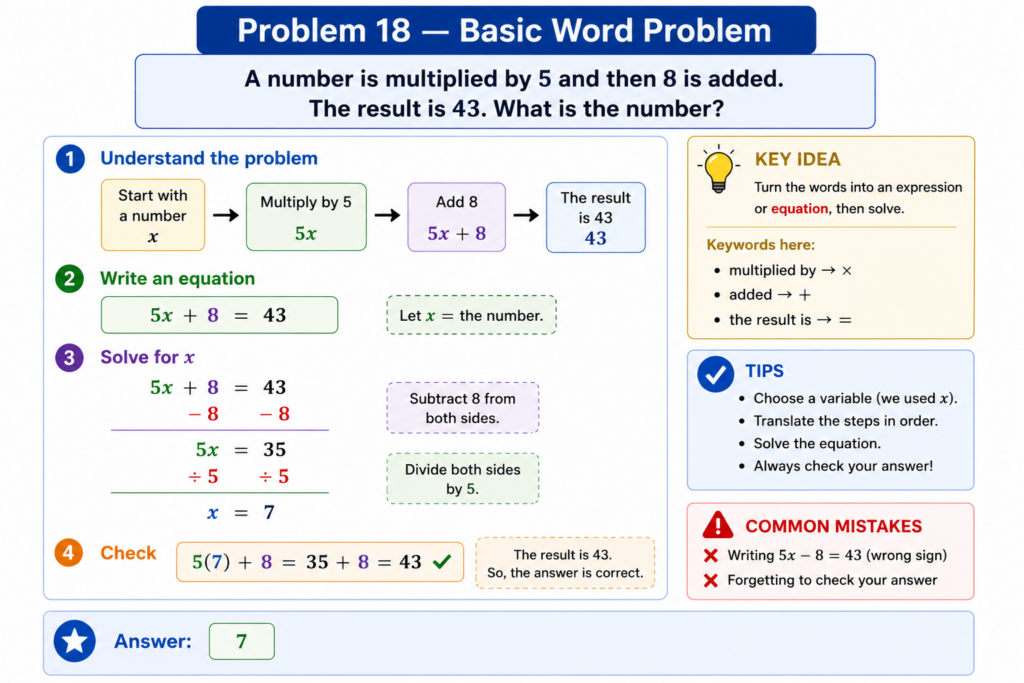
A number is multiplied by 5 and then 8 is added. The result is 43. What is the number?
Solution: Let x = the number. 5x + 8 = 43 5x = 35 x = 7
Check: 5(7) + 8 = 35 + 8 = 43 ✓
Answer: 7
Problem 19 — age problem
Sam is 4 years older than twice his sister’s age. The sum of their ages is 25. How old is Sam?
Solution: Let sister’s age = x. Sam’s age = 2x + 4.
x + (2x + 4) = 25 3x + 4 = 25 3x = 21 x = 7
Sam’s age = 2(7) + 4 = 18.
Answer: Sam is 18
Problem 20 — perimeter word problem
A rectangle has a length that is 3 more than twice its width. The perimeter is 48. Find the dimensions.
Solution: Let width = w. Length = 2w + 3.
Perimeter = 2(l + w) = 48 l + w = 24 (2w + 3) + w = 24 3w + 3 = 24 3w = 21 w = 7
Length = 2(7) + 3 = 17.
Check: Perimeter = 2(17 + 7) = 2(24) = 48 ✓
Answer: Width = 7, Length = 17
Try more area and perimeter problems at: Area and Perimeter Worksheets: How to Solve Every AMC 8 Geometry Problem.
Problem 21 — Gauss style word problem
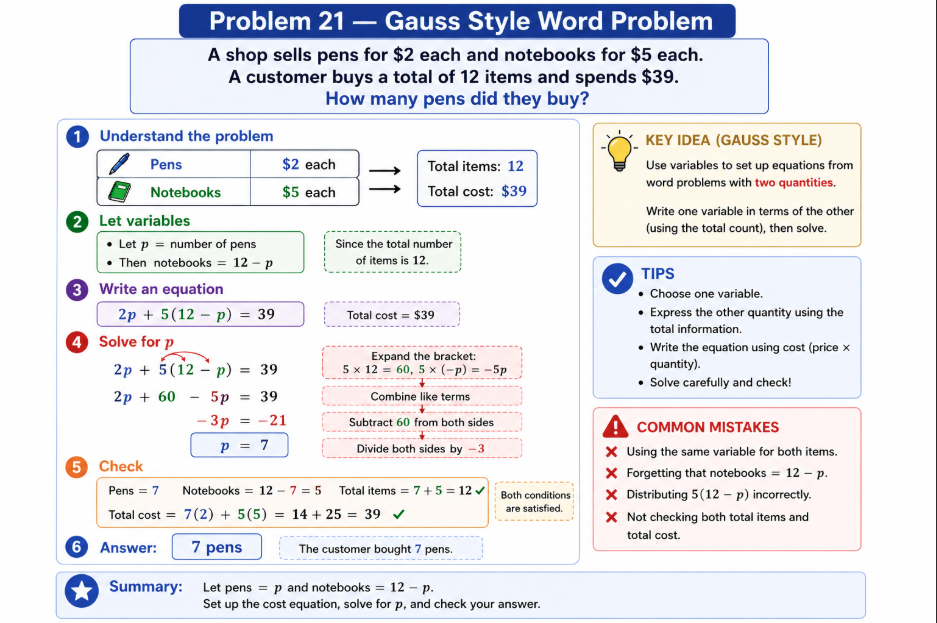
A shop sells pens for $2 each and notebooks for $5 each. A customer buys a total of 12 items and spends $39. How many pens did they buy?
Solution: Let pens = p. Notebooks = 12 – p.
2p + 5(12 – p) = 39
2p + 60 – 5p = 39
-3p = -21
p = 7
Check: 7 pens + 5 notebooks = 12 items. 7(2) + 5(5) = 14 + 25 = 39 ✓
Answer: 7 pens
Problem 22 — Gauss style, harder word problem
Three friends share some money. The second friend receives twice as much as the first. The third receives $10 more than the second. Together they receive $90. How much does the first friend receive?
Solution: Let first friend’s share = x. Second = 2x. Third = 2x + 10.
x + 2x + (2x + 10) = 90
5x + 10 = 90
5x = 80 x = 16
Check: 16 + 32 + 42 = 90 ✓
Answer: $16
Algebra grade 8 worksheets — Gauss style harder problems
These problems combine algebra with other mathematical ideas in the way the Gauss Part B and Part C questions do.
Problem 23
If 2^x = 8, what is the value of 2^(x+3)?
Solution: 2^x = 8 = 2^3, so x = 3. 2^(x+3) = 2^6 = 64.
Alternatively: 2^(x+3) = 2^x x 2^3 = 8 x 8 = 64.
Answer: 64
Key insight: The second approach is faster and does not require finding x explicitly. Recognising that 2^(x+3) = 2^x x 2^3 uses the exponent law a^(m+n) = a^m x a^n.
Problem 24
The sum of five consecutive even integers is 120. What is the largest of the five integers?
Solution: Consecutive even integers differ by 2. Let them be n, n+2, n+4, n+6, n+8.
n + (n+2) + (n+4) + (n+6) + (n+8) = 120
5n + 20 = 120
5n = 100 n = 20
Largest = 20 + 8 = 28.
Answer: 28
Problem 25
A rectangle has area 60. Its length is 3 more than its width. What is the perimeter?
Solution: Let width = w. Length = w + 3.
Perimeter = 2(l + w) = 54
l + w = 27 (w + 3) + w = 27
2w + 3 = 27
2w = 24
w = 12
Length = 12 + 3 = 15. Area = 12 x 15 = 180.
Check: Perimeter = 2(15 + 12) = 2(27) = 54 ✓
Answer: 180
Key insight: This problem gives perimeter and asks for area — the reverse of what many students expect. Setting up the perimeter equation finds the dimensions, then area follows directly. Gauss word problems often ask for a secondary quantity (area here) that requires a two-step process: find the dimensions first, then calculate what the question actually asks for.
Problem 26 — hardest
A function is defined as f(x) = 3x – 2. If f(a) = 13 and f(b) = 7, what is f(a + b)?
Solution: f(a) = 3a – 2 = 13 → 3a = 15 → a = 5.
f(b) = 3b – 2 = 7 → 3b = 9 → b = 3.
a + b = 8.
f(8) = 3(8) – 2 = 22.
Answer: 22
Key insight: Function notation is introduced in Grade 8 and appears on the Gauss. f(x) simply means “the value of the expression when x is substituted.” Treating f(x) as a machine that takes a number in and gives a number out — rather than trying to manipulate f algebraically — is the clearest way to approach these problems.
Grade 8 algebra reference sheet
Use this as a quick reference alongside the practice problems above.
Key rules for expressions
| Operation | Rule | Example |
|---|---|---|
| Collecting like terms | Add coefficients of same variable | 3x + 5x = 8x |
| Expanding brackets | Multiply each term inside | 3(x + 4) = 3x + 12 |
| Subtracting brackets | All signs inside change | -(x – 3) = -x + 3 |
| Substitution | Replace variable with number | x = 5 in 3x + 2 → 17 |
Solving equations — steps in order
- Expand all brackets
- Collect variable terms on one side
- Collect number terms on the other side
- Divide both sides by the coefficient
- Check by substituting back into the original equation
nth term of a sequence
| Sequence type | nth term formula |
|---|---|
| Arithmetic (common difference d, first term a) | a + (n-1)d |
| Geometric (common ratio r, first term a) | a x r^(n-1) |
Setting up word problem equations
- “x more than y” → y + x
- “x less than y” → y – x
- “twice x” → 2x
- “x times as many as y” → xy
- “sum of x and y is z” → x + y = z
- “x is divided equally among n” → x/n
How to use these grade 8 algebra worksheets
These grade 8 algebra worksheets are most effective when used as part of a structured Gauss preparation plan rather than completed all at once.
Attempt every problem before reading the solution. For word problems specifically, always write “Let x = …” before doing anything else. Students who define their variable explicitly make significantly fewer setup errors than those who start writing equations without declaring what their variable represents.
Work through the levels in order. The expression and substitution problems build the mechanical skills that the word problems and harder Gauss-style problems require. Students who skip the early problems and go straight to the harder ones often discover they are making basic sign or bracket errors that the early problems would have identified and fixed.
Use these algebra grade 8 worksheets alongside Gauss past papers. The past papers show you the exact question style and context — these worksheets give you concentrated practice on the algebraic technique. Use both together rather than choosing one over the other.
For any problem in the algebra grade 8 worksheets pdf format you may be printing, add the steps in writing rather than trying to work problems mentally. Writing each step clearly is a habit that prevents errors and is essential on the Gauss where the questions are hard enough that mental arithmetic introduces unnecessary risk.
For more practice questions with solutions, check out:
Factors of 24 and 45: How to Find All Factors AMC 8 Guide
What is the GCF? How to Find the Greatest Common Factor With Examples
Equivalent Fractions Worksheet: Practice Problems and Examples
Skip Counting Worksheets: Practice Sheets Games and Examples
Frequently Asked Questions
What algebra topics are covered in Grade 8? Grade 8 algebra covers simplifying and evaluating algebraic expressions, solving one-step and two-step linear equations, solving equations with variables on both sides, working with patterns and sequences including finding nth terms, and setting up and solving algebraic word problems. The Ontario Grade 8 curriculum also introduces linear relations and basic function notation.
How does algebra appear on the Gauss math contest? Algebra appears on the Gauss contest in several forms: direct equation solving, evaluating expressions for given values, finding missing values in patterns, setting up equations from word problem contexts, and problems that combine algebra with geometry or number theory. Part A questions involve straightforward equation solving. Part B and C questions require setting up algebraic relationships from more complex contexts.
What is the best way to prepare for Grade 8 algebra? Work through structured grade 8 algebra worksheets covering expressions, equations, patterns, and word problems in that order. Practice identifying the variable and writing the equation before solving — this step prevents most common errors. Use past Gauss contest papers alongside worksheet practice to see how algebra appears in competition context.
Why do students lose marks on algebra problems in the Gauss contest? The most common errors are sign mistakes when expanding brackets (forgetting to change signs inside a subtracted bracket), setting up word problems incorrectly (not defining the variable clearly before writing the equation), and not checking the answer in the original context. These errors are preventable with systematic practice.
Where can I find Grade 8 algebra worksheets PDF resources? Free algebra grade 8 worksheets pdf resources are available through the CEMC at cemc.uwaterloo.ca — their past Gauss contest papers contain algebraic problems representative of what appears in the competition. The problems in this guide can also be printed directly as algebra grade 8 worksheets for offline practice.
How is Grade 8 algebra different from Grade 7 algebra? Grade 7 algebra focuses primarily on one-step equations, simple patterns, and introductory expressions. Grade 8 algebra adds multi-step equations, equations with brackets, variables on both sides, and more complex pattern rules including geometric sequences. The Gauss Grade 8 contest reflects this increased algebraic sophistication compared to the Grade 7 version.

