


When your child is motivated by puzzles, fast mental math, or proof-style questions, it is natural to wonder which opportunities are legitimate and worth their time. For high school students, taking a math contest can build confidence, stretch problem-solving, and add structure to independent learning. However, the choices can feel overwhelming, and parents often worry about stress or over-prepping. This guide compares well-known contests, typical timelines, and practical ways to support your teen at home.

Choosing a math contest that fits your teen (not just their résumé)
In Canada, many students start with contests organized by the University of Waterloo’s Centre for Education in Mathematics and Computing (CEMC). These are widely used because schools can administer them, and the questions reward clear thinking more than memorized tricks. You can explore the official contest list on the University of Waterloo CEMC contests hub.
In the U.S. and internationally, families often hear about the AMC series, which is commonly used as a pathway to further invitational exams. Because AMC policies and availability can vary by school or testing site, it helps to rely on the official organizer’s information at the Mathematical Association of America (MAA) competitions hub.
Before you pick anything, align on a simple goal. For example, is your teen exploring for fun, building habits for Grade 9–12 math, or aiming for advanced problem-solving?

How math contests for high school students differ: format, difficulty, and timing
Not all contests measure the same skills. Some focus on multiple-choice speed and accuracy, while others reward full written solutions and mathematical reasoning (explaining why a method works). Therefore, a “best” contest depends on your child’s strengths and how they like to think.
Common contest families Canadian parents will see
- Waterloo CEMC contests (Canada): widely offered in schools; typically paper-based or school-administered; strong alignment with problem-solving and clear reasoning. Start at the CEMC contests page.
- AMC 8/10/12 (North America): multiple-choice; often used as a qualifier pathway in the U.S. system. Confirm current details through the MAA.
- Canadian Mathematical Olympiad pathway (advanced): invitational stages and higher difficulty; students usually reach this after strong performance in earlier contests. See the most reliable overview here at Waterloo Math Competitions: A Canadian Parent’s Complete Guide to CEMC Contests.
Quick comparison table for parents
| Contest family | Typical question style | What it tends to reward | Best for |
|---|---|---|---|
| Waterloo CEMC (e.g., Gauss/Pascal/Cayley/Fermat/Euclid) | Mixture; often short-answer or full-solution depending on contest | Reasoning, clarity, multi-step thinking | Canadian students building strong contest foundations |
| AMC 8/10/12 | Multiple-choice | Efficient problem-solving under time limits | Students who enjoy pace and breadth |
| Olympiad-style progression | Proof and deep problem-solving (proof = a logical written argument) | Depth, creativity, persistence | Teens who love challenging “why” questions |
Timing matters just as much as difficulty. Many contests run once per year, and schools set their own internal deadlines. Therefore, your best first step is to ask your child’s school office which contests they host and when they register, then verify the official season details on the organizer’s site.
What skills are actually being tested?
Math contest math is not just “harder school math.” It often emphasizes number sense (comfort with numbers), combinatorics (counting methods), and geometry patterns. If you want a simple reference for what topics mean, you can check definitions on Britannica’s mathematics overview or topic pages on Wikipedia (useful for quick refreshers, although official contest sources should guide preparation).
However, most teens do best when they focus on a few core habits: reading carefully, organizing work, and checking results. Those habits transfer directly to classroom tests, too.

Practical preparation that protects confidence and family time
Parents often worry that contest prep will turn into nightly battles. That usually happens when the plan is too intense or too vague. Instead, keep prep predictable and light, then increase only if your teen asks for more.
A realistic 6–8 week prep rhythm
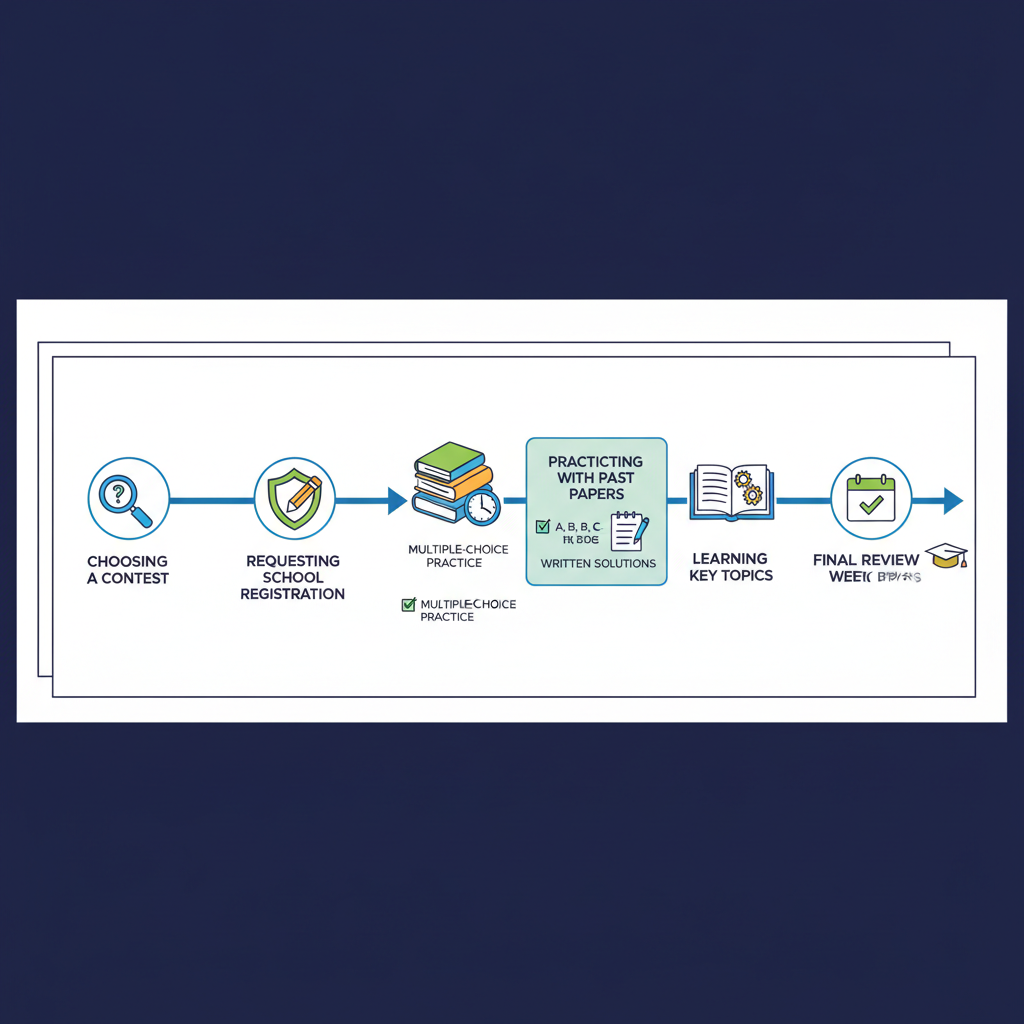
- Week 1: Choose one contest and download 2–3 past papers from the official source, such as the CEMC past contests archive.
- Weeks 2–5: Two short sessions per week (30–45 minutes). For example, do 6–10 problems, then review mistakes.
- Weeks 6–7: Add one timed set every week to build pacing without panic.
- Week 8: Light review only. Prioritize sleep and calm routines.
Therefore, the real “secret” is review. Your teen improves fastest when they write a short correction note: what went wrong, and what to try next time.
How parents can help without teaching the math
You do not need to remember Grade 11 functions to be helpful. Instead, support the process.
- Ask your teen to explain one solved problem out loud (teaching strengthens memory).
- Encourage clean work: label steps, draw diagrams, and box final answers.
- Track patterns in errors, such as rushing, skipping units, or misreading constraints.
- Keep the focus on growth: “What strategy did you try?” rather than “What score did you get?”
Tools & resources (official and parent-friendly)
Use resources that are stable and reputable, especially when your child is following a qualification pathway.
- CEMC (University of Waterloo) for official contest info and past papers.
- University of Waterloo math contests hub for Canadian contest pathways.
- Mathematical Association of America competitions hub for AMC-related information.
- Desmos for graphing and exploring functions (a function is a rule that maps inputs to outputs).
- GeoGebra for geometry and algebra visualization.
If your teen is using online explanations, remind them to cross-check with official solutions when available. Otherwise, they may learn shortcuts that do not generalize.
Helping your teen decide what “success” looks like
Contest culture can feel score-focused, especially online. However, for most families, the healthiest metric is consistency: showing up, reviewing mistakes, and staying curious. A math contest result becomes one data point, not a label.
It also helps to normalize that many strong students find their first contest surprisingly hard. That is expected, because contests intentionally include stretch questions that separate levels of mastery.
Conclusion: a calm path into challenge
Math contests for high school students work best when they match your teen’s personality, schedule, and learning stage. Start with one well-run contest, use official past papers, and keep practice short but consistent. Therefore, your child can gain problem-solving confidence without sacrificing family balance. If you want, treat the first contest as a baseline, then choose the next step with more information and less pressure.
Take our free Math Evaluation to find your child’s current level and next steps.
About Think Academy
Think Academy, part of TAL Education Group, helps K–12 students succeed in school today by building strong math foundations and critical thinking skills. At the same time, we focus on the bigger picture—developing learning ability, curiosity, and healthy study habits that inspire a lifelong love of learning. With expert teachers, proven methods, and innovative AI tools, we support every child’s journey from classroom confidence to long-term growth.



That’s a great list! My younger brother loves a good challenge with math problems, so I’ll definitely check these out.