Skip counting is one of the most important early mathematics skills — the foundation for multiplication, division, fractions, and number patterns that appear throughout elementary school and beyond. These skip counting worksheets cover counting by 2s, 3s, 4s, 5s, 6s, 7s, 8s, 9s, 10s, and beyond, with practice problems, number line exercises, games, and printable-style activities designed to build fluency and number sense at every level. Whether your child is just beginning skip counting or preparing for more advanced number pattern work, the skip counting sheets and activities in this guide give them everything they need to practise effectively.
Skip counting and recognizing numerical patterns based on skip counting (e.g., counting by 2s, 3s, 5s, 10s) often appear in the Gauss Math Contest, particularly in the earlier, foundational questions. While skip counting is itself a basic skill, the Gauss Contest (Grades 7 and 8) focuses on applying this to pattern recognition, logical reasoning, and, in more advanced questions, arithmetic sequences and series.

What is skip counting?
Skip counting is counting forward or backward by a number other than one — jumping by equal steps rather than moving one unit at a time. Instead of counting 1, 2, 3, 4, 5, 6, a student skip counting by 2s counts 2, 4, 6, 8, 10.
The number being skipped by is called the skip counting interval or the step size. Every skip count sequence is an arithmetic sequence — a list of numbers where the difference between consecutive terms is always the same.
Why skip counting matters
Skip counting is not just a preliminary exercise before multiplication tables. It builds the number sense that makes multiplication meaningful rather than mechanical. A student who has genuinely internalised skip counting by 7s understands why 7 x 4 = 28 — they can count 7, 14, 21, 28 and see the relationship — rather than just recalling a memorised fact.
This distinction becomes important in later mathematics. Students with strong skip counting foundations handle multiplication, factors, multiples, fractions, and number patterns more confidently than students who learned times tables as isolated facts. Skip counting also directly supports mental arithmetic, estimation, and the recognition of patterns in sequences.
Knowing skip counting is very important for the Gauss Math Contest – it acts as a fundamental mental math tool for speed, pattern recognition, and solving arithmetic sequences without a calculator. The contest emphasizes logical reasoning and quick techniques over laborious manual counting, so mastering skip counting is a crucial skill. Skip counting worksheets help to build this skill.
Skip counting and competition math
Skip counting and number patterns appear in AMC 8 and Gauss math contest problems involving multiples, divisibility, and sequences. Students who can instantly recognise multiples of 6, 7, 8, and 9 solve number theory problems faster than those who calculate from scratch. The fluency built through skip counting practice at elementary level pays dividends in competition math years later.
Skip counting worksheets — counting by 2s, 5s and 10s
Counting by 2s, 5s, and 10s are the natural starting points for skip counting because they have the most visible patterns and the most immediate real-world connections.
Counting by 2s
Counting by 2s produces the sequence of even numbers: 2, 4, 6, 8, 10, 12, 14, 16, 18, 20…
Every number in the sequence ends in 0, 2, 4, 6, or 8. This is the divisibility rule for 2 — a number is even if its last digit is even.
Practice problems — counting by 2s:
Fill in the missing numbers:
- 2, 4, 6, __, 10, __, 14
- 16, 18, __, 22, __, 26
- __, 30, 32, __, 36, 38
- 44, __, 48, __, 52, 54
- 96, 98, __, __, 104
Answers: 8 and 12 / 20 and 24 / 28 and 34 / 46 and 50 / 100 and 102
Counting by 5s
Counting by 5s: 5, 10, 15, 20, 25, 30, 35, 40, 45, 50…
Every number in the sequence ends in 0 or 5. This is the divisibility rule for 5.
Practice problems — counting by 5s:
- 5, 10, __, 20, __, 30
- 35, __, 45, __, 55
- __, 65, 70, __, 80
- 85, 90, __, __, 105
- 120, __, 130, __, 140
Answers: 15 and 25 / 40 and 50 / 60 and 75 / 95 and 100 / 125 and 135
Counting by 10s
Counting by 10s: 10, 20, 30, 40, 50, 60, 70, 80, 90, 100…
Every number in the sequence ends in 0. This is the most immediately visible skip counting pattern and is typically the first one introduced in school.
Practice problems — counting by 10s:
- 10, 20, __, 40, __, 60
- 70, __, 90, __, 110
- __, 130, 140, __, 160
- 210, __, 230, __, 250
- 470, 480, __, __, 510
Answers: 30 and 50 / 80 and 100 / 120 and 150 / 220 and 240 / 490 and 500
Skip counting worksheets — counting by 3s, 4s and 6s
These intervals are slightly harder than 2s, 5s, and 10s because the patterns are less immediately visible. Mastering them is essential before moving to the harder intervals.
Counting by 3s
Counting by 3s: 3, 6, 9, 12, 15, 18, 21, 24, 27, 30…
A useful check: in the sequence of multiples of 3, the sum of the digits of every number is divisible by 3. For example, 24: 2 + 4 = 6, which is divisible by 3. This is the divisibility rule for 3.
Practice problems — counting by 3s:
- 3, 6, __, 12, __, 18
- 21, __, 27, __, 33
- __, 39, 42, __, 48
- 54, __, 60, __, 66
- 87, 90, __, __, 99
Answers: 9 and 15 / 24 and 30 / 36 and 45 / 57 and 63 / 93 and 96
Counting by 4s
Counting by 4s: 4, 8, 12, 16, 20, 24, 28, 32, 36, 40…
The sequence of multiples of 4 alternates between even numbers ending in 0, 4, 8, 2, 6 in a repeating cycle. A number is divisible by 4 if its last two digits form a number divisible by 4.
Practice problems — counting by 4s:
- 4, 8, __, 16, __, 24
- 28, __, 36, __, 44
- __, 52, 56, __, 64
- 68, __, 76, __, 84
- 92, 96, __, __, 108
Answers: 12 and 20 / 32 and 40 / 48 and 60 / 72 and 80 / 100 and 104
Counting by 6s
Counting by 6s: 6, 12, 18, 24, 30, 36, 42, 48, 54, 60…
Every multiple of 6 is also a multiple of both 2 and 3. A number is divisible by 6 if it is even AND its digit sum is divisible by 3.
Practice problems — counting by 6s:
- 6, 12, __, 24, __, 36
- 42, __, 54, __, 66
- __, 78, 84, __, 96
- 102, __, 114, __, 126
- 144, 150, __, __, 168
Answers: 18 and 30 / 48 and 60 / 72 and 90 / 108 and 120 / 156 and 162
Skip counting worksheets — counting by 7s
Counting by 7s is where many students first find skip counting genuinely challenging. Unlike 2s, 5s, and 10s there is no obvious last-digit pattern to rely on. Building fluency with counting by 7s requires specific practice.
The counting by 7s sequence
Counting by sevens: 7, 14, 21, 28, 35, 42, 49, 56, 63, 70, 77, 84, 91, 98, 105…
There is no simple visual pattern in the last digits of multiples of 7 — they cycle through 7, 4, 1, 8, 5, 2, 9, 6, 3, 0 before repeating. This is why counting by 7s requires more deliberate practice than other intervals.
One technique that helps: anchor multiples of 7 to known facts. 7 x 7 = 49 is a landmark. 7 x 10 = 70 is easy. Working backward from 70 (70, 63, 56, 49) and forward from 49 (49, 56, 63, 70) reinforces the sequence around the most commonly needed multiples.
Why counting by sevens matters
Multiples of 7 appear in AMC 8 and Gauss math problems involving days of the week (7-day cycles), modular arithmetic, and divisibility. A student who can instantly identify whether a number is a multiple of 7 and what the next multiple is solves these problems faster than one who calculates from scratch.
Practice problems — counting by 7s:
- 7, 14, __, 28, __, 42
- 49, __, 63, __, 77
- __, 91, 98, __, 112
- 119, __, 133, __, 147
- 168, 175, __, __, 196
Answers: 21 and 35 / 56 and 70 / 84 and 105 / 126 and 140 / 182 and 189
Counting by 7s — harder practice
These problems mix counting by sevens with simple reasoning:
- What is the 12th multiple of 7?
- Is 84 a multiple of 7? How do you know?
- What is the largest multiple of 7 that is less than 100?
- How many multiples of 7 are there between 1 and 50?
- A pattern starts at 7 and adds 7 each time. What is the 15th number in the pattern?
Answers: 84 / Yes — 7 x 12 = 84 or count: 7, 14, 21…84 / 98 / Seven (7, 14, 21, 28, 35, 42, 49) / 105
Skip counting worksheets — counting by 8s and 9s
Counting by 8s
Counting by 8s: 8, 16, 24, 32, 40, 48, 56, 64, 72, 80, 88, 96…
The last digits cycle: 8, 6, 4, 2, 0, 8, 6, 4, 2, 0. Every multiple of 8 is even and divisible by 4. A number is divisible by 8 if its last three digits form a number divisible by 8.
Practice problems — counting by 8s:
- 8, 16, __, 32, __, 48
- 56, __, 72, __, 88
- __, 104, 112, __, 128
- 136, __, 152, __, 168
- What is the 11th multiple of 8?
Answers: 24 and 40 / 64 and 80 / 96 and 120 / 144 and 160 / 88
Counting by 9s
Counting by 9s: 9, 18, 27, 36, 45, 54, 63, 72, 81, 90…
The multiples of 9 have a beautiful pattern: the digit sum of every multiple of 9 is itself divisible by 9 (or is 9). For example: 27 → 2 + 7 = 9. 54 → 5 + 4 = 9. 81 → 8 + 1 = 9. This is both the divisibility rule for 9 and a useful way to check membership in the sequence.
Another pattern: as you count by 9s, the tens digit goes up by 1 and the units digit goes down by 1 for single-prefix multiples: 09, 18, 27, 36, 45, 54, 63, 72, 81, 90.
Practice problems — counting by 9s:
- 9, 18, __, 36, __, 54
- 63, __, 81, __, 99
- __, 117, 126, __, 144
- Is 135 a multiple of 9? How do you know?
- What is the 14th multiple of 9?
Answers: 27 and 45 / 72 and 90 / 108 and 135 / Yes — 1 + 3 + 5 = 9 / 126
Skip counting printables — number line activities
Number line activities are one of the most effective formats in skip counting worksheets and printables because they make the equal-step nature of skip counting visually explicit.
How to use number line skip counting
Draw a number line from 0 to a target number. Mark the starting point. Draw arcs jumping by the skip count interval — each arc the same length. The landing points show the skip count sequence visually.
For counting by 3s on a number line from 0 to 30: arcs land on 3, 6, 9, 12, 15, 18, 21, 24, 27, 30. The equal spacing of the arcs makes the pattern immediately visible.
Number line practice problems
Complete the following number lines by filling in the missing values at each marked point.
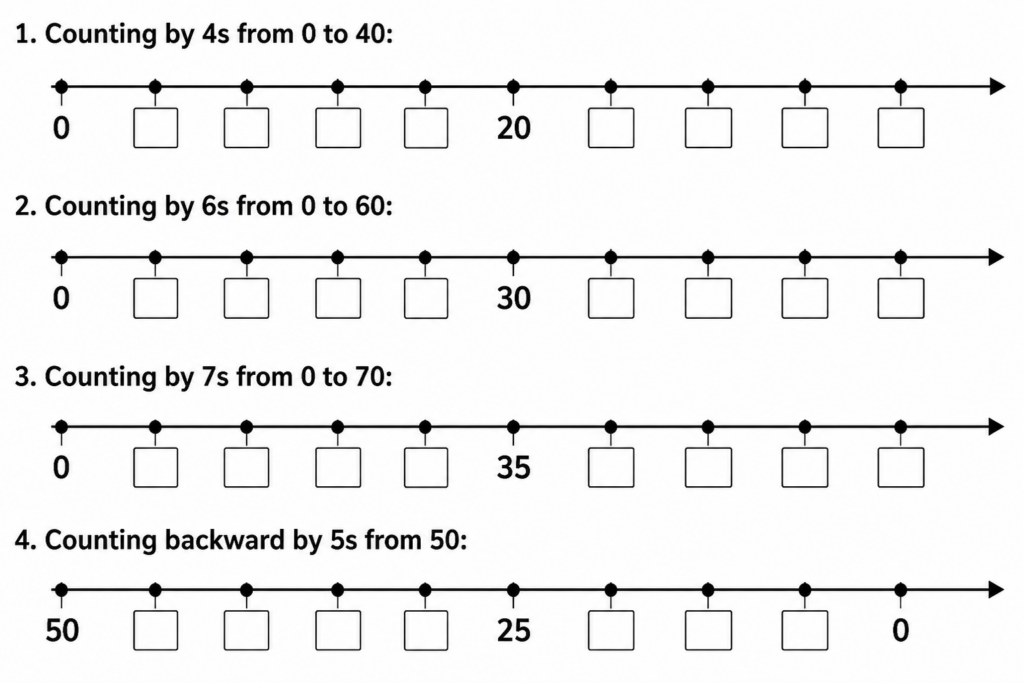
Counting by 4s from 0 to 40: 0, __, __, __, __, 20, __, __, __, __, 40
Answer: 4, 8, 12, 16, 20, 24, 28, 32, 36, 40
Counting by 6s from 0 to 60: 0, __, __, __, __, 30, __, __, __, __, 60
Answer: 6, 12, 18, 24, 30, 36, 42, 48, 54, 60
Counting by 7s from 0 to 70: 0, __, __, __, __, 35, __, __, __, __, 70
Answer: 7, 14, 21, 28, 35, 42, 49, 56, 63, 70
Counting backward by 5s from 50: 50, __, __, __, __, 25, __, __, __, __, 0
Answer: 45, 40, 35, 30, 25, 20, 15, 10, 5, 0
Skip counting games
Skip counting games are one of the most effective ways to build fluency because they replace repetitive drilling with an engaging activity that creates the same repetitions naturally.
Skip counting game 1 — Buzz
Two or more players count aloud from 1 upward, one number per player per turn. Whenever the count reaches a multiple of the chosen skip number, that player says “Buzz” instead of the number. Anyone who says the number instead of Buzz, or says Buzz at the wrong time, is out. Start with counting by 5s and work up to harder intervals like 7s and 8s.
Skip counting game 2 — Skip count race
Write a starting number on a piece of paper and a target number. The challenge is to reach the target by skip counting by a specific interval as fast as possible. Player one counts by 3s from 0 to 60, player two counts by 4s from 0 to 60 — who reaches the target first? This builds speed and fluency simultaneously.
Skip counting game 3 — missing number challenge
Write out a skip counting sequence with several numbers removed and challenge your child to fill in all the blanks as fast as possible. Time them. Record their best time and challenge them to beat it on the next attempt. This is essentially the worksheet format turned into a game through the addition of timing and competition.
Skip counting game 4 — multiplication connection
Once a student is comfortable with a skip counting interval, connect it explicitly to multiplication. Call out a multiplication fact and ask the student to answer it by skip counting. “What is 7 x 6?” — the student counts 7, 14, 21, 28, 35, 42 and answers 42. This bridges the gap between skip counting fluency and multiplication fact recall.
Skip counting game 5 — pattern detective
Write down several multiples of a chosen interval mixed in with some non-multiples. Challenge your child to identify which numbers are in the skip count sequence and which are not, and explain how they knew. This builds the divisibility awareness that underlies both skip counting fluency and number theory reasoning.
Skip counting sheets — complete reference
Use these skip counting sheets as a quick reference for the full sequence of multiples at each interval up to the 15th multiple.
| Skip count by | First 15 multiples |
|---|---|
| 2s | 2, 4, 6, 8, 10, 12, 14, 16, 18, 20, 22, 24, 26, 28, 30 |
| 3s | 3, 6, 9, 12, 15, 18, 21, 24, 27, 30, 33, 36, 39, 42, 45 |
| 4s | 4, 8, 12, 16, 20, 24, 28, 32, 36, 40, 44, 48, 52, 56, 60 |
| 5s | 5, 10, 15, 20, 25, 30, 35, 40, 45, 50, 55, 60, 65, 70, 75 |
| 6s | 6, 12, 18, 24, 30, 36, 42, 48, 54, 60, 66, 72, 78, 84, 90 |
| 7s | 7, 14, 21, 28, 35, 42, 49, 56, 63, 70, 77, 84, 91, 98, 105 |
| 8s | 8, 16, 24, 32, 40, 48, 56, 64, 72, 80, 88, 96, 104, 112, 120 |
| 9s | 9, 18, 27, 36, 45, 54, 63, 72, 81, 90, 99, 108, 117, 126, 135 |
| 10s | 10, 20, 30, 40, 50, 60, 70, 80, 90, 100, 110, 120, 130, 140, 150 |
| 11s | 11, 22, 33, 44, 55, 66, 77, 88, 99, 110, 121, 132, 143, 154, 165 |
| 12s | 12, 24, 36, 48, 60, 72, 84, 96, 108, 120, 132, 144, 156, 168, 180 |
How to use these skip counting worksheets effectively
Working through skip counting sheets systematically rather than randomly produces faster fluency development. Here is the most effective approach.
Start with 2s, 5s, and 10s if any of these are not yet fluent. Do not move on until these are automatic — any hesitation on the basic intervals makes the harder ones significantly more difficult.
Move to 3s and 4s next. These are the first intervals without an obvious visual pattern. Practice by counting aloud rather than writing — hearing the sequence builds a different kind of memory than seeing it on paper.
Tackle 6s, 7s, 8s, and 9s in any order depending on which ones cause the most difficulty. For most students, counting by sevens and counting by 8s are the hardest. Use the games described above alongside the practice problems to build fluency without pure repetition.
Once all intervals are fluent in the forward direction, practice backward counting. Counting down by 7s from 100 — 100, 93, 86, 79, 72… — is significantly harder than counting up and builds a deeper number sense.
Return to these skip counting worksheets at intervals rather than completing them all at once. A student who practices skip counting for ten minutes three times a week will build more lasting fluency than a student who completes all the skip counting sheets in one long session.
Other topics that may be tested in the Gauss math competition often overlap with the AMC 8. Read more about factors at: Factors of 24 and 45: How to Find All Factors AMC 8 Guide.
To figure out how to find the GCF, check out: What is the GCF? How to Find the Greatest Common Factor With Examples.
For fractions practice, see: Equivalent Fractions Worksheet: Practice Problems and Examples.
Frequently Asked Questions
What is skip counting? Skip counting is counting forward or backward by a number other than one — for example counting by 3s (3, 6, 9, 12…) or counting by 7s (7, 14, 21, 28…). Each step adds or subtracts the same amount. Skip counting builds number sense, supports multiplication and division, and develops pattern recognition skills used throughout mathematics.
What order should skip counting be taught? Start with 2s, 5s, and 10s — these have the most visible patterns and the most immediate connections to everyday maths. Then move to 3s and 4s, followed by 6s, 7s, 8s, and 9s. Counting by sevens and counting by 8s are typically the hardest and benefit from the most dedicated practice.
How do you make skip counting easier? Connect each interval to a pattern or rule where one exists — multiples of 9 always have a digit sum divisible by 9, multiples of 5 always end in 0 or 5. Use skip counting games to build fluency through engagement rather than pure repetition. Practice forward and backward counting. Use number lines to make the equal-step pattern visually explicit.
Why is counting by 7s harder than other intervals? Counting by sevens is harder because there is no simple last-digit pattern — the units digits cycle through 7, 4, 1, 8, 5, 2, 9, 6, 3, 0 with no immediately obvious regularity. Unlike counting by 5s (always ends in 0 or 5) or counting by 2s (always ends in an even digit), multiples of 7 require deliberate memorisation and practice rather than pattern recognition.
How does skip counting connect to multiplication? Every skip count sequence is the multiplication table for that interval. Counting by 6s — 6, 12, 18, 24, 30… — is the 6 times table in order. A student who has genuinely internalised counting by 6s can instantly retrieve any 6 times table fact by counting up to the right position.
How do skip counting worksheets help with competition maths? Skip counting fluency builds instant recognition of multiples, which is directly useful in number theory problems on the AMC 8 and Gauss math contest. Recognising that 84 is a multiple of 7, or that 72 is a multiple of both 8 and 9, eliminates the need for calculation and saves time under competition conditions.
What are the best skip counting games for children? The most effective skip counting games combine repetition with engagement. Buzz (saying “Buzz” instead of multiples of the chosen number) works well for groups. Timed missing number challenges work well for individual practice. The multiplication connection game — answering multiplication facts by skip counting aloud — bridges directly to times table fluency.