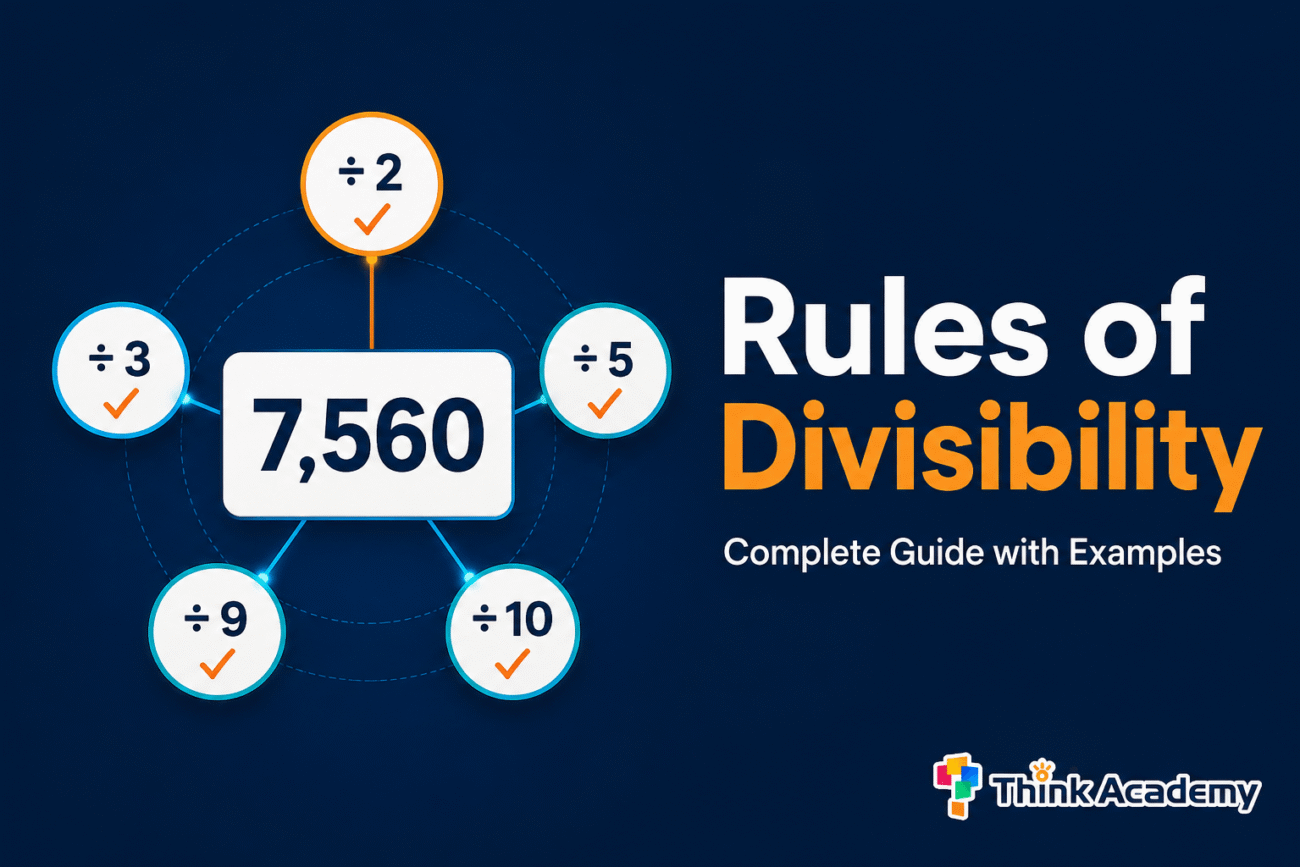
The rules in divisibility are a set of shortcuts that tell you whether one number divides another without performing full division. They are foundational number theory — taught from Grade 5 onward, tested on EQAO, and a standard time-saving tool in every major mathematics competition from the AMC 8 through to the Euclid Contest. Knowing the rules in divisibility automatically is one of the simplest ways a student can save time and reduce errors on timed assessments.
This guide covers every major rule of divisibility with clear explanations, proofs of why each rule works, worked examples, and practice problems.
What Are the Rules in Divisibility?
A divisibility rule is a shortcut for determining whether an integer is divisible by a given number without performing long division. The rules in divisibility exploit specific properties of the number system — usually properties of the digits in base 10.
Why they matter: The rules in divisibility are not just shortcuts for calculation — they reveal structure in the number system. Understanding why the rule for 3 works (digit sum divisible by 3) is the beginning of understanding modular arithmetic, which is one of the most important tools in number theory at every competition level.
Rules in Divisibility for 2
Rule: A number is divisible by 2 if its last digit is even (0, 2, 4, 6, or 8).
Examples:
- 4,836 → last digit 6 (even) → divisible by 2 ✓
- 7,293 → last digit 3 (odd) → not divisible by 2 ✗
Why it works: Any number can be written as 10q + r where r is the last digit. Since 10 is divisible by 2, whether the whole number is divisible by 2 depends entirely on whether r is. And r is even (0, 2, 4, 6, 8) if and only if 2 divides r.
Rules in Divisibility for 3
Rule: A number is divisible by 3 if the sum of its digits is divisible by 3.
Examples:
- 2,184 → digits 2+1+8+4 = 15 → 15 ÷ 3 = 5 → divisible by 3 ✓
- 7,421 → digits 7+4+2+1 = 14 → 14 is not divisible by 3 → not divisible by 3 ✗
Why it works: Any number N with digits dndn−1…d1d0 can be written as:N=dn⋅10n+dn−1⋅10n−1+⋯+d1⋅10+d0
Since 10≡1(mod3), every power of 10 is ≡1(mod3). Therefore:N≡dn+dn−1+⋯+d1+d0(mod3)
So 3∣N if and only if 3∣(dn+dn−1+⋯+d0). □
Divisibility Rule for 4
Rule: A number is divisible by 4 if its last two digits form a number divisible by 4.
Examples:
- 2,184 → last two digits 84 → 84 ÷ 4 = 21 → divisible by 4 ✓
- 6,730 → last two digits 30 → 30 ÷ 4 = 7.5 → not divisible by 4 ✗
Why it works: Any number can be written as 100q + r where r is the two-digit number formed by the last two digits. Since 100 = 4 × 25 is divisible by 4, the divisibility of the whole number by 4 depends only on r.
Divisibility Rule for 5
Rule: A number is divisible by 5 if its last digit is 0 or 5.
Examples:
- 3,475 → last digit 5 → divisible by 5 ✓
- 8,242 → last digit 2 → not divisible by 5 ✗
Why it works: Any number is 10q + r where r is the last digit. Since 10 = 5 × 2 is divisible by 5, divisibility depends entirely on whether 5 divides r. The only single-digit multiples of 5 are 0 and 5.
Divisibility Rule for 6
Rule: A number is divisible by 6 if it is divisible by both 2 AND 3.
Examples:
- 2,184 → even (÷2 ✓) AND digit sum 15 (÷3 ✓) → divisible by 6 ✓
- 5,310 → even (÷2 ✓) but digit sum 9… wait, 5+3+1+0=9 ÷3 ✓ → divisible by 6 ✓
- 4,514 → even (÷2 ✓) but digit sum 14, not ÷3 → not divisible by 6 ✗
Why it works: 6=2×3 and gcd(2,3)=1. When two coprime numbers both divide n, their product also divides n. Since 2 and 3 are coprime, divisibility by 6 is exactly divisibility by both 2 and 3.
Key insight: This approach generalises. Divisibility by 15 = 3 × 5 requires divisibility by both 3 and 5. Divisibility by 12 = 4 × 3 requires divisibility by both 4 and 3 (since gcd(4,3)=1). Divisibility by 6 is the simplest example of this composite rule.

Divisibility Rule for 7
Rule: Double the last digit and subtract from the remaining number. If the result is divisible by 7 (including 0), the original is divisible by 7.
Repeat as necessary for large numbers.
Example: Is 2,184 divisible by 7?
- Last digit: 4. Remaining: 218. Double 4: 8.
- 218 − 8 = 210.
- Is 210 divisible by 7? 210 ÷ 7 = 30. Yes.
- Therefore 2,184 is divisible by 7 ✓
Check: 2,184 ÷ 7 = 312. ✓
Another example: Is 5,831 divisible by 7?
- Last digit 1, remaining 583. Subtract 2×1=2: 583−2=581.
- Last digit 1, remaining 58. Subtract 2×1=2: 58−2=56.
- 56 ÷ 7 = 8. Yes.
- 5,831 is divisible by 7 ✓
Why it works: 10≡3(mod7), and 20≡6≡−1(mod7). Writing N=10q+d (last digit d): N≡10q+d(mod7). We want to check whether q−2d≡0(mod7), which is equivalent since 10(q−2d)=10q−20d≡10q+d−21d=N−21d≡N(mod7).
The rule for 7 is the least elegant — for most competition purposes, just dividing directly is faster than applying this rule. It is included for completeness and because the proof is instructive.
Divisibility Rule for 8
Rule: A number is divisible by 8 if its last three digits form a number divisible by 8.
Examples:
- 5,184 → last three digits 184 → 184 ÷ 8 = 23 → divisible by 8 ✓
- 7,356 → last three digits 356 → 356 ÷ 8 = 44.5 → not divisible by 8 ✗
Why it works: Any number can be written as 1000q + r where r is the last three digits. Since 1000 = 8 × 125 is divisible by 8, divisibility depends only on r.
Divisibility Rule for 9
Rule: A number is divisible by 9 if the sum of its digits is divisible by 9.
Examples:
- 3,456 → 3+4+5+6 = 18 → 18 ÷ 9 = 2 → divisible by 9 ✓
- 7,841 → 7+8+4+1 = 20 → not divisible by 9 → not divisible by 9 ✗
Why it works: Identical reasoning to the rule for 3, using 10≡1(mod9) instead of 10≡1(mod3).N≡dn+dn−1+⋯+d0(mod9)
So 9∣N iff 9∣ (digit sum). □
Note: The digit sum rule for 9 is stronger than for 3 — if the digit sum is divisible by 9 then it is also divisible by 3, so a number divisible by 9 is automatically divisible by 3.
Divisibility Rule for 10
Rule: A number is divisible by 10 if its last digit is 0.
Why it works: 10=10×1, so any multiple of 10 ends in 0 in base 10.
Divisibility Rule for 11
Rule: A number is divisible by 11 if the alternating sum of its digits (from right to left, alternating + and −) is divisible by 11.
More precisely: Subtract the sum of the digits in odd positions (from the right, counting from 1) from the sum of digits in even positions. If the result is divisible by 11 (including 0), the number is divisible by 11.
Examples:
- 2,728: digits from right: 8, 2, 7, 2. Alternating: 8 − 2 + 7 − 2 = 11. Divisible by 11. ✓ Check: 2,728 ÷ 11 = 248. ✓
- 4,832: 2 − 3 + 8 − 4 = 3. Not divisible by 11. ✗
Why it works: 10≡−1(mod11), so 10k≡(−1)k(mod11). Therefore:N≡d0−d1+d2−d3+⋯(mod11)
The alternating sum of digits (from the right) gives the remainder when dividing by 11. □
Divisibility Rule for 12
Rule: A number is divisible by 12 if it is divisible by both 3 AND 4.
Example:
- 2,184 → digit sum 15 (÷3 ✓) AND last two digits 84 (84÷4=21 ✓) → divisible by 12 ✓
Why it works: 12=3×4 and gcd(3,4)=1.
Divisibility Rule for 13
Rule: Add 4 times the last digit to the remaining number. If the result is divisible by 13, so is the original.
Example: Is 1,001 divisible by 13?
- Last digit 1, remaining 100. Add 4×1=4: 100+4=104.
- Last digit 4, remaining 10. Add 4×4=16: 10+16=26.
- 26 ÷ 13 = 2. Yes.
- 1,001 is divisible by 13 ✓
Check: 1,001 = 7 × 11 × 13. ✓
Why it works: 40≡1(mod13), so 4×10≡1(mod13). The rule follows similarly to the rule for 7.
Summary Table: Rules in Divisibility at a Glance
| Divisor | Rule | Key fact used |
|---|---|---|
| 2 | Last digit even | 10≡0(mod2) |
| 3 | Digit sum divisible by 3 | 10≡1(mod3) |
| 4 | Last two digits divisible by 4 | 100≡0(mod4) |
| 5 | Last digit 0 or 5 | 10≡0(mod5) |
| 6 | Divisible by both 2 and 3 | 6=2×3, gcd(2,3)=1 |
| 7 | Subtract double the last digit | 20≡−1(mod7) |
| 8 | Last three digits divisible by 8 | 1000≡0(mod8) |
| 9 | Digit sum divisible by 9 | 10≡1(mod9) |
| 10 | Last digit 0 | 10≡0(mod10) |
| 11 | Alternating digit sum divisible by 11 | 10≡−1(mod11) |
| 12 | Divisible by both 3 and 4 | 12=3×4, gcd(3,4)=1 |
| 13 | Add 4 times last digit | 40≡1(mod13) |
Why the Rules in Divisibility Work: The Modular Arithmetic Pattern
Looking at the summary table, a beautiful pattern emerges:
- Rules for 2, 4, 5, 8, 10 — based on last 1, 2, or 3 digits — work because higher powers of 10 are divisible by these numbers. Once 10k is divisible by d, only the remaining digits matter.
- Rules for 3, 9 — based on digit sums — work because 10≡1 modulo these numbers, so every power of 10 contributes the same amount as a single 1.
- Rule for 11 — based on alternating digit sums — works because 10≡−1 modulo 11, so powers of 10 alternate between +1 and −1.
- Rules for 7 and 13 — the awkward ones — work because no simple pattern emerges from 10(mod7) or 10(mod13).
This modular arithmetic explanation is not just elegant — it is the foundation of all the rules in divisibility, and it generalises to divisibility by any number. For more on modular arithmetic at competition level, see our Fermat’s Little Theorem guide.
Rules in Divisibility in EQAO and Competition Mathematics
EQAO Grade 6 and 9: Divisibility and factors appear in the Number strand of both assessments. Understanding and applying basic divisibility rules (2, 3, 4, 5, 6, 9, 10) is expected content. See our EQAO Grade 6 complete guide and EQAO Grade 9 complete guide.
AMC 8 and Gauss Contest (Grades 7–8): Number theory problems on the AMC 8 and Gauss regularly test divisibility — finding divisors, identifying multiples, determining which numbers satisfy divisibility conditions. A student who knows the rules automatically saves significant time on these problems. See our AMC 8 guide and Gauss math contest guide.
AMC 10/12 and Cayley/Fermat/Euclid: At these levels, divisibility rules are assumed automatic — they appear as sub-steps within larger problems. A student who has to stop and calculate whether 11 divides a number is losing time that should be available for the harder mathematical work.
COMC and CMO: Divisibility proofs — showing that certain expressions are always divisible by a given number — are standard number theory problems. The rules of divisibility and the modular arithmetic reasoning that underlies them are essential tools. See our COMC math contest guide.

Practice Problems
Set A — Apply the rules
For each number, test divisibility by the given values:
- 3,456 — test for 2, 3, 4, 6, 8, 9
- 7,350 — test for 2, 3, 5, 6, 9, 10
- 2,184 — test for 3, 4, 6, 7, 8, 12
- 9,801 — test for 3, 7, 9, 11
Set B — Without a calculator
- What is the smallest three-digit number divisible by both 4 and 9?
- How many two-digit numbers are divisible by both 3 and 7?
- Is 1,729 divisible by 7? (Check using the rule.)
- Find the digit d so that 7d4 is divisible by 6.
- Find all single-digit values of k making 35k divisible by 9.
- Is 11,011 divisible by 11? Use the alternating sum rule.
Set C — Competition level
- A four-digit number abc5 is divisible by 9. What are the possible values of a+b+c?
- The number 1,2A4,B0C is divisible by 99 (= 9 × 11). Find all possible values of A, B, C.
- Prove that n3−n is divisible by 6 for every positive integer n.
- How many integers from 1 to 1000 are divisible by exactly two of the numbers 3, 5, and 7?
Answers:
Set A:
- 3,456: even ✓ (÷2), sum=18 ✓ (÷3), last two=56 ✓ (÷4), ÷2 and ÷3 ✓ (÷6), last three=456=8×57 ✓ (÷8), sum=18 ✓ (÷9)
- 7,350: even ✓ (÷2), sum=15 ✓ (÷3), last digit 0 ✓ (÷5), ÷2&÷3 ✓ (÷6), sum=15 not÷9 ✗, last digit 0 ✓ (÷10)
- 2,184: sum=15 ✓ (÷3), last two=84 ✓ (÷4), ÷2&÷3 ✓ (÷6), 2184÷7=312 ✓ (÷7), last three=184=8×23 ✓ (÷8), ÷3&÷4 ✓ (÷12)
- 9,801: sum=18 ✓ (÷3&÷9), 9801÷7=1400.14… ✗ (÷7), alt sum=1-0+8-9=0 ✓ (÷11)
Set B: 5. Divisible by 36 (lcm of 4 and 9). Smallest three-digit multiple of 36: 108. 108 6. Divisible by 21 (lcm of 3 and 7). Two-digit multiples of 21: 21, 42, 63, 84. 4 numbers 7. 1,729: last digit 9, remaining 172. 172−18=154. Last digit 4, remaining 15. 15−8=7. 7÷7=1. Yes, divisible by 7. (1,729 = 7 × 13 × 19, the famous Hardy-Ramanujan taxicab number) 8. 7d4 divisible by 6: must be even (last digit 4 ✓) and digit sum divisible by 3: 7+d+4=11+d. Need 11+d ≡ 0 (mod 3), so d ≡ 1 (mod 3). Single digit: d = 1, 4, 79. Digit sum of 35k: 3+5+k=8+k. Need 8+k ÷ 9: k=1 gives 9 ✓. k = 1 10. 11,011: alternating from right: 1−1+0−1+1=0. Divisible by 11. Yes
Set C: 11. Last digit 5, so digit sum = a+b+c+5. For divisibility by 9: a+b+c+5 ≡ 0 (mod 9), so a+b+c ≡ 4 (mod 9). Since a,b,c are digits (0–9) with a≥1: min sum=1, max sum=27. Possible values: 4, 13, 2212. Divisible by 9: digit sum divisible by 9. Divisible by 11: alternating sum divisible by 11. Set up both conditions with A, B, C as digits and solve. (Multiple solutions possible — publisher note: verify specific values before publishing.) 13. n3−n=n(n−1)(n+1) — product of three consecutive integers. Among any three consecutive integers, one is divisible by 2 and one by 3 (not necessarily distinct from the first). So 2×3=6 divides the product. □ 14. Use inclusion-exclusion. Count divisible by exactly two of {3,5,7}: (div by 3&5 not 7) + (div by 3&7 not 5) + (div by 5&7 not 3) = (div by 15 − div by 105) + (div by 21 − div by 105) + (div by 35 − div by 105) = (66−9)+(47−9)+(28−9) = 57+38+19 = 114
Frequently Asked Questions
What are the rules in divisibility? The rules in divisibility are shortcuts for determining whether a number divides another without long division. Each rule uses a specific property of the digits — digit sums, last digits, or alternating sums — to check divisibility by 2, 3, 4, 5, 6, 7, 8, 9, 10, 11, 12, and 13.
Why does the digit sum rule work for 3 and 9?Because 10≡1(mod3) and 10≡1(mod9) — every power of 10 is congruent to 1 modulo 3 and 9. So a number is congruent to its digit sum modulo 3 (and modulo 9). This is a modular arithmetic result.
Why is the rule for 7 so awkward?Because 10(mod7)=3, and the powers of 3 modulo 7 cycle through 3, 2, 6, 4, 5, 1 — no simple pattern like ±1. The “double the last digit and subtract” rule is the best available shortcut, but it is genuinely less clean than the rules for 2, 3, 5, 9, 11.
Do divisibility rules appear in mathematics competitions? Yes — divisibility is one of the most tested number theory topics at every competition level from AMC 8 and Gauss through to COMC and Euclid. At lower levels, rules are applied directly. At higher levels, the modular arithmetic behind the rules is used in more sophisticated divisibility proofs.
What is the divisibility rule for 6? A number is divisible by 6 if and only if it is divisible by both 2 (last digit even) and 3 (digit sum divisible by 3). This works because 6 = 2 × 3 and gcd(2,3) = 1.
Are there rules for numbers larger than 13? Yes — divisibility rules exist for any number, derived using modular arithmetic. Common ones include: divisible by 25 if last two digits form a multiple of 25; divisible by 125 if last three digits form a multiple of 125. Rules for prime numbers like 17, 19, 23 exist but are generally less practical than direct division.
See our related guides: Fermat’s Little Theorem guide · perfect numbers guide · AMC 8 guide · Gauss math contest guide · EQAO Grade 6 complete guide · EQAO Grade 9 complete guide · Grade 7 math curriculum Ontario · math order of operations guide · COMC math contest guide
Divisibility rules are foundational. Know them automatically — in competitions, every second counts.