


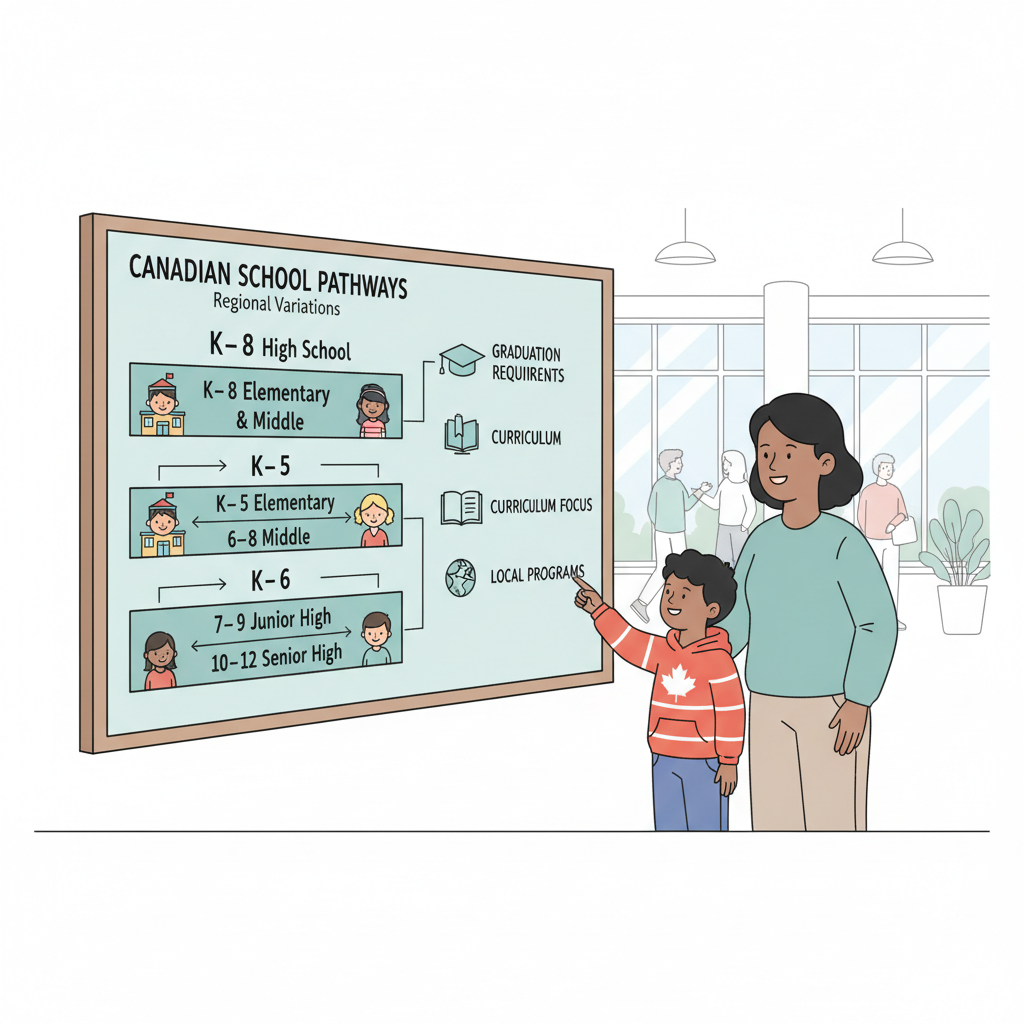
If you are trying to understand the elementary vs middle vs high school structure, the hardest part is that there is no single Canada-wide template. Your child might be in a K–8 school, a K–6 plus 7–8 middle model, or a 5–8 middle school depending on your province and local school board. However, the day-to-day changes parents notice—more subjects, more independence, and bigger social shifts—follow a fairly predictable pattern. This article explains the stages clearly and tells you what to check locally.
Why “School Stages” Look Different Across Canada
Education in Canada is managed by provinces and territories, not the federal government. Therefore, grade groupings and school configurations can vary, even between neighbouring communities. For example, some areas use “elementary” and “secondary,” while others use “middle school” or “junior high.”
A reliable starting point is your provincial/territorial education ministry, because it outlines the official grade structure and curriculum expectations. You can look up your local framework through the Ontario Ministry of Education, BC Ministry of Education and Child Care (K–12), or Alberta’s overview via Alberta Education.
Elementary vs middle vs high school structure: What Typically Changes at Each Stage
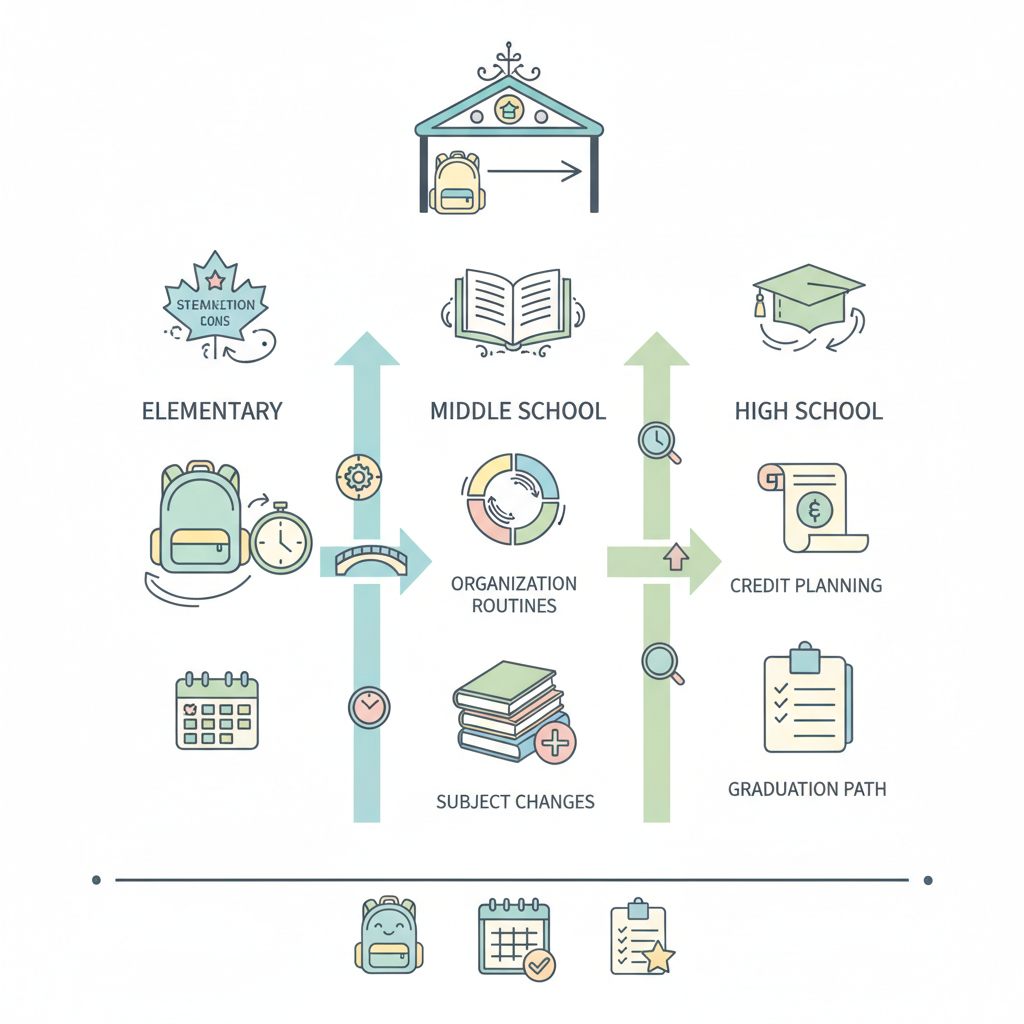
Even when grade groupings differ, most families experience three broad phases: early elementary routines, a “bridge” phase (often middle/junior high), and then high school/secondary. However, the biggest differences are not only academic. They also affect your child’s confidence, friendships, organization, and time at home.
Elementary school: building core skills and learning habits
Elementary usually covers the early grades where children learn foundational literacy and numeracy, plus basic science and social studies. In many Canadian settings, children spend most of the day with one main teacher. Therefore, routines feel stable, and parents often get frequent updates.
In this stage, schools focus heavily on foundational competencies—skills children need to keep learning successfully. If you want a plain-language overview of how elementary schooling works globally, Britannica’s elementary education overview can help you put terms in context.
- Typical parent experience: one main classroom, consistent expectations, shorter-term projects
- Skills that usually expand quickly: reading stamina, number sense, basic problem-solving
- Common friction point at home: getting consistent practice without turning it into a nightly battle
Middle school or junior high: more independence, more moving parts
Middle school (or junior high) often introduces a rotating schedule and multiple teachers. As a result, children must track materials, deadlines, and different classroom rules. This is also when executive function (brain-based skills for planning, organizing, and self-control) becomes more important, because students manage more tasks each day.
Depending on the school, students may start receiving more formal marks, larger projects, and subject-specific expectations. However, the biggest leap is often organization rather than difficulty. If your child struggles here, it does not automatically mean they are “not academic”—it often means they need a clear system and steady practice.
- Typical parent experience: fewer day-to-day teacher updates, more responsibility on the child
- Skills that usually matter more: planning, note-taking, time estimation, asking for help early
- Common friction point at home: forgotten homework, surprise tests, lost items
High school/secondary: credit courses and longer-term planning
High school usually runs on a credit system (a “credit” is a course completed toward graduation). Therefore, course choices begin to shape options for graduation pathways, apprenticeships, college, CEGEP (in Quebec), or university. Your local school board and provincial ministry publish graduation requirements and course structures.
Students also face higher expectations for independent study and longer assignments. For example, a science lab report or a multi-step math unit may require several evenings of work. If you want a general explainer of what “secondary education” means internationally, Wikipedia’s secondary education overview can clarify the term while you confirm your local rules through official Canadian sources.
- Typical parent experience: students manage emails, learning platforms, and deadlines directly
- Skills that matter most: study planning, test preparation, course selection awareness
- Common friction point at home: motivation dips, procrastination, uneven grades across subjects
A quick comparison parents can use at home
Because Canadian schools vary, use this table as a “what often happens” guide, not a strict rule. Then, confirm specifics with your school’s handbook or board website. However, the broad patterns below match many families’ experiences across provinces.
| What changes | Elementary (often K–5/6/7) | Middle/Junior (often 6–8 or 7–9) | High/Secondary (often 9–12) |
|---|---|---|---|
| Teachers | Mostly one homeroom teacher | Several subject teachers | Many teachers; semestered or linear schedules |
| Schedule | Stable daily routine | Rotating periods; more movement | Bell schedule; credits; exams in many schools |
| Homework | Short, skill-based practice | More deadlines and projects | Longer-term studying and assignments |
| Assessment | Frequent feedback; report cards | More tests; rubrics (a scoring guide) | Course marks tied to graduation requirements |
| Parent support | High day-to-day visibility | Systems coaching becomes key | Planning and accountability support matters most |
How to confirm your child’s exact grade pathway
Because school configuration can differ within the same province, start local. First, check your school board’s grade range for each building (for example, K–8 vs K–6). Next, confirm the transition year, because it affects childcare, transportation, and after-school activities.
These official hubs help you verify the framework and curriculum expectations:
- Ontario curriculum and education overview: Ontario Ministry of Education
- British Columbia K–12 information: BC Ministry of Education and Child Care
- Quebec education system overview: Gouvernement du Québec education
Practical ways to support your child through transitions
Transitions tend to go better when families plan for systems, not just emotions. For example, a simple backpack routine can prevent nightly conflict. However, children also need time to adjust socially, especially if many classmates come from different feeder schools (schools that send students to the next level).
Before the move: reduce uncertainty with small rehearsals
- Walk the route and practise the morning timing for one week.
- Set up a single homework spot with the same supplies every day.
- Create a two-minute “launch checklist” (lunch, water bottle, agenda, device).
In the first month: build routines that match the new workload
- Use a weekly preview on Sunday: tests, practices, and big deadlines.
- Help your child break projects into steps (topic, outline, first draft, final).
- Encourage early questions: “What does success look like for this assignment?”
When grades change: focus on patterns, not one bad week
A temporary dip is common, especially when students learn a new schedule or locker routine. Therefore, look for patterns over 4–6 weeks: which subject, what type of task, and what time of day causes stress. If needed, ask for clarification on expectations and assessment criteria (the standards used to grade work).
Tools & Resources (official and parent-friendly)
These tools can help you confirm curriculum expectations, organize schoolwork, and practise core skills at home. However, always match practice to your child’s grade outcomes in your province.
- Curriculum expectations (Ontario): Ontario Digital Curriculum Platform
- Curriculum information (British Columbia): BC Curriculum
- Homework and skill practice (free): Khan Academy
- Reading and learning supports (free library access): Government of Canada reading and book supports (for programs and context) and your local public library’s homework help pages
- Digital organization for families: Google Families (family tools and supervision options)
Concluding Paragraph
Once you see the purpose of each stage, the elementary vs middle vs high school structure becomes less intimidating and much more practical. Focus on what actually changes—teacher structure, organization demands, and course planning—then confirm your local grade pathway through your province and school board. Most importantly, treat transitions as skill-building seasons: your child can learn routines and confidence step by step. If you want extra support, a clear learning plan at home can make school choices feel simpler.
About Think Academy
Think Academy Canada is a K-12 mathematics tutoring programme, part of TAL Education Group. We work with motivated students across Canada from Grade 1 through Grade 12, with a focus on Ontario curriculum, EQAO preparation, and competition mathematics including CEMC contests (Pascal, Cayley, Fermat, Euclid) and AMC. All lessons are delivered online. Follow us on Instagram at @thinkacademyca.

