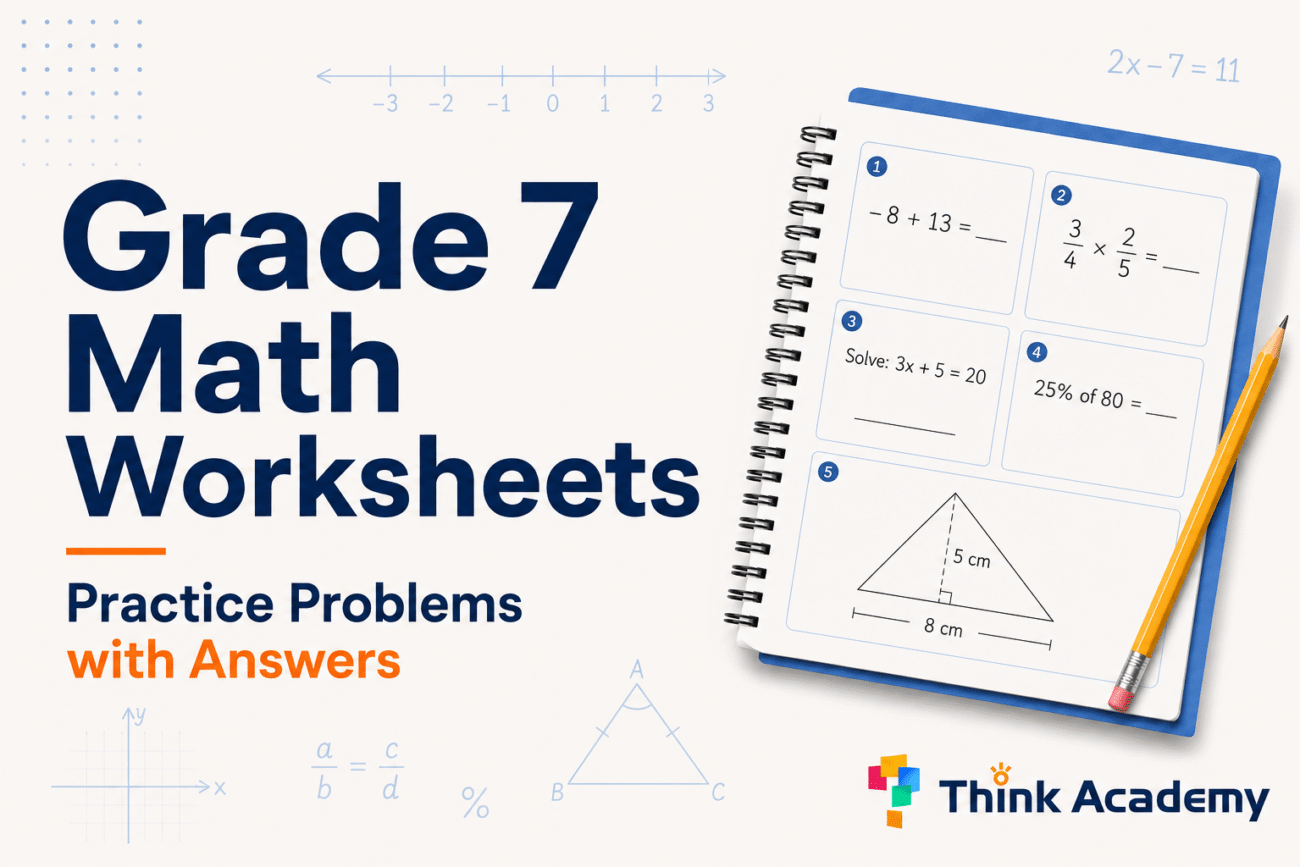
Grade 7 is the year the Ontario mathematics curriculum gets genuinely abstract. Integers, algebraic expressions, proportional reasoning, and two-step equations all arrive in the same year — and students who were comfortable in Grade 6 sometimes find Grade 7 harder than anything they have encountered before. Regular practice at home, with Grade 7 math worksheets targeted at the right content, closes gaps before they follow a student into Grade 8 and Grade 9.
This page provides free Grade 7 math practice problems across every major curriculum strand, with full answers. Use them for test preparation, homework support, or to find out specifically where your child needs more work.
What Grade 7 Math Covers in Ontario
The Ontario Grade 7 mathematics curriculum covers five main strands:
- Number — integers (positive and negative), fractions and decimals, percent, ratios and rates, order of operations
- Algebra — patterns, algebraic expressions, solving one- and two-step equations
- Data — mean, median, mode, range, circle graphs, and interpreting data
- Spatial Sense (Geometry) — transformations, similarity, area and circumference of circles
- Measurement — area of composite shapes, volume of prisms, surface area
For a complete breakdown of the Ontario Grade 7 curriculum by strand, see our Grade 7 math curriculum Ontario guide.
Grade 7 Math Worksheets: Number Practice Problems
Integers
Practice Set 1 — Adding and Subtracting Integers
- 7 + (−3) = ___
- −5 + (−8) = ___
- −12 + 9 = ___
- 6 − (−4) = ___
- −3 − (−7) = ___
- −15 + 8 − (−3) = ___
- A diver is 18 m below the surface. She rises 11 m. What is her new position relative to the surface? ___
- The temperature on Monday was −6°C. By Thursday it had risen 14°C. What was Thursday’s temperature? ___
- −9 + 4 − (−6) + (−2) = ___
- A stock is worth $23. It drops $7, rises $4, then drops $12. What is it worth now? ___
Answers: 1) 4 2) −13 3) −3 4) 10 5) 4 6) −4 7) −7 m (7 m below surface) 8) 8°C 9) −1 10) $8
Practice Set 2 — Multiplying and Dividing Integers
- 4 × (−6) = ___
- (−7) × (−3) = ___
- −5 × 8 = ___
- (−9) × (−4) = ___
- −36 ÷ 9 = ___
- 48 ÷ (−6) = ___
- (−56) ÷ (−8) = ___
- −3 × 4 × (−2) = ___
- If the temperature drops 3°C each hour for 5 hours, what is the total change? ___
- A submarine descends 6 m per minute. How far below its starting point is it after 9 minutes? ___
Answers: 1) −24 2) 21 3) −40 4) 36 5) −4 6) −8 7) 7 8) 24 9) −15°C 10) −54 m
Fractions, Decimals and Percent
Practice Set 3 — Operations with Fractions
- 3/4 + 1/3 = ___
- 5/6 − 1/4 = ___
- 2/3 × 3/5 = ___
- 3/4 ÷ 1/2 = ___
- 1 1/2 + 2 3/4 = ___
- 3 1/3 − 1 5/6 = ___
- 2/3 × 4 1/2 = ___
- A recipe needs 2/3 cup of flour. If you are making 3 batches, how much flour do you need? ___
Answers: 1) 13/12 = 1 1/12 2) 7/12 3) 6/15 = 2/5 4) 3/2 = 1 1/2 5) 4 1/4 6) 1 1/2 7) 3 8) 2 cups
Practice Set 4 — Percent
- What is 25% of 80? ___
- What is 15% of 60? ___
- Express 3/5 as a percent. ___
- Express 0.72 as a percent. ___
- A shirt costs $45. It is on sale for 20% off. What is the sale price? ___
- 30 students took a test. 24 passed. What percent passed? ___
- A restaurant bill is $68. You leave a 15% tip. How much is the tip? ___
- A score of 38 out of 40 — what percentage is this? ___
Answers: 1) 20 2) 9 3) 60% 4) 72% 5) $36 6) 80% 7) $10.20 8) 95%
Ratio, Rate and Proportional Reasoning
Practice Set 5 — Ratios and Rates
- Simplify the ratio 18:24. ___
- A car travels 240 km in 3 hours. What is the unit rate? ___
- If 5 apples cost $3.75, how much do 8 apples cost? ___
- A map uses a scale of 1:50,000. A distance of 4 cm on the map represents how many km in real life? ___
- A class has 12 boys and 16 girls. What is the ratio of boys to girls in simplest form? ___
- If you can type 180 words in 4 minutes, how many words per minute is that? ___
- A recipe uses 3 cups of oats for every 2 cups of nuts. How many cups of oats are needed for 5 cups of nuts? ___
- The ratio of red to blue marbles is 4:7. There are 28 blue marbles. How many red marbles are there? ___
Answers: 1) 3:4 2) 80 km/h 3) $6.00 4) 2 km 5) 3:4 6) 45 words/min 7) 7.5 cups 8) 16
Order of Operations with Integers
Practice Set 6 — Order of Operations
- 3 + 4 × (−2) = ___
- (−5 + 3) × 4 − 1 = ___
- −18 ÷ (−3) + 5 × 2 = ___
- (−4)² − 3 × 5 = ___
- 2 × (−3)² − 4 ÷ (−2) = ___
- −(3 + 2) × (4 − 7) = ___
For more on BEDMAS rules, see our math order of operations guide.
Answers: 1) −5 2) −9 3) 16 4) 1 5) 20 6) 15
Grade 7 Math Worksheets: Algebra Practice Problems
Expressions and Equations
Practice Set 7 — Algebraic Expressions
- If n = 4, evaluate 3n + 7. ___
- If x = −2, evaluate 5x − 3. ___
- If a = 3 and b = −1, evaluate 2a − 4b. ___
- Simplify: 4x + 3x − 2x. ___
- Simplify: 5a − 3b + 2a + 4b. ___
- Simplify: 3(x + 4) − 2x. ___
- Write an expression for: “5 more than three times a number n.” ___
- Write an expression for: “a number doubled and then decreased by 7.” ___
Answers: 1) 19 2) −13 3) 10 4) 5x 5) 7a + b 6) x + 12 7) 3n + 5 8) 2n − 7
Practice Set 8 — Solving One- and Two-Step Equations
- x + 8 = 15 → x = ___
- n − 6 = −3 → n = ___
- 3m = 24 → m = ___
- y ÷ 4 = −5 → y = ___
- 2x + 5 = 17 → x = ___
- 3n − 7 = 14 → n = ___
- x/3 + 4 = 9 → x = ___
- 4(n − 2) = 20 → n = ___
- A number multiplied by 5 and then increased by 3 equals 28. What is the number? ___
- Rami has some cards. After giving away 8 and doubling what he has left, he has 14 cards. How many did he start with? ___
Answers: 1) 7 2) 3 3) 8 4) −20 5) 6 6) 7 7) 15 8) 7 9) 5 10) 15
Grade 7 Math Worksheets: Data Practice Problems
Practice Set 9 — Data Analysis
Use this data set for questions 1–6: Scores on a math quiz: 8, 6, 9, 7, 6, 10, 5, 8, 9, 6
- What is the mean? ___
- What is the median? ___
- What is the mode? ___
- What is the range? ___
- If one more student scored 10, how would the mean change? ___
- Which score appears most often? ___
Circle graph question: 7. In a class, 40% chose hockey, 25% chose soccer, 20% chose basketball, and 15% chose tennis as their favourite sport. What angle represents hockey in a circle graph? ___ 8. What angle represents tennis? ___
Answers: 1) 7.4 2) 7.5 (average of 7 and 8) 3) 6 4) 5 5) New mean = (74 + 10) ÷ 11 ≈ 7.6 6) 6 7) 144° 8) 54°
Grade 7 Math Worksheets: Geometry Practice Problems
Practice Set 10 — Transformations and Similarity
- A triangle is translated 3 units right and 4 units down. Do its side lengths change? ___
- A shape is reflected across the y-axis. Does its size change? ___
- Two triangles are similar. One has sides 3, 4, 5. The other’s shortest side is 6. What are the other two sides? ___
- A rectangle is enlarged by a scale factor of 3. If the original is 4 cm × 7 cm, what are the new dimensions? ___
- What type of transformation produces a mirror image? ___
- What type of transformation turns a shape around a fixed point? ___
Answers: 1) No 2) No 3) 8 and 10 4) 12 cm × 21 cm 5) Reflection 6) Rotation
Grade 7 Math Worksheets: Measurement Practice Problems
Practice Set 11 — Area, Circumference and Volume
Use π ≈ 3.14
- Find the circumference of a circle with radius 5 cm. ___
- Find the area of a circle with diameter 8 cm. ___
- Find the volume of a rectangular prism with length 6 cm, width 4 cm, height 5 cm. ___
- Find the surface area of a cube with side length 3 cm. ___
- A composite shape is made of a rectangle (6 × 4 cm) and a triangle on top (base 6 cm, height 3 cm). Find the total area. ___
- A cylindrical can has a radius of 4 cm and height of 10 cm. Find its volume. ___
- A circular garden has a radius of 7 m. Find its area. ___
- Find the perimeter of a shape made of a rectangle (8 × 5 cm) with a semicircle on one end (diameter 5 cm). ___
Answers: 1) 31.4 cm 2) 50.24 cm² 3) 120 cm³ 4) 54 cm² 5) 33 cm² 6) 502.4 cm³ 7) 153.86 m² 8) 28 + 7.85 = 35.85 cm
Why Grade 7 Is the Most Important Year to Address Math Gaps
Grade 7 is not just another year of school mathematics. It is the transition point from concrete, arithmetic-focused elementary mathematics to abstract, algebra-focused secondary mathematics — and the gap between the two is wider than most parents realise until their child is already in it.
The key skills introduced in Grade 7 — integers, algebraic expressions, solving equations, proportional reasoning — are not self-contained topics that can be left with gaps and revisited later. They are the foundation of Grade 8, Grade 9, and everything that follows. A student who leaves Grade 7 without genuine fluency in algebra and integers will find every subsequent year of mathematics harder than it needs to be.
This is also the year many students decide — consciously or not — whether they are “a maths person” or not. A student who hits a wall in Grade 7 and doesn’t get the right support often draws a conclusion about ability that is simply not accurate. Getting help in Grade 7, rather than waiting for the problem to surface in Grade 9 when the stakes are higher, is the single most effective intervention most families can make.
For a full picture of how Grade 7 connects to what comes next, see our Grade 8 math curriculum Ontario guide and Ontario Grade 9 math curriculum guide.
Signs Your Grade 7 Child Needs More Than Worksheets
Integers are confusing, not just hard. A child who understands that −3 − (−7) = 4 (subtracting a negative makes it positive) has a conceptual grip on integers. A child who just tries to remember rules without understanding them will make inconsistent errors — getting some problems right by luck and others wrong seemingly at random. Rule memorisation without understanding fails under test conditions.
Algebra feels like a foreign language. When a student says “I don’t get algebra” they usually mean one of two things: they don’t understand what a variable represents, or they don’t understand the logic of equation solving (what you do to one side you do to the other). Both are fixable with the right explanation — but they require explanation, not more practice problems.
Word problems trigger shutdown. A child who can solve 2x + 5 = 17 but freezes when asked “a number doubled and increased by 5 equals 17 — what is the number?” has a translation gap between mathematical language and everyday language. This gap widens in Grade 8 and Grade 9 as problems become more applied.
Their Gauss contest result was disappointing. The Gauss Contest is taken by many Grade 7 students across Canada. A lower-than-expected result is often the first objective signal that gaps exist — not in a student’s effort or intelligence, but in specific concepts that weren’t solidly built. Our math enrichment guide covers how to use a disappointing competition result constructively.
Test marks are declining. A drop between Grade 6 and Grade 7 marks is common — and significant. It is not always a sign of effort decreasing. It is frequently a sign that the Grade 7 content has exceeded the student’s current foundation, and the gap is widening rather than closing on its own.
How Think Academy Helps Grade 7 Students
Think Academy Canada works with students from Grade 1 through Grade 12. At the Grade 7 level, our focus is on building the algebraic fluency and integer fluency that the rest of secondary school mathematics depends on.
Our Grade 7 programme is diagnostic-led: every student starts with an assessment that identifies specifically which concepts have gaps and which are solid, and the programme builds from there. Students who are behind catch up. Students who are at grade level build the above-grade-level skills that will matter in Grade 8, Grade 9, and beyond.
The free assessment takes 20 minutes and produces a written feedback report showing exactly which Grade 7 strands need work. No obligation — just a clear, honest picture of where your child stands.
Frequently Asked Questions
What maths should a Grade 7 student know by the end of the year? By the end of Grade 7, students should be able to add, subtract, multiply, and divide integers fluently; simplify and evaluate algebraic expressions; solve two-step equations; work with fractions and percent in multi-step problems; calculate area and circumference of circles; find the volume of prisms; and read and interpret circle graphs.
My child can do the worksheets but fails the tests. Why? Two common reasons. First, worksheets are often done without time pressure and with support available — tests remove both. Second, Grade 7 tests frequently combine concepts from multiple strands in a single problem, which requires the student to decide which approach to use before applying it. Practising in exam conditions — timed, independently, with unfamiliar problem combinations — closes this gap more effectively than more worksheets.
Are these problems aligned to EQAO? These problems are aligned to the Ontario Grade 7 mathematics curriculum. EQAO assesses Grade 3 and Grade 6 in Ontario — not Grade 7. However, Grade 7 content feeds directly into Grade 8, which feeds into the Grade 9 EQAO assessment. See our EQAO Grade 6 complete guide for the closest EQAO reference point.
My child is ahead — are these problems too easy? Possibly. For students who have mastered Grade 7 content, Grade 8 algebra and geometry are the right next challenge. See our Grade 8 math curriculum guide for what that looks like. For students who are significantly ahead, mathematics competitions — particularly the Gauss Contest — are the most meaningful way to test that ability.
How much practice does a Grade 7 student need each week? Three to four focused practice sessions of 20–25 minutes each, consistently maintained across the school year, produces more durable learning than occasional long sessions. The key is consistency — and targeting the specific strands that are weakest, not just the ones that feel comfortable.
See our related guides: Grade 7 math curriculum Ontario · Grade 6 math curriculum Ontario · Grade 8 math curriculum Ontario · Ontario Grade 9 math curriculum · math order of operations guide · adding and subtracting integers · Gauss math contest guide · math enrichment guide · number sense parent guide · Grade 4 math worksheets · Grade 3 math worksheets
Grade 7 gaps don’t fix themselves. Find out exactly what your child needs — free.