
AMC 10 is one of the most well-known math competitions for students in grade 10 and below. For many students, AMC 8 is often the first step into American math competitions, while AMC 10 is not simply “AMC 8 with harder numbers”; it requires a higher level of mathematical reasoning and strategy. Before students begin solving practice tests, it is important to understand what AMC 10 is, who can take it, what it tests, and how to prepare effectively.
1.What Is AMC 10?
The AMC 10, short for the American Mathematics Competition 10, is a national math contest organized by the Mathematical Association of America, or MAA.

The contest includes topics such as algebra, geometry, number theory, counting, probability, and logical reasoning. While many of these concepts are covered in school curriculums, AMC 10 problems often require students to apply those ideas in more flexible and challenging ways.
2.Who Can Take the AMC 10?
Students must be in grade 10 or below and under 17.5 years of age on the day of the competition.
This means the AMC 10 is commonly taken by 9th and 10th grade students, but advanced middle school students may also participate if they meet the grade and age requirements. Because eligibility rules can be updated, students and parents should always check the latest MAA contest policies before registering.
3.What Is the AMC 10 Format?
| Key format details: 25 multiple-choice questions 75 minutes No calculators Five answer choices per question Questions generally increase in difficulty |
In general, the questions become more difficult as the test progresses. The early problems are usually more accessible, while the later problems often require deeper reasoning, stronger mathematical insight, and more efficient problem-solving methods.
Because students have limited time, success on the AMC 10 depends on more than just knowing math content. Students need to balance accuracy, pacing, and decision-making throughout the test.
4.How Is the AMC 10 Scored?
The AMC 10 has a maximum score of 150 points. Traditionally, the scoring system is:
- 6 points for each correct answer
- 1.5 points for each unanswered question
- 0 points for each incorrect answer
Because blank answers receive partial credit, students do not need to answer every question. In fact, random guessing can sometimes lower a student’s expected score compared with leaving a difficult problem blank.
This scoring system makes strategy important. Students need to decide when to solve a problem, when to skip it, and when it may be worth making an educated guess. Strong AMC 10 performance usually requires both mathematical accuracy and smart test-taking decisions.
5. What Topics Are Covered on AMC 10?
AMC 10 covers Algebra 1 + Geometry + part of Algebra 2. However, there is a fundamental difference between competitions and school examinations. The exams in the school only require students to master the knowledge presented in the textbooks, but AMC 10 tests how students use these topics in creative problem-solving situations.The main topic areas include:
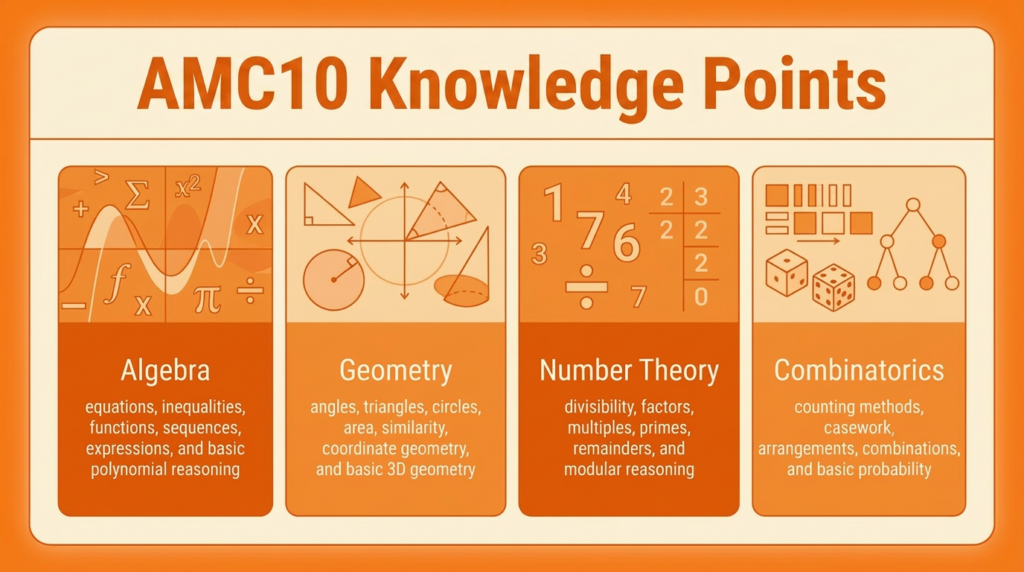
Among these, algebra and geometry are more closely connected to regular school math curriculum. Number theory and combinatorics, however, are often not taught systematically in school, which is why many students find AMC 10 very different from a typical math class.
6. Why Do Students Take AMC 10?
Students take the AMC 10 for more than just a contest score. For many, it is a way to challenge themselves beyond the regular school curriculum and develop stronger mathematical thinking.
AMC 10 helps students:
- Build advanced problem-solving skills through non-routine questions that require logic, creativity, and strategy.
- Go beyond school math by exploring topics and problem types that are rarely or never covered in regular classes.
- Prepare for AIME qualification opportunities, since strong AMC 10 performance can make students eligible for the next stage of the MAA competition pathway.
- Strengthen math confidence by learning how to approach challenging problems step by step.
- Explore interest in competitive math, STEM, and advanced math pathways, especially for students who enjoy deeper mathematical thinking.
7. Who is suitable for preparing for the AMC 10?
AMC 10 is a good fit for students who want to go beyond regular school math and develop stronger problem-solving skills. In general, students preparing for AMC 10 usually fall into three groups:
Students aiming for math competition achievement
These students have a strong interest in math, enjoy challenging problems, and are willing to train consistently over time. They often have strong logical thinking skills and can handle the pressure of more intensive competition prep.
For this group, AMC 10 can be an important step toward AIME qualification and, for top students, later opportunities in more advanced math competitions.
Students preparing for future academic pathways
AMC 10 is also suitable for students who are planning for competitive academic programs, especially those interested in STEM, economics, business, or other math-related fields.
Strong performance in math competitions can help demonstrate a student’s interest, initiative, and problem-solving ability. However, it should be viewed as one part of a broader academic profile—not a guaranteed advantage in college admissions.
Students who want to strengthen mathematical thinking
Some students may not be aiming for awards immediately, but they want to build a deeper and more complete math foundation. AMC 10 prep can help them improve:
- Logical reasoning
- Problem-solving strategies
- Accuracy and calculation skills
- Algebra and geometry foundations
- Confidence with unfamiliar problems
8. What Should Students Know Before Starting AMC 10 Prep?
Before starting AMC 10 prep, students should not jump straight into past papers. A stronger approach is to first understand the student’s starting point, weak areas, available time, and final goal. This helps make preparation more targeted and realistic.
Before building a study plan, check these four things:
- Current math level
Students should know whether they are comfortable with core algebra, geometry, and multi-step problem solving before beginning AMC 10 practice. - Weakest topics and modules
Students should identify which areas need the most work, such as algebra, geometry, number theory, or combinatorics. - Realistic weekly study time
A good prep plan should match the student’s actual schedule. Studying one hour per week requires a different approach from preparing several hours per week. - Clear preparation goal
Students should decide whether their goal is early exposure, score improvement, earning an award, or AIME qualification. The goal determines the pace, difficulty level, practice volume, and test-taking strategy needed.
9. How Can Students Prepare Effectively for AMC 10?
Effective AMC 10 prep is not just about doing as many past papers as possible. Students need a balanced plan that builds knowledge, strengthens problem-solving skills, and develops smart test-taking habits.
A strong AMC 10 prep plan usually includes:
- Learning core concepts
- Practicing topic-based problems
- Taking timed mock tests.
- Building test-taking strategy
- Getting personalized guidance when needed
For students who are not sure where to start, a 1-on-1 diagnostic assessment can help identify strengths, weaknesses, and the right AMC 10 preparation path. Think Academy 1-on-1’s personalized math tutoring can support students with targeted instruction, structured practice.Each student receives a prep plan tailored to their current level and goals.
About Think Academy 1-on-1
Think Academy’s 1-on-1 Math Tutoring offers customized systematic courses based on individual needs. It provides a reliable one-on-one teaching service escorted by professional American teachers and dedicated learning advisors. The service also includes a complete learning tracking system and a flexible refund policy.

Think Academy 1-on-1 AMC 10 tutoring provides a personalized prep plan based on each student’s current level and goals. Through a combination of topic-based lessons and targeted practice.
For beginners, we offer an AMC 10-Intro camp to build foundations step by step; for students with prior AMC 10 experience, we offer an AMC 10-AIME camp focused on higher-level problem solving, award goals, and AIME qualification preparation.
Start preparing for AMC 10
Frequently Asked Question
Q1: Is AMC 10 hard?
Yes, AMC 10 can be challenging, especially for students who are new to math competitions. The difficulty comes not from advanced formulas, but from the need to solve unfamiliar problems using logic, creativity, and efficient strategies.
Students with strong algebra and geometry foundations may still need extra practice in number theory, combinatorics, and contest-style problem solving.
Q2: Can middle school students take AMC 10?
Yes. Middle school students can take AMC 10 as long as they meet the official eligibility requirements. In general, AMC 10 is for students in grade 10 or below and under the age limit set by the Mathematical Association of America.
Since eligibility rules may change, families should always check the latest guidelines on the official MAA website for the current contest year.
Q3: Do students need calculus for AMC 10?
No. AMC 10 does not require calculus.
The contest focuses on precalculus-level topics, including algebra, geometry, number theory, and combinatorics. However, students need to apply these topics in creative and non-routine ways.
Q4: Is AMC 10 useful for AIME preparation?
Yes. AMC 10 is one of the main entry points to the AIME pathway. Students who perform strongly on AMC 10 may qualify for AIME, depending on the official cutoff for that year.
Even for students who do not qualify immediately, AMC 10 prep helps build the problem-solving skills needed for higher-level competitions.
Q5: Should students start with practice tests?
Not always. Practice tests are useful, but beginners should first understand the AMC 10 format, core topics, and their own weak areas.
A better approach is to combine topic-based learning, targeted practice, mistake review, and timed mock tests. Jumping straight into full past papers can be inefficient if the student has major knowledge gaps.
Q6: How are AMC 8 and AMC 10 connected?
AMC 8 is often a good starting point for younger students before moving into AMC 10. It introduces students to contest-style problem-solving, including logic, counting, geometry, and creative reasoning.
However, AMC 10 is significantly more advanced. Compared with AMC 8, it requires stronger algebra, geometry, number theory, combinatorics, and test-taking strategy. Students who do well on AMC 8 may be ready to begin AMC 10 preparation, but they should still check whether their algebra and geometry foundations are strong enough.
Q7: What is the AIME pathway?
The common MAA competition pathway is: AMC 10 / AMC 12 → AIME → USA(J)MO.
Students usually begin with AMC 10 or AMC 12. High scorers may qualify for AIME, which is a more advanced invitational contest. From there, top-performing students may continue toward USAJMO or USAMO, depending on eligibility and results.