


Probability with spinners is one of the most accessible entry points into competition math probability — and one of the most reliably tested formats across AMC and Gauss past papers. A probability spinner problem presents a circular spinner divided into sections of different sizes, and asks students to calculate the likelihood of landing on particular sections or combinations of sections. This guide covers everything students need to solve probability spinner problems confidently: theoretical versus experimental probability, how section size determines probability, the AND and OR rules for combining probabilities, and a full set of AMC-style practice problems with worked solutions.

What is a probability spinner?
A probability spinner is a circular disc divided into sections, each labelled with a number, colour, or outcome. When the spinner is spun, it lands on one section. The probability of landing on any particular section depends on what fraction of the total circle that section occupies.
The key insight for spinner problems is that probability is proportional to area. A section that takes up one quarter of the spinner has a probability of 1/4 of being landed on. A section that takes up one third has a probability of 1/3. The probabilities of all sections must always sum to 1.
How to calculate probability from a spinner
For a spinner section that covers an angle of x degrees out of a full circle of 360 degrees:
Probability = x / 360
For a spinner divided into equal sections of n sections total:
Probability of any one section = 1/n
For a spinner where sections are labelled with numbers and some numbers appear on multiple sections:
Probability of a number = (sum of angles of all sections labelled with that number) / 360
Key probability vocabulary for spinner problems
| Term | Meaning |
|---|---|
| Outcome | One possible result of a single spin |
| Event | A set of one or more outcomes |
| Sample space | The complete list of all possible outcomes |
| Theoretical probability | What should happen based on the spinner design |
| Experimental probability | What actually happened in a series of trials |
| Favourable outcome | An outcome that satisfies the condition being asked about |
Experimental probability vs theoretical probability
Understanding the difference between experimental probability and theoretical probability is essential for spinner problems — AMC 8 and Gauss questions regularly test both concepts and ask students to distinguish between them or compare results.
Theoretical probability
Theoretical probability is calculated from the design of the spinner without running any experiment. It is based entirely on the fraction of the circle each section occupies.
For a spinner with four equal sections labelled 1, 2, 3, and 4:
- Theoretical probability of landing on 3 = 1/4 = 0.25
Theoretical probability assumes every point on the spinner is equally likely to be landed on, which is true for a fair spinner.
Experimental probability
Experimental probability is calculated from the results of actual spins. It tells you what fraction of spins produced a particular outcome in a real experiment.
Experimental probability = number of times outcome occurred / total number of trials
If a spinner is spun 40 times and lands on red 12 times: Experimental probability of red = 12/40 = 3/10 = 0.3
When experimental probability results are collected across multiple trials and displayed visually, double bar graphs are one of the most common formats used — see our Double Bar Graphs: How to Interpret Them AMC 8 for how to read these.
Experimental probability vs theoretical — how they compare
The key relationship between experimental probability vs theoretical probability is that as the number of trials increases, experimental probability tends to get closer to theoretical probability. This is the law of large numbers — a small number of trials can produce results far from the theoretical probability, but a large number of trials will generally converge toward it.
| Feature | Theoretical probability | Experimental probability |
|---|---|---|
| Based on | Design of the spinner | Actual results of trials |
| Calculation | Section angle / 360 | Outcomes / total trials |
| Changes with more trials | No | Yes — converges toward theoretical |
| Always exactly correct | For a fair spinner, yes | No — varies with each experiment |
| AMC question type | Find probability from diagram | Compare results to expected |
Experimental probability results are often displayed in data tables or graphs — for a guide to reading data displays that appear in AMC 8 problems, see our What is a Broken Line Graph? Examples, How to Read One and AMC Practice.
Example — experimental vs theoretical comparison
A spinner has three equal sections labelled A, B, and C. The theoretical probability of landing on A is 1/3.
A student spins it 30 times and gets: A appears 12 times, B appears 9 times, C appears 9 times.
Experimental probability of A = 12/30 = 2/5.
The experimental probability (2/5 = 0.4) is higher than the theoretical probability (1/3 ≈ 0.333). This does not mean the spinner is unfair — with only 30 trials, this kind of variation is expected. With 3,000 trials the experimental probability would almost certainly be much closer to 1/3.
Probability AND and OR rules
Many AMC 8 spinner problems involve two spins or two spinners and ask about combinations of outcomes. The AND rule and OR rule are the tools for calculating these.
The AND rule — probability of two events both occurring
For two independent events — events where the result of one does not affect the other — the probability of both occurring is the product of their individual probabilities.
P(A and B) = P(A) x P(B)
Two spins are always independent because the result of the first spin does not affect the second spin.
Example: A spinner has four equal sections: red, blue, green, yellow. What is the probability of landing on red on the first spin AND blue on the second spin?
P(red) = 1/4 P(blue) = 1/4 P(red and blue) = 1/4 x 1/4 = 1/16
The OR rule — probability of at least one of two events occurring
For two mutually exclusive events — events that cannot both happen at the same time — the probability of either one occurring is the sum of their individual probabilities.
P(A or B) = P(A) + P(B) (for mutually exclusive events)
On a single spin, landing on red and landing on blue are mutually exclusive — you cannot land on both at once.
Example: A spinner has four equal sections: red, blue, green, yellow. What is the probability of landing on red OR blue on a single spin?
P(red) = 1/4 P(blue) = 1/4 P(red or blue) = 1/4 + 1/4 = 1/2
When events are not mutually exclusive
For events that can both occur at the same time, the OR rule requires subtracting the overlap to avoid double-counting.
P(A or B) = P(A) + P(B) – P(A and B)
This appears in AMC 8 problems involving spinners with overlapping conditions — for example, sections that are both red and numbered above 3.
Probability AND OR worksheet — summary table
| Situation | Rule | Formula |
|---|---|---|
| Both events on separate spins | AND — multiply | P(A) x P(B) |
| Either event on a single spin (mutually exclusive) | OR — add | P(A) + P(B) |
| Either event (not mutually exclusive) | OR — add then subtract overlap | P(A) + P(B) – P(A and B) |
| Neither event occurs | Complement rule | 1 – P(A or B) |
| At least one occurs in multiple trials | Complement rule | 1 – P(none occur) |
For a broader guide to counting and probability techniques that appear alongside spinner problems in AMC 8 past papers, see our AMC 8 Counting and Probability: Key Rules and Real Problems.
Probability spinner worked examples
Example 1 — basic spinner probability
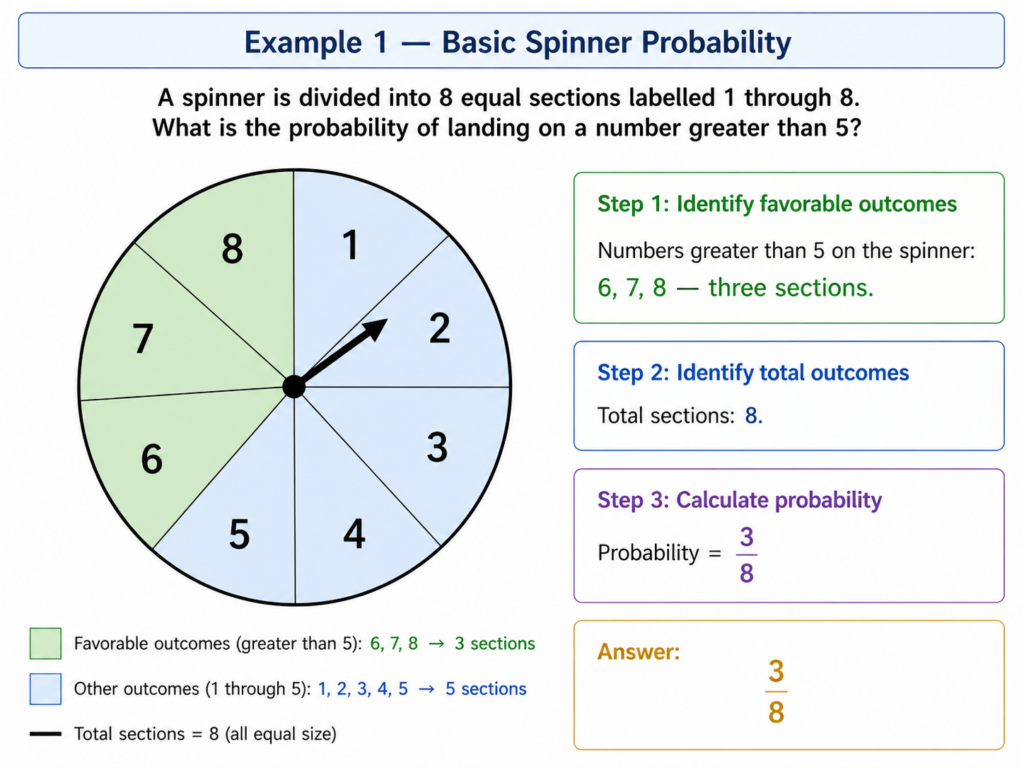
A spinner is divided into 8 equal sections labelled 1 through 8. What is the probability of landing on a number greater than 5?
Solution: Numbers greater than 5 on the spinner: 6, 7, 8 — three sections.
Total sections: 8.
Probability = 3/8.
Answer: 3/8
Example 2 — spinner with unequal sections
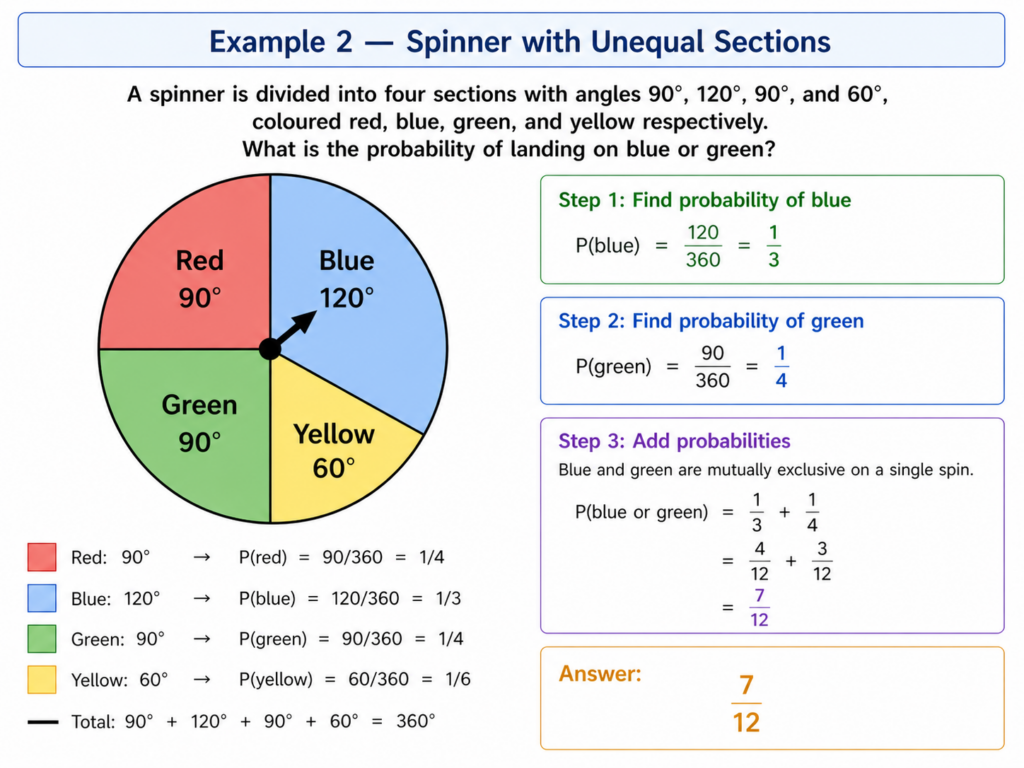
A spinner is divided into four sections with angles 90°, 120°, 90°, and 60°, coloured red, blue, green, and yellow respectively. What is the probability of landing on blue or green?
Solution: P(blue) = 120/360 = 1/3
P(green) = 90/360 = 1/4
Blue and green are mutually exclusive on a single spin.
P(blue or green) = 1/3 + 1/4 = 4/12 + 3/12 = 7/12
Answer: 7/12
Adding fractions with different denominators – as in 1/3 + 1/4 above – requires finding equivalent fractions with a common denominator first. See our Equivalent Fractions Worksheet: Practice Problems and Examples if this step needs more practice.
Example 3 — two spins, AND rule
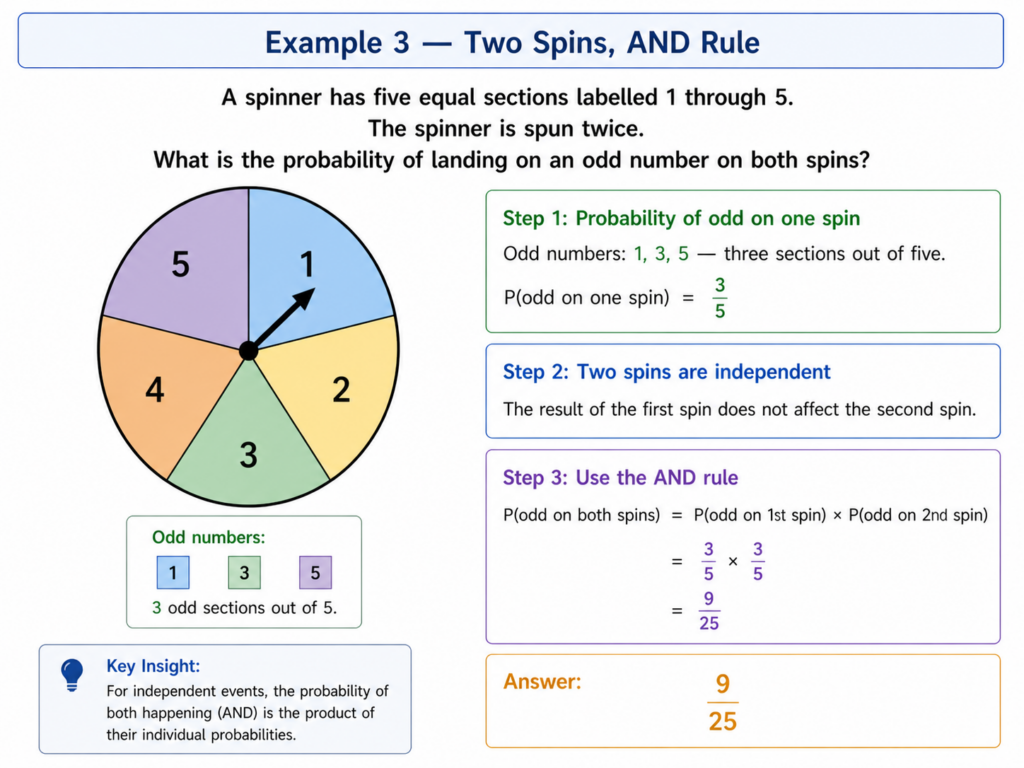
A spinner has five equal sections labelled 1 through 5. The spinner is spun twice. What is the probability of landing on an odd number on both spins?
Solution: Odd numbers: 1, 3, 5 — three sections out of five.
P(odd on one spin) = 3/5
Two spins are independent.
P(odd on both spins) = 3/5 x 3/5 = 9/25
Answer: 9/25
Example 4 — using the complement rule
A spinner has six equal sections labelled 1 through 6. The spinner is spun twice. What is the probability that at least one spin lands on 6?
Solution: It is easier to use the complement: P(at least one 6) = 1 – P(no 6 on either spin).
P(not 6 on one spin) = 5/6 P(no 6 on either spin) = 5/6 x 5/6 = 25/36
P(at least one 6) = 1 – 25/36 = 11/36
Answer: 11/36
Key insight: “At least one” problems are almost always easier using the complement. Finding the probability that something does NOT happen, then subtracting from 1, avoids having to count multiple overlapping cases individually.
Example 5 — expected number of outcomes
A spinner has three equal sections: red, blue, and green. If it is spun 90 times, how many times would you expect it to land on red?
Solution: Theoretical probability of red = 1/3. Expected number = 90 x 1/3 = 30.
Answer: 30 times
Key insight: Expected value is theoretical probability multiplied by the number of trials. This gives the average outcome you would expect over many repetitions — not a guarantee for any specific experiment.
Probability spinner practice problems
Problem 1
A spinner has 10 equal sections numbered 1 through 10. What is the probability of landing on a multiple of 3?
Solution: Multiples of 3 from 1 to 10: 3, 6, 9 — three sections. Probability = 3/10.
Answer: 3/10
Problem 2
A spinner has sections with angles 180°, 90°, and 90°, coloured red, blue, and green. What is the probability of NOT landing on red?
Solution: P(red) = 180/360 = 1/2. P(not red) = 1 – 1/2 = 1/2.
Answer: 1/2
Problem 3
A spinner with eight equal sections labelled 1 through 8 is spun twice. What is the probability of landing on an even number on the first spin and a number less than 4 on the second spin?
Solution: Even numbers: 2, 4, 6, 8 — four sections. P(even) = 4/8 = 1/2. Numbers less than 4: 1, 2, 3 — three sections. P(less than 4) = 3/8.
P(even and less than 4) = 1/2 x 3/8 = 3/16.
Answer: 3/16
Problem 4
A spinner is spun 60 times. The results are: red 18 times, blue 15 times, green 12 times, yellow 15 times. What is the experimental probability of landing on green or yellow?
Solution: Green appeared 12 times, yellow appeared 15 times. Total favourable outcomes: 12 + 15 = 27. Experimental probability = 27/60 = 9/20.
Answer: 9/20
Problem 5
A spinner has four equal sections labelled A, B, C, D. The theoretical probability of landing on A is 1/4. In an experiment, the spinner is spun 200 times and lands on A exactly 60 times. What is the difference between the experimental and theoretical probability of landing on A?
Solution: Theoretical probability = 1/4 = 0.25. Experimental probability = 60/200 = 3/10 = 0.30. Difference = 0.30 – 0.25 = 0.05 = 1/20.
Answer: 1/20
Problem 6
A spinner has sections worth 2, 4, 6, and 8 points with equal probability. A player wins if the total of two spins is greater than 10. What is the probability of winning?
Solution: Each section has probability 1/4. List all combinations where the total exceeds 10:
| First spin | Second spin | Total | Exceeds 10? |
|---|---|---|---|
| 4 | 8 | 12 | Yes |
| 6 | 6 | 12 | Yes |
| 6 | 8 | 14 | Yes |
| 8 | 4 | 12 | Yes |
| 8 | 6 | 14 | Yes |
| 8 | 8 | 16 | Yes |
6 favourable outcomes out of 16 total. Probability = 6/16 = 3/8.
Answer: 3/8
Problem 7 — AMC 8 style
A spinner has six equal sections. Three sections are red, two are blue, and one is green. The spinner is spun twice. What is the probability that both spins land on the same colour?
Solution: P(red) = 3/6 = 1/2. P(blue) = 2/6 = 1/3. P(green) = 1/6.
P(both red) = 1/2 x 1/2 = 1/4. P(both blue) = 1/3 x 1/3 = 1/9. P(both green) = 1/6 x 1/6 = 1/36.
P(same colour) = 1/4 + 1/9 + 1/36. Common denominator = 36. = 9/36 + 4/36 + 1/36 = 14/36 = 7/18.
Answer: 7/18
Key insight: “Same colour” means the first and second spin produce the same result. Calculate P(both red), P(both blue), and P(both green) separately and add — these are mutually exclusive outcomes.

Problem 8 — AMC 8 style
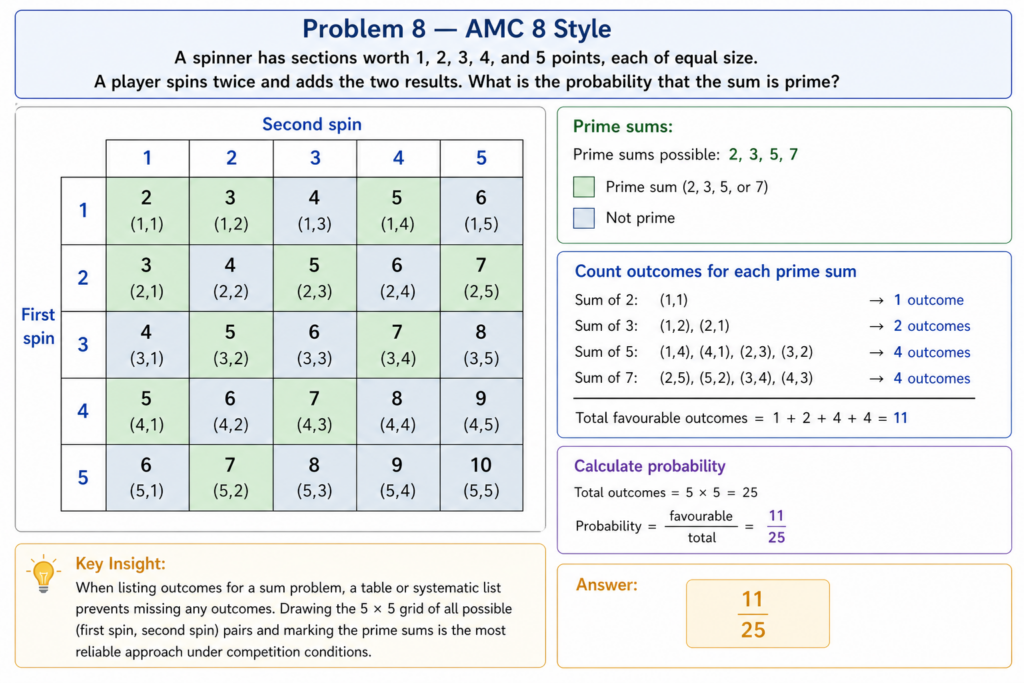
A spinner has sections worth 1, 2, 3, 4, and 5 points, each of equal size. A player spins twice and adds the two results. What is the probability that the sum is prime?
Solution: Total outcomes: 5 x 5 = 25. List all sums and check which are prime:
Possible sums range from 2 (1+1) to 10 (5+5). Prime sums: 2, 3, 5, 7.
Count outcomes for each prime sum: Sum of 2: (1,1) — 1 outcome
Sum of 3: (1,2), (2,1) — 2 outcomes
Sum of 5: (1,4), (4,1), (2,3), (3,2) — 4 outcomes
Sum of 7: (2,5), (5,2), (3,4), (4,3) — 4 outcomes
Total favourable: 1 + 2 + 4 + 4 = 11. Probability = 11/25.
Answer: 11/25
Key insight: When listing outcomes for a sum problem, a table or systematic list prevents missing any outcomes. Drawing the 5 x 5 grid of all possible (first spin, second spin) pairs and marking the prime sums is the most reliable approach under competition conditions.
Problem 9 — Gauss style
A spinner is divided into three sections with angles 120°, 120°, and 120° labelled 1, 2, and 3. The spinner is spun three times. What is the probability of getting three different numbers?
Solution: P(first spin any number) = 1 (any result is fine).
P(second spin different from first) = 2/3 (two sections remain).
P(third spin different from both) = 1/3 (one section remains).
P(all different) = 1 x 2/3 x 1/3 = 2/9.
Answer: 2/9
Key insight: For “all different” problems, think about each spin sequentially. The first spin can be anything. The second must avoid one outcome. The third must avoid two outcomes. Multiply the conditional probabilities.
Students who find these multi-spin problems straightforward may be ready to begin AMC 10 preparation, where probability problems become significantly more complex. See our AMC 10 Math Competition: The Complete Guide for Canadian Students.
Problem 10 — AMC 8 style, hardest
Two spinners each have four equal sections. Spinner A is labelled 1, 2, 3, 4. Spinner B is labelled 2, 4, 6, 8. Both are spun once. What is the probability that the product of the two results is a multiple of 8?
Solution: Total outcomes: 4 x 4 = 16.
A product is a multiple of 8 if it contains at least three factors of 2.
Spinner A contributes: 1 (no factors of 2), 2 (one factor), 3 (none), 4 (two factors). Spinner B contributes: 2 (one factor), 4 (two factors), 6 (one factor), 8 (three factors).
List combinations where product has at least three factors of 2:
From Spinner B = 8 (three factors of 2 already): any Spinner A value works. (1,8), (2,8), (3,8), (4,8) — 4 outcomes.
From Spinner B = 4 (two factors): need at least one more from Spinner A. Spinner A values with at least one factor of 2: 2 (one factor), 4 (two factors). (2,4): product = 8 ✓, (4,4): product = 16 ✓ — 2 outcomes.
From Spinner B = 2 (one factor): need at least two more from Spinner A. Spinner A values with at least two factors of 2: 4 (two factors). (4,2): product = 8 ✓ — 1 outcome.
From Spinner B = 6 (one factor of 2): need at least two more from Spinner A. Spinner A = 4 (two factors): product = 24 = 8 x 3 ✓ — 1 outcome.
Total favourable: 4 + 2 + 1 + 1 = 8. Probability = 8/16 = 1/2.
Answer: 1/2
Key insight: Factor of 2 analysis is a powerful technique for divisibility probability problems. Identify how many factors of 2 each section contributes, then count combinations that together reach the required total.
Common mistakes on probability spinner problems
Forgetting that section size determines probability. On a spinner with unequal sections, a larger section is more likely to be landed on. Always convert section angles to fractions of 360 before calculating — never assume sections are equal unless the problem states it.
Using the wrong rule for AND vs OR. AND means multiply (for independent events). OR means add (for mutually exclusive events). Confusing the two produces answers that are either too large (if you add when you should multiply) or too small (if you multiply when you should add).
Forgetting to use the complement for “at least one” problems. “At least one” problems become significantly harder if you try to calculate directly — you end up adding cases for exactly one, exactly two, exactly three, and so on. The complement method (1 minus the probability of zero occurrences) is almost always faster.
Confusing experimental and theoretical probability. Experimental probability comes from actual results. Theoretical probability comes from the spinner design. They are not the same thing and the question will specify which one is being asked for.
Probability spinner reference sheet
| Concept | Formula |
|---|---|
| Basic spinner probability | Angle of section / 360 |
| Equal sections spinner | 1 / number of sections |
| AND rule (independent events) | P(A) x P(B) |
| OR rule (mutually exclusive) | P(A) + P(B) |
| OR rule (not mutually exclusive) | P(A) + P(B) – P(A and B) |
| Complement rule | 1 – P(event does not occur) |
| Experimental probability | Observed outcomes / total trials |
| Expected number of outcomes | Theoretical probability x number of trials |
| At least one in multiple trials | 1 – P(none occur) |
Frequently Asked Questions
What is a probability spinner? A probability spinner is a circular disc divided into labelled sections used to demonstrate and practise probability concepts. The probability of landing on any section equals the fraction of the total circle that section occupies — its angle divided by 360 degrees.
How do you calculate probability from a spinner? Divide the angle of the section you are interested in by 360. For equal sections, divide 1 by the total number of sections. If multiple sections have the same label, add their angles before dividing by 360.
What is the difference between experimental probability and theoretical probability? Theoretical probability is calculated from the design of the spinner — it is the fraction of the circle a section occupies. Experimental probability is calculated from the results of actual spins — the number of times an outcome occurred divided by the total number of spins. As the number of trials increases, experimental probability converges toward theoretical probability.
What is the AND rule in probability? The AND rule states that for two independent events, the probability of both occurring equals the product of their individual probabilities. For spinner problems, two separate spins are always independent, so P(outcome on spin 1 AND outcome on spin 2) = P(outcome on spin 1) x P(outcome on spin 2).
What is the OR rule in probability? The OR rule states that for two mutually exclusive events, the probability of either occurring equals the sum of their individual probabilities. Landing on red or landing on blue on a single spin are mutually exclusive, so P(red or blue) = P(red) + P(blue).
How do you solve “at least one” probability problems? Use the complement rule. P(at least one occurrence) = 1 – P(no occurrences). Calculate the probability that the event does NOT happen on each trial, multiply for all trials, then subtract from 1. This is significantly faster than adding up the cases for exactly one, exactly two, and so on.
How does probability with spinners appear in AMC problems? Spinner probability appears in AMC 8 problems involving single spins, double spins with AND and OR conditions, expected values from multiple trials, and comparison of experimental and theoretical results. The most common problem types are finding the probability of a combined outcome from two spins and using the complement to find “at least one” probabilities. Problems involving probability with spinners can also appear on the AMC 10, usually in the earlier to mid-section of the test. While spinners are a staple of the AMC 8 contest, they are also used in AMC 10 to test basic probability reasoning, geometric probability, and independent events. See AoPS for an example of an AMC problem involving spinners.
How does probability with spinners appear in Gauss problems? The Gauss contest tests similar spinner concepts to the AMC 8 but often uses three or more spins and asks about more complex combined outcomes. The same AND, OR, and complement rules apply — the additional complexity comes from counting outcomes systematically in multi-spin problems.



That’s a really helpful breakdown. I’ve always found visualizing the spinner outcomes makes the probability calculations much clearer.