


Area and perimeter are two of the most frequently tested topics in AMC 8 geometry, appearing in some form on almost every past paper. This guide serves as a complete area and perimeter worksheet for AMC 8 students — covering every shape and formula you need, worked examples at increasing difficulty levels, and full practice problems written in the style of real AMC 8 past contest questions. Whether your child is building their geometry foundations or polishing their competition technique, working through these area and perimeter worksheets systematically is one of the most efficient uses of AMC 8 preparation time.
Saving and printing these area and perimeter worksheets gives students a physical resource they can annotate, draw diagrams on, and return to between study sessions — which is more effective for geometry practice than working on a screen.

Area and perimeter — the core formulas
Before working through any area and perimeter worksheets, make sure every formula in the table below is fully memorised. AMC 8 geometry problems test these formulas in unfamiliar contexts, which means the formula itself must be automatic so all mental effort can go toward the problem-solving.
| Shape | Area formula | Perimeter formula |
|---|---|---|
| Square | s² | 4s |
| Rectangle | l x w | 2(l + w) |
| Triangle | (1/2) x b x h | a + b + c |
| Equilateral triangle | (s²√3)/4 | 3s |
| Parallelogram | b x h | 2(a + b) |
| Trapezoid | (1/2)(b₁ + b₂) x h | a + b₁ + b₂ + c |
| Circle | πr² | 2πr (circumference) |
| Semicircle | (1/2)πr² | πr + 2r |
The difference between area and perimeter
Area measures the space inside a shape — it is always expressed in square units such as cm², m², or units².
Perimeter measures the total distance around the outside of a shape — it is always expressed in linear units such as cm, m, or units.
Confusing the two is one of the most common errors on AMC 8 geometry problems. Before solving any problem, confirm whether the question is asking for area or perimeter. Writing the correct unit alongside your answer — square units for area, linear units for perimeter — helps prevent this mistake.
Units and scaling
If the dimensions of a shape are multiplied by a scale factor k:
- The perimeter is multiplied by k
- The area is multiplied by k²
This scaling relationship appears regularly in AMC 8 problems. A shape with dimensions doubled has four times the area but only twice the perimeter. Understanding why this is true — rather than memorising it — makes it much easier to apply in unfamiliar problem contexts.
Area and perimeter of squares and rectangles
Squares and rectangles are the most common shapes in AMC 8 geometry problems. They appear directly and embedded inside more complex figures.
Key facts for squares and rectangles
- The diagonal of a rectangle with sides l and w has length √(l² + w²)
- The diagonal of a square with side s has length s√2
- A square with diagonal d has side length d/√2 and area d²/2
- If the perimeter of a rectangle is known, there are many possible dimension combinations — always check whether additional information constrains the dimensions
These area and perimeter worksheets begin with the most straightforward problem types — direct substitution into a formula with no additional steps required. Work through each problem in order rather than skipping ahead, since later problems build on the techniques introduced here.
Worksheet problem 1 — rectangle area and perimeter
A rectangle has length 14 and width 6. Find its area and perimeter.
Solution:
Area = l x w = 14 x 6 = 84 square units
Perimeter = 2(l + w) = 2(14 + 6) = 2 x 20 = 40 units
Answer: Area = 84, Perimeter = 40
Worksheet problem 2 — finding dimensions from area and perimeter
A rectangle has area 48 and perimeter 28. What are its dimensions?
Solution: Let the length be l and width be w. From perimeter: 2(l + w) = 28, so l + w = 14 From area: l x w = 48
These give the system: l + w = 14 and l x w = 48
Using the identity (l – w)² = (l + w)² – 4lw: (l – w)² = 196 – 192 = 4 l – w = 2
Solving: l + w = 14 and l – w = 2 2l = 16, so l = 8 and w = 6
Answer: Length = 8, Width = 6
Key insight: When a problem gives both area and perimeter of a rectangle, set up two equations in two unknowns and use the identity (l + w)² – 4lw = (l – w)² to find the individual dimensions. This technique appears in AMC 8 past papers across multiple years.
Worksheet problem 3 — AMC 8 style rectangle problem
A rectangle has perimeter 40. Its length is three times its width. What is its area?
Solution: Let width = w. Then length = 3w.
Perimeter = 2(3w + w) = 8w = 40 w = 5, length = 15
Area = 15 x 5 = 75
Answer: 75
Area and perimeter of triangles
Triangles appear in AMC 8 geometry both independently and as components of more complex figures. Finding the area of a triangle often requires finding the height first using the Pythagorean theorem.
Key facts for triangles
- The height must be perpendicular to the base — not just any side
- For a right triangle with legs a and b, area = (1/2) x a x b
- For an isosceles triangle, drop a perpendicular to the base to find the height
- The area formula (1/2) x b x h works for any triangle regardless of shape
Worksheet problem 4 — area of a right triangle
A right triangle has legs of length 9 and 12. Find its area and perimeter.
Solution: Area = (1/2) x 9 x 12 = 54 square units
For perimeter, find the hypotenuse first: 9² + 12² = c²
81 + 144 = c²
225 = c²
c = 15
Perimeter = 9 + 12 + 15 = 36 units
Answer: Area = 54, Perimeter = 36
Key insight: This is a 3-4-5 triple scaled by 3. Recognising common Pythagorean triples instantly saves time on perimeter calculations for right triangles.
For more problems working on the Pythagorean theorem, read: Pythagorean Theorem Worksheet: Practice Problems for AMC 8 Students.
Worksheet problem 5 — area of an isosceles triangle
An isosceles triangle has two equal sides of length 13 and a base of length 10. Find its area.
Solution: Drop a perpendicular from the apex to the base. Half the base = 5, hypotenuse = 13
5² + h² = 13²
25 + h² = 169
h² = 144 h = 12
Area = (1/2) x 10 x 12 = 60 square units
Answer: 60
Key insight: This is the 5-12-13 Pythagorean triple. Every isosceles triangle area problem requires finding the height by dropping a perpendicular to the base and applying the Pythagorean theorem.
Worksheet problem 6 — AMC 8 style triangle problem
A triangle has base 16 and the same area as a rectangle with dimensions 6 by 8. What is the height of the triangle?
Solution: Area of rectangle = 6 x 8 = 48
Area of triangle = (1/2) x 16 x h = 48
8h = 48
h = 6
Answer: Height = 6
Key insight: Setting the area of two shapes equal is a common AMC 8 technique. The question does not ask you to find the triangle’s area from scratch — it gives it to you indirectly by describing an equal-area shape.
Before moving on to circles, review your answers to Problems 1 to 6 from these area and perimeter worksheets and check that every answer includes the correct unit — square units for area and linear units for perimeter. Students who build this habit early make significantly fewer careless errors on AMC 8 geometry questions.
Area and perimeter of circles and semicircles
Circle problems are consistently among the harder geometry questions on the AMC 8, primarily because students confuse area and circumference formulas or forget to account for the straight edge when finding the perimeter of a semicircle.
Key facts for circles
- Area = πr² — always uses radius squared
- Circumference = 2πr — sometimes written as πd where d is the diameter
- The perimeter of a semicircle = πr + 2r — the curved part plus the diameter
- The area of a semicircle = (1/2)πr²
- Problems often give diameter rather than radius — always halve the diameter before substituting into the formula
Worksheet problem 7 — area and circumference of a circle
A circle has radius 7. Find its area and circumference. Leave answers in terms of π.
Solution: Area = πr² = π x 7² = 49π square units
Circumference = 2πr = 2 x π x 7 = 14π units
Answer: Area = 49π, Circumference = 14π
Worksheet problem 8 — perimeter of a semicircle
A semicircle has diameter 12. Find its perimeter and area. Leave answers in terms of π.
Solution: Radius = 6
Curved part of perimeter = πr = 6π
Straight part = diameter = 12
Total perimeter = 6π + 12 units
Area = (1/2)πr² = (1/2) x π x 36 = 18π square units
Answer: Perimeter = 6π + 12, Area = 18π
Key insight: The most common error on semicircle perimeter problems is forgetting to add the diameter. The perimeter goes all the way around the outside of the shape — for a semicircle that means the curved arc plus the straight diameter edge.
Worksheet problem 9 — AMC 8 style circle problem
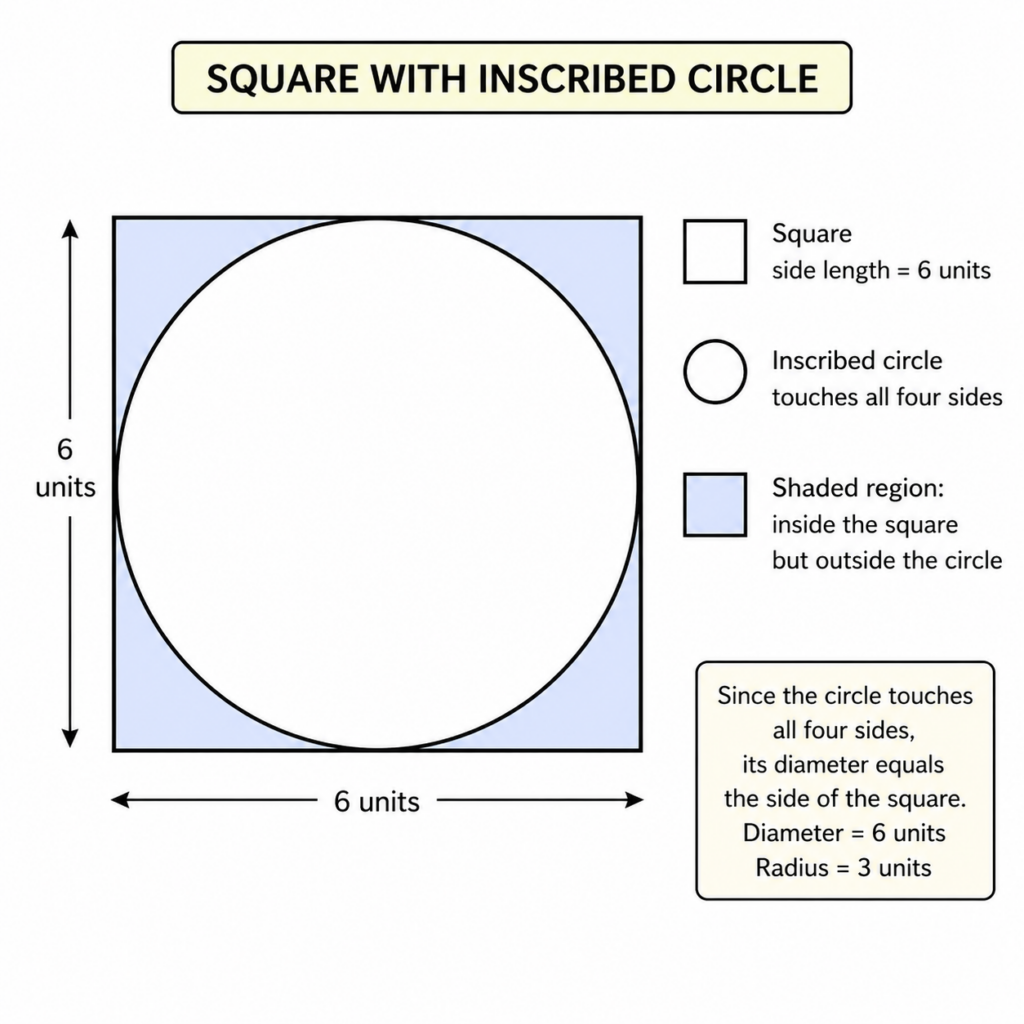
A square has side length 6. A circle is drawn inside the square touching all four sides. What is the area of the region inside the square but outside the circle? Leave your answer in terms of π.
Solution: The circle touches all four sides, so its diameter equals the side of the square. Diameter = 6, radius = 3
Area of square = 6² = 36
Area of circle = πr² = 9π
Shaded area = 36 – 9π
Answer: 36 – 9π
Key insight: Shaded region problems always involve subtracting one area from another. Identify the larger shape, find its area, subtract the area of the shape inside it. This structure is consistent across dozens of AMC 8 past paper geometry questions.
Composite shapes — area and perimeter of combined figures
Many AMC 8 geometry problems involve composite shapes — figures made by combining or removing basic shapes. These are the most common geometry question type in the middle difficulty range of the AMC 8.
Composite shape problems are where area and perimeter worksheets become genuinely useful for AMC 8 preparation. The formulas for basic shapes are straightforward to learn from a textbook, but the skill of decomposing an irregular figure into its components and knowing which areas to add or subtract is developed through practice, which is exactly what these area and perimeter worksheets are designed to build.
Strategy for composite shape problems
Step one: identify all the basic shapes the composite figure is made from or can be divided into.
Step two: calculate the area or perimeter of each component separately.
Step three: add or subtract as required.
For area: add areas of combined shapes, subtract areas of removed shapes. For perimeter: trace around the outside of the composite figure carefully — do not include any internal lines that are not on the outer boundary.
Worksheet problem 10 — L-shaped composite figure
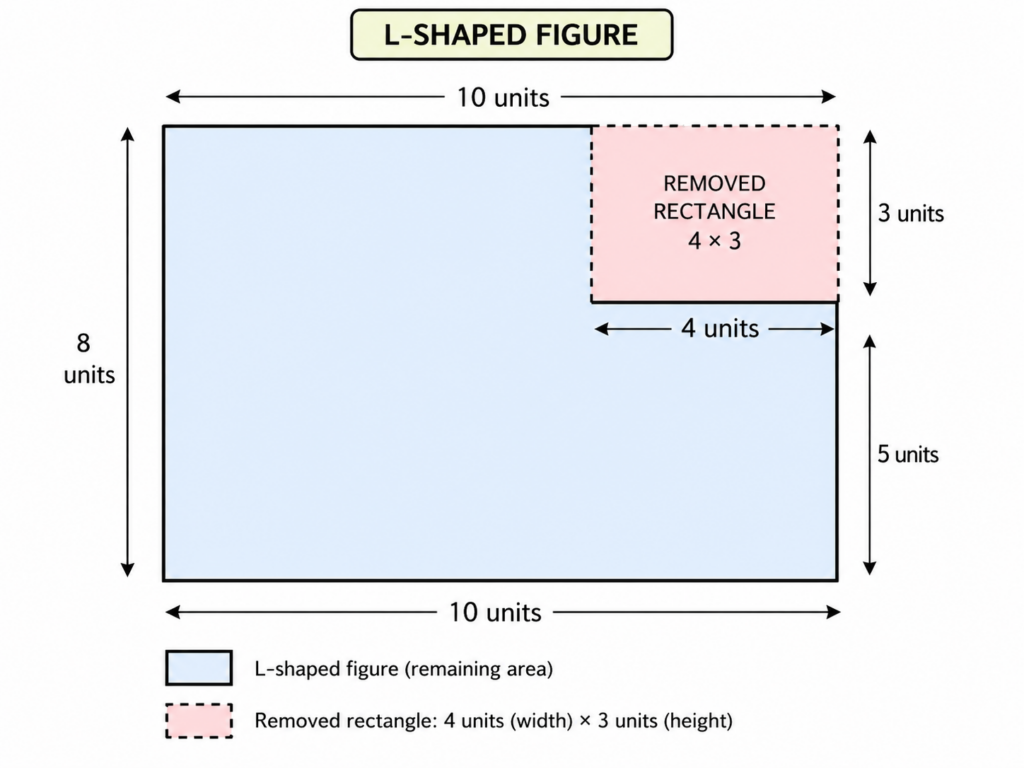
An L-shaped figure is formed by taking a 10 by 8 rectangle and removing a 4 by 3 rectangle from one corner. Find its area and perimeter.
Solution: Area = area of full rectangle minus removed rectangle
Area = (10 x 8) – (4 x 3) = 80 – 12 = 68 square units
For perimeter, trace around the outside: The L-shape has six sides.
Going around: 10, 8, 4, (8-3)=5, (10-4)=6, 3
Wait — let us be systematic. Place the full rectangle with bottom-left corner at the origin. The removed section is the top-right corner.
Sides going clockwise from bottom-left:
- Bottom: 10
- Right side of remaining section: 8 – 3 = 5
- Step going left: 4
- Step going up: 3
- Left of top: 10 – 4 = 6
- Left side going down: 8
Perimeter = 10 + 5 + 4 + 3 + 6 + 8 = 36 units
Answer: Area = 68, Perimeter = 36
Key insight: Perimeter of composite shapes requires careful tracing. The most common error is including internal lines or missing a step edge. Drawing the shape and labelling every outer edge before adding is the most reliable approach.
Worksheet problem 11 — rectangle with semicircle
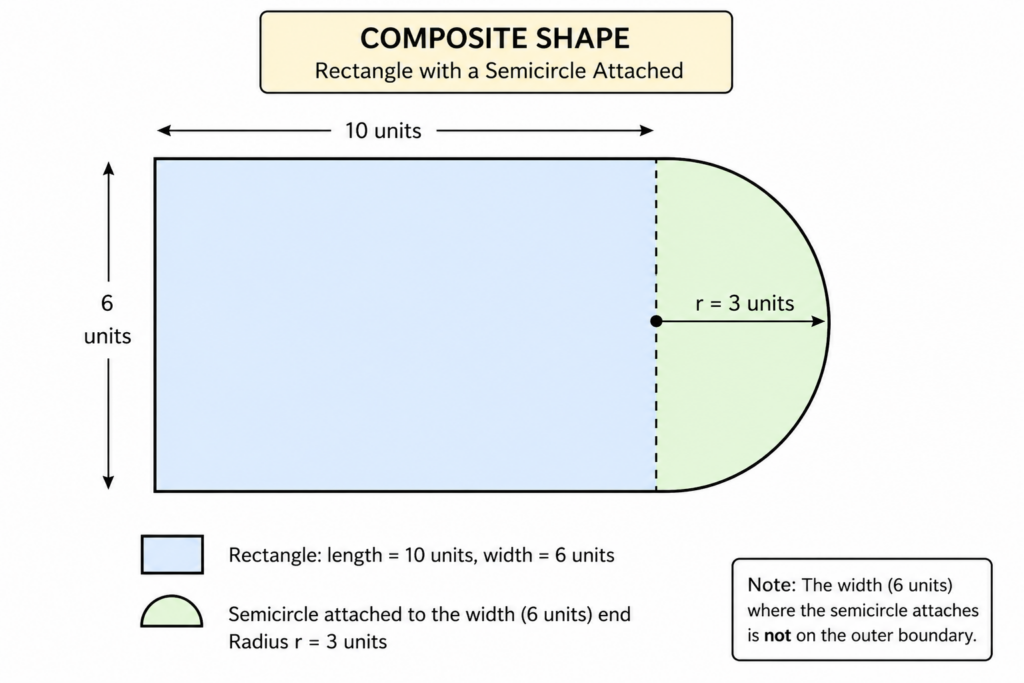
A shape is formed by attaching a semicircle to one end of a rectangle. The rectangle has length 10 and width 6. The semicircle is attached to the width end. Find the area and perimeter of the combined shape. Leave answers in terms of π.
Solution: Semicircle radius = half the width = 3
Area = rectangle area + semicircle area
Area = (10 x 6) + (1/2 x π x 3²)
Area = 60 + (9π/2) square units
Perimeter = two lengths + one width + semicircle arc (The width where the semicircle attaches is not on the outer boundary)
Perimeter = 10 + 10 + 6 + πr Perimeter = 26 + 3π units
Answer: Area = 60 + 9π/2, Perimeter = 26 + 3π
Key insight: When a semicircle is attached to a rectangle, the straight edge of the semicircle is shared with the rectangle and does not appear in the perimeter. Only the curved arc is on the outer boundary.
Worksheet problem 12 — AMC 8 style composite problem
A figure is made up of three squares. The largest square has side length 6, the middle square has side length 4, and the smallest has side length 2. They are arranged in a staircase pattern so each smaller square sits on top of the corner of the next larger one. What is the total area of the figure?
Solution: Total area = sum of individual areas = 6² + 4² + 2² = 36 + 16 + 4 = 56 square units
Answer: 56
Key insight: When squares or other shapes are simply placed together without overlap, total area is just the sum of individual areas. Confirm there is no overlap before adding.

AMC 8 style area and perimeter problems
These problems are written in the style of actual AMC 8 past contest questions. They require recognising which formula and technique to use without being guided.
Problem 13
A square and a rectangle have equal perimeters. The square has side length 9. The rectangle has length 12. What is the area of the rectangle?
Solution: Perimeter of square = 4 x 9 = 36
Rectangle perimeter = 36, so 2(12 + w) = 36
12 + w = 18
w = 6
Area of rectangle = 12 x 6 = 72
Answer: 72
Problem 14
A circle has the same area as a square with side length 6. What is the radius of the circle? Leave your answer in terms of π.
Solution: Area of square = 36
Area of circle = πr² = 36
r² = 36/π r = 6/√π = 6√π/π
Answer: r = 6/√π
Key insight: Setting areas equal is a powerful technique that appears across many AMC 8 problems. Set up the equation, solve for the unknown, and simplify carefully.
Problem 15
A path 2 metres wide is built around the outside of a rectangular garden that measures 20 metres by 14 metres. What is the area of the path alone?
Solution: The outer rectangle including the path has dimensions: Length = 20 + 2 + 2 = 24
Width = 14 + 2 + 2 = 18
Area of outer rectangle = 24 x 18 = 432
Area of inner garden = 20 x 14 = 280
Area of path = 432 – 280 = 152 square metres
Answer: 152 square metres
Key insight: Border and path problems always involve subtracting the inner area from the outer area. The outer dimensions are the inner dimensions plus twice the border width on each side — a common error is adding the border width once rather than twice.
Problem 16
A triangle has vertices at coordinates (0, 0), (8, 0), and (0, 6). What is the perimeter of the triangle?
Solution: The two legs lie along the axes with lengths 8 and 6. Hypotenuse = √(8² + 6²) = √(64 + 36) = √100 = 10
Perimeter = 8 + 6 + 10 = 24
Answer: 24
Key insight: This is a 3-4-5 triple scaled by 2. Right triangles placed on coordinate grids with legs along the axes are a standard AMC 8 setup. The legs are read directly from the coordinates and the hypotenuse is found using the Pythagorean theorem.
Problem 17
The area of a trapezoid is 84. Its two parallel sides have lengths 10 and 18. What is its height?
Solution: Area = (1/2)(b₁ + b₂) x h
84 = (1/2)(10 + 18) x h
84 = (1/2)(28) x h 84 = 14h
h = 6
Answer: 6
Problem 18
A rectangle has length twice its width. Its area is 72. What is its perimeter?
Solution: Let width = w. Then length = 2w.
Area = 2w x w = 2w² = 72
w² = 36
w = 6, length = 12
Perimeter = 2(12 + 6) = 36
Answer: 36
Problem 19
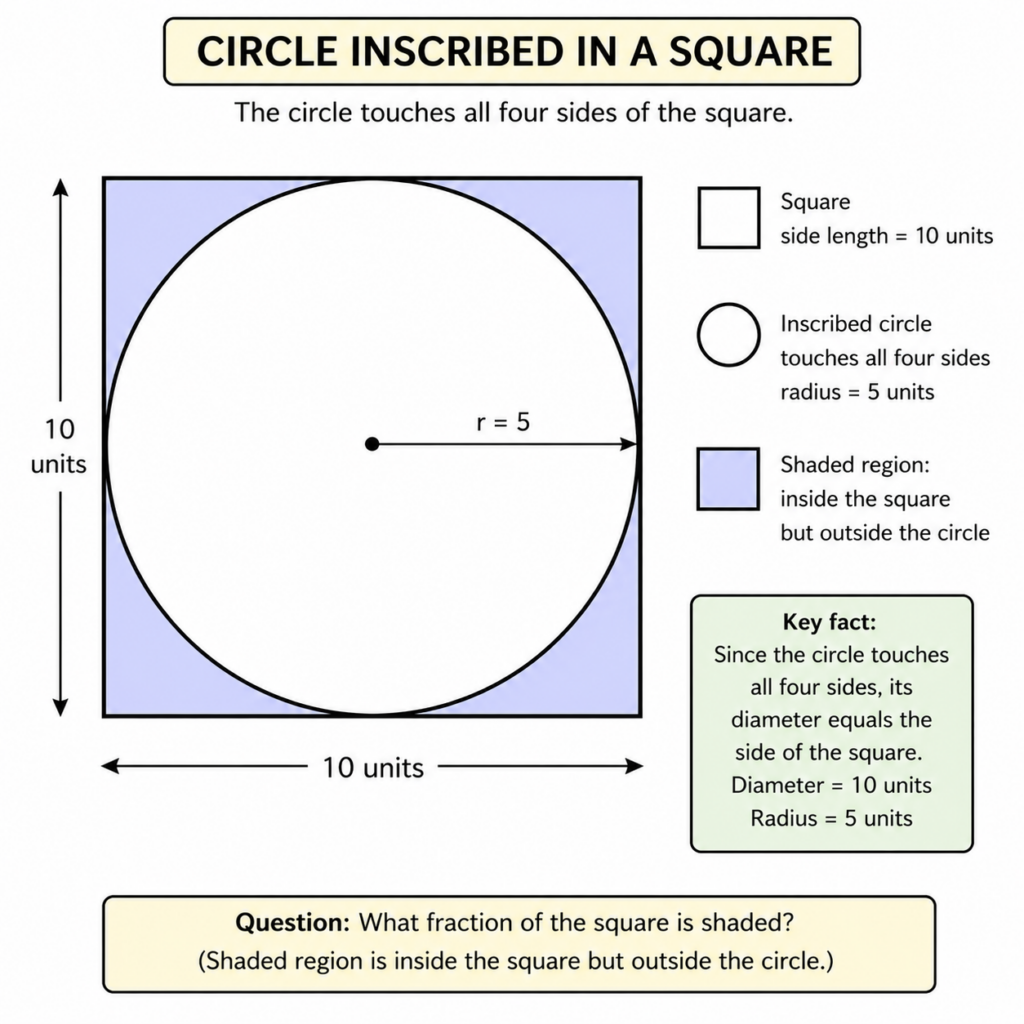
A shaded region is formed by drawing a circle of radius 5 inside a square of side length 10, with the circle touching all four sides. What fraction of the square is shaded?
Solution: Area of square = 100
Area of circle = π x 5² = 25π
Shaded area (inside square, outside circle) = 100 – 25π
Fraction shaded = (100 – 25π)/100 = 1 – π/4
Answer: 1 – π/4
Key insight: Fraction problems involving circles and squares appear regularly on the AMC 8. The answer is often left in terms of π. Confirm the question asks for the fraction of the square that is shaded — not the area — before substituting.
Problem 20 — hardest
A rectangle with area 120 has its length decreased by 20% and its width increased by 25%. What is the area of the new rectangle?
Solution: New length = original length x 0.8
New width = original width x 1.25
New area = (0.8 x length) x (1.25 x width) = 0.8 x 1.25 x (length x width) = 1.0 x 120 = 120
Answer: 120
Key insight: The area is unchanged because 0.8 x 1.25 = 1.0 exactly. This type of problem tests whether students work through the algebra rather than assuming the area must change. AMC 8 problems sometimes have surprising answers — never assume the result before working it out.
If you have worked through all twenty problems in these area and perimeter worksheets, you have covered every geometry technique that appears in AMC 8 past papers at this topic level. Return to any problem you found difficult and attempt it again without looking at the solution — being able to reproduce a solution independently rather than just understand it when reading confirms the technique has been properly learned.
Area and perimeter reference sheet
Use this as a quick reference alongside the practice problems above.
Formulas to memorise
| Shape | Area | Perimeter or circumference |
|---|---|---|
| Square (side s) | s² | 4s |
| Rectangle (l x w) | lw | 2(l + w) |
| Triangle (base b, height h) | (1/2)bh | sum of sides |
| Right triangle (legs a, b) | (1/2)ab | a + b + hypotenuse |
| Equilateral triangle (side s) | (s²√3)/4 | 3s |
| Circle (radius r) | πr² | 2πr |
| Semicircle (radius r) | (1/2)πr² | πr + 2r |
| Trapezoid (bases b₁, b₂, height h) | (1/2)(b₁ + b₂)h | sum of sides |
Common problem types and approaches
| Problem type | Approach |
|---|---|
| Shaded region | Larger area minus smaller area |
| Border or path | Outer area minus inner area |
| Equal areas | Set formulas equal and solve |
| Composite shape area | Sum of component areas |
| Composite shape perimeter | Trace outer boundary only |
| Dimensions from area and perimeter | Set up two equations in two unknowns |
| Scaling | Perimeter scales by k, area scales by k² |
How to use these area and perimeter worksheets
These area and perimeter worksheets are most effective when used as part of a structured preparation plan rather than completed once and set aside.
Attempt every problem before reading the solution. Write down what you know, draw a diagram, and identify which formula applies before doing any calculation. The attempt itself builds problem-solving intuition even when it does not produce the correct answer.
Draw a diagram for every problem. Geometry problems become significantly easier once you can see the shape. Label all known dimensions and mark the unknown clearly before setting up any equation.
Use this area and perimeter worksheet alongside AMC 8 past papers. The past papers show you the exact question style — these area and perimeter worksheets give you the concentrated practice on the specific skill those questions test. Use them together rather than choosing one over the other.
Return to these area and perimeter worksheets at different stages of preparation. Problems that feel difficult in the early months often feel straightforward later. Working through the same area and perimeter worksheet problems a second time a few months later is a useful way to measure how much geometry understanding has developed.
AMC 8 Math Competition: The Complete Guide for Canadian Students
Pythagorean Theorem Worksheet: Practice Problems for AMC 8 Students
What is a Broken Line Graph? Examples, How to Read One and AMC Practice
Factors of 24 and 45: How to Find All Factors AMC 8 Guide
Frequently Asked Questions
What formulas do I need for AMC 8 area and perimeter problems?
The essential formulas are area and perimeter of squares, rectangles, triangles, and circles. For harder problems, also know the area of trapezoids and equilateral triangles, the perimeter of semicircles, and the formula for the diagonal of a rectangle. All of these are in the reference sheet above.
How do area and perimeter appear in AMC 8 problems?
They appear in direct calculation problems, composite shape problems, shaded region problems, border and path problems, equal area problems, and problems that give area and perimeter together and ask for dimensions. The harder problems combine geometry with algebra or require applying the Pythagorean theorem to find a height before calculating area.
What is the difference between area and perimeter?
Area measures the space inside a shape and is expressed in square units. Perimeter measures the distance around the outside of a shape and is expressed in linear units. Confusing the two is one of the most common geometry errors on the AMC 8 — always check which one the question is asking for before solving.
How do I find the area of a composite shape?
Divide the composite shape into basic shapes you know the area formula for. Calculate the area of each component separately, then add the areas together. If a shape has been removed from a larger shape, subtract the removed area from the larger area.
How do I find the perimeter of a composite shape?
Trace around the outer boundary of the composite shape carefully, adding up the length of each outer edge. Do not include any internal edges that are not on the outer boundary. Drawing the shape and labelling every outer edge before adding prevents mistakes.
What is a shaded region problem?
A shaded region problem asks for the area of a region formed by the difference between two shapes — typically a region inside one shape but outside another. The approach is always the same: find the area of the larger shape, find the area of the smaller shape, subtract. Many AMC 8 problems involve a circle inside a square or a triangle inside a rectangle.
How do area and perimeter scale when a shape is enlarged?
If all dimensions of a shape are multiplied by a scale factor k, the perimeter is multiplied by k and the area is multiplied by k². A shape with dimensions doubled has four times the area but only twice the perimeter.



This is a really helpful breakdown. It makes the concepts feel a little less intimidating, especially when you’re trying to tackle those AMC 8 problems.