


Similar triangles are one of the most important concepts in geometry for both AMC 8 and AMC 10 students. Two triangles are similar when they have the same shape but not necessarily the same size — their corresponding angles are equal and their corresponding sides are in proportion. This similar triangles worksheet covers the definition of similarity, the three rules for proving triangles are similar, how to find missing sides using proportions, and a full set of practice problems at increasing difficulty levels written in the style of AMC 8 and AMC 10 past contest questions. Mastering similar triangles unlocks a wide range of geometry problems involving scale, proportion, and indirect measurement that appear across both competitions.

What are similar triangles?
Two triangles are similar if they have exactly the same shape — all three pairs of corresponding angles are equal — even if their sizes are different. The symbol for similarity is ~. If triangle ABC is similar to triangle DEF, this is written as △ABC ~ △DEF.
When two triangles are similar, three things are always true:
- All three pairs of corresponding angles are equal
- All three pairs of corresponding sides are in the same ratio
- The ratio of any two corresponding sides is called the scale factor
The order of letters matters when writing a similarity statement. △ABC ~ △DEF means angle A corresponds to angle D, angle B corresponds to angle E, and angle C corresponds to angle F. Side AB corresponds to side DE, side BC corresponds to side EF, and side AC corresponds to side DF.
Similar triangles vs congruent triangles
| Feature | Similar triangles | Congruent triangles |
|---|---|---|
| Angles | All corresponding angles equal | All corresponding angles equal |
| Sides | Corresponding sides in proportion | Corresponding sides equal |
| Size | Can be different sizes | Must be the same size |
| Symbol | ~ | ≅ |
| Scale factor | Any positive value | Always 1 |
Congruent triangles are a special case of similar triangles where the scale factor is exactly 1.
Why similar triangles matter in AMC 8 and AMC 10
Similar triangles appear in a wide range of geometry problems across both competitions. In AMC 8, they appear in problems involving scale drawings, shadow problems, and nested triangles. In AMC 10, they appear in more complex configurations including triangles formed by parallel lines, triangles inscribed in circles, and multi-step problems where the similarity relationship is not immediately obvious. Students who can identify similar triangles quickly and set up the proportion correctly solve these problems significantly faster than students who work from scratch.
For more on AMC 8, check out: AMC 8 Math Competition: The Complete Guide for Canadian Students.
Thinking about taking the AMC 10? Read: AMC 10 Math Competition: The Complete Guide for Canadian Students.
Three rules for proving triangles are similar
There are three standard similarity rules used in geometry. Knowing all three — and which one to apply in a given situation — is essential for both this similarity triangles worksheet and for AMC competition problems.
Rule 1 — AA (Angle-Angle)
If two angles of one triangle are equal to two angles of another triangle, the triangles are similar.
This is the most commonly used similarity rule in competition math. Because the angles of any triangle always sum to 180 degrees, if two angles match then the third must match automatically — you only ever need to show two pairs of equal angles.
When to use AA: When a diagram shows parallel lines (which create equal alternate or corresponding angles), when two triangles share an angle, or when one angle in each triangle is a right angle and another pair of angles are equal.
Example: Triangle ABC has angles 50°, 70°, and 60°. Triangle DEF has angles 50°, 70°, and 60°. By AA (or in this case AAA), △ABC ~ △DEF.
Rule 2 — SAS (Side-Angle-Side)
If two pairs of corresponding sides are in the same ratio and the included angles — the angles between those sides — are equal, the triangles are similar.
When to use SAS: When you are given two pairs of sides and the angle between them, and you can verify the ratios are equal.
Example: Triangle ABC has sides AB = 4 and AC = 6 with included angle A = 50°.
Triangle DEF has sides DE = 8 and DF = 12 with included angle D = 50°.
The ratios are 4/8 = 6/12 = 1/2 and the included angles are equal, so △ABC ~ △DEF by SAS.
Rule 3 — SSS (Side-Side-Side)
If all three pairs of corresponding sides are in the same ratio, the triangles are similar.
When to use SSS: When you are given all three side lengths of both triangles and need to verify or establish similarity.
Example: Triangle ABC has sides 3, 4, 5. Triangle DEF has sides 6, 8, 10. The ratios are 3/6 = 4/8 = 5/10 = 1/2, so △ABC ~ △DEF by SSS.
Quick reference — when to use each rule
| Rule | What you need to show | Most common context |
|---|---|---|
| AA | Two pairs of equal angles | Parallel lines, shared angles, right triangles |
| SAS | Two sides in ratio, included angle equal | Sides given with one angle |
| SSS | All three sides in the same ratio | All three sides given |
How to find missing sides using similar triangles
Once two triangles are established as similar, missing side lengths can be found using proportions. This is the core calculation skill tested in geometry similar triangles worksheet problems and AMC competition questions.
Setting up the proportion
When △ABC ~ △DEF, the corresponding sides are in proportion:
AB/DE = BC/EF = AC/DF = scale factor
To find a missing side, identify the corresponding sides, set up a proportion using the known values, and solve for the unknown.
Example — finding a missing side
△ABC ~ △DEF. AB = 6, BC = 8, AC = 10, DE = 9. Find EF and DF.
Solution: Scale factor = DE/AB = 9/6 = 3/2
EF = BC x (3/2) = 8 x 3/2 = 12 DF = AC x (3/2) = 10 x 3/2 = 15
Answer: EF = 12, DF = 15
Verification: 6/9 = 8/12 = 10/15 = 2/3. All ratios equal — correct.
Example — using cross multiplication
△PQR ~ △XYZ. PQ = 5, QR = 7, XY = 15. Find YZ.
Solution: PQ/XY = QR/YZ 5/15 = 7/YZ 5 x YZ = 15 x 7 5 x YZ = 105 YZ = 21
Answer: YZ = 21
Key insight: Always identify which sides correspond before setting up the proportion. The order of letters in the similarity statement tells you which sides match — PQ corresponds to XY, QR to YZ, and PR to XZ.
Similar triangles worksheet — Level 1 problems
These problems test direct application of the similarity rules and proportion calculation. They are equivalent in difficulty to questions 1 to 10 on the AMC 8.
Problem 1 — identifying similar triangles by AA
Triangle ABC has angles 45°, 75°, and 60°. Triangle DEF has angles 45°, 60°, and 75°. Are the triangles similar? If so, write the similarity statement.
Solution: Both triangles have the same three angles: 45°, 60°, and 75°. By AA (any two pairs match), the triangles are similar.
Matching angles: A = 45° corresponds to D = 45°, B = 75° corresponds to F = 75°, C = 60° corresponds to E = 60°.
Answer: △ABC ~ △DFE
Key insight: The order of the similarity statement must match corresponding angles — B (75°) corresponds to F (75°), not to E (60°). Writing the similarity statement correctly is essential for setting up proportions accurately.
Problem 2 — finding the scale factor
△ABC ~ △DEF. AB = 8, BC = 12, AC = 16, DE = 6. Find the scale factor from △ABC to △DEF and find EF and DF.
Solution: Scale factor = DE/AB = 6/8 = 3/4
EF = BC x (3/4) = 12 x 3/4 = 9 DF = AC x (3/4) = 16 x 3/4 = 12
Answer: Scale factor = 3/4, EF = 9, DF = 12
Problem 3 — finding a missing side from a proportion
△PQR ~ △STU. PQ = 10, QR = 14, ST = 15. Find TU.
Solution: PQ/ST = QR/TU 10/15 = 14/TU
10 x TU = 15 x 14 = 210
TU = 21
Answer: TU = 21
Problem 4 — verifying similarity by SSS
Triangle ABC has sides 5, 8, and 10. Triangle DEF has sides 10, 16, and 20. Are the triangles similar?
Solution: Check ratios: 5/10 = 1/2, 8/16 = 1/2, 10/20 = 1/2. All three ratios are equal.
Answer: Yes, △ABC ~ △DEF by SSS with scale factor 1/2
Problem 5 — finding multiple missing sides
△ABC ~ △XYZ with scale factor 2/3. AB = 12, BC = 15, CA = 18. Find XY, YZ, and ZX.
Solution: XY = AB x (2/3) = 12 x 2/3 = 8 YZ = BC x (2/3) = 15 x 2/3 = 10 ZX = CA x (2/3) = 18 x 2/3 = 12
Answer: XY = 8, YZ = 10, ZX = 12
Similar triangles worksheet — Level 2 problems
These problems require setting up similarity from a geometric context rather than being told directly that triangles are similar. They are equivalent in difficulty to questions 10 to 18 on the AMC 8 and questions 1 to 10 on the AMC 10.
Problem 6 — parallel lines creating similar triangles
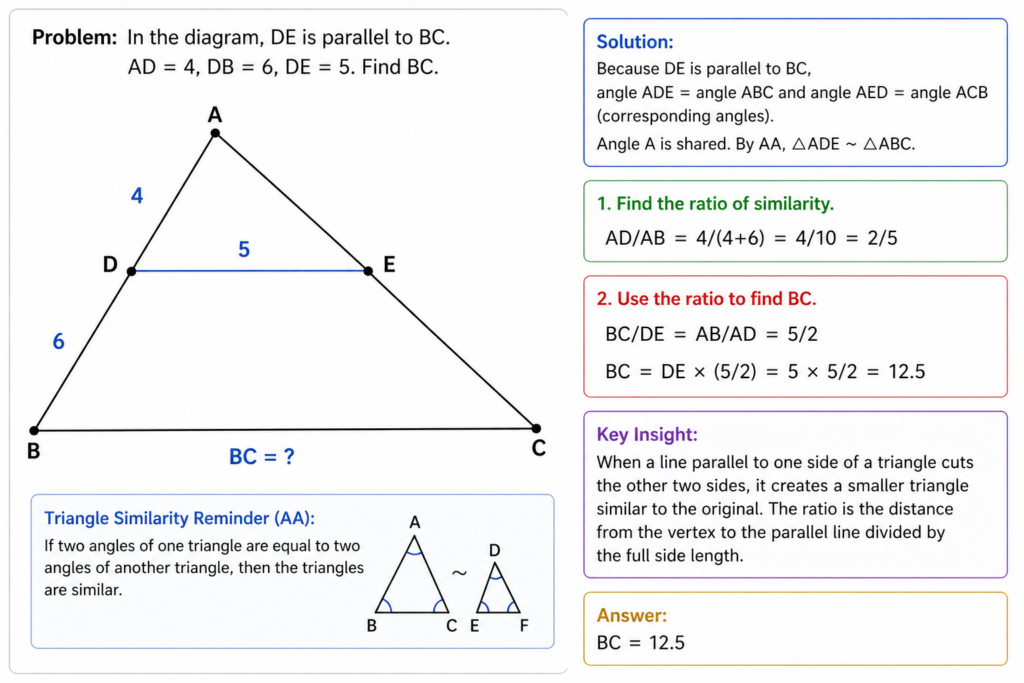
In the diagram, DE is parallel to BC. AD = 4, DB = 6, DE = 5. Find BC.
Solution: Because DE is parallel to BC, angle ADE = angle ABC and angle AED = angle ACB (corresponding angles). Angle A is shared. By AA, △ADE ~ △ABC.
The ratio of similarity: AD/AB = 4/(4+6) = 4/10 = 2/5.
BC/DE = AB/AD = 5/2 BC = DE x (5/2) = 5 x 5/2 = 12.5
Answer: BC = 12.5
Key insight: When a line parallel to one side of a triangle cuts the other two sides, it creates a smaller triangle similar to the original. The ratio is the distance from the vertex to the parallel line divided by the full side length.
Problem 7 — triangles sharing a vertex
Two triangles share vertex A. Triangle ABC has AB = 8 and AC = 12. Triangle ADE has AD = 12 and AE = 18. Angle A is common to both triangles. Are the triangles similar? If so find the scale factor.
Solution: Check SAS: angle A is shared (equal). AB/AD = 8/12 = 2/3 AC/AE = 12/18 = 2/3
Both ratios are equal and the included angle is the same.
By SAS, △ABC ~ △ADE with scale factor 2/3.
Answer: Yes, △ABC ~ △ADE by SAS, scale factor 2/3
Problem 8 — finding a height using similar triangles
A tree casts a shadow of 18 metres. At the same time, a 2-metre pole casts a shadow of 3 metres. How tall is the tree?
Solution: The pole and its shadow form a triangle similar to the tree and its shadow (same sun angle, both right triangles).
Height/shadow = 2/3 for the pole. Tree height/18 = 2/3 Tree height = 18 x 2/3 = 12
Answer: 12 metres
Key insight: Shadow problems are always similar triangle problems. The sun’s rays create the same angle with the ground for all vertical objects at the same time, which means all shadow triangles at that moment are similar to each other.
Problem 9 — right triangles and altitude
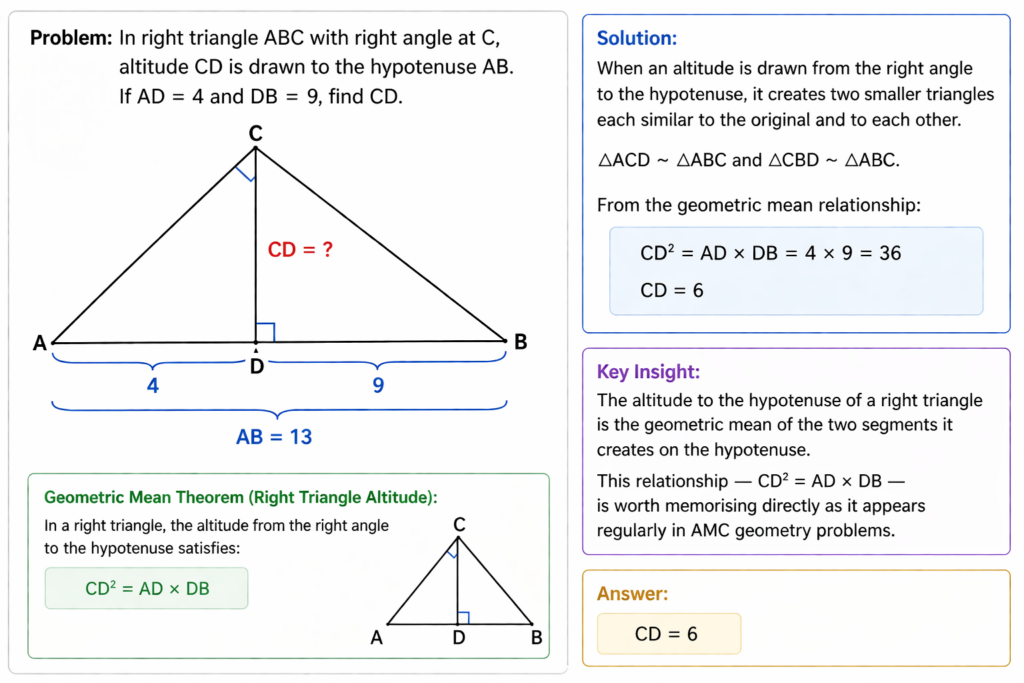
In right triangle ABC with right angle at C, altitude CD is drawn to the hypotenuse AB. If AD = 4 and DB = 9, find CD.
Solution: When an altitude is drawn from the right angle to the hypotenuse, it creates two smaller triangles each similar to the original and to each other.
△ACD ~ △ABC and △CBD ~ △ABC.
From the geometric mean relationship: CD² = AD x DB = 4 x 9 = 36 CD = 6
Answer: CD = 6
Key insight: The altitude to the hypotenuse of a right triangle is the geometric mean of the two segments it creates on the hypotenuse. This relationship — CD² = AD x DB — is worth memorising directly as it appears regularly in AMC geometry problems.
Problem 10 — finding a side from nested triangles
Triangle ABC has a point D on AB and a point E on AC such that DE is parallel to BC. If AD = 3, AB = 9, and BC = 12, find DE.
Solution: DE parallel to BC means △ADE ~ △ABC by AA. Scale factor = AD/AB = 3/9 = 1/3.
DE = BC x (1/3) = 12 x 1/3 = 4.
Answer: DE = 4
Similar triangles worksheet — AMC 8 and AMC 10 style problems
These problems are written in the style of actual AMC 8 and AMC 10 past contest questions. They require identifying that similar triangles are involved without being told explicitly.
Problem 11 — AMC 8 style
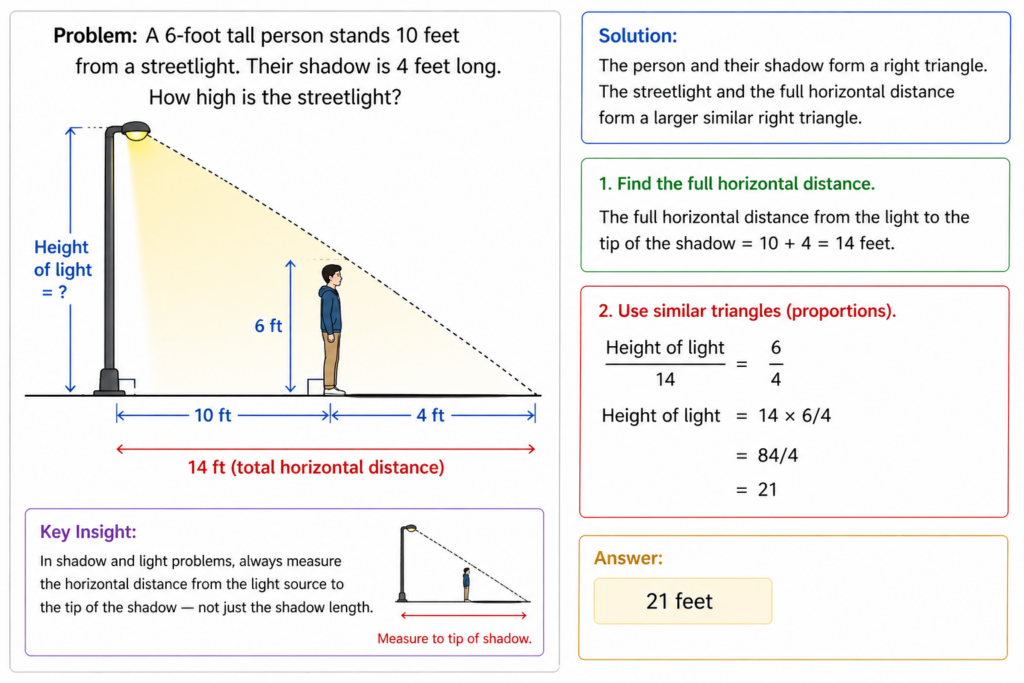
A 6-foot tall person stands 10 feet from a streetlight. Their shadow is 4 feet long. How high is the streetlight?
Solution: The person and their shadow form a right triangle. The streetlight and the full horizontal distance form a larger similar right triangle.
The full horizontal distance from the light to the tip of the shadow = 10 + 4 = 14 feet.
Height of light / 14 = 6 / 4 Height = 14 x 6/4 = 84/4 = 21
Answer: 21 feet
Key insight: In shadow and light problems, always measure the horizontal distance from the light source to the tip of the shadow — not just the shadow length.
Problem 12 — AMC 8 style
In triangle ABC, DE is parallel to BC where D is on AB and E is on AC. The ratio AD:DB = 2:3. If the area of triangle ADE is 12, what is the area of triangle ABC?
Solution: AD/AB = AD/(AD + DB) = 2/(2+3) = 2/5.
Scale factor from △ADE to △ABC = 2/5.
Area scales as the square of the scale factor: Area of △ABC / Area of △ADE = (5/2)² = 25/4.
Area of △ABC = 12 x 25/4 = 75.
Answer: 75
Key insight: When two similar figures have a linear scale factor of k, their areas are in the ratio k². This relationship — that area scales as the square of the linear scale factor — is one of the most important results in AMC geometry.
Problem 13 — AMC 10 style
Two similar triangles have perimeters in the ratio 3:5. The area of the smaller triangle is 27. What is the area of the larger triangle?
Solution: Linear scale factor = 3/5 (same as ratio of perimeters — perimeters scale linearly). Area scale factor = (3/5)² = 9/25.
Area of smaller / Area of larger = 9/25. 27 / Area of larger = 9/25. Area of larger = 27 x 25/9 = 75.
Answer: 75
Problem 14 — AMC 10 style
In right triangle ABC, angle C = 90°. Altitude CD is drawn to hypotenuse AB. If AB = 25 and AD = 9, find AC.
Solution: From the right triangle altitude relationships: AC² = AD x AB = 9 x 25 = 225. AC = 15.
Answer: AC = 15
Key insight: When an altitude is drawn from the right angle to the hypotenuse, AC² = AD x AB and BC² = DB x AB. These are direct consequences of the similar triangles formed and are worth memorising for both AMC 8 and AMC 10.
Problem 15 — AMC 10 style
Triangle ABC has AB = 10, BC = 8, CA = 6. Point D lies on BC such that AD bisects angle A. Find BD.
Solution: By the angle bisector theorem, BD/DC = AB/AC = 10/6 = 5/3.
BD + DC = BC = 8. BD = 8 x 5/(5+3) = 8 x 5/8 = 5.
Answer: BD = 5
Key insight: The angle bisector theorem — BD/DC = AB/AC — is a direct consequence of similar triangles formed by the angle bisector and a line parallel to it. This result appears regularly in AMC 10 geometry problems and is worth knowing directly.

Problem 16 — AMC 10 style, harder
Two triangles are similar with a scale factor of 3:4. The sum of their perimeters is 140. Find the perimeter of each triangle.
Solution: Let the perimeters be 3k and 4k. 3k + 4k = 140 7k = 140 k = 20
Perimeters: 3 x 20 = 60 and 4 x 20 = 80.
Answer: 60 and 80
Problem 17 — AMC 10 style, harder
In trapezoid ABCD, AB is parallel to CD, AB = 12, and CD = 8. The diagonals AC and BD intersect at point E. Find the ratio AE:EC.
Solution: Because AB is parallel to CD, triangles ABE and CDE are similar by AA (alternate interior angles with the parallel lines, plus vertical angles at E).
The ratio of similarity equals the ratio of the parallel sides: AE/EC = AB/CD = 12/8 = 3/2.
Answer: AE:EC = 3:2
Key insight: When diagonals of a trapezoid intersect, they create two similar triangles. The ratio in which the diagonals are divided equals the ratio of the parallel sides. This is a standard AMC 10 geometry result.
Problem 18 — AMC 10 style, hardest
Triangle ABC has vertices A(0, 0), B(12, 0), and C(0, 9). Point D is on AB and point E is on AC such that DE is parallel to BC and the area of trapezoid BCED is three times the area of triangle ADE. Find AD.
Solution: Let the scale factor from △ADE to △ABC be k. Then AD = k x AB.
Area of △ADE = k² x Area of △ABC.
Area of trapezoid BCED = Area of △ABC – Area of △ADE = (1 – k²) x Area of △ABC.
Given: (1 – k²) = 3k² 1 = 4k² k² = 1/4 k = 1/2.
AD = k x AB = (1/2) x 12 = 6.
Answer: AD = 6
Key insight: This problem combines the area scaling property of similar triangles with the condition about the trapezoid area. Setting up the equation (1 – k²) = 3k² uses the fact that the trapezoid area is what remains of the full triangle after the small similar triangle is removed.
Similar triangles reference sheet
Key definitions
- Similar triangles have equal corresponding angles and proportional corresponding sides
- Scale factor = ratio of any pair of corresponding sides
- The similarity symbol is ~
- The order of letters in a similarity statement defines the correspondence
Similarity rules
| Rule | Condition |
|---|---|
| AA | Two pairs of equal angles |
| SAS | Two sides in proportion with equal included angle |
| SSS | All three sides in the same ratio |
Key relationships
| Relationship | Formula |
|---|---|
| Corresponding sides | AB/DE = BC/EF = AC/DF = scale factor k |
| Perimeters | Perimeter ratio = k |
| Areas | Area ratio = k² |
| Altitude to hypotenuse | CD² = AD x DB |
| Leg of right triangle | AC² = AD x AB |
| Angle bisector | BD/DC = AB/AC |
| Parallel line in triangle | AD/AB = DE/BC = AE/AC |
How to use this similar triangles worksheet
Attempt every problem before reading the solution. For every problem, start by drawing a diagram and labelling all known sides and angles before setting up any proportion. Many errors in similar triangles problems come from setting up the proportion with non-corresponding sides — the diagram makes the correspondence clear.
Work through the levels in order. Level 1 problems build the mechanical skills — identifying similarity, writing the similarity statement, calculating the scale factor, finding missing sides. Level 2 problems develop the ability to identify similar triangles in a geometric context. The AMC-style problems require both skills together.
For every problem you get wrong, identify which step produced the error: identifying the similar triangles, writing the similarity statement correctly, setting up the proportion, or the arithmetic. Each type of error has a specific fix and knowing which step went wrong is more useful than simply re-reading the solution.
This similarity triangles worksheet covers the full range of similar triangle techniques that appear across AMC 8 and AMC 10. Students preparing for the AMC 8 should focus on Levels 1 and 2 and Problems 11 to 12. Students preparing for the AMC 10 should work through all problems including the harder AMC 10 style questions in Problems 13 to 18.
We have tons of articles working through popular AMC problems.
For an in-depth explanation of the pythagorean theorem, including a worksheet with practice problems and solutions, read: Pythagorean Theorem Worksheet: Practice Problems for AMC 8 Students.
For more on supplementary angles, check out: Supplementary Angles Explained: Definition, Examples and AMC 8 Problems.
Like working through AMC problems using worksheets? See: Area and Perimeter Worksheets: How to Solve Every AMC 8 Geometry Problem.
Frequently Asked Questions
What are similar triangles? Similar triangles are triangles that have the same shape but not necessarily the same size. All three pairs of corresponding angles are equal and all three pairs of corresponding sides are in the same ratio. The ratio of corresponding sides is called the scale factor.
What are the three rules for similar triangles? The three similarity rules are AA (two pairs of equal angles), SAS (two sides in proportion with an equal included angle), and SSS (all three sides in the same ratio). AA is the most commonly used rule in competition math because it requires only two pieces of angle information.
How do you find missing sides in similar triangles? Write the similarity statement to identify which sides correspond. Set up a proportion using the corresponding sides: known side of triangle 1 / known side of triangle 2 = unknown side of triangle 1 / unknown side of triangle 2. Cross multiply and solve.
How do areas of similar triangles compare? If two similar triangles have a linear scale factor of k — meaning all corresponding sides are in ratio k — their areas are in ratio k². A triangle with sides twice as long has four times the area, not twice the area.
What is the difference between similar and congruent triangles? Congruent triangles are identical in both shape and size — corresponding angles are equal and corresponding sides are equal. Similar triangles have equal corresponding angles but corresponding sides are only in proportion, not necessarily equal. Congruent triangles are a special case of similar triangles where the scale factor is 1.
How do similar triangles appear in AMC 8 problems? In AMC 8, similar triangles appear in problems involving parallel lines cutting a triangle, shadow and height problems, scale drawing problems, and problems involving nested triangles. The AA rule is almost always sufficient to establish similarity at AMC 8 level.
How do similar triangles appear in AMC 10 problems? In AMC 10, similar triangles appear in more complex configurations including the altitude to the hypotenuse of a right triangle, the angle bisector theorem, diagonals of trapezoids, triangles inscribed in circles, and multi-step problems combining similarity with area or the Pythagorean theorem. The key skill is recognising that a similarity relationship exists without being told explicitly.
What is the altitude to the hypotenuse property? When an altitude is drawn from the right angle of a right triangle to the hypotenuse, it creates two smaller triangles each similar to the original and to each other. This creates the geometric mean relationships: the altitude squared equals the product of the two hypotenuse segments, and each leg squared equals the product of the adjacent hypotenuse segment and the full hypotenuse.



This is a really helpful breakdown of similar triangles. I’ve been struggling with understanding the proportionality aspect, so this worksheet looks perfect for some extra practice.
This is a really helpful breakdown of similar triangles. I found the rules section especially clear – it’s good to revisit these foundational concepts.