The Pascal math contest is a 25-question multiple choice mathematics competition for Grade 9 students in Canada, run by the Centre for Education in Mathematics and Computing at the University of Waterloo. It is the natural next step after the Gauss contest and the third level in the CEMC series that runs through Cayley, Fermat, and Euclid all the way to university admissions consideration. This guide covers everything Canadian students and parents need to know about the Pascal math contest: what it tests, how it is scored, what topics appear most frequently, how the Pascal math contest 2025 compares to previous years, how to register, and how to prepare effectively.
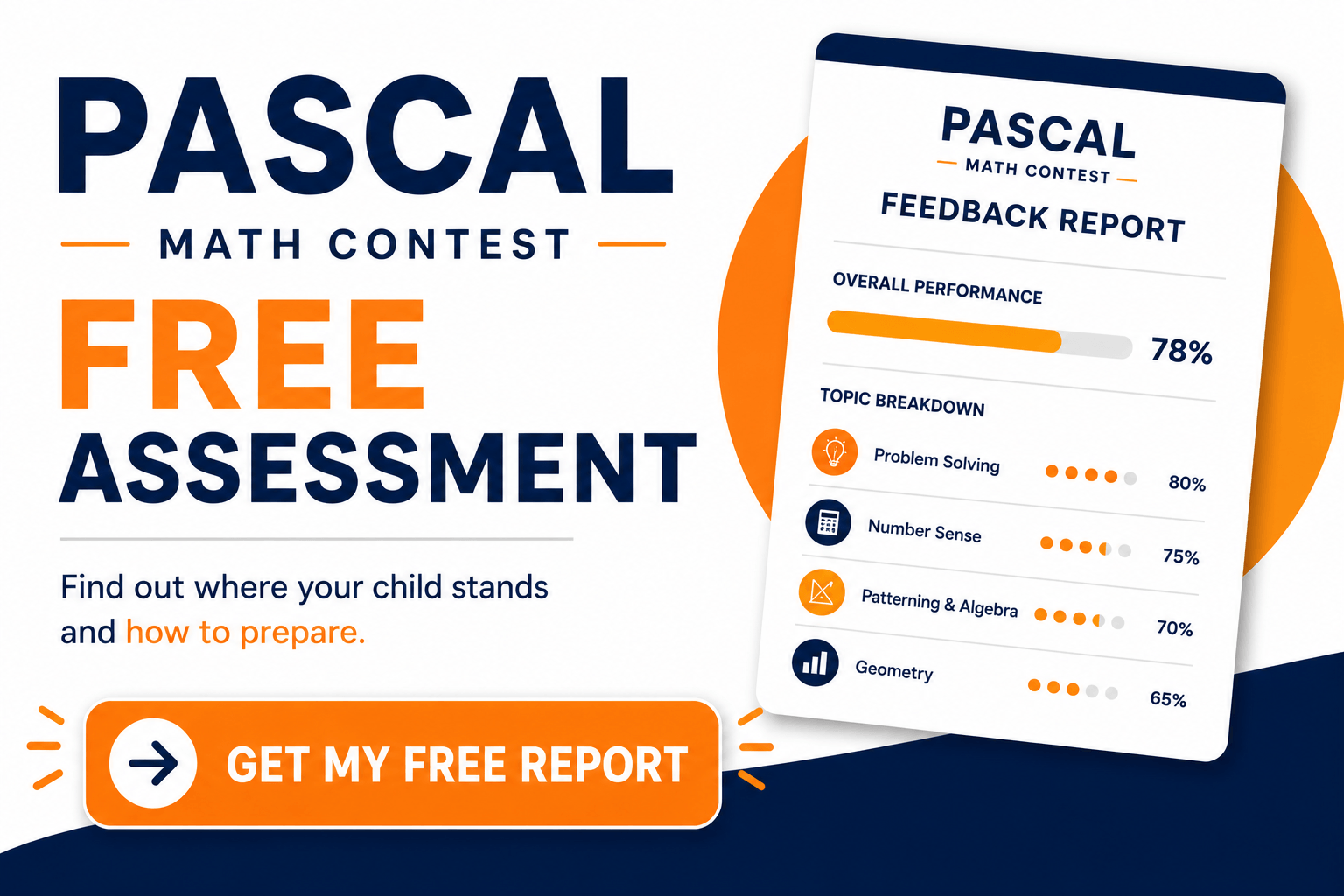
Want to see whether you’d pass the Pascal with your current knowledge? Try our free Pascal assessment and get free feedback and resources to study with!
What is the Pascal math contest?
The Pascal math contest is part of the CEMC contest series run by the University of Waterloo. It is designed for Grade 9 students and sits one level above the Gauss contest (Grade 7 and 8) and one level below the Cayley contest (Grade 10). Like all CEMC contests, it tests mathematical reasoning and problem solving rather than curriculum recall — questions are designed so that no directly applicable procedure has been taught for that specific situation.
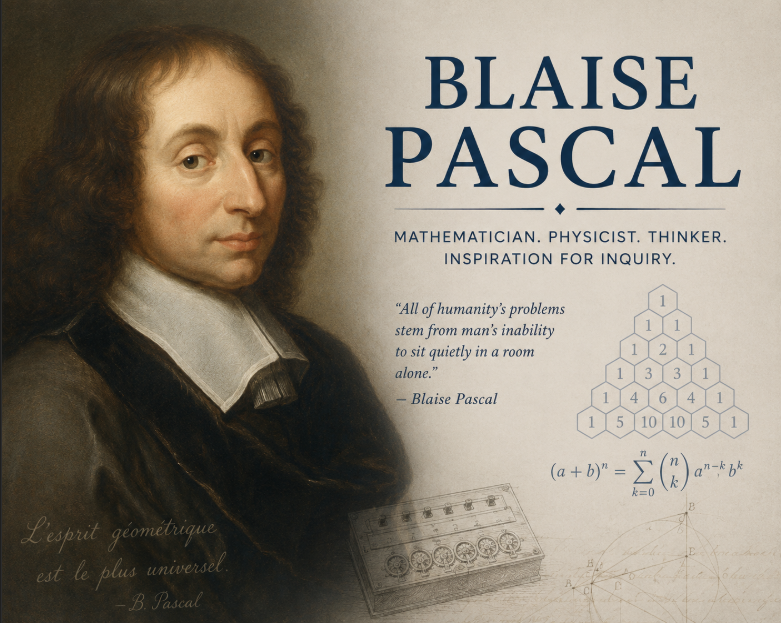
The Pascal math contest was named after Blaise Pascal, the seventeenth-century French mathematician who made foundational contributions to probability theory and combinatorics — two topics that appear regularly in the contest that bears his name.
For official information about the Pascal math contest including current year dates and registration, visit the University of Waterloo CEMC contests hub.
Who can sit the Pascal math contest?
The Pascal is designed for students in Grade 9, though some advanced Grade 8 students sit it as a stretch goal depending on their school’s policy. Students who sat the Gauss in Grade 7 or 8 and performed strongly are the natural audience for the Pascal in Grade 9. Eligibility and registration are handled through schools — check with your child’s math teacher or department head to confirm participation.
How does the Pascal fit into the CEMC contest ladder?
The Pascal sits at the junior-to-intermediate transition in the CEMC series.
| Contest | Grade | Level |
|---|---|---|
| Gauss | Grade 7 and 8 | Junior |
| Pascal | Grade 9 | Junior |
| Cayley | Grade 10 | Intermediate |
| Fermat | Grade 11 | Intermediate |
| Euclid | Grade 12 | Senior |
Students who perform strongly in the Pascal are well-positioned for the Cayley in Grade 10, and the skills built through Pascal preparation directly support performance in every subsequent CEMC contest.
For a complete overview of the CEMC series, check out: Waterloo Math Competition: A Canadian Parent’s Complete Guide to CEMC Contests.
Pascal math contest format and scoring
Exam structure
| Feature | Detail |
|---|---|
| Number of questions | 25 |
| Time allowed | 60 minutes |
| Format | Multiple choice, 5 options per question |
| Calculator | Not permitted |
| When | May each year |
| Where | At school through registered centres |
| Maximum score | 150 points |
Scoring — the three-tier point system
The Pascal math contest uses the same weighted scoring structure as the Gauss contest. Questions are not all worth the same number of points — harder questions are worth more.
| Section | Questions | Points each | Section total |
|---|---|---|---|
| Part A | 1 to 10 | 5 points | 50 points |
| Part B | 11 to 20 | 6 points | 60 points |
| Part C | 21 to 25 | 8 points | 40 points |
| Total | 25 | — | 150 points |
There is no negative marking on the Pascal math contest. Wrong answers and blank answers both score zero. Students should always attempt every question — a guess on a five-option question has a 20% chance of being correct, and eliminating even one option improves those odds.
What is a good score on the Pascal math contest?
The CEMC sets recognition thresholds each year based on the cohort’s performance rather than a fixed cutoff. In general:
- Students in approximately the top 25% earn a Certificate of Distinction
- Students in approximately the top 10% earn higher recognition
- Perfect scores of 150 receive special recognition
Because the thresholds shift with each year’s paper difficulty, a score of 100 might earn a Certificate of Distinction in a harder year and might not in an easier one. The CEMC publishes score distribution data alongside results so you can see exactly where your child’s result sits.
Pascal math contest topics
The Pascal math contest covers the Grade 9 mathematics curriculum and extends beyond it with competition-style problems that require creative reasoning. Understanding which topic areas appear most frequently helps students focus preparation efficiently.
Primary topic areas
| Topic | What it includes | Frequency |
|---|---|---|
| Number theory | Factors, multiples, primes, divisibility, modular arithmetic | Very high |
| Algebra | Linear equations, word problems, simultaneous equations, expressions | Very high |
| Geometry and measurement | Angles, area, perimeter, triangles, coordinate geometry | High |
| Counting and probability | Systematic counting, multiplication principle, basic probability | High |
| Patterns and sequences | Arithmetic sequences, nth term, pattern rules | Moderate |
| Percentages, fractions and ratios | Percentage increase and decrease, proportional reasoning, rates | Moderate |
| Data and graphs | Reading and interpreting statistical displays | Moderate |
How Pascal topics differ from Gauss topics
Students who sat the Gauss in Grade 7 or 8 will find the Pascal covers familiar topic areas but at a noticeably higher level of sophistication. The differences are:
More advanced algebra. The Pascal regularly features simultaneous equations, equations with fractions, and algebraic word problems that require setting up two relationships simultaneously. The Gauss rarely goes beyond single-variable linear equations.
Coordinate geometry. The Pascal introduces coordinate geometry problems — finding distances between points, slopes of lines, and properties of geometric figures on a coordinate grid — that do not appear on the Gauss.
More complex counting. Pascal counting and probability problems often use multi-stage counting with conditions and restrictions, rather than the straightforward multiplication principle problems that dominate the Gauss.
Number theory depth. The Pascal tests modular arithmetic, integer properties, and number theory reasoning at a depth the Gauss does not reach.
What makes Pascal problems different from school math
Like all CEMC contests, the Pascal tests creative reasoning rather than procedural recall. A school question asks a student to apply a known method. A Pascal question presents a problem where the approach must be figured out rather than recalled.
For students making the transition from Gauss to Pascal, the most important shift is in algebraic sophistication — the ability to set up algebraic relationships from complex word problem contexts and work through multi-step solutions efficiently. Students who prepared seriously for the Gauss have the foundational problem-solving habits. Pascal preparation builds the algebraic layer on top.
For a full set of Grade 9 algebra practice problems at increasing difficulty, see our [Grade 8 Algebra Worksheets: Practice Problems for the Gauss Contest] — the techniques covered there are directly applicable to Pascal-level algebra questions.
Pascal math contest dates and registration
When does the Pascal math contest take place?
The Pascal math contest takes place in May each year alongside the other CEMC spring contests — Gauss, Cayley, and Fermat. For the pascal math contest 2025, the competition ran in May 2025. The pascal waterloo math contest 2026 date will be announced by the CEMC in the autumn of 2025.
Always check the official CEMC website at cemc.uwaterloo.ca for the current year’s exact dates as these change slightly each year.
How does registration work?
Registration for the Pascal math contest goes through schools. The math teacher or department head responsible for CEMC contests submits the school’s registration through the CEMC Contest Supervisor Portal. Students do not register individually.
If your child’s school does not participate, ask the math teacher to consider registering — any school can join the CEMC programme. If this is not possible, past Pascal math contest papers are available free at cemc.uwaterloo.ca and can be used for practice at home, though this does not produce an official result.
What to bring on contest day
- Several sharpened pencils and an eraser
- No calculator — not permitted on any CEMC contest
- No notes or formula sheets — not permitted
Pascal math contest 2025 — what we know
The Pascal Math Contest 2025 followed the same format as previous years — 25 questions in 60 minutes, scored out of 150. Results from the 2025 Pascal Math Contest were distributed to schools in the weeks following the contest window. The CEMC published official solutions and score distributions after all results were processed.
Pascal math contest 2024 and recent trends
Looking at the Pascal Math Contest 2024 and recent papers, several patterns are consistent:
Algebra and coordinate geometry together account for a significant portion of Part B questions. Students who are not yet comfortable with coordinate geometry — finding slopes, midpoints, and distances on a grid — consistently underperform relative to their overall ability.
Part C questions in recent years have emphasised elegant multi-step reasoning that combines algebra with number theory or geometry. Students who have only drilled individual topics find these questions harder than students who have practised identifying which combination of techniques a problem requires.
The difficulty jump from Gauss to Pascal is most noticeable in questions 11 to 20. Students who scored in the top 25% of the Gauss typically find Pascal Part A accessible but need significant preparation before Part B feels manageable.
For students who want to track how recent papers compare, the CEMC publishes complete past contest packages, including the Pascal Math Contest 2024 at cemc.uwaterloo.ca. Working through recent papers is the most direct way to understand current difficulty and question style.
How to prepare for the Pascal math contest
Foundation — what you need before starting
Students preparing for the Pascal math contest should have a solid foundation in the following before beginning contest-specific preparation:
- Linear equations with one and two variables
- Basic coordinate geometry — plotting points, finding slopes and distances
- Percentage calculations including increase, decrease, and reverse percentage
- Arithmetic sequences and basic pattern rules
- Factors, multiples, primes, and divisibility rules up to 12
Students who have prepared seriously for the Gauss contest and performed in the top 25% typically have most of these foundations in place. Students who are new to competition mathematics may need to build these skills before Pascal-specific preparation becomes productive.
Past papers — the most important resource
Free past Pascal math contest papers and full solutions are available at the CEMC resources library. Both the contest papers and complete worked solutions are published for every year going back many years. Working through these systematically is the foundation of any effective preparation plan.
The most effective approach to past paper practice: complete one paper under timed conditions (60 minutes, no calculator), then spend two to three review sessions going through every question including those answered correctly. For each question identify the topic, the key insight, and whether a more efficient approach exists. Keep a running tally of which topics produce the most errors across multiple papers — this tells you where to focus targeted practice.
A six to eight week preparation plan
| Weeks | Focus | What to do |
|---|---|---|
| 1 to 2 | Understand the style | Work through 8 to 10 problems untimed. Focus on reading carefully and organising work before calculating. |
| 3 to 4 | Build the toolkit | Practise algebra word problems, coordinate geometry, and counting problems specifically. Use CEMC Problem Set Generator for targeted topic sets. |
| 5 to 6 | Timed practice | Complete one half-paper timed. Review mistakes and rewrite solutions. Focus on Part A accuracy. |
| 7 to 8 | Full paper practice | Complete one full paper timed under contest conditions. Use the three-pass strategy. |
The three-pass strategy for contest day
Managing 60 minutes across 25 questions efficiently is a learnable skill. The three-pass strategy prevents the most common time management error — spending too long on one hard question and missing easier ones later.
First pass (25 to 30 minutes): Work through all 25 questions in order. Answer any question you can solve within two minutes. Circle questions that need more time and move on without spending more than two minutes on any single question.
Second pass (20 to 25 minutes): Return to circled questions. Spend up to four minutes on each. Skip any that are still not yielding progress.
Third pass (remaining time): Make a best guess on any remaining blanks by eliminating obviously wrong options. Review uncertain answers from the first two passes.
Because Part A questions are worth 5 points each, securing all ten Part A marks is worth 50 points — the same as getting all five Part C questions correct. Never rush Part A to get to Part C.
See: Gauss Math Contest Practice: A Complete Preparation Guide with Past Paper Strategy for an in-depth preparation guide to math contest practice that you can use for the Pascal contest.
What comes after the Pascal math contest
The next step — Cayley in Grade 10
Students who perform strongly in the Pascal are naturally progressing toward the Cayley contest in Grade 10. The Cayley adds more advanced algebraic topics — quadratic equations, circle theorems, systems of equations — and marks the transition from junior to intermediate level competition mathematics.
Students who prepared seriously for the Pascal and performed in the top 25% are well positioned for the Cayley with continued preparation over the summer and into Grade 10.
The full pathway to university admissions
The Pascal sits four steps below the Euclid contest in Grade 12, which carries direct weight in University of Waterloo admissions and scholarship decisions for mathematics, computer science, and engineering programmes. Students who begin at the Pascal level and build consistently through the ladder arrive at the Euclid with a depth of mathematical reasoning that students who begin preparation later cannot replicate.
For students with Waterloo ambitions, treating the Pascal as the beginning of a four-year development journey toward the Euclid is the right framing. Every year of Pascal, Cayley, and Fermat preparation is an investment in Euclid performance.
Pascal and the AMC series
Many Canadian Grade 9 students who sit the Pascal also participate in the AMC 10, which takes place in November. The two competitions develop the same underlying problem-solving skills and preparation for one directly benefits performance in the other. The AMC 10 carries more weight with American and international universities while the CEMC series is more directly recognised in Canadian domestic admissions.
Think Academy and the Pascal math contest
Think Academy Canada offers structured competition preparation for the full CEMC contest ladder including the Pascal math contest. The same spiral curriculum approach that has produced over 1,700 AMC 8 medals and helped nearly one in three students qualify for AIME applies directly to Pascal preparation — revisiting key concepts at increasing depth with live classes, teacher-marked homework, and past paper practice.
Frequently Asked Questions
What is the Pascal math contest? The Pascal math contest is a 25-question multiple choice mathematics competition for Grade 9 students in Canada, run by the CEMC at the University of Waterloo. It takes place in May each year and is the third level in the Waterloo CEMC contest series, sitting above the Gauss (Grade 7 and 8) and below the Cayley (Grade 10). The maximum score is 150 and there is no penalty for wrong answers.
How hard is the Pascal math contest? The Pascal is harder than the Gauss and considerably harder than the Grade 9 school curriculum. Part A questions are accessible for well-prepared students. Part C questions are designed to challenge the strongest students nationally. Students who have done systematic competition math preparation since the Gauss typically find the Pascal significantly more manageable than students who are encountering competition mathematics for the first time.
When does the Pascal math contest take place? The Pascal math contest takes place in May each year alongside other CEMC spring contests. The exact date changes slightly each year. Check cemc.uwaterloo.ca for the current year’s dates.
What are the results for the Pascal math contest 2025? Pascal math contest 2025 results were distributed to schools in the weeks following the May 2025 contest window. Individual results go to the school’s contest supervisor for distribution to students. The CEMC publishes score distributions and official solutions at cemc.uwaterloo.ca after all results are processed. If your child sat the 2025 Pascal Math Contest and has not yet received their result, ask their math teacher.
How do I find Pascal math contest past papers? Free past papers and complete solutions for the pascal waterloo math contest are available at cemc.uwaterloo.ca going back many years. Working through past papers systematically under timed conditions is the most effective preparation resource available.
What topics are on the Pascal math contest? The Pascal covers number theory, algebra (including coordinate geometry and simultaneous equations), geometry and measurement, counting and probability, patterns and sequences, percentages and ratios, and data interpretation. It covers the Grade 9 curriculum and extends beyond it with problems that require creative mathematical reasoning rather than procedural recall.
What is the difference between the Pascal and Gauss math contests? Both are 25-question, 60-minute multiple-choice contests scored out of 150 using the same weighted system. The Pascal is harder, covers more advanced algebraic topics including coordinate geometry and simultaneous equations, and is designed for Grade 9 students rather than Grade 7 and 8 students. Preparation for the Gauss is the best foundation for Pascal preparation.
What comes after the Pascal math contest? Students who perform well in the Pascal naturally progress to the Cayley contest in Grade 10, then the Fermat in Grade 11, and the Euclid in Grade 12. The Euclid result carries direct weight in University of Waterloo admissions and scholarship decisions. Students in Grade 9 who also want to participate in the AMC series can sit the AMC 10 in November.