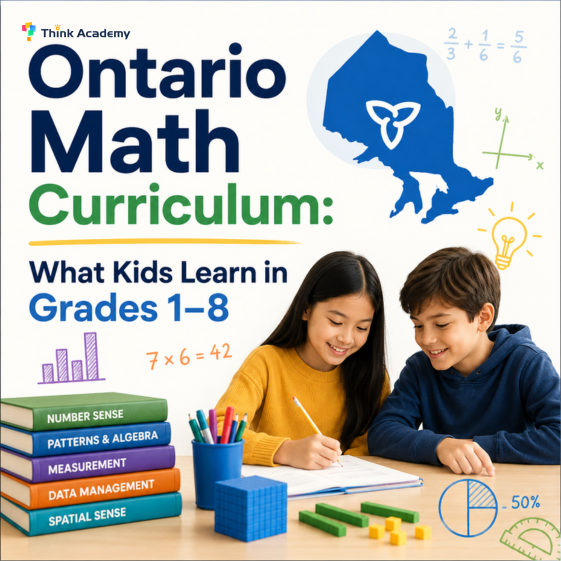
When your child brings home math homework that looks different from how you learned it, it is easy to worry you are missing something important. This Ontario math curriculum overview explains what Ontario students are expected to learn from Grades 1–8, and how skills connect across years. You will get a clear map of the main strands, common parent pain points, and practical ways to support learning at home.

Ontario math curriculum overview: the big picture for parents
Ontario sets province-wide expectations for what students should know and be able to do in math by the end of each grade. Teachers use these expectations to plan lessons and assess progress, while students build skills across connected areas like numbers, geometry, and data. Because expectations are cumulative, gaps in one year can show up as frustration later, especially around fractions and algebra.
For the most authoritative starting point, use the Ontario government curriculum hub, which links to current elementary math curriculum documents and supporting resources from the Ontario Ministry of Education curriculum pages. If you want a plain-language refresher on key concepts, Britannica’s mathematics overview can help you decode terms your child uses at home.
How Ontario structures elementary math (Grades 1–8)
Ontario math expectations are commonly organized into strands, which are broad topic areas that repeat each year with increasing depth. In recent curricula, you will see a strong emphasis on skills students can apply in real life, such as understanding data and developing financial literacy.
At a high level, parents will often hear about these recurring strands:
- Number (counting, place value, operations, fractions, decimals, percents)
- Algebra (patterns, relations, equations, and early function thinking)
- Data (collecting, analyzing, and interpreting information)
- Spatial sense (geometry and measurement)
- Financial literacy (earning, spending, saving, budgeting, and decision-making)
If you want to see grade-by-grade expectations in the official wording, start with Ontario’s curriculum portal and the elementary math resources linked there. For families comparing learning expectations across Canada, the Council of Ministers of Education, Canada offers national context on education systems (helpful for newcomers).
Grade-by-grade learning map (what changes each year)
The most helpful way to read the curriculum is to look for progression. For example, your child moves from counting and composing numbers to operating with larger numbers, then to fractions and proportional reasoning (reasoning about relationships like “twice as much”).
Use this table as a parent-friendly map. It summarizes typical focus areas, while the Ontario documents provide the precise expectations.
| Grade band | Number and operations | Algebra and patterns | Geometry, measurement, data | Financial literacy |
|---|---|---|---|---|
| Grades 1–2 | Place value foundations, addition/subtraction strategies | Repeating patterns, simple relationships | 2D/3D shapes, basic measurement, simple graphs | Needs vs wants, simple coins and bills |
| Grades 3–4 | Multiplication/division concepts, fraction basics | Growing patterns, intro to equations (missing numbers) | Perimeter/area beginnings, data collection and display | Budgeting with simple scenarios, saving goals |
| Grades 5–6 | Fractions and decimals operations, percent concepts | Variables (letters for numbers), expressions (math phrases) | Angle concepts, coordinate grids, data analysis | Comparing prices, value, and basic consumer choices |
| Grades 7–8 | Rational numbers (including negatives), proportional reasoning | Linear relationships, solving equations, more formal algebra | Geometric reasoning, surface area/volume, probability basics | Interest (cost of borrowing), budgeting trade-offs |
When you see new terms like “expressions” or “linear relationships,” they describe how students represent and connect quantities. An expression is a math phrase like 3x + 2, while a linear relationship is a straight-line pattern between two variables (quantities that change).
Common pain points parents notice (and what they usually mean)
Many parent concerns are predictable because certain concepts act like gateways. However, the good news is that small, consistent practice often works better than long drills.
- “My child knows facts but freezes on word problems.” This often points to reading the situation, choosing operations, and checking reasonableness (whether an answer makes sense).
- “Fractions are a constant battle.” This usually means the child needs stronger fraction meaning (part-whole, number line) before procedures.
- “Why are they using multiple strategies?” Ontario emphasizes flexible thinking so students can select efficient methods, not just one memorized algorithm.
- “Algebra seems to appear out of nowhere.” In reality, it starts earlier with patterns, equality, and unknowns, then becomes more formal in Grades 7–8.
To better interpret your child’s progress in Ontario, you can also look at how math is assessed in the province. The EQAO site explains Ontario’s large-scale assessments and provides context on skills like problem solving and reasoning.

What to do at home: practical supports that match Ontario expectations
You do not need to replicate classroom lessons to help. Instead, focus on daily moments that build number sense and reasoning, because those support every strand.
Try these routines, 10 minutes at a time:
- Ask for the estimate first, then the exact answer. Therefore, your child learns to check if results are reasonable.
- Use a number line for fractions and decimals. For example, place 0.4 and 2/5 in the same spot to connect ideas.
- Talk through “why” using simple prompts: “What do you notice?” “What would happen if…?” “How do you know?”
- Use real-life math: grocery comparisons, unit price, recipe scaling, and time planning.
When homework strategies differ from yours, ask your child to teach you their method. This works because explaining strengthens retrieval (pulling information from memory) and reveals gaps without confrontation.
Tools and resources you can trust (official and reputable)
To stay aligned with Ontario expectations, prioritize official curriculum sources first. Then add high-quality practice and explanations that build understanding.
- Ontario Ministry of Education curriculum pages for official curriculum documents and updates
- EQAO for Ontario assessment context and provincial skill focus
- Khan Academy for structured practice with clear videos (use as targeted support, not endless assignments)
- Desmos for graphing and visualizing relationships, especially helpful in Grades 6–8
- GeoGebra for geometry and measurement exploration through interactive models
If your child is curious about math beyond class, Ontario families can also explore well-known Canadian contests through official sources. The University of Waterloo CEMC contests hub explains the Gauss Contest and other options, including who they are for and how schools typically participate.

The strongest takeaway from this Ontario math curriculum overview is that Ontario math is designed to build connected understanding across strands, year after year. Therefore, when you focus on number sense, clear explanations, and small daily practice, you support your child’s learning far beyond a single worksheet. If you want a quick reference while you read curriculum documents, Wikipedia can help you refresh definitions, but always rely on Ontario’s official curriculum for expectations.
In Ontario, Grade 9 is when the math curriculum changes. Math is offered as a de-streamed course, commonly identified by the code MTH1W. Check out Ontario Grade 9 Math Curriculum (MTH1W): Parent Guide to Success.
About Think Academy
Think Academy, part of TAL Education Group, helps K–12 students succeed in school today by building strong math foundations and critical thinking skills. At the same time, we focus on the bigger picture—developing learning ability, curiosity, and healthy study habits that inspire a lifelong love of learning. With expert teachers, proven methods, and innovative AI tools, we support every child’s journey from classroom confidence to long-term growth.