When your child hits Grade 6, math can suddenly feel faster, less familiar, and more “wordy.” Many parents tell me the hardest part is not the arithmetic, but understanding what the school expects and how topics fit together. This article explains the Grade 6 math curriculum in a clear, Canada-focused way, so you can help with confidence. You will also get practical next steps for homework, practice, and progress checks.
For an introduction to the Ontario math curriculum from grades 1-8, read: Ontario Math Curriculum: What Kids Learn in Grades 1–8.
Grade 9 is where the math curriculum changes the most. For more on that, see: Ontario Grade 9 Math Curriculum (MTH1W): Parent Guide to Success.
Grade 6 Math Curriculum Explained: The Big Ideas
Across Canada, Grade 6 math generally moves from “skills practice” toward “using math to reason.” However, specific expectations vary by province and territory. A reliable way to stay aligned is to check your local ministry curriculum page and then use it to interpret your child’s worksheets and report card comments.
For example, Ontario organizes math into strands like Number, Algebra, Data, Spatial Sense, and Financial Literacy. You can review the current structure on the Ontario elementary mathematics curriculum hub. In British Columbia, learning standards are listed by grade on the BC Curriculum website.
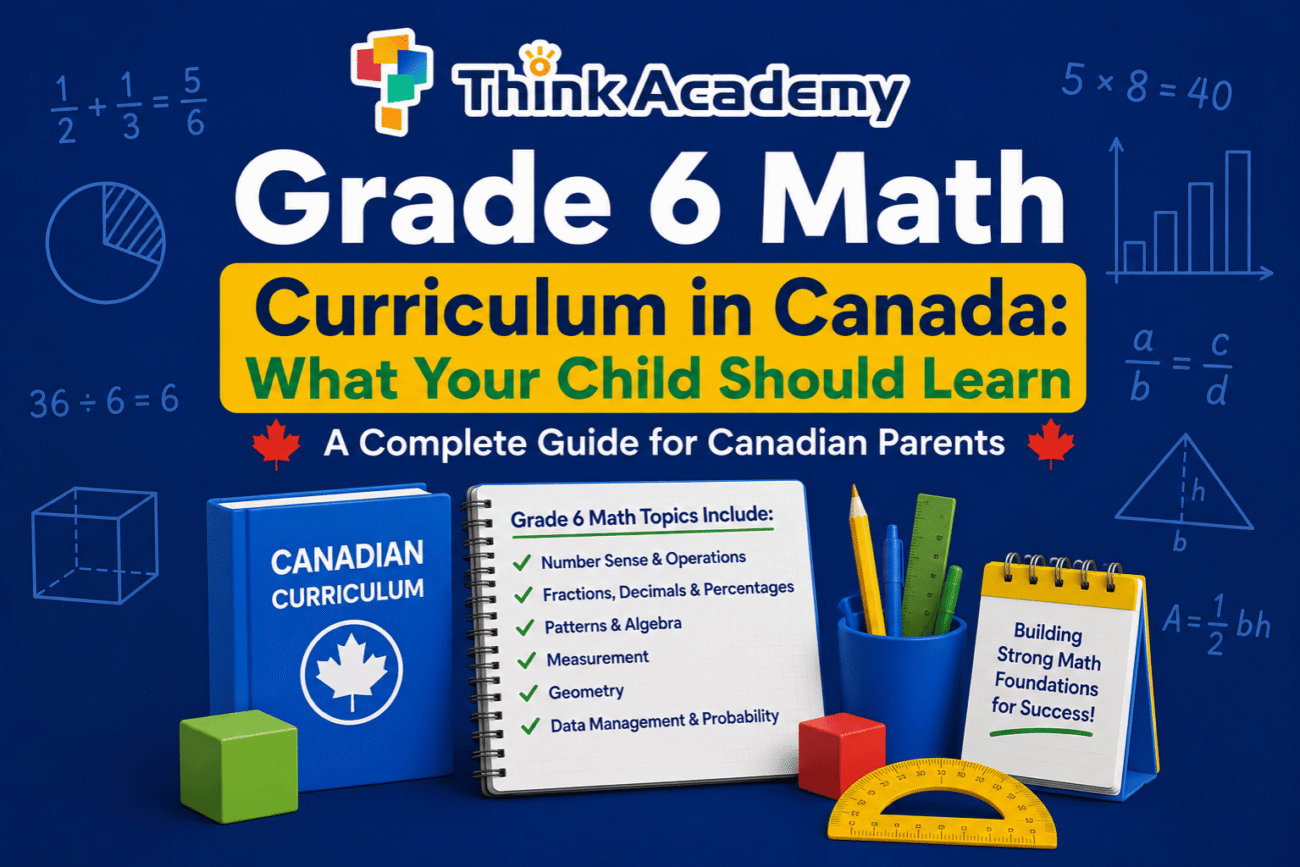
Key Topics Most Grade 6 Students Cover
Even with provincial differences, the same core themes show up in most Canadian classrooms. Therefore, if your family moves between provinces, these skills still transfer well.
- Number sense with fractions, decimals, and percentages
- Ratios and rates (how quantities compare)
- Intro algebra (patterns, expressions, and simple equations)
- Geometry and spatial reasoning (visualizing and describing shapes)
- Measurement (area, perimeter, and volume)
- Data literacy (graphs, averages, and probability basics)
- Financial literacy (money decisions in everyday contexts)
- Problem solving and mathematical reasoning (explaining thinking clearly)
In many provinces, students also practise the “process” side of math: choosing strategies, showing work, and checking whether answers make sense. That emphasis often explains why homework looks different from what parents remember.
Fractions, Decimals, and Percent: Where Confusion Often Starts
In Grade 6, students are expected to move smoothly between fractions, decimals, and percent. However, many children still treat these as three separate topics. You can help by using one idea repeatedly: they are different ways to name the same value.
Here are common Grade 6 expectations you may see:
- Compare and order fractions and decimals using benchmarks (friendly reference points like 0, 0.5, and 1).
- Convert between decimals and percent (for example, 0.25 = 25%).
- Multiply and divide decimals in practical contexts (money, measurement).
- Solve fraction problems using visual models (area models, number lines).
If your child gets stuck, ask them to draw it. For example, a number line can show why 3/4 is greater than 0.7, even if the digits feel confusing.
Ratios and Rates: The “Comparing” Skills That Show Up Everywhere
Ratios compare two quantities, like 2 red blocks for every 3 blue blocks. Rates are ratios with different units, like kilometres per hour. Therefore, these lessons connect directly to recipes, sports stats, and shopping.
At home, you can build ratio thinking with simple prompts:
- Cooking: “If we double this recipe, how many cups do we need now?”
- Shopping: “Which pack is the better deal per 100 grams?”
- Sports: “What is the average points per game?” (average means “typical value,” found by dividing the total by the number of games)
These conversations matter because ratios later support proportional reasoning (thinking about how quantities scale together), which is a key bridge into algebra and science.
Intro Algebra: Patterns, Expressions, and Early Equations
Grade 6 algebra is usually not about complex solving. Instead, it focuses on patterns, variables, and writing math in a more general way. A variable (a letter that stands for a number) helps students describe relationships, not just compute one answer.
You may see tasks like:
- Identify and extend patterns, then explain the rule.
- Write expressions (math phrases like 3n + 2) from a story problem.
- Solve simple equations (like n + 15 = 42) by reasoning or inverse operations (undoing the operation).
If your child dislikes algebra, remind them it is often “pattern spotting with symbols.” For example, building a pattern with tiles and predicting step 10 makes algebra feel concrete.
Want to see whether you’d pass an Intro to Algebra test with your current knowledge? Try our free assessment and get free feedback and resources to study with!
Geometry and Measurement: Area, Volume, and Spatial Sense
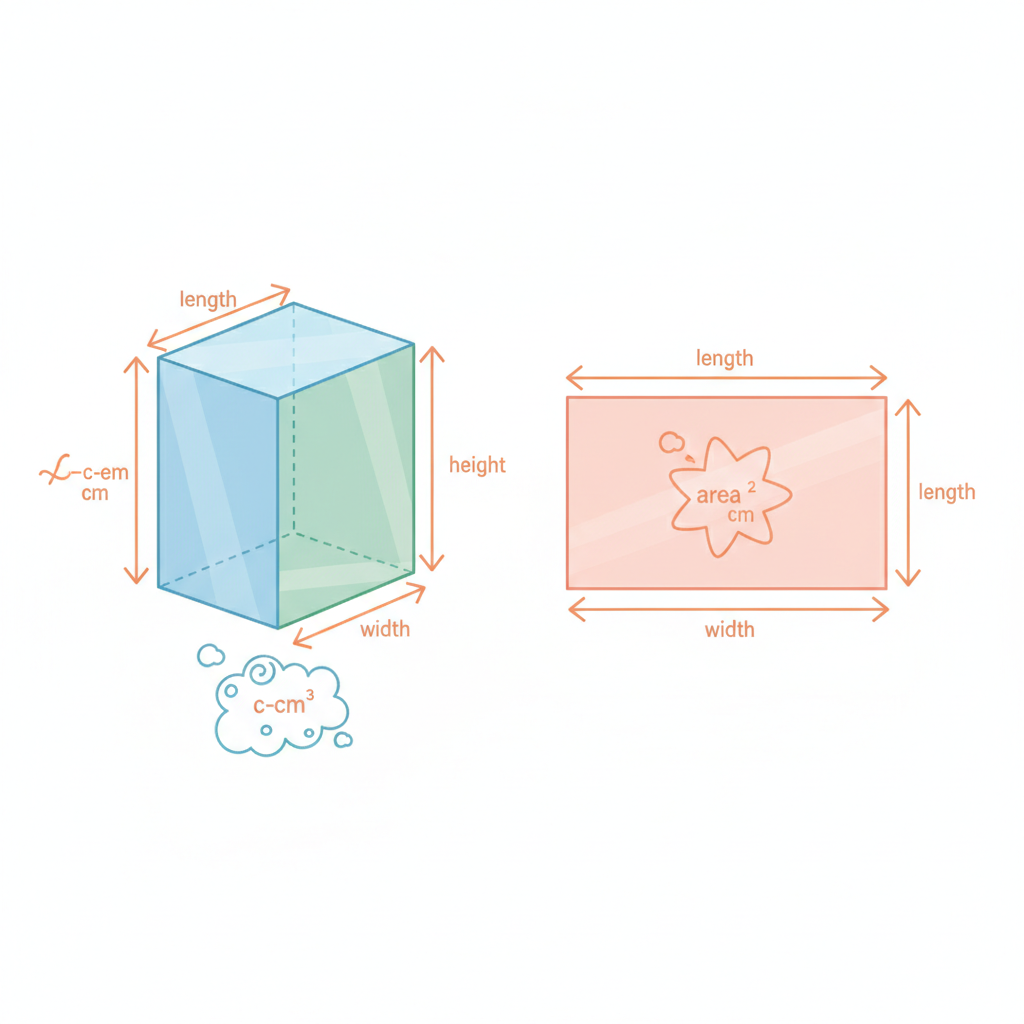
In Grade 6, geometry goes beyond naming shapes. Students often calculate area (space inside a 2D shape), perimeter (distance around), and volume (space inside a 3D object). However, errors often come from mixing up formulas or units.
This quick table can help you coach without overtalking:
| Concept | What it measures | Common units | Typical Grade 6 tasks |
|---|---|---|---|
| Perimeter | Distance around | cm, m | Add side lengths; find missing side |
| Area | Surface coverage | cm², m² | Rectangles, triangles, composite shapes (shapes made of parts) |
| Volume | Space inside a 3D object | cm³, m³ | Rectangular prisms using length × width × height |
A practical home check: ask your child to label units on every final answer. Therefore, even if they forget a step, you can spot whether they are thinking “length” or “area.”
Data and Probability: Reading the World with Graphs
Grade 6 students often interpret and create graphs, and they start to discuss probability. Probability means the chance of something happening, often described from 0 (impossible) to 1 (certain), or as a percentage. Therefore, everyday examples like weather forecasts become learning moments.
Look for these skills:
- Read and compare bar graphs, line graphs, and circle graphs.
- Describe trends (what increases, decreases, or stays steady).
- Calculate mean (average), median (middle), and mode (most frequent), depending on the province.
- Explain simple probabilities using fractions or percent.
When your child answers a data question, ask: “What does the graph actually show?” This encourages evidence-based thinking, not guessing.

Financial Literacy: Math That Feels Real
Many Canadian curricula now include financial literacy as a regular part of math. The Grade 6 math curriculum often involves budgets, saving plans, and making sense of price comparisons. However, it is usually about reasoning, not memorizing banking terms.
Try one low-stress weekly routine:
- Give a small “practice budget” for one family choice (snacks for a movie night).
- Ask your child to estimate total cost, then calculate exactly.
- Compare options and explain which choice fits the budget and why.
This builds number sense and communication at the same time, which matches how math is assessed in many classrooms.
How to Check Progress Without Turning Home Into School
Parents often ask what “on track” looks like. While only your child’s teacher can confirm grading details, you can still look for consistent signals. For example, a child who understands usually explains a strategy, catches mistakes, and adapts when numbers change.
Use this quick checklist during homework:
- Can they restate the problem in their own words?
- Do they choose a reasonable strategy without prompting?
- Can they show work clearly enough to follow later?
- Do they check answers using estimation (a quick “about how much” check)?
If your child struggles, focus on one gap at a time. Therefore, instead of doing more pages, do fewer questions with better explanations.
Tools and Resources Parents Can Trust
When you want practice or clearer explanations, start with official curriculum pages and reputable learning platforms. These sources help you avoid worksheets that teach the wrong method for your province or your child’s grade.
- Ontario elementary math curriculum hub (official expectations and strand structure)
- BC Curriculum (official learning standards by grade)
- Khan Academy Math (free practice and videos; align topics carefully to your province)
- Desmos (free graphing and math activities; useful for patterns and visual reasoning)
- GeoGebra (free geometry and measurement visuals)
For parent-friendly background reading, you can also review definitions and examples of key concepts on Encyclopaedia Britannica and Wikipedia. Use these to clarify terms like ratio, variable, and probability, then return to your child’s assigned work.
Grade 6 is a turning point: students shift from computing answers to explaining thinking, comparing strategies, and applying math in real situations. With the Grade 6 math curriculum explained in a calm, structured way, you can support your child through fractions-to-percent connections, early algebra, measurement, and data skills without daily conflict. Start by checking your provincial curriculum, then pick one routine at home that builds confidence week by week.
About Think Academy
Think Academy, part of TAL Education Group, helps K–12 students succeed in school today by building strong math foundations and critical thinking skills. At the same time, we focus on the bigger picture—developing learning ability, curiosity, and healthy study habits that inspire a lifelong love of learning. With expert teachers, proven methods, and innovative AI tools, we support every child’s journey from classroom confidence to long-term growth.