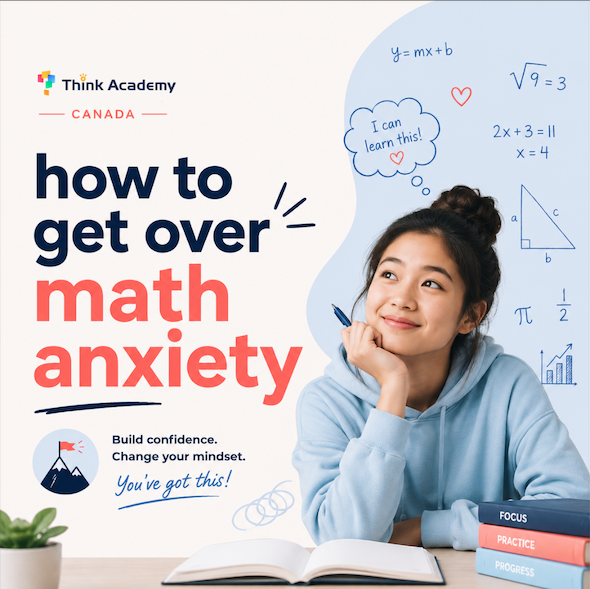
For many parents, the thought of their child participating in a math competition can bring mixed emotions. While opportunities for growth are clear, concerns about contest anxiety and confidence often arise. Understanding how to support your child through this challenge is paramount, transforming potential stress into a valuable learning journey. This guide offers practical advice on how to get over math anxiety to help your child approach math contests with a positive mindset and a robust belief in their abilities.

Understanding Math Competitions in Canada
Canadian math competitions offer unique opportunities for students to develop problem-solving skills and critical thinking. These contests, such as the ones organized by the University of Waterloo’s Centre for Education in Mathematics and Computing (CEMC) and the American Mathematics Competitions (AMC), are popular for young learners. They are not merely tests; they are platforms for students to explore mathematics beyond the classroom curriculum, engaging with challenging and creative problems. Participating in these events can significantly boost a child’s interest in mathematics, fostering a deeper appreciation for the subject.
However, the competitive nature can also introduce pressure for some students. Parents often wonder about the right age to start or which competition best suits their child’s abilities and personality. When their children are enrolled in math contests, the question often shifts to how to get over math anxiety to ease their children’s nerves.The goal is always to encourage a love for learning, not just to win. Therefore, understanding the landscape of available competitions helps parents guide their children appropriately, ensuring a positive and enriching experience.
Strategies for Building Contest Confidence: How to Get Over Math Anxiety
Addressing contest anxiety and confidence involves a multi-faceted approach, focusing on preparation, mindset, and ongoing support. Adequate preparation is a cornerstone, equipping children with the tools and knowledge needed to tackle complex problems. This does not mean endless drilling but rather a strategic understanding of common question types and problem-solving techniques. For instance, many competitions, like the Gauss Contest for Grades 7 and 8, emphasize logical reasoning and conceptual understanding over rote memorization.
One answer to the question of how to get over math anxiety is by de-emphasizing the outcome and highlighting the learning process. Encourage your child to view challenges as opportunities to grow rather than tests of their inherent intelligence. Furthermore, teaching effective test-taking strategies, such as time management and how to approach difficult questions, can significantly reduce pre-contest jitters. Discussing past contest questions from official sources, like the CEMC website, can also familiarize children with the format and style, making the actual competition less intimidating.
Creating a calm and supportive home environment before a contest is also crucial. Ensure your child gets adequate rest and a nutritious meal. Remind them that their effort and learning are what truly matter, irrespective of the final score. Exploring different problem-solving methods, perhaps through resources like Britannica’s articles on mathematical logic, can further expand their toolkit. This holistic approach helps to build resilience and fosters a positive attitude towards academic challenges.

The Enduring Value of Math Competitions
Participating in math competitions offers benefits far beyond academic scores; it instills a lifelong love for learning and problem-solving. Children learn to persist through challenging problems, develop analytical thinking, and gain resilience in the face of setbacks. These experiences also help them understand that failure is a part of growth, providing valuable lessons in perseverance and critical self-reflection. The skills honed in these contests are transferable, aiding success in various academic subjects and future careers.
Moreover, these competitions provide a sense of community among young mathematicians. Students meet peers who share similar interests, fostering healthy competition and collaboration. Many Canadian universities, such as the University of Toronto, recognize the value of participation in such activities, as they demonstrate initiative and a strong academic foundation. Therefore, encouraging your child to participate, even if just for the experience, can open doors to new friendships and academic pathways. The ultimate goal is to nurture a curious, confident, and capable learner, equipped for any intellectual challenge.
About Think Academy
Think Academy helps K–12 students succeed in school today by building strong math foundations and critical thinking skills. At the same time, we focus on the bigger picture—developing learning ability, curiosity, and healthy study habits that inspire a lifelong love of learning. With expert teachers, proven methods, and innovative AI tools, we support every child’s journey from classroom confidence to long-term growth.