The area and surface area of a cylinder is one of the most heavily tested topics on the EQAO Grade 9 assessment and shows up repeatedly across Grade 10 and 11 Ontario math. It’s also a topic where students lose easy marks: not because the formulas are difficult, but because it’s easy to mix up the two circular ends, the curved side, and the volume — three different quantities that look similar on paper. This guide walks through the cylinder formulas step by step, derives them from scratch so they actually stick, and works through five examples at increasing difficulty, including EQAO-style problems.
For more on the EQAO, check out EQAO Grade 9: A Complete Guide for Ontario Students and Parents.
By the end, you should be able to find the area of any circular face, the lateral surface area, and the total surface area of a cylinder without looking anything up.
Want to see whether you’d pass an EQAO test with your current knowledge? Try our free EQAO assessment and get free feedback and resources to study with!

What is a cylinder?
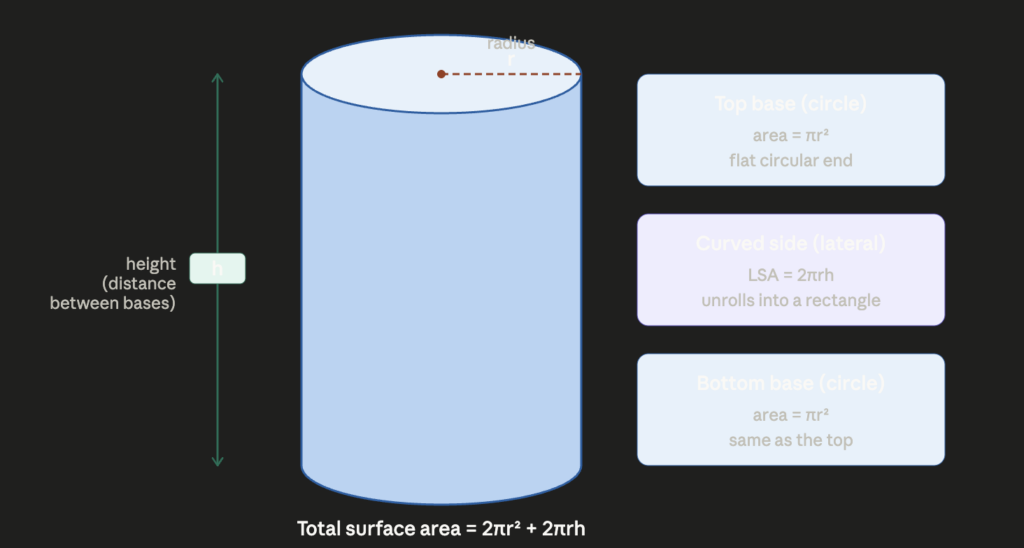
A cylinder is a three-dimensional solid with two parallel circular faces of equal size connected by a curved surface. The two flat ends are called the bases. The curved surface wrapping around the sides is called the lateral surface.
Every cylinder has three measurements that matter:
- The radius (r) — the distance from the centre of a circular base to its edge
- The diameter (d) — the distance across the circle through the centre; d = 2r
- The height (h) — the distance between the two bases
These three measurements are all you need to find every area and volume associated with the cylinder. The trick is keeping straight which formula uses which measurement.
Right cylinders vs oblique cylinders
In Grade 9, every cylinder you’ll see is a right cylinder, meaning the sides are perpendicular to the bases. An oblique cylinder, where the sides lean at an angle, exists but isn’t tested at this level. If a problem doesn’t specify, assume it’s a right cylinder.
The three “area” quantities of a cylinder
Students often lose marks because they confuse three different quantities, all of which involve the word “area” and all of which apply to a cylinder. Here are the three, clearly separated.
| Quantity | What it measures | Formula |
|---|---|---|
| Area of a circular base | The flat area of one end of the cylinder | A = πr² |
| Lateral surface area | The area of the curved side only | LSA = 2πrh |
| Total surface area | All three surfaces combined (top, bottom, and curved side) | TSA = 2πr² + 2πrh |
These three quantities answer three different questions:
- “How much pizza fits on one circular base?” — Area of a base
- “How much wrapping paper covers just the side of a soup can?” — Lateral surface area
- “How much paint covers the entire outside of a closed can?” — Total surface area
If a question asks about a closed cylindrical container (a soda can, a closed tank), use total surface area. If it asks about an open cylinder (a pipe, an open tube), you’ll need to subtract one or both circular bases.
Area of a circular base
The two ends of a cylinder are identical circles. The area of one circle is given by the classic formula:
A = πr²
Where r is the radius and π ≈ 3.14159.
Example 1 — area of a base
A cylinder has a radius of 5 cm. Find the area of one of its circular bases.
A = πr² A = π × 5² A = 25π cm² A ≈ 78.5 cm²
EQAO and most Ontario teachers accept either the exact answer (25π cm²) or the decimal approximation (78.5 cm²). When in doubt, give both. The exact answer is preferable when no rounding instruction is given.
Common mistake
Squaring the diameter instead of the radius. If a problem tells you the diameter is 10 cm, the radius is 5 cm, and you square the 5, not the 10. Sketch the cylinder, label the diameter and radius separately, and you’ll catch this every time.
Lateral surface area of a cylinder
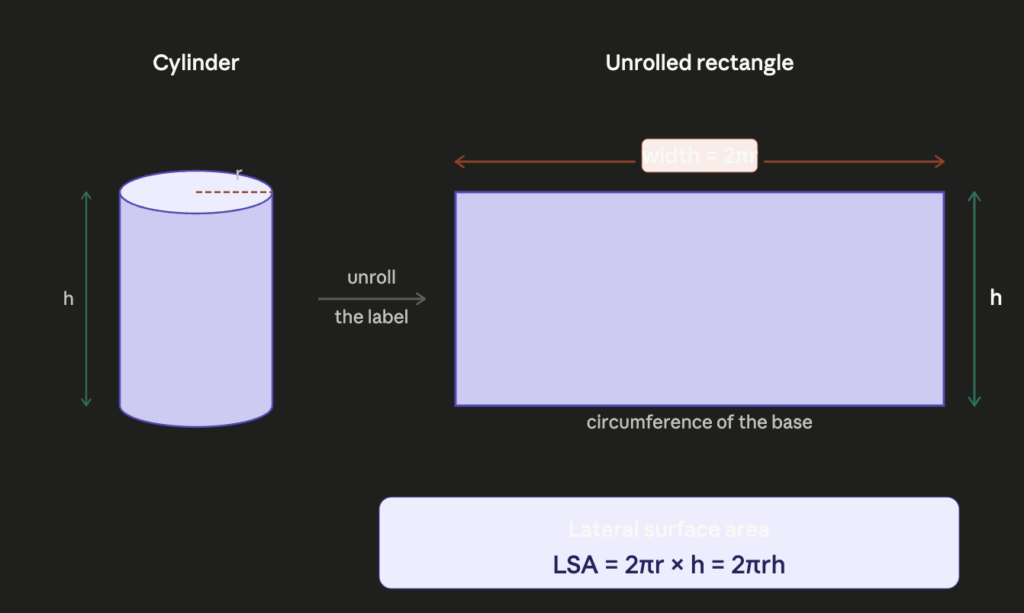
The lateral surface area is the area of the curved side only, not counting the top or bottom. This is the trickier formula because the curved surface doesn’t look like a rectangle, but it actually unrolls into one.
Where the formula comes from
Imagine taking a soup-can label and peeling it off. You can flatten it into a rectangle. The rectangle has:
- A height equal to the cylinder’s height (h)
- A width equal to the circumference of the circular base (2πr), because the label wraps once around the can
The area of this rectangle is:
LSA = 2πr × h = 2πrh
This is the lateral surface area of a cylinder formula. Understanding the derivation matters because students who learn it this way rarely forget the formula under exam pressure.
Example 2 — lateral surface area
A cylindrical pipe has a radius of 3 cm and a height of 10 cm. Find the lateral surface area.
LSA = 2πrh LSA = 2 × π × 3 × 10 LSA = 60π cm² LSA ≈ 188.5 cm²
When to use lateral surface area on its own
EQAO problems often ask for lateral surface area when describing:
- The label area on a soup can or soda can
- The painted area on a column or pillar
- The metal needed to make an open pipe with no ends
- Any open-ended cylindrical object
Read the question carefully. If it mentions “label,” “side only,” “without the ends,” or “open at the top and bottom,” it’s a lateral surface area question.
Total surface area of a cylinder
The total surface area of a closed cylinder is the sum of:
- Two circular bases (top and bottom)
- The lateral surface (curved side)
Combining the formulas:
TSA = 2πr² + 2πrh
Or, factored: TSA = 2πr(r + h)
Either form is acceptable. The factored form is faster for mental arithmetic; the expanded form makes it clearer where each piece comes from.
Example 3 — total surface area of a closed can
A closed cylindrical can has a radius of 4 cm and a height of 12 cm. Find the total surface area.
Step 1: Area of two bases 2πr² = 2 × π × 4² = 2 × π × 16 = 32π cm²
Step 2: Lateral surface area 2πrh = 2 × π × 4 × 12 = 96π cm²
Step 3: Add them TSA = 32π + 96π = 128π cm² TSA ≈ 402.1 cm²
Always lay out the work in steps. EQAO and Ontario teachers award part marks for correct method even when the final number is wrong, but only if the working is clear enough to follow.

Volume of a cylinder
While this guide focuses on area and surface area, volume is closely related and shows up in the same EQAO problems often enough that it’s worth covering together.
The volume of a cylinder is the area of the base times the height:
V = πr²h
The units are cubic units (cm³, m³), not square units. This is a common error: students who write the volume in cm² instead of cm³ lose a mark even when the number is right.
Example 4 — volume
A cylindrical water tank has a radius of 2 m and a height of 5 m. Find its volume.
V = πr²h V = π × 2² × 5 V = π × 4 × 5 V = 20π m³ V ≈ 62.8 m³
Surface area vs volume — which one is the question asking?
| If the question asks about… | Use… |
|---|---|
| The amount of paint or label needed | Surface area |
| The amount of water or material that fits inside | Volume |
| The wrapping paper around a can | Lateral surface area |
| The total outside skin of a sealed container | Total surface area |
| The capacity of a tank | Volume |
The word “capacity” almost always signals volume. The words “covers,” “paint,” “label,” “wrap,” almost always signal surface area.
Cylinder formula summary
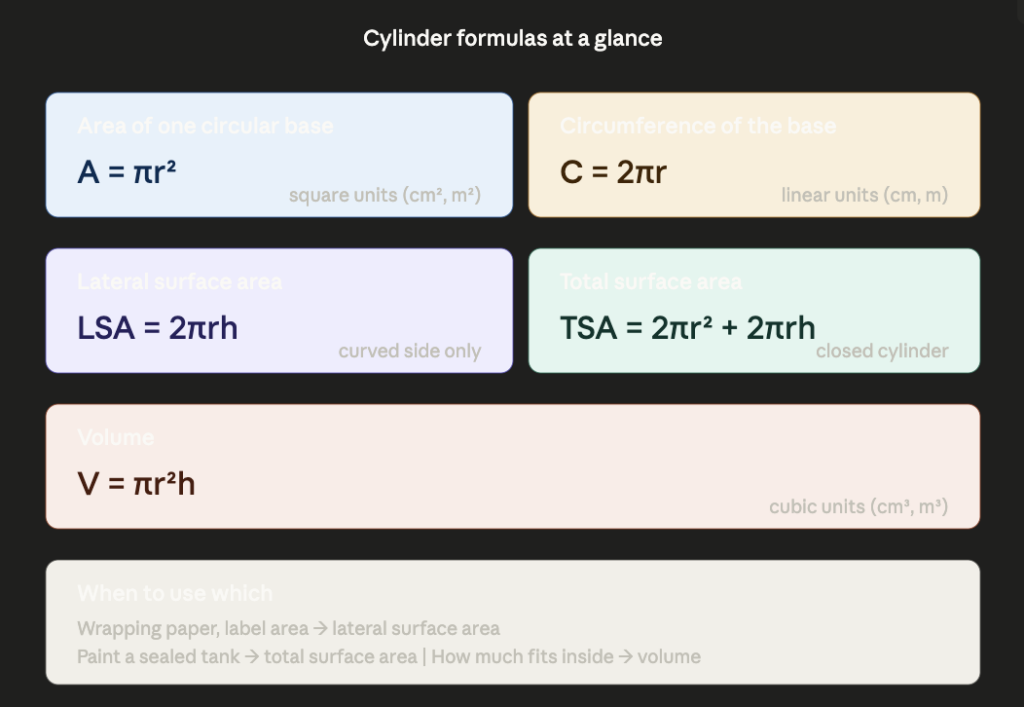
The full set of cylinder formulas every Grade 9 student should know cold:
| Quantity | Formula | Units |
|---|---|---|
| Area of one circular base | πr² | square units (cm², m²) |
| Circumference of base | 2πr | linear units (cm, m) |
| Lateral surface area | 2πrh | square units |
| Total surface area (closed) | 2πr² + 2πrh | square units |
| Volume | πr²h | cubic units (cm³, m³) |
These formulas appear on the EQAO formula sheet, so students will have them during the test. But knowing them by memory is faster, and more importantly, recognising when to use each one is what the EQAO actually tests. The formula sheet doesn’t help if you can’t tell whether a problem needs lateral surface area or total surface area.
EQAO-style cylinder problems
These are the kinds of cylinder problems that appear on the actual EQAO Grade 9 assessment. Each is worked through in full.
Example 5 — composite shape (EQAO Level 3 difficulty)
A cylindrical silo has a radius of 6 m and a height of 15 m. The silo is open at the top and closed at the bottom. How much sheet metal is needed to build the silo?
This is an open cylinder (open at the top), so we need:
- The lateral surface area (the curved side)
- One circular base (the bottom only, not the top)
Step 1: Lateral surface area LSA = 2πrh = 2 × π × 6 × 15 = 180π m²
Step 2: One circular base A = πr² = π × 6² = 36π m²
Step 3: Total Sheet metal needed = 180π + 36π = 216π m² ≈ 678.6 m²
Notice this is not total surface area, because the top is open. EQAO loves this kind of question because it punishes students who blindly apply TSA = 2πr² + 2πrh without thinking about which surfaces are actually present.
Example 6 — working backwards (EQAO Level 4 difficulty)
A cylindrical container has a total surface area of 100π cm² and a radius of 5 cm. Find its height.
We know TSA = 2πr² + 2πrh, so:
100π = 2π(5²) + 2π(5)h 100π = 50π + 10πh
Divide everything by π: 100 = 50 + 10h
Subtract 50: 50 = 10h
Divide by 10: h = 5 cm
The container has a height of 5 cm. This is a typical Level 4 question because it tests whether the student can use the formula in reverse, which requires genuine understanding rather than substitution.
Example 7 — real-world EQAO context
A factory makes cylindrical aluminium cans for soup. Each can has a radius of 3.5 cm and a height of 11 cm. The factory paints the lateral surface only (the labels are paper, but the curved metal underneath is painted). How much paint, in cm², is needed to coat 100 cans?
LSA per can = 2πrh = 2 × π × 3.5 × 11 = 77π cm²
For 100 cans: Total = 100 × 77π = 7700π cm² ≈ 24,190 cm²
The decimal answer rounds to roughly 24,189.96 cm². EQAO usually accepts 24,190 cm² or 7700π cm². When a question doesn’t specify a rounding instruction, students should give both the exact and the approximate answer.
Common mistakes to avoid
After marking thousands of EQAO-style Grade 9 papers, the same handful of errors come up over and over.
- Using diameter instead of radius. If the problem says “diameter = 10 cm,” the radius is 5 cm. Always re-read the question and label your diagram.
- Mixing up the lateral and total surface area formulas. Lateral is 2πrh. Total is 2πr² + 2πrh. The extra 2πr² is the two circular ends. Sketch the cylinder and ask: am I including the ends?
- Forgetting to include both circular bases. Total surface area uses 2πr², not πr², because there are two ends (top and bottom).
- Wrong units. Surface area is in square units (cm², m²); volume is in cubic units (cm³, m³). Mixing these is one of the easiest marks to lose.
- Open vs closed cylinders. If the cylinder is open (no top, no bottom, or neither), subtract the missing bases from the total surface area. Read the question carefully for clues like “open at the top” or “no lid.”
- Calculator misuse. Students often press π × 5² and get something unexpected because they squared π too. Use brackets or compute πr² as (π) × (r × r) explicitly.
- Premature rounding. Don’t round 25π to 78.5 in the middle of a multi-step calculation. Carry the exact value (or at least four decimal places) until the very end.
How cylinders connect to senior math and contests
Cylinder formulas are not just a Grade 9 topic. They reappear constantly:
- Grade 10 (MPM2D) — More complex composite solids involving cylinders, cones, and spheres. The Grade 9 formulas are assumed knowledge.
- Grade 11 (MCR3U Functions) — Cylinders appear in optimisation problems: find the dimensions of a can with minimum surface area for a given volume.
- Grade 12 (MCV4U Calculus & Vectors) — Optimisation problems involving cylinders are a classic calculus topic. Strong Grade 9 cylinder fluency makes Grade 12 dramatically easier.
- Math contests — Cayley, Fermat, Euclid, AMC 10, and AMC 12 all use cylinders in geometry problems. A typical Cayley Part B problem might inscribe a cone inside a cylinder and ask for a volume or surface area ratio.
Students preparing for the Pascal, Cayley, or Fermat contests should treat the Grade 9 cylinder material as the floor, not the ceiling. The contests expect students to recognise cylinders inside more complex shapes, not just plug numbers into formulas.
How Think Academy Canada teaches cylinder geometry
Think Academy is the international arm of TAL Education Group, one of the largest education companies in the world. Our Canadian programs build geometry the same way we build every other topic: derivation first, then memorisation, then application across increasing difficulty levels.
For cylinder problems specifically:
- We teach the unrolling-the-label derivation before we teach the lateral surface area formula. Students who understand why LSA = 2πrh are far less likely to forget it under EQAO pressure than students who just memorised it. For more on area, see Area and Perimeter Worksheets: How to Solve Every AMC 8 Geometry Problem.
- Our curriculum runs ahead of the Ontario MTH1W timeline. Grade 8 students at Think Academy meet cylinders before their Grade 9 school classmates do, which means EQAO Grade 9 cylinder questions become straightforward review rather than new content.
- Built-in interactive practice. Every concept has dozens of practice problems in the app, scaling from school-level questions up to Fermat and AMC contest problems involving cylinders.
- Mock EQAO sessions. In the weeks before each testing window, we run timed practice tests on a computer-based interface similar to the real EQAO platform.
- Free resources before you commit. Cylinder practice sheets, a free MTH1W evaluation, and access to our problem library are available before signing up for a paid program.
- Teachers who mark homework personally. Every homework set is reviewed by the teaching team, with feedback on where the student needs to focus.
Frequently asked questions
What is the surface area of a cylinder formula?
The total surface area of a closed cylinder is TSA = 2πr² + 2πrh, where r is the radius and h is the height. The first term covers the two circular ends; the second term covers the curved lateral surface.
What is the lateral surface area of a cylinder?
The lateral surface area is the area of the curved side only, excluding the two circular ends. The formula is LSA = 2πrh. You can derive it by imagining unrolling the curved side into a rectangle of height h and width equal to the base’s circumference (2πr).
What is the volume of a cylinder?
The volume of a cylinder is V = πr²h. It measures how much space the cylinder contains, and is given in cubic units (cm³, m³).
What is the difference between surface area and volume of a cylinder?
Surface area measures the outside skin of the cylinder (in square units like cm²). Volume measures the space inside (in cubic units like cm³). A water tank’s capacity is volume; the amount of paint to coat the tank is surface area.
How do you find the area of a cylinder for EQAO?
EQAO problems usually ask for either lateral surface area, total surface area, or volume. Read the question carefully for clues: “label” or “wrap” usually means lateral surface area, “paint the outside” usually means total surface area, “capacity” or “how much fits inside” means volume.
Is the cylinder formula on the EQAO Grade 9 formula sheet?
Yes. The EQAO Grade 9 formula sheet includes πr², 2πrh, 2πr² + 2πrh, and πr²h. Students should still know these by heart because the formula sheet doesn’t tell you which formula to use, only what each one is.
How do you find the surface area of an open cylinder?
An open cylinder is one missing either the top, the bottom, or both. Start with the total surface area formula (2πr² + 2πrh) and subtract πr² for each missing end. An open-top cylinder has surface area πr² + 2πrh; a cylinder open at both ends has surface area 2πrh (just the lateral surface).
What’s a common cylinder mistake on EQAO?
Confusing radius and diameter. If the problem gives the diameter, divide by 2 to get the radius before plugging into the formula. The second most common mistake is using square units when the answer should be cubic units (or vice versa).
How can my child practise cylinder problems for EQAO Grade 9?
Work through the five examples in this guide, then attempt the official EQAO Grade 9 sample test (free from eqao.com). Focus on questions that combine cylinders with other shapes (cones, prisms) since these composite problems are where most students lose marks at the Level 3 / Level 4 boundary.