The EQAO Grade 9 practice test is the single most useful preparation tool for the Ontario provincial math assessment. EQAO publishes a free official sample test that uses the same computer-based interface as the real assessment, and there are plenty of additional resources that go deeper. The problem most Grade 9 students face isn’t a shortage of practice material — it’s not knowing which resources are actually worth their time, how to use them properly, and how to translate practice into a better mark. This guide walks through the official EQAO practice resources, the EQAO Grade 9 formula sheet, where to find Grade 9 EQAO practice test with answers in PDF format, and a structured plan for grade 9 math EQAO practice that actually moves the needle. If you’re new to EQAO Grade 9 generally, start with our complete guide to the EQAO Grade 9 assessment for the full background on what the test covers and how it’s scored.
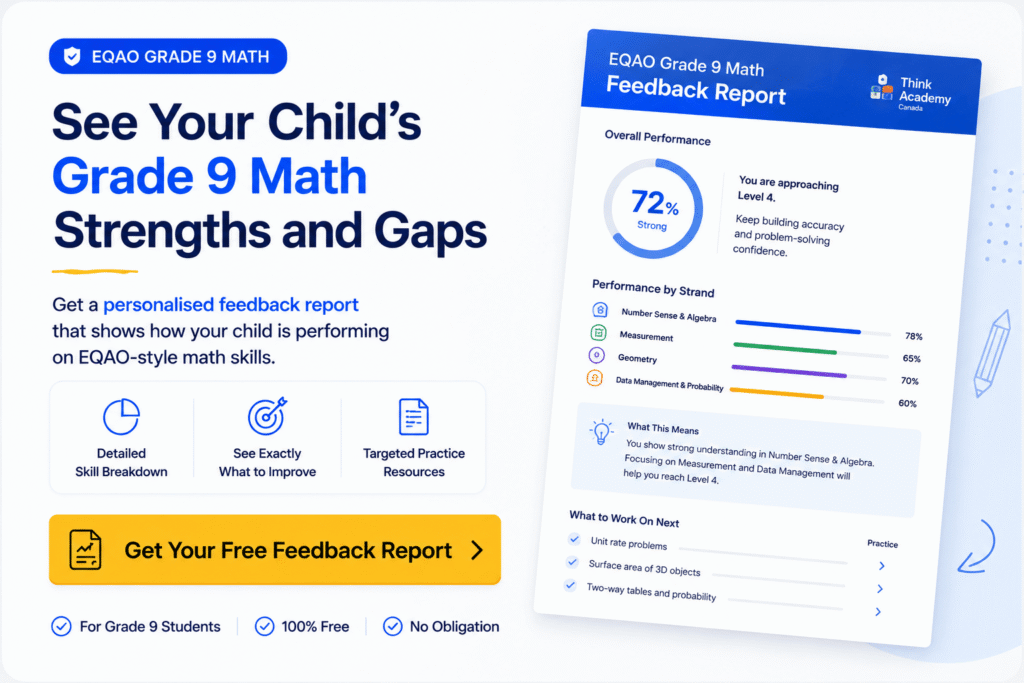
Want to see whether you’d pass the EQAO test with your current knowledge? Try our free EQAO assessment and get free feedback and resources to study with!

Why the EQAO Grade 9 practice test matters
Most Grade 9 students walk into the EQAO assessment without ever having tried the actual computer-based interface. They’ve done plenty of school math, plenty of textbook problems, plenty of homework — but the EQAO platform itself, with its on-screen calculator, drag-and-drop questions, and built-in formula sheet, is genuinely different from anything they’ve used before.
A practice test does three things that classroom math doesn’t:
It exposes the student to the real interface before test day, so they don’t waste their first 10 minutes figuring out how the platform works.
It reveals which strands are weakest, so the remaining preparation time can be spent where it matters rather than reviewing topics the student already knows.
It builds timing intuition. The Grade 9 assessment isn’t brutally time-pressured, but students who haven’t practised pacing themselves often spend too long on early questions and run out of time at the end.
Skipping the practice test entirely is the single biggest preparation mistake students make. Even one timed sitting of the official sample test, two or three weeks before the real thing, materially improves outcomes.
The official EQAO Grade 9 practice test
EQAO publishes a free, complete EQAO Grade 9 practice test on its official website. This is the resource every Grade 9 student should start with, because it’s the only one that uses the exact computer-based interface, question formats, and difficulty calibration of the real assessment.
What’s in the official practice test
The official EQAO Grade 9 sample test contains:
- A full-length practice version with questions across all six MTH1W strands
- The same computer-based interface as the real assessment
- The on-screen calculator students will have on the real test
- The official EQAO formula sheet as a built-in reference
- Drag-and-drop, multiple choice, and open-response question types
The sample test is not graded automatically and doesn’t give a Level 1 to 4 score, but EQAO publishes the answer key separately so students or parents can mark it manually.
How to access the practice test
The practice test is available free at eqao.com. There’s no login required and no time limit on when you can use it. Students can attempt it multiple times, though after the first attempt the value diminishes because the questions become familiar.
The platform works on most modern browsers. EQAO recommends Chrome or Edge on a laptop or desktop for the closest match to the real test environment.
The EQAO formula sheet Grade 9
Students taking the EQAO Grade 9 assessment have access to a built-in EQAO formula sheet Grade 9 version throughout the test. Knowing what’s on it (and what isn’t) is part of preparation.
What’s on the EQAO Grade 9 formula sheet
The formula sheet covers the most heavily tested formulas across the MTH1W curriculum:
| Category | Formulas included |
|---|---|
| Linear relationships | Slope formula, point-slope form, slope-intercept form |
| Pythagorean theorem | a² + b² = c² |
| Area formulas | Rectangle, triangle, trapezoid, circle, parallelogram |
| Surface area | Cylinder, cone, sphere, prism |
| Volume | Prism, cylinder, cone, sphere, pyramid |
| Financial literacy | Simple interest (I = Prt), compound interest |
For the full breakdown of cylinder formulas specifically — which is the single highest-tested topic in the geometry strand — see our area and surface area of cylinder guide.
What’s NOT on the formula sheet
Equally important to know what’s missing:
- Quadratic formula (not tested in Grade 9, but students sometimes panic looking for it)
- Trigonometric ratios (also not tested at this level)
- Mean, median, mode, range definitions (students are expected to know these by memory)
- The relationship between slopes of parallel and perpendicular lines (students need to know these directly)
- Integer rules, fraction operations, and order of operations
The formula sheet is a reference for formulas, not a complete cheat sheet. The biggest preparation mistake is assuming the formula sheet will rescue you on test day. It only rescues you if you remembered to look — and only for formulas, not concepts.
How to use the formula sheet during practice
Treat it as a safety net, not a study aid:
- During practice tests, try to solve each question without looking at the formula sheet first
- Only refer to the sheet if you genuinely can’t recall a formula
- Track how often you use it; the goal is to need it less and less as preparation progresses
- On test day, the sheet should be a backup for momentary blanks, not your primary working tool
Students who lean on the formula sheet from the start often struggle on questions where the application of the formula is the hard part — and the sheet gives no help there.

Grade 9 EQAO practice test with answers PDF
A lot of students search for grade 9 EQAO practice test with answers PDF because they want to print the test, write on it by hand, and check their work afterward. This is a legitimate preparation method, especially for students who learn better with pen and paper than on a screen. Here’s where to find PDF versions and how to use them effectively.
Official PDF resources
EQAO doesn’t publish the full sample test as a downloadable PDF, because the real assessment is computer-based and the practice version is designed to mirror that. However, EQAO does publish:
- Released items — Individual past questions with answers and explanations, available as PDFs organised by strand
- Framework documents — Detailed breakdowns of what each strand tests, available as PDFs
- Annual results reports — Aggregate performance data, which sometimes includes sample questions
All of these are free from eqao.com.
Third-party PDF practice tests
Several Ontario tutoring organisations and teachers publish unofficial grade 9 EQAO practice test with answers PDF documents. Quality varies. The better ones:
- Match the current MTH1W curriculum (post-2021 de-streamed version, not pre-2021 Academic/Applied)
- Cover all six strands proportionally
- Include detailed worked solutions, not just answer keys
- Use the same question style and difficulty as the official EQAO
Treat third-party PDFs as supplementary practice, not replacements for the official EQAO sample test. The real assessment is computer-based, and printed PDFs miss the drag-and-drop interactions and on-screen calculator that students need to be familiar with.
How to use a printed practice test effectively
If you’re working through a PDF version at home:
- Sit it under timed conditions — 60 to 90 minutes, no help
- Mark it using the answer key the same day, while the questions are still fresh
- Redo every question you got wrong, this time without looking at the solution
- Then read the worked solution, even for questions you got right (there’s often a faster method)
- Tag each mistake by type: concept gap, careless arithmetic, misread the question, or ran out of time
After three or four practice tests with this method, patterns emerge that show exactly where the student should focus their remaining preparation time.
A structured Grade 9 math EQAO practice plan
The biggest mistake students make is treating EQAO preparation as a sprint in the final two weeks. Here’s the 8-week grade 9 math EQAO practice plan we use at Think Academy Canada with students aiming for Level 3 or Level 4.
Weeks 1–2: Diagnose
Sit the official EQAO Grade 9 practice test under timed conditions. Mark it carefully and record three numbers: the total score, the score by strand (Number, Algebra, Data, Geometry, Financial Literacy), and the topics where mistakes clustered. Identify the two weakest strands. These become the priority for the next four weeks.
For most Ontario students, the weakest strands tend to be Financial Literacy (because it’s new to the post-2021 curriculum and many students were taught from older resources) and Geometry/Measurement (especially surface area and volume of 3D solids).
Weeks 3–6: Targeted topic work
Spend two weeks each on the two weakest strands. Twenty focused minutes a day, five days a week, on a single topic produces more progress than three hours on Sunday.
For Algebra weaknesses, focus on solving linear equations with fractions, working with inequalities, and recognising linear relationships from graphs and tables.
For Geometry weaknesses, prioritise cylinders, cones, and spheres since composite shapes appear regularly.
For Financial Literacy, drill simple and compound interest, currency exchange, and budgeting word problems. Make sure the student is comfortable with the formulas I = Prt and A = P(1 + r/n)^(nt).
For Number, work through integer operations, fraction arithmetic, percentages, and exponent rules.
Weeks 7–8: Practice test rotation and rehearsal
Aim for one full practice test per week, both under timed conditions on the EQAO computer-based platform. After each test, run a 60–90 minute post-mortem: redo every question missed without looking at the solution first, then read the official explanation.
Build a personal “cheat sheet” of formulas and concepts the student keeps forgetting. They won’t be allowed to use it on the real test, but the act of writing it out cements the content.
In the final week, also practise on the actual EQAO computer-based platform at least twice more. The interface itself catches some students off guard on the real day.
Strand-by-strand practice priorities
The EQAO Grade 9 assessment covers six strands, but they’re not equally weighted in terms of where students typically lose marks. Here’s where the highest-value practice time should go.
Linear relationships and slope (Algebra strand)
The single most important topic on the test, and the single highest-leverage area for practice. Students should drill:
- Finding the slope between two points
- Writing equations in slope-intercept form (y = mx + b) and point-slope form
- Identifying parallel and perpendicular lines from their slopes
- Graphing linear equations by hand
- Interpreting slope and y-intercept in real-world contexts
This topic alone accounts for roughly 15–20% of the EQAO Grade 9 assessment. It’s also the foundation for Grade 10, 11, and 12 math, so the practice compounds.
Surface area and volume of 3D solids (Geometry strand)
Especially cylinders, which appear on almost every EQAO Grade 9 paper. See our complete cylinder guide for formulas, derivations, and worked EQAO-style examples. Cones, spheres, and composite shapes (a cone on top of a cylinder, for example) also appear regularly.
Solving linear equations and inequalities (Algebra strand)
One-variable equations with fractions, distributing brackets, isolating variables on both sides. Students should also be comfortable representing inequality solutions on a number line.
Financial literacy (Financial Literacy strand)
Simple interest (I = Prt) and compound interest appear regularly, as do currency exchange and basic budgeting scenarios. This strand confuses students taught from older resources, so make sure the practice material is post-2021.
Integer and fraction operations (Number strand)
Often dismissed as elementary, but errors here account for a surprising number of lost marks across every other strand. A student who consistently makes sign errors when adding negative numbers, or who can’t add fractions with different denominators under time pressure, loses marks on questions that have nothing to do with integers or fractions specifically.
Data interpretation (Data strand)
Reading box-and-whisker plots, calculating mean, median, mode, and range from data sets, and answering basic probability questions involving one or two events.
Common practice mistakes to avoid
After working with thousands of Grade 9 students preparing for EQAO, the same mistakes come up over and over.
Practising without timing. A student who can solve every problem given unlimited time will still struggle on a 2-hour test. Always use a timer.
Skipping the post-mortem. Doing a practice test and just looking at the final score is worthless. The mark comes from the analysis afterward: which questions were missed, why, and what the pattern is across multiple tests.
Practising only the easy strands. Students naturally gravitate toward the topics they’re already good at, because it feels productive. The opposite is true: practice time should be concentrated where the weaknesses are, not where the comfort is.
Using outdated practice tests. Anything pre-2021 was written for the old Academic/Applied split and doesn’t match the current MTH1W de-streamed curriculum. Make sure any practice material — official or third-party — is dated 2021 or later.
Relying on the formula sheet during practice. The EQAO formula sheet is a safety net, not a study aid. Students who lean on it during practice will lean on it during the real test, and that costs time.
Practising only on paper. The real EQAO assessment is computer-based with an on-screen calculator and drag-and-drop questions. At least half of practice sessions should be on the actual EQAO platform.
How EQAO Grade 9 practice connects to senior math
Strong EQAO Grade 9 preparation isn’t just about the test. The topics covered are the foundation for everything that follows in Ontario senior mathematics.
Linear relationships from Grade 9 become functions in Grade 11 (MCR3U). The Pythagorean theorem and basic right-triangle work prepare students for trigonometry, including the special triangles tested heavily in Grade 10 and 11. Algebraic manipulation becomes the bread-and-butter of Grade 12 Advanced Functions and Calculus.
Students aiming at Canadian math contests should also note the overlap. The same algebra and geometry foundations that EQAO Grade 9 tests are what the Pascal Contest (Grade 9), Cayley Contest (Grade 10), and Fermat Contest (Grade 11) test, just at higher difficulty. A student who reaches EQAO Level 4 is well positioned to write the Cayley as a Grade 9 student.
How Think Academy Canada supports EQAO Grade 9 practice
Think Academy is the international arm of TAL Education Group, one of the largest education companies in the world. Our Canadian programs are built around a carefully paced math curriculum, an online interactive platform built specifically for math, and gamified rewards that keep students engaged across the full school year rather than burning out in a six-week sprint.
For EQAO Grade 9 practice specifically:
We run mock EQAO sessions in the weeks before each testing window, on a computer-based interface similar to the real one, so students arrive at the actual test already familiar with the format.
Our practice problem library includes several hundred MTH1W-aligned questions written in the EQAO question style, organised by strand and difficulty. Students can drill the topics they’re weakest on, not just whatever the textbook happens to cover next.
Our teachers mark every practice set personally, with written feedback on what the student needs to work on. Auto-graded software can tell a student which questions they got wrong; it can’t tell them why they got them wrong, which is where real improvement happens.
We offer free MTH1W evaluations before any paid program, so parents can see exactly where their child stands against the EQAO Level 3 benchmark before committing to anything.
Our curriculum runs ahead of the Ontario MTH1W timeline. Students who join Think Academy in Grade 7 or 8 meet the Grade 9 content before they see it at school, which turns EQAO preparation into review rather than new learning.
Frequently asked questions
Where can I find an EQAO Grade 9 practice test?
The official EQAO Grade 9 practice test is free on eqao.com. It uses the same computer-based interface as the real assessment and covers all six MTH1W strands. EQAO also publishes individual released items and framework documents as supplementary resources.
Is there a Grade 9 EQAO practice test with answers in PDF format?
EQAO doesn’t publish the full practice test as a downloadable PDF, but the released items (individual past questions with answers and explanations) are available as PDFs from eqao.com. Several third-party tutoring organisations also publish unofficial practice tests with answers in PDF format, though quality varies.
What’s on the EQAO formula sheet Grade 9?
The Grade 9 formula sheet includes the slope formula and point-slope form, the Pythagorean theorem, area formulas for common 2D shapes, surface area and volume formulas for cylinders, cones, spheres, and prisms, and the simple and compound interest formulas. It does not include the quadratic formula, trig ratios, or statistical definitions.
How long is the EQAO Grade 9 assessment?
The assessment is approximately two hours total, split across two booklets, completed on a computer at school. Students typically write it during regular math periods over one or two days.
How many practice tests should my child do before EQAO Grade 9?
Most Grade 9 students benefit from three to four full practice tests in the eight weeks before the assessment, with detailed post-mortems on each. More than four tends to produce diminishing returns; the value is in the analysis afterward, not the number of tests completed.
Is the EQAO Grade 9 practice test the same as the real test?
The official EQAO sample test uses the same interface, question types, and difficulty calibration as the real assessment, but it’s not the same questions. The real test is generated fresh each testing window. Practising on the sample test is the closest possible preview.
When should my child start practising for EQAO Grade 9?
Eight weeks before the assessment is ideal. That gives time for an initial diagnostic test, four weeks of targeted topic work on the weakest strands, and two to three full practice tests in the final stretch. Starting earlier doesn’t hurt; starting later forces a sprint.
What’s a good score on the EQAO Grade 9 practice test?
The provincial Level 3 benchmark corresponds to roughly 60–70% on the practice test. Level 4 is roughly 80% and above. Students aiming at competitive university programs in math, science, or engineering should target Level 4.
Can my child use a calculator on the EQAO Grade 9 practice test?
Yes. The EQAO platform includes a built-in on-screen calculator that students can use throughout the assessment. Students should practise with this calculator during preparation, not their own physical calculator, so the interface is familiar on test day.
What’s the difference between EQAO Grade 9 practice and EQAO Grade 9 sample test?
There’s no meaningful difference — they refer to the same resource. EQAO uses both terms on its website. The “practice test” and “sample test” are the same free, full-length practice version of the assessment.
About Think Academy Canada
Think Academy Canada, part of TAL Education Group, supports K–12 students with structured math programs built around an online interactive platform, gamified learning, and teachers who personally mark every homework set. Our curriculum runs ahead of the provincial standards and is designed to prepare students for both school excellence and Canadian math competitions, including the Gauss, Pascal, Cayley, Fermat, and Euclid contests.