Special triangles in trigonometry are the two right-angled triangles that show up everywhere in Grade 10 and 11 math, in contest problems like the Fermat and Cayley, and in physics and engineering courses for the next several years. The 30-60-90 triangle and the 45-45-90 triangle have side ratios that produce exact values for sine, cosine, and tangent — no decimals, no calculator. Once a student memorises the two diagrams and understands where the ratios come from, a huge class of problems becomes nearly automatic. This guide covers both triangles, derives the side ratios from scratch, walks through the exact trig values, and shows how to use them on school questions and contest problems.

What are special triangles in trigonometry?
In trigonometry, “special triangles” are right-angled triangles whose angle measures produce side ratios that can be written exactly using simple square roots, rather than approximated as decimals. There are two of them, and almost every trigonometry problem at the Grade 10 and 11 level either uses one of these directly or builds on them.
The two special right triangles are:
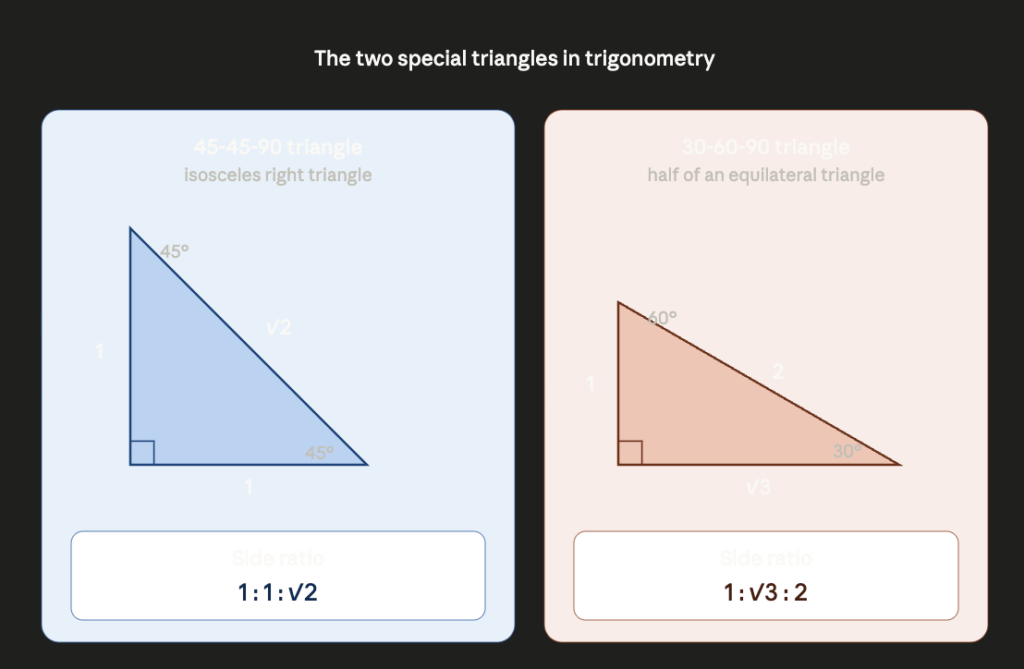
- The 45-45-90 triangle — an isosceles right triangle with two 45° angles and one 90° angle.
- The 30-60-90 triangle — a right triangle formed by cutting an equilateral triangle in half.
Both of these triangles produce exact values for sin, cos, and tan at angles students need to know cold: 30°, 45°, and 60°. Knowing them by heart turns a five-step calculator problem into a single line of working.
Why these specific triangles?
These two triangles matter because their angle measures are the only “nice” angles (other than 0° and 90°) where the trig ratios come out as clean expressions involving √2, √3, and small integers. Every other angle requires a calculator or a more advanced method. That makes 30°, 45°, and 60° the natural building blocks for everything from solving for missing sides to unit-circle work in Grade 12 and beyond.
The 45-45-90 triangle
Side ratios
A 45-45-90 triangle is an isosceles right triangle: two equal sides at right angles, and a hypotenuse opposite the 90° angle. Because two angles are equal (both 45°), the two legs are equal in length.
The side ratio is:
1 : 1 : √2
That is, if each leg has length 1, the hypotenuse has length √2. If each leg has length 5, the hypotenuse is 5√2. The ratio scales.
Where the √2 comes from
Apply the Pythagorean theorem to a right triangle with both legs equal to 1:
c² = 1² + 1² = 2
So c = √2.
That’s the whole derivation. Students who understand this can rebuild the ratio from scratch in 10 seconds if they ever forget it under exam pressure.
Exact trig values at 45°
Using the side ratios with the definitions sin = opposite/hypotenuse, cos = adjacent/hypotenuse, tan = opposite/adjacent:
| Function | Value | Decimal approximation |
|---|---|---|
| sin 45° | √2 / 2 | ≈ 0.707 |
| cos 45° | √2 / 2 | ≈ 0.707 |
| tan 45° | 1 | 1.000 |
Notice that sin 45° = cos 45°. This is a direct consequence of the symmetry: the two legs are equal, so the “opposite” side and the “adjacent” side from either 45° angle have the same length.
Some textbooks write √2 / 2; some write 1 / √2. They are equal. The first form has a rationalised denominator and is generally preferred in formal working.
The 30-60-90 triangle
Side ratios
A 30-60-90 triangle is a right triangle with one 30° angle, one 60° angle, and one 90° angle. Its side ratio is:
1 : √3 : 2
The side opposite the 30° angle is the shortest. The side opposite the 60° angle is √3 times longer. The hypotenuse (opposite the 90° angle) is twice the shortest side.
A useful way to remember this: the side opposite each angle scales with the size of the angle, and the hypotenuse is always twice the shortest side.
Where the √3 comes from
The cleanest derivation starts with an equilateral triangle of side length 2. Drop a perpendicular from one vertex to the opposite side. That perpendicular cuts the equilateral triangle into two identical 30-60-90 triangles.
The hypotenuse of each smaller triangle is still 2 (an original side of the equilateral triangle). The shorter leg is half the base, so it equals 1. The longer leg comes from the Pythagorean theorem:
(longer leg)² + 1² = 2² (longer leg)² = 4 − 1 = 3 longer leg = √3
So the sides are 1, √3, and 2 — opposite the angles 30°, 60°, and 90° respectively.
Exact trig values at 30° and 60°
| Function | Value | Decimal approximation |
|---|---|---|
| sin 30° | 1/2 | 0.500 |
| cos 30° | √3 / 2 | ≈ 0.866 |
| tan 30° | √3 / 3 (or 1/√3) | ≈ 0.577 |
| sin 60° | √3 / 2 | ≈ 0.866 |
| cos 60° | 1/2 | 0.500 |
| tan 60° | √3 | ≈ 1.732 |
Notice the symmetry: sin 30° = cos 60°, and sin 60° = cos 30°. This is an instance of the cofunction identity: sin θ = cos (90° − θ). Students who notice this pattern need to memorise only half the table.
The full exact trig values table
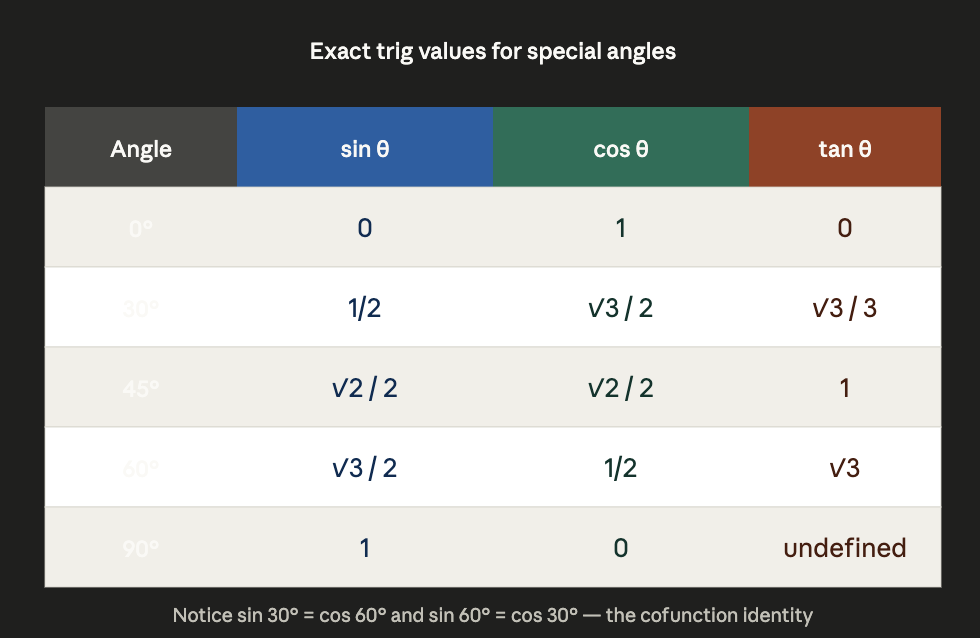
This is the table every Grade 10 and 11 student should be able to write out from memory in under 60 seconds.
| Angle | sin | cos | tan |
|---|---|---|---|
| 0° | 0 | 1 | 0 |
| 30° | 1/2 | √3 / 2 | √3 / 3 |
| 45° | √2 / 2 | √2 / 2 | 1 |
| 60° | √3 / 2 | 1/2 | √3 |
| 90° | 1 | 0 | undefined |
A memory trick that actually works
Many Canadian teachers teach the “hand trick” for the sine values. Hold up one hand with fingers spread. Number the fingers 0, 1, 2, 3, 4 starting from the thumb. The sine of an angle is √(finger number) / 2:
- 0°: √0 / 2 = 0
- 30°: √1 / 2 = 1/2
- 45°: √2 / 2
- 60°: √3 / 2
- 90°: √4 / 2 = 1
Cosine reads the same pattern in reverse (thumb is 90°, pinky is 0°). Tangent is just sine divided by cosine.
This trick is genuinely useful in the first few weeks, but students should aim to know the table directly within a month. Relying on the hand trick on a Fermat or AMC problem costs 10–15 seconds per use, which adds up across a 25-question paper.
Using special triangles in problems
The point of memorising special triangles is to make problems faster. Here is how they actually show up.
Example 1: Finding a missing side (Grade 10 level)
A right triangle has one angle of 30° and a hypotenuse of length 10. Find the length of the side opposite the 30° angle.
This is a direct application. The 30-60-90 ratio is 1 : √3 : 2, with the side opposite 30° being the shortest. If the hypotenuse is 10, the shortest side is half of that: 5.
No calculator needed. No working beyond one line: “Side opposite 30° = (1/2) × 10 = 5.”
Example 2: Exact value evaluation (Grade 11 level)
Evaluate: sin 60° × cos 30° + sin 30° × cos 60°.
Substituting the exact values:
= (√3 / 2)(√3 / 2) + (1/2)(1/2) = 3/4 + 1/4 = 1
This is actually the angle-addition formula for sine: sin(60° + 30°) = sin 90° = 1. Students who recognise this can do the problem in their head, but even the slow substitution method takes under 30 seconds.
Example 3: A Fermat-style contest problem
In triangle ABC, angle B = 90° and angle A = 30°. If the area of the triangle is 18√3, what is the length of the hypotenuse?
The triangle is a 30-60-90 with sides in the ratio 1 : √3 : 2. Let the shortest side (opposite the 30° angle) be x. Then the other leg is x√3, and the hypotenuse is 2x.
Area of a right triangle = (1/2) × leg × leg:
(1/2) × x × x√3 = 18√3 x²√3 / 2 = 18√3 x² = 36 x = 6
Hypotenuse = 2x = 12.
This is exactly the kind of problem that appears in Fermat Part A and early Part B. A student who knows the ratios solves it in under two minutes. A student who has to look up the ratios or use a calculator can easily spend five minutes.
Common mistakes to avoid
After marking thousands of student papers, the same handful of mistakes come up over and over.
- Mixing up the side opposite 30° and the side opposite 60°. The shorter side is always opposite the smaller angle. Sketch the triangle every time, even if it feels like wasted effort.
- Forgetting to rationalise the denominator. Writing tan 30° as 1/√3 is usually acceptable, but √3 / 3 is the standard form on Ontario provincial exams.
- Assuming sin 30° = √3 / 2. A surprisingly common mistake. sin 30° = 1/2; sin 60° = √3 / 2. The cofunction symmetry causes the confusion.
- Using the special triangle ratios for non-right triangles. The ratios 1 : √3 : 2 and 1 : 1 : √2 only apply to right triangles with those exact angles. For a general triangle, students need the sine rule or cosine rule.
- Reaching for a calculator when not needed. Calculators give decimal approximations. Many contest and exam problems require exact answers in surd form. If a student writes 0.866 instead of √3 / 2, they often lose marks even when the underlying reasoning is correct.
How special triangles connect to senior math
Special triangles are not just a Grade 10 topic. They reappear constantly:
- Grade 11 Functions (MCR3U) in Ontario. The unit-circle work in Grade 11 is built on the 30-60-90 and 45-45-90 ratios. Students who know the exact values cold can sketch the unit circle from scratch and find trig values at any multiple of 30° or 45° without a calculator.
- Grade 12 Advanced Functions and Calculus. Trig identities, derivatives of trig functions, and integration all assume fluency with exact values at the special angles.
- Physics. Resolving forces into components on inclined planes almost always uses 30°, 45°, or 60°, because those are the angles physics problems are designed around.
- Math contests. Cayley, Fermat, Euclid, AMC 10, and AMC 12 all rely on students recognising special triangles inside larger geometric figures. A typical Part B Fermat geometry problem hides a 30-60-90 triangle that the student has to spot before the algebra becomes manageable.
If a student is preparing for Canadian math contests, see our Fermat Math Contest guide and our Cayley Math Contest guide for how special triangles in trigonometry fit into broader contest preparation.
How Think Academy Canada teaches trigonometry
Our Canadian programs build trigonometry the same way we build every other topic: a carefully paced curriculum, an online interactive platform built specifically for math, and gamified rewards that keep students engaged across the full school year.
For trigonometry specifically:
- We teach the derivations before the memorisation. Students who understand why the 30-60-90 ratios are 1 : √3 : 2 are far less likely to forget them under exam pressure than students who just memorised the table.
- Our curriculum runs ahead of the Ontario standard. Grade 9 students at Think Academy typically meet the special triangles in trigonometry before their school classmates do, which means they go into Grade 10 with the topic already locked in.
- Built-in interactive practice. Every concept has dozens of practice problems in the app, scaling in difficulty from Grade 9 school questions up to Fermat and AMC contest problems.
- Free resources before you commit. Trig practice sheets, a free math evaluation, and access to our problem library are available before signing up for a paid program.
- Teachers who mark homework personally. Every homework set is reviewed by the teaching team, not auto-graded by software.
Frequently asked questions
What are the special triangles in trigonometry?
The two special triangles in trigonometry are the 45-45-90 triangle (an isosceles right triangle with side ratio 1 : 1 : √2) and the 30-60-90 triangle (formed by cutting an equilateral triangle in half, with side ratio 1 : √3 : 2). They produce exact values for sin, cos, and tan at 30°, 45°, and 60°.
What is the 30-60-90 triangle ratio?
The sides of a 30-60-90 triangle are in the ratio 1 : √3 : 2. The shortest side is opposite the 30° angle, the medium side (length √3 times the shortest) is opposite the 60° angle, and the hypotenuse (twice the shortest side) is opposite the 90° angle.
What is the 45-45-90 triangle ratio?
The sides of a 45-45-90 triangle are in the ratio 1 : 1 : √2. The two legs are equal, and the hypotenuse is √2 times the length of each leg.
How do I remember sin, cos, and tan for 30°, 45°, and 60°?
The hand trick works as a starting point: number your fingers 0 to 4 from thumb to pinky; sin θ = √(finger number) / 2. After a few weeks of regular practice, students should know the table directly without the trick.
Why are special triangles important?
They appear in nearly every Grade 10 and 11 trigonometry problem, in Grade 12 unit-circle work, in physics force-resolution problems, and in math contests like Cayley, Fermat, AMC 10, and AMC 12. Knowing them by heart converts five-minute problems into 30-second problems.
Are special triangles in trigonometry tested on the Ontario Grade 10 curriculum?
Yes. The Ontario MPM2D Principles of Mathematics course in Grade 10 covers right-triangle trigonometry, including the special triangles and exact trig values. Grade 11 Functions (MCR3U) builds on these directly when introducing the unit circle.
Do I need a calculator for special triangle problems?
No, and you usually shouldn’t use one. Special triangles in trigonometry problems are designed to have exact answers in surd form (involving √2 or √3). Using a calculator gives decimal approximations that often lose marks on Ontario exams and contest problems.
What’s the difference between special triangles and the unit circle?
The unit circle is a Grade 11 and 12 tool that uses the special triangle ratios to extend trig functions beyond right triangles, allowing angles greater than 90° and negative angles. The special triangles are the foundation; the unit circle is the framework that holds them.
About Think Academy Canada
Think Academy Canada, part of TAL Education Group, supports K–12 students with structured math programs built around an online interactive platform, gamified learning, and teachers who personally mark every homework set. Our curriculum runs ahead of the provincial standards and is designed to prepare students for both school excellence and Canadian math competitions, including the Gauss, Pascal, Cayley, Fermat, and Euclid contests.