


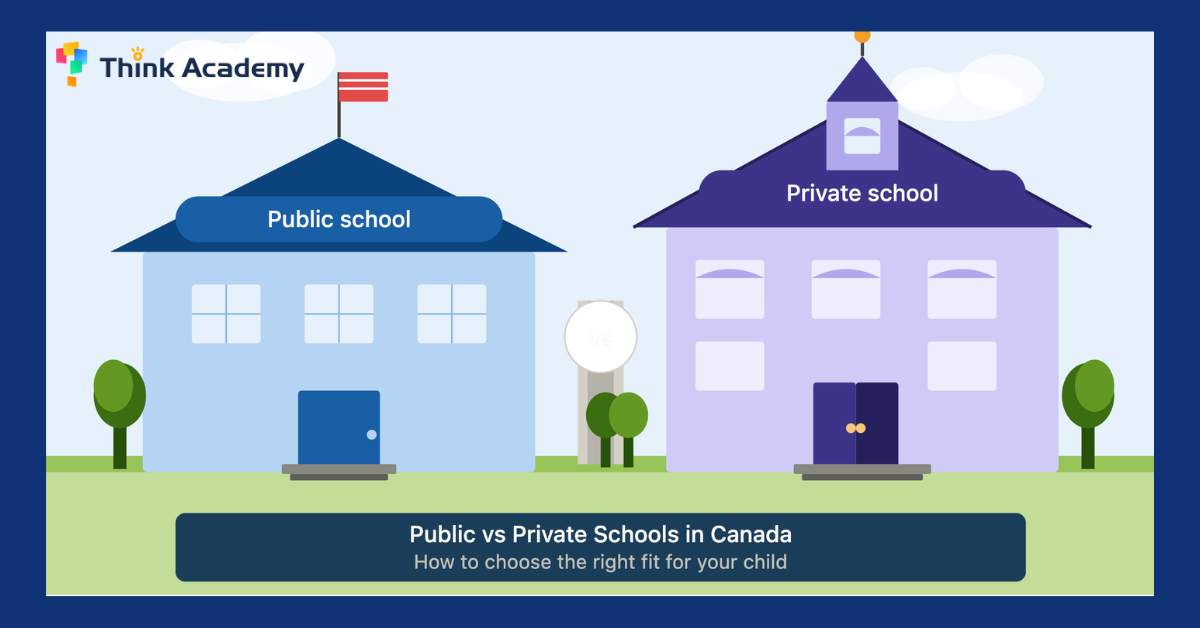
Has the question of private or public schools ever come up? If you are weighing between public vs private schools in Canada, you may be carrying a quiet worry: What if I choose the wrong environment for my child? That pressure is real — especially when you are comparing costs, class size, programs, and commute all at once.
This article breaks the decision into clear, verifiable facts and practical questions, so you can move from uncertainty to a confident next step.
Choosing a School Without Second-Guessing: Private or Public Schools?
Canada’s K–12 landscape varies by province and territory, which means advice from a friend in another city may not match your reality. However, the core decision points are surprisingly consistent: funding and oversight, admissions, curriculum, learning supports, and total family cost.
Before you compare private and public schools, it helps to separate two things: what is required by your province and what is a school’s own choice. For example, provincial curriculum sets learning expectations, while schools may differ in schedules, enrichment options, and extracurriculars.
One factor many families overlook: if private school is on your list, entrance assessments like the SSAT (Secondary School Admission Test) may be part of the process. More on that below.

What is actually different: private or public schools in Canada
At a high level, public schools are funded by the government and run by publicly accountable boards or authorities. Private schools are independently operated and typically funded primarily through tuition, although rules and recognition vary by province. Your first step is always to confirm your province’s definitions and requirements.
Funding, oversight, and accountability
Public schooling is financed through public funding and governed by provincial rules, making policies around reporting, curriculum expectations, and school board processes more standardised within a province.
Private schools must still follow provincial requirements, but the level of oversight can differ. Some provinces distinguish between independent schools that follow ministry requirements and other private learning settings. In British Columbia, for example, you can review how independent schools are classified through the BC Ministry of Education and Child Care.
Curriculum and what your child learns: Private or public schools?
The curriculum in Canada is set provincially, not federally. That means a public school in Ontario follows the Ontario curriculum, while a public school in Alberta follows Alberta’s program of studies. Many private schools teach the provincial curriculum but may add particular approaches, extra subjects, or different pacing.
Ask this concrete question: Which curriculum does your school follow for math and language arts, and how do you report progress against it?
You can review the Ontario government education pages or your province’s equivalent for what learning expectations look like by grade.
Admissions and who gets a seat
Public schools typically serve students based on residential catchment boundaries. Check your local school board’s registration pages for boundary tools and required documents.
Private schools usually require a formal application — and many competitive private schools require the SSAT (Secondary School Admission Test) as part of their admissions process. The SSAT is a standardised test for students applying to Grades 4–11 at independent schools across North America, including many top Canadian private schools.
What Is the SSAT and Does Your Child Need It?
If private school is a serious option, the SSAT is worth understanding early — ideally 6–12 months before your target entry year.
What the SSAT covers:
- Quantitative (Maths) — two sections testing arithmetic, algebra, geometry, and data interpretation
- Verbal — vocabulary, synonyms, and analogies
- Reading comprehension — passages across a range of styles
- Writing sample — unscored, but sent to schools
Which SSAT level does my child take?
| Level | Grades applying to |
|---|---|
| Elementary | 4–5 |
| Middle | 6–8 |
| Upper | 9–11 |
Where can you take the SSAT in Canada? The SSAT is offered at registered test centres across Canada, including locations in Toronto, Vancouver, Calgary, and Montreal. You can find official test dates and register through the SSAT official website. Many families also take the Flex test, which can be arranged through an enrolled school on alternative dates.
How is it scored? Each level is scored on a scale, and results are compared against other students who have taken the test in the past three years — so understanding where your child stands before test day matters.
For help building your child’s math foundation and more on what the quantitative seciton covers, check out our guides:
- Supplementary Angles Explained — geometry is tested on SSAT Upper level
- Similar Triangles Worksheet — directly relevant to SSAT geometry prep
- Equivalent Fractions Worksheet — core SSAT quantitative content
- Algebra Formula Worksheet — relevant for Middle/Upper SSAT levels
Comparing daily experience: class size, programs, and community
Parents often focus on reputation first, yet day-to-day fit matters more for many children aged 4–12. For example, your child’s learning confidence can change quickly when the commute is too long or the schedule leaves no time to play.
Because schools describe themselves in similar language, it helps to compare observable details. Therefore, try to gather information you can see on a tour or confirm in writing.
What to look for on a school tour
- How morning arrival works and whether it feels calm and organised
- How teachers communicate with families (newsletter, app, email cadence)
- How reading and math practice are assigned and supported at home
- What happens when a child struggles for a few weeks (who notices, what changes)
- How recess and physical activity fit into the day
Extracurriculars and enrichment: Private or public schools?
Public schools often offer clubs, sports, music, and enrichment, although the range can depend on school size and local resources. Private schools may offer extensive enrichment, but sometimes with additional fees.
For maths enrichment available to students regardless of school type, the University of Waterloo’s CEMC contests are a well-respected Canadian resource for challenge materials and competitions. The CEMC contests are broken up by age: check out Waterloo Math Competitions: A Canadian Parent’s Complete Guide to CEMC Contests to find out more, and see what your child may be interested in. University admissions in particular look favourably on math competition results.
Many private school applicants enter the Gauss math contest, a Grades 7-8 competition. Find out more about Gauss using our article Gauss Math Contest: The Complete Guide.
Costs: looking beyond tuition
Cost comparisons can feel awkward, yet they are essential. Even in public systems, families often face costs for supplies, lunches, transportation, field trips, and activities. Meanwhile, private schooling may include tuition plus uniforms, transportation, and fundraising expectations.
To make this concrete, use a simple total-cost view. However, keep in mind that exact fees vary by school and grade, so only use numbers you can verify from official documents.
Total cost comparison table (what to ask for)
| Cost category | Public school | Private school |
|---|---|---|
| Tuition | Programme fee? | Annual tuition + payment schedule |
| Transportation | Busing available? Who qualifies? | Offered or parent-arranged? |
| Meals | Lunchroom or bring-from-home? | Included or extra? |
| Activities | Which clubs/trips have fees? | Included vs paid add-ons? |
| Supplies/devices | Provided or required? | Laptops required, provided, or extra? |
| Admissions prep | N/A | SSAT registration + prep costs |
How to check quality without relying on hype
Rankings and word-of-mouth are tempting shortcuts, but for younger children, the most meaningful quality signals are consistency, communication, and whether teaching matches your child’s needs.
In Ontario, the EQAO administers large-scale assessments that offer a broad check of skills — useful context, but not the whole picture.
Check out EQAO Grade 3: The Complete Guide or EQAO Grade 6: The Complete Guide to understand what the EQAO is and why students take it. Or for a more general overview, see Ontario Math Curriculum: What Kids Learn in Grades 1–8, and get a broader overview of what curriculum alignment means.
Three evidence-based questions to ask any school:
- How do you monitor progress in reading and maths, and how often do you share results?
- What does homework look like in Grades 1–6, and how long should it take?
- How do you support positive behaviour and classroom routines day to day?
Admission timelines and practical planning
Planning reduces stress, especially when juggling work schedules and siblings.
- Public school registration follows school board timelines — typically late winter to early spring
- Private school admissions often begin much earlier, sometimes 12–18 months ahead, and may include multiple steps
- SSAT registration opens several months before each test date, with Flex testing available year-round through schools
A simple three-date timeline helps: when you tour, when you apply or register, and when you confirm.
Common myths that raise stress (and what to do instead)
Myth: A private school automatically means stronger academics. Academic strength depends on programme design, teaching consistency, and how well the school monitors individual progress.
Myth: A public school cannot offer enrichment. Many public schools offer strong clubs and opportunities. Ask what is offered this year, not what existed five years ago.
Myth: The SSAT is only for academically gifted students. The SSAT is a tool for schools to understand a student’s current level. Solid preparation — particularly in maths — makes a significant difference regardless of starting point.
What’s best for my child?
The best choice is usually the one that matches your child’s daily needs, your family’s budget, and your province’s learning expectations. Focus on verifiable details: curriculum alignment, communication, total costs, and how progress is tracked over time.
If private school is part of the picture, start researching the SSAT early and make sure your child’s maths foundation is solid before test day arrives.
✅ Ready to take the next step? Try our specialised free maths assessment — our teachers will identify exactly where your child is and what to focus on next, whether you’re aiming for private school admissions or simply want to build confidence in the classroom.
Frequently Asked Questions
Is the SSAT required for all Canadian private schools? No — requirements vary by school. Many competitive independent schools across Canada do require the SSAT, particularly for Grades 4 and above, but some schools use their own entrance assessments or interviews instead. Always check directly with each school’s admissions office to confirm what is required and by when.
How early should my child start preparing for the SSAT? Most families begin structured preparation 3–6 months before their test date, though starting earlier gives more room to address gaps without pressure. The quantitative (maths) sections in particular benefit from consistent practice over time rather than last-minute cramming. A baseline assessment early on helps identify exactly where to focus. Check out our article How to Make a Study Schedule for Math Competitions for more on this, which is directly relevant to SSAT prep.
What is a good SSAT score for Canadian private schools? There is no universal benchmark, as each school sets its own expectations. However, most competitive Canadian independent schools look for scores in the 70th percentile or above. Because the SSAT is normed against a high-achieving applicant pool, preparation matters more than many families expect — even strong students benefit from familiarising themselves with the format and question types.
Can my child take the SSAT more than once? Yes. Students can take the SSAT multiple times, and most schools will see all scores reported unless you use Score Choice (available on some test types). Many families use a first sitting as a diagnostic and a second sitting as their competitive attempt after a focused preparation period.
What is the difference between the SSAT and the ISEE? Both are admissions tests used by independent schools in North America. The SSAT is more widely accepted across Canadian private schools, while the ISEE (Independent School Entrance Exam) is more common in the United States, though some Canadian schools accept either. If you are applying to multiple schools, check which test each school prefers before registering.
How do public and private school report cards differ in Canada? Both must meet provincial reporting requirements, but private schools often have more flexibility in how they communicate progress — some use narrative reports, others use portfolios or learning conferences in addition to grades. Ask each school specifically how and when they report, and what happens if your child falls behind mid-year.
Does Think Academy help with SSAT preparation? Yes. Our maths programmes are well suited to building the quantitative foundations the SSAT tests — including arithmetic, fractions, algebra, and geometry — in a structured, confidence-building way. Try our free maths assessment to see where your child stands and what a preparation plan could look like.
Tools & Resources
- Government of Canada education information
- Ontario government education pages
- BC independent schools information
- EQAO — Ontario provincial assessments
- University of Waterloo CEMC contests
- SSAT official website — test dates and registration
Think Academy, part of TAL Education Group, helps K–12 students build strong maths foundations and critical thinking skills — with expert teachers, proven methods, and innovative AI tools. We teach over 4 million students globally and have helped them achieve high results.
🟦 Follow us on Instagram @thinkacademycanada for daily SSAT math tips, worked examples, SSAT prep, and free resources.


That’s a really helpful breakdown. I’ve been looking into this a lot lately and the cost differences are definitely a major factor for families in Ontario.