The y-intercept in slope intercept form is one of the most useful concepts in Grade 9 math. Once you know it, you can write the equation of any line, sketch the graph in seconds, and answer a huge class of EQAO Grade 9 questions almost automatically. The y-intercept is the b in the famous equation y = mx + b — the point where a line crosses the y-axis. This guide walks through what the y-intercept actually means, how to find the y-intercept from a graph, two points, or an equation, and how to use it on EQAO-style problems. It pairs directly with our point slope formula guide — together they cover everything you need to handle linear relationships at the Grade 9 level.

What is slope intercept form?
Slope intercept form is the most useful way to write the equation of a straight line. It’s written as:
y = mx + b
Where:
- y and x are the variables (the coordinates of any point on the line)
- m is the slope of the line — how steep it is, and whether it goes up or down
- b is the y-intercept — the y-coordinate of the point where the line crosses the y-axis
The reason this form is so useful is that the two numbers you care about most — the slope and the y-intercept — are right there in the equation, ready to read.
Why “slope intercept form”?
The name tells you exactly what it gives you. The slope is m. The y-intercept is b. Slope intercept form. Once you see the equation, you immediately know:
- How steep the line is (m)
- Where it crosses the y-axis (the point (0, b))
That’s enough information to sketch the line, find any other point on it, or answer almost any Grade 9 question about it.
How it compares to other line forms
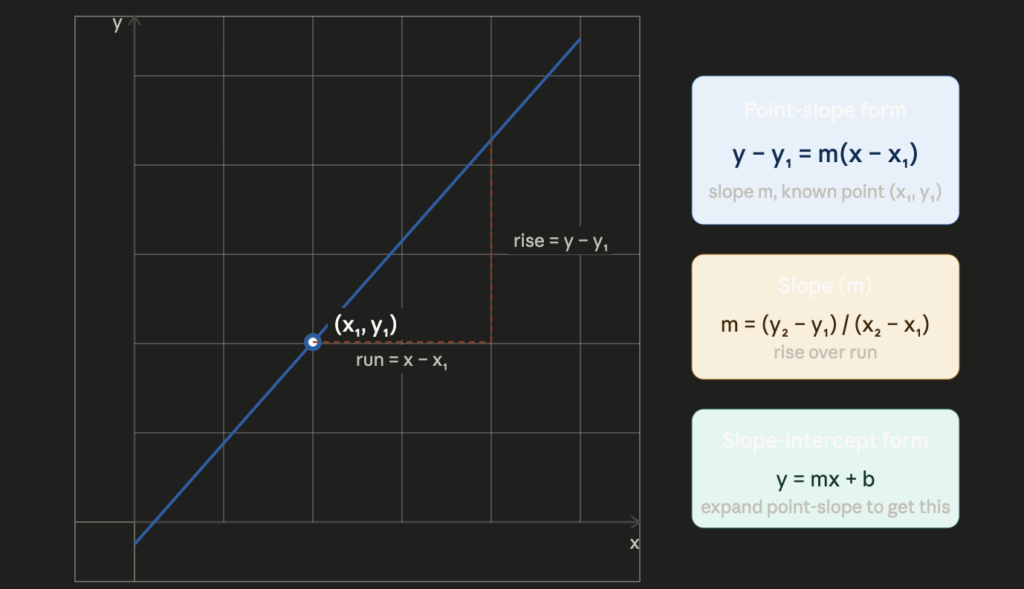
There are three standard ways to write the equation of a line, all equivalent but useful in different situations:
| Form | Equation | When to use it |
|---|---|---|
| Slope intercept form | y = mx + b | When you know (or want to find) the slope and y-intercept |
| Point-slope form | y − y₁ = m(x − x₁) | When you know a point on the line and the slope |
| Standard form | Ax + By = C | When the equation has integer coefficients |
Strong Grade 9 students can convert between all three. For deep coverage of point-slope form, see our point slope formula guide.
What is the y-intercept?
The y-intercept is the point where a line crosses the y-axis. Two things make this point special:
Its x-coordinate is always 0. The y-axis itself is the line x = 0 — every point on it has x = 0. So the y-intercept is always at (0, something).
Its y-coordinate is the value of b in slope intercept form. That’s why slope intercept form is so convenient — you can read the y-intercept off the equation without doing any work.
What the y-intercept means in real-world problems
In a word problem, the y-intercept usually represents the starting value — what something equals before any change happens.
A few examples:
- A taxi charges a $4 flat fee plus $2 per kilometre. The y-intercept is 4 — the cost before you’ve travelled any distance.
- A water tank starts with 50 litres and fills at 3 litres per minute. The y-intercept is 50 — the starting volume.
- You’re saving money. You have $200 in your account and add $50 per week. The y-intercept is 200 — your starting balance.
Pattern: in any problem where one quantity changes at a steady rate with respect to another, the y-intercept is the value when the other quantity is zero.
The y-intercept on a graph
Visually, the y-intercept is easy to spot. Find where the line crosses the vertical (y) axis. The y-coordinate at that point is your y-intercept.
If the line crosses at y = 5, the y-intercept is 5, and the equation has the form y = mx + 5.
If the line crosses at y = −2, the y-intercept is −2, and the equation has the form y = mx − 2.
If the line passes through the origin (0, 0), the y-intercept is 0, and the equation simplifies to y = mx.
How to find the y-intercept
There are three main ways to find the y-intercept, depending on what information you have to start with.
Method 1 — when you have the equation in slope intercept form
If the equation is already in y = mx + b form, the y-intercept is just b. Read it off.
Example: y = 3x + 7
The y-intercept is 7. The line crosses the y-axis at the point (0, 7).
Example: y = −2x − 5
The y-intercept is −5. The line crosses the y-axis at (0, −5). Watch for negative signs — students often misread “−5” as “5.”
Method 2 — when you have a graph
Find where the line crosses the y-axis. Read off the y-coordinate at that point. That number is the y-intercept.
If the line crosses the y-axis at y = 4, the y-intercept is 4. If it crosses at y = −3, the y-intercept is −3. If it passes through the origin, the y-intercept is 0.
A common trap on EQAO: students sometimes read the x-intercept (where the line crosses the x-axis) by mistake. The y-intercept is always on the y-axis (the vertical one). Sketch a quick label if you’re not sure.
Method 3 — when you have the slope and one point
If you know the slope (m) and any point on the line (x₁, y₁), you can find the y-intercept by:
- Starting with y = mx + b
- Substituting in the slope and the coordinates of the known point
- Solving for b
Example: A line has slope 2 and passes through (3, 11). Find the y-intercept.
Substitute m = 2, x = 3, y = 11 into y = mx + b:
11 = 2(3) + b 11 = 6 + b b = 5
The y-intercept is 5, so the equation is y = 2x + 5.
Method 4 — when you have two points (no slope yet)
If you only have two points, first find the slope using the slope formula:
m = (y₂ − y₁) / (x₂ − x₁)
Then use Method 3 to find the y-intercept.
Example: Find the y-intercept of the line passing through (2, 7) and (5, 16).
Step 1 — slope:
m = (16 − 7) / (5 − 2) = 9 / 3 = 3
Step 2 — y-intercept, using point (2, 7):
7 = 3(2) + b 7 = 6 + b b = 1
The y-intercept is 1. The equation is y = 3x + 1.
Verification: plug the second point (5, 16) into the equation. 3(5) + 1 = 16. ✓

The y-intercept formula
There isn’t a single dedicated “y-intercept formula” the way there’s a slope formula or quadratic formula. The y-intercept is found using the slope intercept form equation itself:
b = y − mx
This is just y = mx + b rearranged. Substitute in any point (x, y) and the slope m, and you get b.
Using the y-intercept formula
Example: A line has slope −4 and passes through (2, 3). Find the y-intercept.
b = y − mx b = 3 − (−4)(2) b = 3 − (−8) b = 3 + 8 b = 11
The y-intercept is 11. The equation is y = −4x + 11.
This is essentially the same as Method 3 above, just rearranged. Use whichever approach feels more natural — the math is identical.
How to use slope intercept form to graph a line
One of the biggest practical uses of slope intercept form is sketching a line quickly. Two steps:
Step 1 — plot the y-intercept
The y-intercept gives you a free starting point. If b = 4, plot the point (0, 4). If b = −2, plot (0, −2). You’re now on the line.
Step 2 — use the slope to find the next point
The slope is rise over run. If m = 3, then for every 1 unit you move right, the line goes up 3 units. If m = −2, you go down 2 units for every 1 right. If m is a fraction like 2/3, you rise 2 for every 3 you run right.
From your y-intercept point, move right by the run and up (or down) by the rise. That gives you a second point. Connect the two with a straight line — that’s your graph.
Example — graphing y = 2x − 3
Step 1: y-intercept is −3. Plot (0, −3).
Step 2: slope is 2 (which is 2/1). From (0, −3), move 1 right and 2 up to reach (1, −1). That’s a second point.
Connect (0, −3) and (1, −1) with a straight line. Extend it both directions. You’ve graphed y = 2x − 3 in under a minute.
This is dramatically faster than building a full table of values, which is what students often default to from earlier grades.
Y-intercept on EQAO Grade 9 — worked examples
Linear relationships account for roughly 15–20% of the EQAO Grade 9 assessment. Here are three EQAO-style questions that use the y-intercept directly, each worked through in full.
Example 1 — finding the y-intercept from a graph (EQAO Level 2)
A line passes through (0, 4) and has slope 2. Write the equation of the line in slope intercept form.
The point (0, 4) is on the y-axis, so it is the y-intercept. b = 4.
The equation is y = 2x + 4.
EQAO Level 2 questions often hand you the y-intercept directly like this. If you see a point with x = 0, that’s your y-intercept.
Example 2 — real-world word problem (EQAO Level 3)
A cell phone plan charges a $15 monthly fee plus $0.10 per text message. Write an equation in slope intercept form that gives the total monthly cost (C) for x text messages.
The slope is the rate of change: $0.10 per text. So m = 0.10.
The y-intercept is the starting cost (when x = 0): $15. So b = 15.
The equation is C = 0.10x + 15.
The y-intercept here represents the flat monthly fee — what you’d pay even if you sent zero texts. Reading the y-intercept correctly is often the entire question.
Example 3 — find y-intercept from two points (EQAO Level 3)
A line passes through (−2, 5) and (4, −7). Find its y-intercept.
Step 1 — slope:
m = (−7 − 5) / (4 − (−2)) = −12 / 6 = −2
Step 2 — y-intercept using point (4, −7):
−7 = −2(4) + b −7 = −8 + b b = 1
The y-intercept is 1. The full equation is y = −2x + 1.
This problem combines slope and y-intercept calculations and is exactly the kind of multi-step question that separates Level 3 from Level 4 on EQAO.
Common mistakes with the y-intercept
After marking thousands of Grade 9 papers, the same handful of errors come up repeatedly.
Confusing the y-intercept with the x-intercept. The y-intercept is where the line crosses the y-axis (x = 0). The x-intercept is where it crosses the x-axis (y = 0). They’re different. Always check which one the question is asking for.
Misreading the sign. y = mx − 5 has y-intercept −5, not 5. The negative is part of the value, not a typo. Sign errors here cascade through every subsequent step.
Including the x-coordinate. The y-intercept is a single number (b), or it’s a point (0, b). Students sometimes write the y-intercept as “(4, 0)” — that’s actually the x-intercept. The y-intercept always has x = 0.
Forgetting to verify with the other point. When you find a y-intercept from two points, plug the other point back into the final equation to check. If it doesn’t satisfy the equation, you made an arithmetic error somewhere.
Confusing the slope and the y-intercept in y = mx + b. The slope is the coefficient of x (the m). The y-intercept is the constant on its own (the b). In y = 4x + 7, the slope is 4 and the y-intercept is 7 — not the other way around.
Getting tripped up by equations not in slope intercept form. If the equation is given as 2y = 6x + 8, the y-intercept is not 8 — first divide everything by 2 to get y = 3x + 4. Now the y-intercept is 4. Always get the equation into y = mx + b form before reading off m and b.
Y-intercept and senior math
The y-intercept isn’t just a Grade 9 idea. It reappears constantly:
In Grade 10 (MPM2D Principles of Mathematics), the y-intercept becomes part of systems of linear equations, where you solve for the point where two lines intersect. Knowing each line’s y-intercept makes the graphing approach much faster.
In Grade 11 Functions (MCR3U), the y-intercept generalises to any function — it’s the value of f(x) when x = 0, written as f(0). For a quadratic like f(x) = x² + 3x + 7, the y-intercept is 7 (just plug in x = 0). For a more advanced function like f(x) = 2eˣ − 1, the y-intercept is 1 (since e⁰ = 1). The concept extends naturally. See our Grade 11 Functions guide.
In Grade 12 Advanced Functions and Calculus, the y-intercept appears in optimisation problems, curve sketching, and as the constant of integration in indefinite integrals. Students who never properly internalised the Grade 9 idea struggle with these later applications.
In Canadian math contests like the Pascal, Cayley, and Fermat, coordinate geometry questions appear constantly, and clean y-intercept arithmetic is the difference between solving a problem in 90 seconds versus 4 minutes.
How Think Academy Canada teaches linear equations
Think Academy is the international arm of TAL Education Group, one of the largest education companies in the world. Our Canadian programs build linear equations the same way we build every other topic: understanding first, then memorisation, then application across increasing difficulty levels.
We teach the y-intercept through real-world examples (taxi fares, water tanks, savings accounts) before introducing the abstract algebra. Students who understand what the y-intercept means in context never forget what b stands for in y = mx + b.
Our curriculum runs ahead of the Ontario MTH1W timeline, so Grade 8 students at Think Academy meet linear equations with full fluency before they appear in school.
Our practice problem library includes hundreds of problems on slope, y-intercept, point-slope, slope-intercept, parallel, and perpendicular lines, organised by difficulty from straightforward Grade 9 questions up to Fermat and AMC contest problems.
Our teachers mark every homework set personally, with feedback on the types of mistakes a student is making. Sign errors, x-intercept vs y-intercept confusion, slope-intercept mixups — these patterns get caught and corrected.
Our free Grade 9 math assessment is the fastest way to find out where your child stands on linear equations specifically. They complete a short online test aligned to the MTH1W curriculum, and you get a detailed feedback report on which exact topics need work, plus free practice resources tailored to their level. No commitment, no sales pressure.

Frequently asked questions
What is the y-intercept in slope intercept form?
In slope intercept form (y = mx + b), the y-intercept is b — the constant value at the end of the equation. It’s the y-coordinate of the point where the line crosses the y-axis, and the point itself is always (0, b).
What is the slope intercept form equation?
The slope intercept form equation is y = mx + b, where m is the slope of the line and b is the y-intercept. It’s the most common way to write a linear equation because the slope and y-intercept can be read directly off the equation.
How do you find the y-intercept?
Three main ways. From an equation in y = mx + b form, read off b directly. From a graph, find where the line crosses the y-axis and read the y-coordinate. From the slope and one point, substitute into y = mx + b and solve for b.
Is there a y-intercept formula?
There isn’t a dedicated formula. The y-intercept is found by rearranging slope intercept form: b = y − mx. Substitute any point (x, y) and the slope m to get b.
What’s the difference between the slope and the y-intercept?
The slope (m) tells you how steep the line is — rise over run. The y-intercept (b) tells you where the line crosses the y-axis. In y = 4x + 7, the slope is 4 and the y-intercept is 7. They describe different aspects of the line and are not interchangeable.
What’s the difference between the y-intercept and the x-intercept?
The y-intercept is where the line crosses the y-axis (x = 0). The x-intercept is where the line crosses the x-axis (y = 0). They’re different points on the same line. Always check which one a question is asking for.
Can the y-intercept be negative or zero?
Yes to both. The y-intercept is just a number — it can be positive, negative, or zero. If the y-intercept is zero, the line passes through the origin and the equation simplifies to y = mx.
What does the y-intercept mean in a real-world problem?
In word problems, the y-intercept usually represents the starting value — what the dependent variable equals when the independent variable is zero. A taxi flat fee, a savings account starting balance, the initial volume in a tank, the y-axis intercept of a temperature graph at time 0 — all are y-intercepts.
Is the y-intercept on the EQAO Grade 9 formula sheet?
Slope intercept form (y = mx + b) is on the EQAO Grade 9 formula sheet, along with the slope formula and point-slope form. But the formula sheet doesn’t explain when to use it — that’s still up to the student. See our EQAO formula sheet guide for everything that is and isn’t on the sheet.
How is the y-intercept tested on EQAO Grade 9?
Heavily. Linear relationships (slope, y-intercept, equations of lines, parallel/perpendicular) account for roughly 15–20% of the EQAO Grade 9 assessment. Y-intercept questions appear in three main forms: reading from a graph, writing from a word problem, and finding from two points. All three are covered in this guide.
What if the equation isn’t in y = mx + b form?
Rearrange it first. If you have something like 3x + 2y = 12, isolate y: 2y = −3x + 12, then divide by 2 to get y = −1.5x + 6. Now you can read the y-intercept (6) directly.

About Think Academy Canada
Think Academy Canada, part of TAL Education Group, supports K–12 students with structured math programs built around an online interactive platform, gamified learning, and teachers who personally mark every homework set. Our curriculum runs ahead of the provincial standards and is designed to prepare students for both school excellence and Canadian math competitions, including the Gauss, Pascal, Cayley, Fermat, and Euclid contests.
🟦 Follow us on Instagram @thinkacademycanada for daily Ontario math tips, worked examples, EQAO prep, and free resources.