If your child can add and subtract but freezes when a worksheet mentions “units,” “covering,” or “filling,” you are not alone. In elementary math, measurement, area, surface area and volume can feel abstract because kids must connect numbers to real space. This parent-friendly guide to area, surface area and volume breaks down what these skills look like from Grades 1–6, why children commonly get confused, and what you can do at home to build confidence.

Intro: What kids are really learning (and why it matters)
In Canadian classrooms, measurement is not only about using a ruler. Instead, children learn to choose appropriate units, compare objects, estimate, and explain their thinking. However, these ideas can seem “invisible” at home because the math is tied to real objects.
Area and volume also support later geometry and science. For example, kids eventually connect area to multiplication, and volume to three-dimensional reasoning (visualizing and working with 3D space). Therefore, early practice with real materials makes a big difference.
Measurement, area, surface area and volume: grade-by-grade expectations
Specific expectations vary by province and territory, but the progression is similar across Canada. Children move from comparing and measuring with informal tools to using standard units and solving multi-step problems.
For a reliable reference point, Ontario’s curriculum shows a clear progression many families recognize. You can review the official curriculum framework through the Ontario elementary mathematics curriculum hub. If you live in another province, your ministry’s math pages will show a similar pathway.
Grades 1–2: comparing, estimating, and measuring with purpose
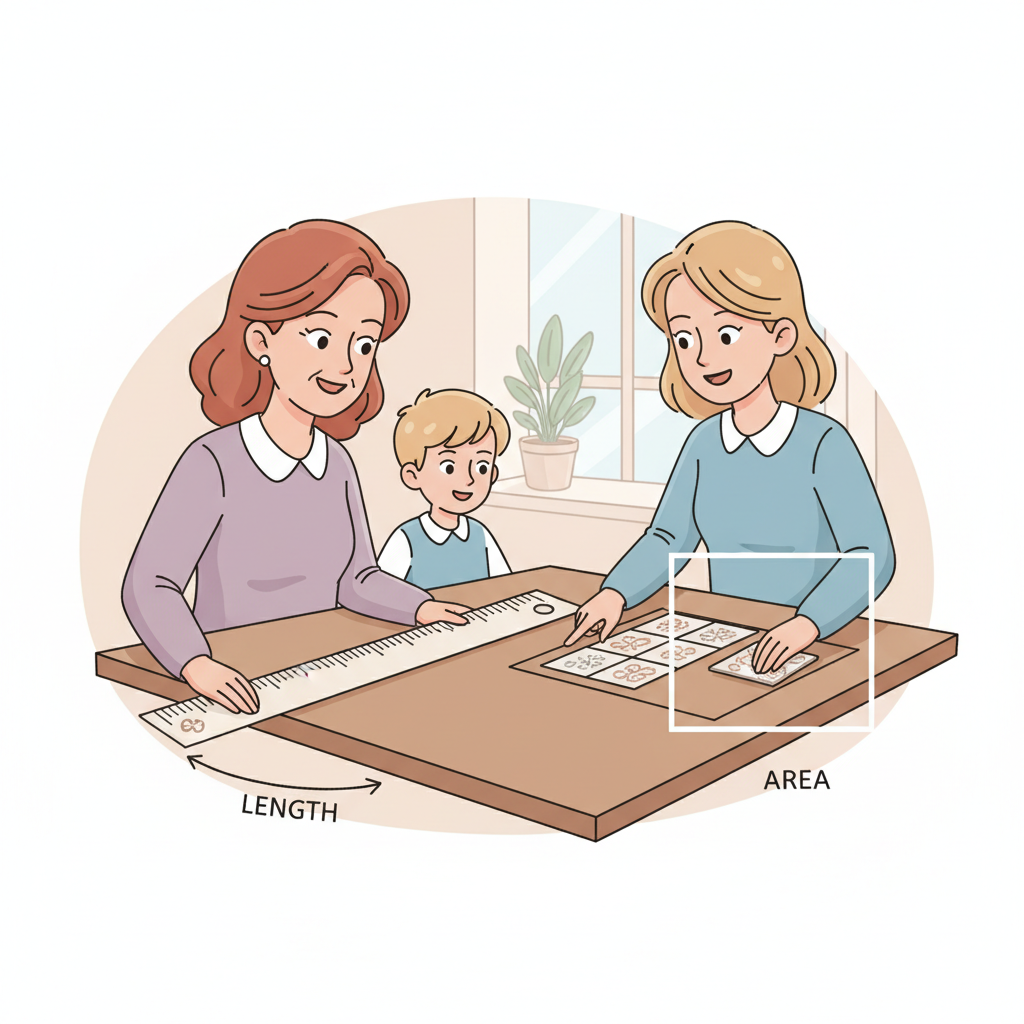
In the early grades, kids learn that measuring answers a question. For example, “Which is longer?” requires length, while “Which holds more?” relates to capacity (how much a container can hold).
- Length: comparing and measuring using non-standard units first (paper clips), then standard units (centimetres).
- Area: understanding “covering” a surface without gaps or overlaps.
- Capacity: informal comparisons (��more” and “less”) before litres become meaningful.
A common misconception is counting the edges of a shape and calling it area. Therefore, quick checks like “Did we cover the whole surface?” help your child self-correct.
Grades 3–4: standard units, perimeter, and early area formulas
By Grades 3–4, many students start mixing up perimeter (distance around) and area (space inside). This is normal, because both use the same shapes but measure different attributes (features).
- Perimeter: adding side lengths; using units like centimetres or metres.
- Area: measuring in square units; learning area of rectangles as length × width.
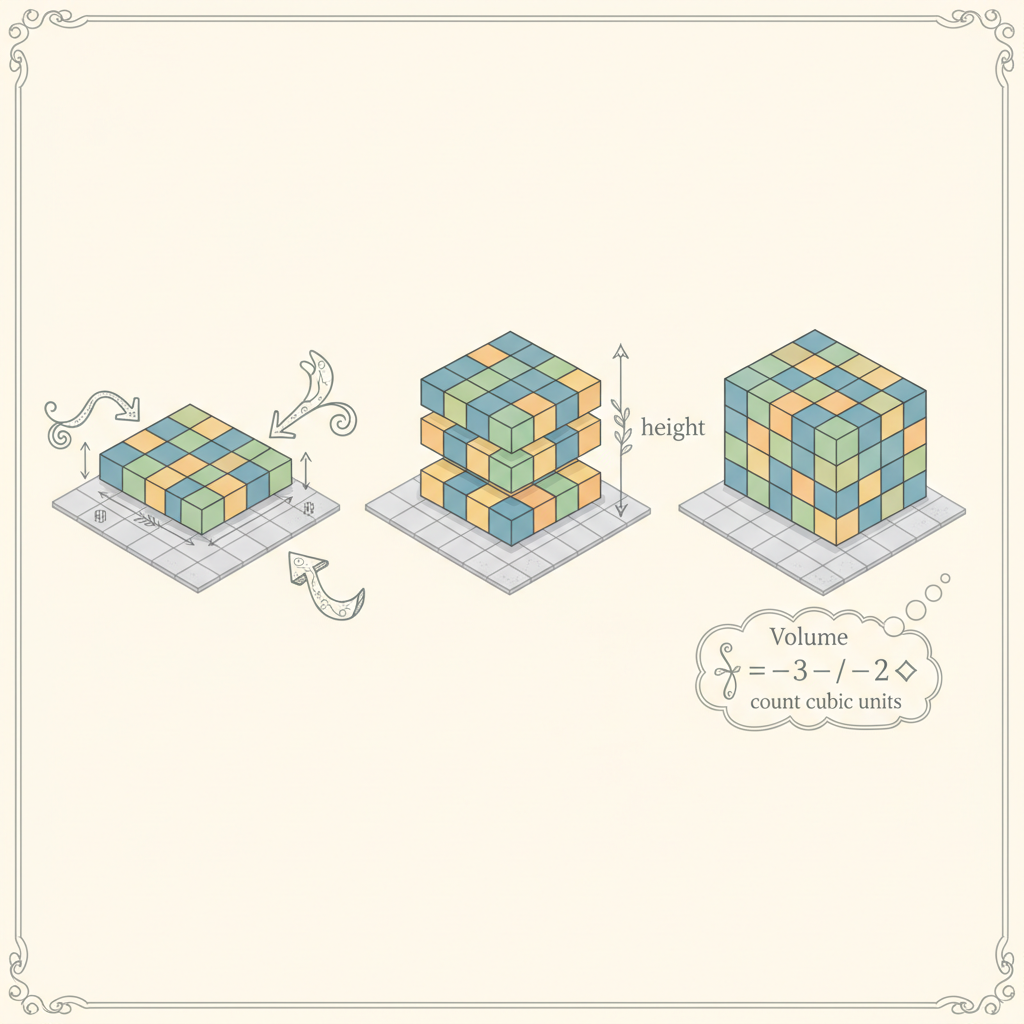
- Volume (intro): recognizing cubes and rectangular prisms, and counting cubes in simple stacks.
If you want a quick, parent-friendly definition of area and volume, Britannica’s overview of area and Wikipedia’s general math reference hub can help you confirm terms when homework wording feels unfamiliar.
Grades 5–6: multi-step problems, conversions, and deeper volume
In Grades 5–6, kids are expected to explain strategies and solve real-world problems, not only compute. For example, they might compare two playground designs or decide how many one-cup servings fit in a container.
- Area: solving for missing side lengths; decomposing shapes (splitting a shape into simpler parts).
- Volume: understanding cubic units and using volume formulas for rectangular prisms.
- Unit conversions: moving between mm, cm, m, and sometimes between mL and L, using place value understanding.
However, conversions often break confidence because the numbers change “too much.” Therefore, it helps to anchor units to something real (a finger width is about a centimetre, a doorway is about two metres).
Common parent pain points (and the simple fixes)
When children struggle, it is often not a calculation issue. Instead, they may misunderstand what is being measured, or which unit makes sense.
1) Confusing the unit type
Length uses linear units (cm, m). Area uses square units (cm²), which means “a 1 cm by 1 cm square.” Volume uses cubic units (cm³), which means “a 1 cm by 1 cm by 1 cm cube.”
Therefore, the fastest fix is to ask: “Are we measuring along, covering, or filling?” That single question clarifies the unit.
2) Mixing up perimeter and area
Kids may compute perimeter when asked for area, because both start with the same picture. However, perimeter walks the border, while area covers the region inside.
- Quick home check: Use string for perimeter and sticky notes for area.
- Ask: “If I painted it, do I paint the edge or the whole surface?”
3) Counting squares incorrectly on grids
On grid paper, children sometimes count squares that are not fully inside a shape. They also skip squares by accident when the shape is irregular.
Therefore, teach a simple routine: trace, mark counted squares lightly, then recount once. This reduces errors without adding stress.
At-home activities that actually build understanding
You do not need fancy kits. In fact, everyday objects often teach these ideas best because kids can see and touch what units mean.
Length and distance (5–10 minutes)
- “Estimate first”: Guess the length of a book spine, then measure in centimetres.
- “Choose the tool”: Ask whether a ruler or measuring tape fits better, and why.
- “Measure the same thing twice”: Measure in cm, then in mm to see the relationship.
Area with tiles or paper (10 minutes)
- Cover a placemat with sticky notes or square tiles and count them.
- Then rearrange into a rectangle and connect it to multiplication.
- For example, 4 rows of 6 tiles means 4 × 6 square units.
Volume with cubes or containers (10–15 minutes)
Volume becomes clearer when children build or fill something. Therefore, choose one simple task and repeat it weekly.
- Build a rectangular prism from snap cubes, then count layers.
- Fill a container with 1/4-cup scoops and record how many scoops it takes.
- Compare two containers and predict which holds more before testing.
A simple table: perimeter vs area vs volume
If your child keeps mixing concepts, this comparison can help. You can even print it and keep it near the homework space.
| Concept | What it measures | Typical units | Home example |
|---|---|---|---|
| Perimeter | Distance around a shape | cm, m | Length of ribbon needed to border a poster |
| Area | Surface covered inside a boundary | cm², m² | How much wrapping paper covers a book |
| Volume | Space inside a 3D object | cm³, m³; sometimes mL/L for liquids | How much sand fills a box |
Tools & Resources (official, parent-friendly)
These tools are reliable and easy to use at home. However, choose one tool at a time so your child does not feel overwhelmed.
- Ontario Ministry of Education curriculum hub for official expectations and strand overviews.
- Mathies (Ontario educators’ resource site) for interactive math tools and activities families can also use at home.
- NCTM Illuminations for concept-based activities and explanations (NCTM is the National Council of Teachers of Mathematics).
- GeoGebra for interactive geometry and measurement explorations, helpful for visual learners.
Concluding Paragraph
When your child understands what a unit represents, homework gets calmer and faster. Start small, use real objects, and keep language consistent: measuring along, covering, or filling. Over time, those routines make word problems less intimidating and help your child explain their thinking with confidence. If you want a steady plan, measurement, area, surface area, and volume practice works best when it is short, hands-on, and repeated across weeks.
About Think Academy
Think Academy Canada is a K-12 mathematics tutoring programme, part of TAL Education Group. We work with motivated students across Canada from Grade 1 through Grade 12, with a focus on Ontario curriculum, EQAO preparation, and competition mathematics including CEMC contests (Pascal, Cayley, Fermat, Euclid) and AMC. All lessons are delivered online. Follow us on Instagram at @thinkacademyca.