Homework tears, “I’m just not a math person,” and nightly negotiations are common in homes with kids ages 4–12. If you are searching for how parents can support math learning without turning your kitchen table into a battleground, you are not alone. The good news is that small, consistent changes at home can strengthen skills and confidence. This article shares practical routines and trusted tools, grounded in reputable research and official curriculum guidance.
Small changes that make math feel safer
Many parents assume math support means teaching new content. However, research and classroom practice suggest your most powerful role is shaping conditions for learning: calm routines, supportive language, and short practice that fits your child’s development.
In Canada, math expectations vary by province, yet core ideas repeat: number sense, patterns, geometry, measurement, and data. Therefore, you can help most by building flexible thinking and steady habits rather than racing ahead. For example, talking through a grocery estimate can support the same skills as a worksheet, but with less pressure.
How parents can support math learning with routines and talk
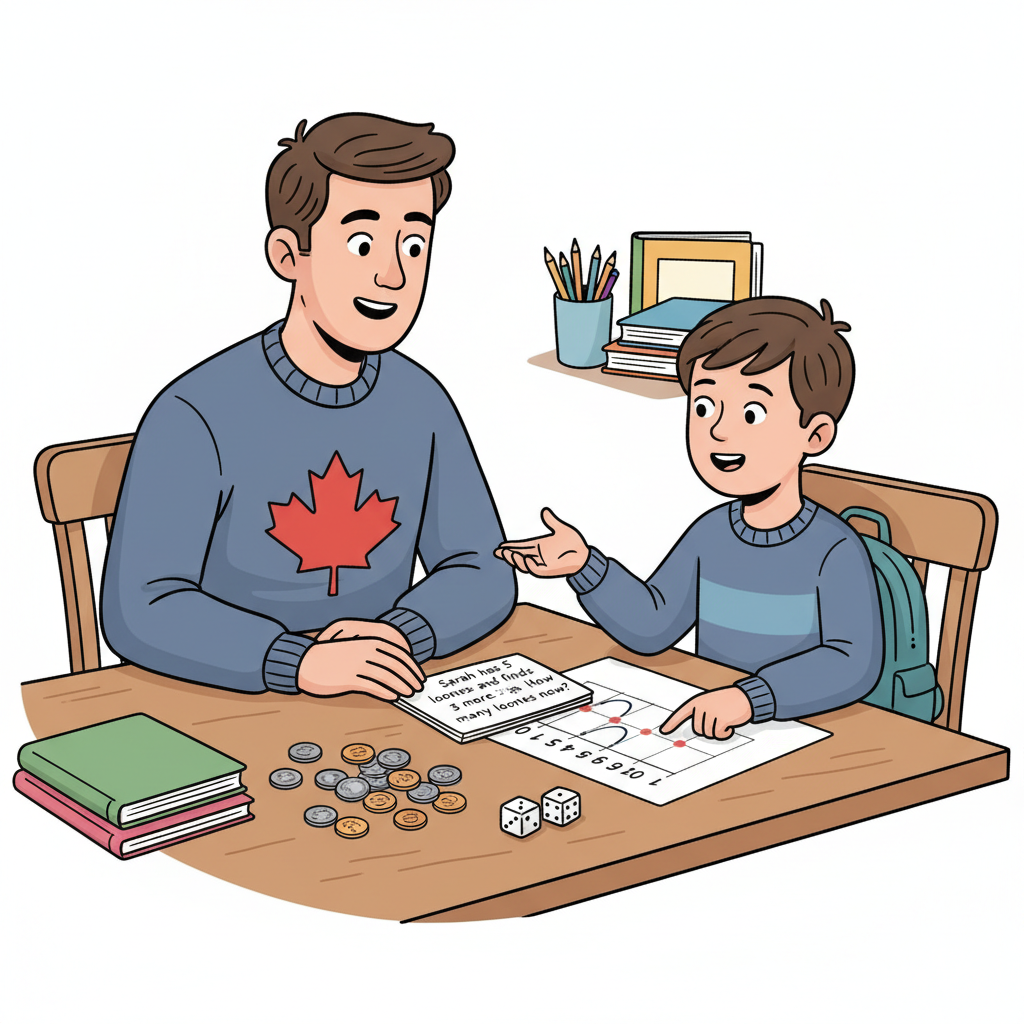
Parents often ask, “Should I correct every mistake?” Usually, it works better to slow down and ask for thinking first. This aligns with what researchers call metacognition (thinking about your own thinking), which helps kids notice patterns and choose strategies.
Try this three-step “Support, don’t rescue” routine:
- Ask: “What is the question asking you to find?” (This reduces misreads.)
- Ask: “What do you already know that might help?” (This activates prior knowledge.)
- Offer a choice: “Do you want a hint, an example, or to draw it?” (This supports independence.)
Language matters more than many families expect. According to the American Psychological Association overview of growth mindset (the belief that ability can grow with practice), praising effort and strategy can be more helpful than praising “being smart.” However, it is important to keep praise specific and honest.
Use sentence starters like these:
- “I like how you tried two ways.”
- “That mistake is useful. What did it teach us?”
- “Show me your steps so I can follow your thinking.”
What to do by age: quick supports from 4 to 12
Kids’ math needs change quickly between kindergarten and Grade 6. Therefore, matching your support to your child’s stage prevents frustration and keeps practice efficient.
| Age range | What to focus on at home | Simple, low-stress activities |
|---|---|---|
| 4–6 | Counting, comparing, shapes, story problems with objects | Count steps, sort toys by size, build patterns with blocks, “How many more?” with snacks |
| 7–9 | Add/subtract strategies, place value, time, basic multiplication meaning | Number lines, card games for making 10/20, skip-counting rhythms, clock practice |
| 10–12 | Fractions/decimals, multi-step problems, introductory algebra ideas | Recipe scaling, sale discounts, fraction strips, explain-and-check homework steps |
If you want a clear benchmark for what “on grade” can look like, start with your provincial curriculum. For example, Ontario families can reference the Ontario government education hub and the Ontario Digital Curriculum Platform (a central place to access curriculum information). If you live elsewhere, your provincial ministry of education site will offer similar guidance.
Homework time without power struggles
A smoother homework routine often depends on timing, environment, and emotional temperature. Therefore, aim for short, predictable sessions rather than long “catch-up” nights.
Try a simple structure that works for many families:
- Preview (2 minutes): read the instructions together and circle key numbers or words.
- Work block (10–20 minutes): one focused chunk, then stop.
- Check (3 minutes): ask your child to explain one answer out loud.
- Reset (2 minutes): pack up and choose tomorrow’s start point.
If your child freezes, avoid immediately showing the solution. Instead, offer a bridge: “Let’s do an easier version first.” This is similar to scaffolding (temporary support that you gradually remove), a common learning approach described in many education resources, including Britannica’s overview of scaffolding in learning.
Tools & resources you can trust (with official links)
Digital tools can help, especially when they provide immediate feedback and clear examples. However, choose tools that match school math, protect privacy, and avoid overwhelming kids with distractions.
Here are reputable options with official websites:
- Khan Academy for free skill practice and short instructional videos.
- GeoGebra for visual math models (great for geometry and graphs).
- Desmos for interactive graphs and math activities (useful as kids approach Grades 5–7 concepts).
- Math Playground for kid-friendly practice games (best when you set a short time limit).
- Common Sense Education to help you evaluate learning apps and privacy considerations.
For clear explanations of terms your child may hear in class, you can also use broad reference sites like Wikipedia to quickly look up definitions, then translate them into kid-friendly language together.
Build a weekly plan you can actually keep
Consistency beats intensity for most children. Therefore, aim for a light weekly rhythm that includes practice, real-life math, and rest.
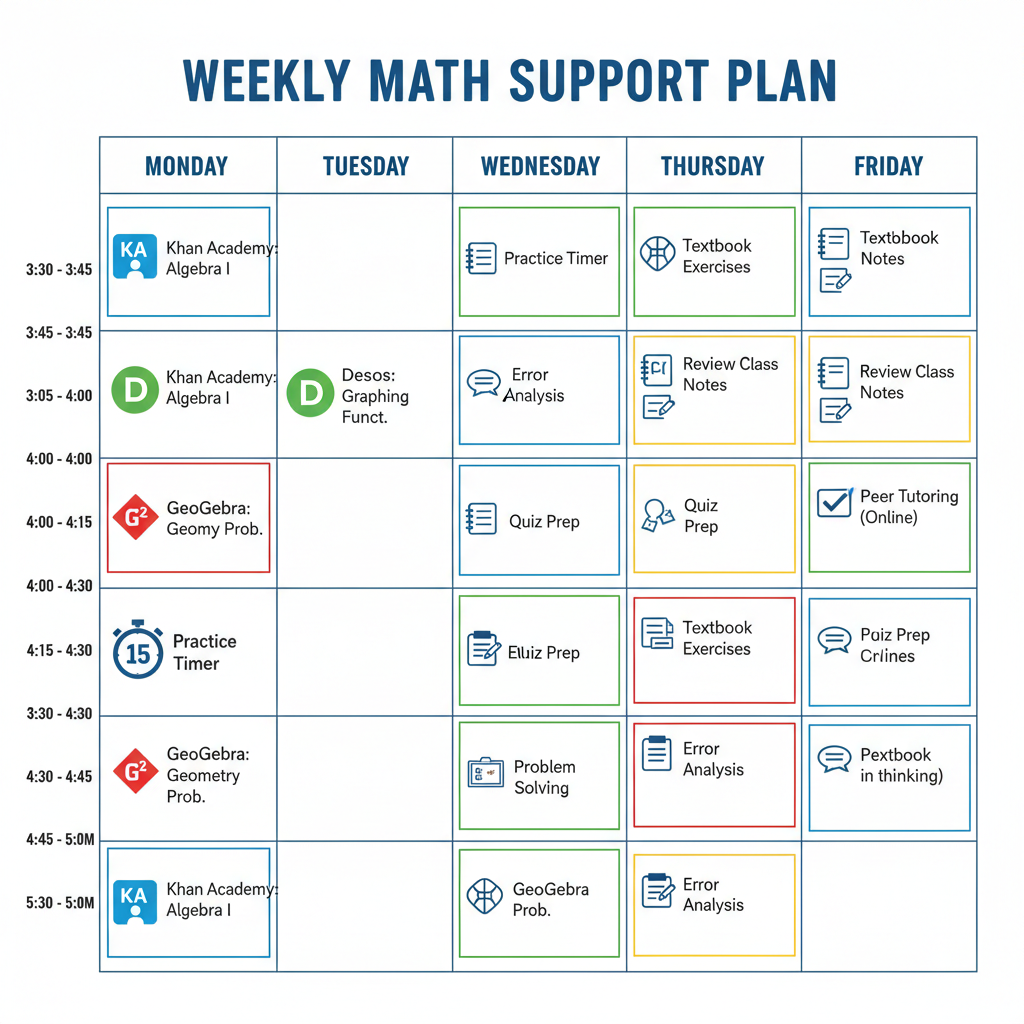
Here is a sample plan for busy families (adjust times to your child’s stamina):
- Monday: 15 minutes of skill practice (one topic only).
- Tuesday: 10 minutes of math facts or number sense, then stop.
- Wednesday: Real-life math (cooking, measuring, shopping estimates).
- Thursday: One word problem with a drawing and explanation.
- Friday: Review mistakes from the week and rewrite one solution clearly.
When kids explain solutions, they strengthen mathematical reasoning (the ability to justify steps). This matters because many Canadian assessments value process, not just answers. If you want to understand how large-scale assessments describe skills, you can explore Canada’s assessment context through reputable sources such as the Council of Ministers of Education, Canada and international frameworks like the OECD PISA program (a worldwide study of student skills in reading, math, and science).
When should you worry? Signs to follow up
Every child has “sticky” topics, especially with fractions, place value, and multi-step word problems. However, a few patterns suggest you should gather more information and talk with your child about what feels hard.
Consider a follow-up plan if you notice:
- Frequent confusion with basic number meaning (for example, 300 vs 30).
- Strong emotional reactions that do not ease with shorter sessions.
- Persistent difficulty explaining steps even when answers are correct.
A helpful next step is to ask your child’s classroom teacher what skill strand they are working on (for example, number sense or measurement) and which examples best match class methods. Then you can practise the same style briefly at home, which reduces mixed messages.
Sources: American Psychological Association: Growth mindset and learning, Britannica: Scaffolding (learning), Government of Ontario education hub, Ontario Digital Curriculum Platform, Council of Ministers of Education, Canada, OECD PISA.
Concluding Paragraph
Supporting math at home does not require you to be a perfect “teacher.” Instead, steady routines, calm language, and a few trustworthy tools can help your child feel capable and curious. If you came looking for how parents can support math learning, start this week with one small change: a 15-minute routine and one daily “explain your thinking” moment. Over time, those simple supports often lead to better confidence, clearer reasoning, and fewer homework battles.
About Think Academy
Think Academy Canada is a K-12 mathematics tutoring programme, part of TAL Education Group. We work with motivated students across Canada from Grade 1 through Grade 12, with a focus on Ontario curriculum, EQAO preparation, and competition mathematics including CEMC contests (Pascal, Cayley, Fermat, Euclid) and AMC. All lessons are delivered online. Follow us on Instagram at @thinkacademyca.