A tangent line to a circle is one of the most useful geometric objects in Ontario Grade 10 math. It connects circle geometry to coordinate geometry, to the Pythagorean theorem, and to algebraic reasoning — all in one topic. It also appears regularly in the Cayley Contest, where problems involving tangent lines reward students who understand both the geometric properties and how to apply them in coordinate settings. This guide covers every key property and theorem, with worked examples, coordinate geometry problems, and practice problems with solutions.

What is a tangent line to a circle?
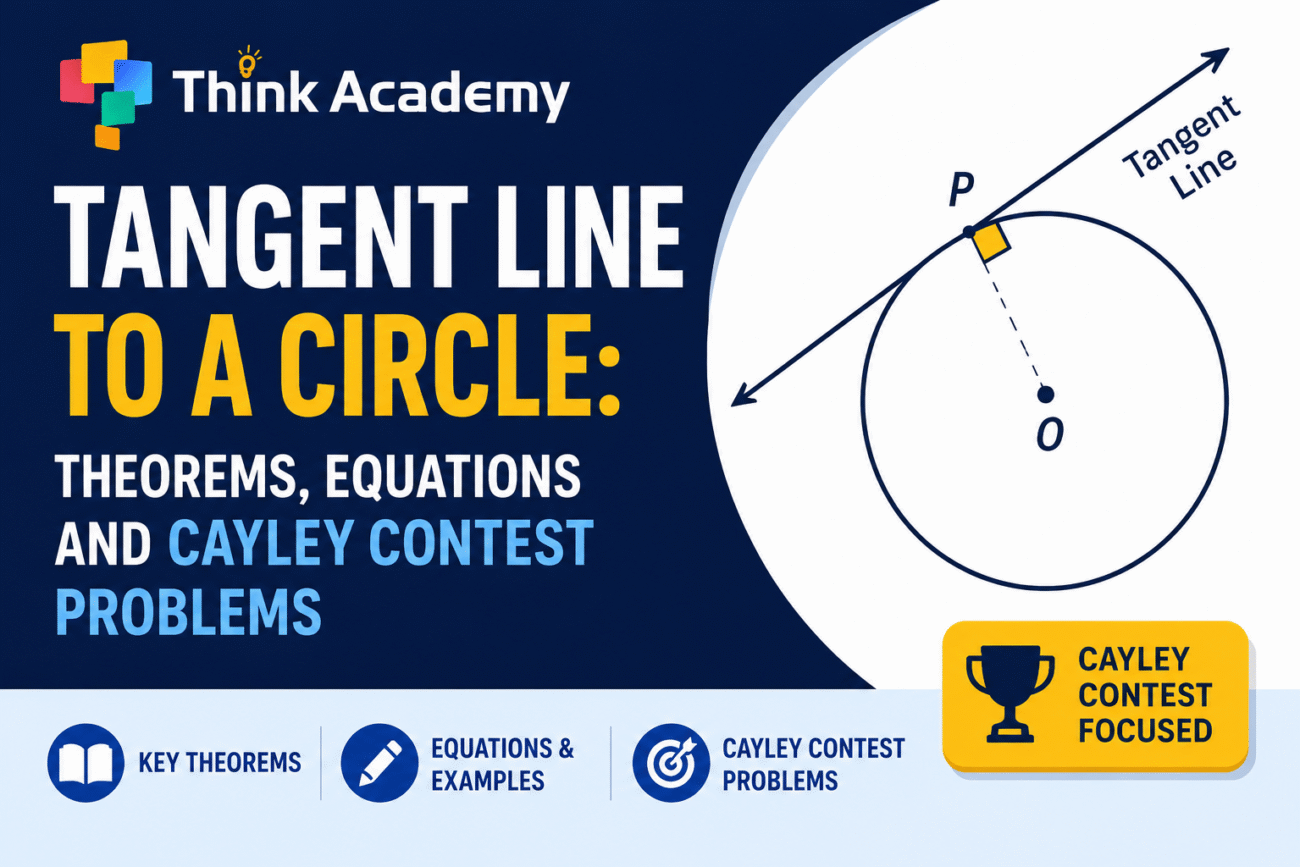
A tangent line to a circle is a straight line that touches the circle at exactly one point. That point is called the point of tangency.
Three things distinguish a tangent line from other lines in relation to a circle:
- A tangent touches the circle at exactly one point
- A secant crosses the circle at two points
- A line with no intersection does not touch the circle at all
The tangent line does not enter the interior of the circle — it just grazes the boundary at a single point and continues on either side.
The key properties and theorems
Theorem 1: Tangent-radius perpendicularity
A tangent to a circle is perpendicular to the radius drawn to the point of tangency.
This is the most important property of a tangent line. If a line is tangent to a circle at point P, and O is the centre of the circle, then OP ⊥ tangent at P.
This theorem works in both directions:
- If a line is tangent to a circle at P, then it is perpendicular to the radius OP
- If a line through P is perpendicular to radius OP, then it is tangent to the circle at P
Why this matters: The perpendicularity relationship creates a right angle at the point of tangency. This means the Pythagorean theorem becomes available in any diagram involving a tangent, a radius, and a line from an external point.
Theorem 2: Two tangents from an external point
If two tangent lines are drawn to a circle from the same external point, the tangent segments are equal in length.
If point P lies outside a circle with centre O, and PA and PB are tangent to the circle at A and B respectively, then:
PA = PB
Proof outline: Triangles OAP and OBP are congruent by the hypotenuse-leg theorem (OA = OB as radii; OP is shared; both have a right angle at the tangent point). Therefore PA = PB by corresponding parts.
This theorem appears frequently in Cayley Contest problems involving an external point and two tangent lengths — often as the key insight needed to find a missing length.
Check out Similar Triangles Worksheet: Properties, Rules and Practice Problems.
Finding the equation of a tangent line to a circle
This is the most common examination and contest application of tangent lines. It combines the perpendicularity theorem with coordinate geometry.
The standard approach
Given: A circle with centre O and a point P on the circle. Find: The equation of the tangent to the circle at P.
Step 1: Find the slope of the radius OP.
Step 2: The tangent is perpendicular to OP, so its slope is the negative reciprocal of the radius slope.
If the radius slope = m, then the tangent slope = −1/m.
Step 3: Use point-slope form with the point of tangency P to write the tangent equation.
y − y₁ = m_tangent(x − x₁)
Worked example 1: Tangent at a given point
A circle has centre O(0, 0) and passes through P(3, 4). Find the equation of the tangent to the circle at P.
Step 1: Slope of radius OP = (4 − 0) / (3 − 0) = 4/3
Step 2: Slope of tangent = −1/(4/3) = −3/4
Step 3: Equation of tangent through P(3, 4): y − 4 = −3/4(x − 3) y − 4 = −3x/4 + 9/4 y = −3x/4 + 9/4 + 16/4 y = −3x/4 + 25/4
Or in standard form: 3x + 4y = 25
Verify: Check that P(3, 4) satisfies the equation: 3(3) + 4(4) = 9 + 16 = 25 ✓
Worked example 2: Circle not centred at the origin
A circle has centre C(2, −1) and passes through point P(5, 3). Find the equation of the tangent to the circle at P.
Step 1: Slope of radius CP = (3 − (−1)) / (5 − 2) = 4/3
Step 2: Slope of tangent = −3/4
Step 3: Equation through P(5, 3): y − 3 = −3/4(x − 5) y − 3 = −3x/4 + 15/4 y = −3x/4 + 15/4 + 12/4 y = −3x/4 + 27/4
Using the Pythagorean theorem with tangent lines
The right angle at the point of tangency makes the Pythagorean theorem directly available for finding lengths.
Worked example 3: Length of a tangent segment from an external point
A circle has centre O and radius 5 cm. Point P is 13 cm from the centre. A tangent is drawn from P to touch the circle at T. Find the length PT.
Setup: Triangle OTP has a right angle at T (tangent-radius perpendicularity). OT = 5 (radius), OP = 13, PT = ?
Pythagorean theorem: PT² + OT² = OP² PT² + 25 = 169 PT² = 144 PT = 12 cm
Worked example 4: Finding the radius
A tangent from an external point P touches a circle at T. The distance PT = 8 cm and the distance from P to the centre O is 10 cm. Find the radius of the circle.
OT² = OP² − PT² OT² = 100 − 64 = 36 OT = 6 cm
Worked example 5: Two tangents and triangle area
From an external point P, two tangents PA and PB are drawn to a circle with centre O and radius 6 cm. The angle APB = 60°. Find the length of the tangent PA.
Since PA = PB (two tangents from external point), triangle PAB is isosceles. Angle OAP = 90° (tangent-radius). Angle APO = 60°/2 = 30° (line PO bisects angle APB by symmetry).
In right triangle OAP: tan(30°) = OA/PA 1/√3 = 6/PA PA = 6√3 cm
Tangent lines in coordinate geometry: finding if a line is tangent
A line is tangent to a circle if the perpendicular distance from the centre to the line equals the radius.
Distance from point (h, k) to line ax + by + c = 0:
d = |ah + bk + c| / √(a² + b²)
If d = r (radius), the line is tangent. If d < r, the line is a secant. If d > r, the line does not intersect the circle.
Worked example 6: Is this line tangent?
Is the line 3x − 4y + 25 = 0 tangent to the circle with centre O(0, 0) and radius 5?
Distance from O(0, 0) to the line: d = |3(0) − 4(0) + 25| / √(9 + 16) d = 25 / √25 d = 25 / 5 d = 5
Since d = 5 = radius, the line is tangent to the circle. ✓
Tangent lines and the Cayley Contest
The Cayley Contest, written by Grade 10 students, regularly features circle geometry problems involving tangent lines. These appear in two main forms:
Direct property problems: A diagram is given with a tangent, a radius, and an external point. Students must use the perpendicularity theorem and the Pythagorean theorem to find a missing length or angle. These appear in Part A and Part B and reward students who recognise the right angle at the point of tangency immediately.
Coordinate geometry problems: A circle is defined by its centre and a point on the circumference. Students must find the equation of the tangent at that point, often as a step toward finding where the tangent intersects an axis or another line. These appear in Part B and Part C and combine slope reasoning with circle geometry.
Key insight for Cayley: Many tangent problems look complex until the right angle at the point of tangency is identified. Once that right angle is placed in the diagram, the Pythagorean theorem becomes available and the problem usually resolves quickly. Students who mark right angles as soon as they identify a tangent-radius pair save significant time on the contest.

Tangent line to a circle: practice problems
Try these before checking the solutions below.
Q1. A circle has centre O(0, 0) and passes through P(5, 12). Find the equation of the tangent to the circle at P.
Q2. From an external point P, a tangent PT is drawn to a circle with centre O and radius 8 cm. If OP = 17 cm, find the length of the tangent PT.
Q3. A circle has centre C(3, 1) and radius 5. Is the line 4x − 3y + 2 = 0 tangent to the circle?
Q4. Two tangents from external point P touch a circle of radius 5 at points A and B. PA = 12. Find the distance from P to the centre O.
Q5. A circle has centre O(1, 2) and passes through Q(4, 6). Find the equation of the tangent to the circle at Q.
Solutions
Q1. Slope of OP = 12/5 Tangent slope = −5/12 Tangent through P(5, 12): y − 12 = −5/12(x − 5) Multiply through by 12: 12y − 144 = −5x + 25 5x + 12y = 169
Q2. PT² = OP² − OT² = 17² − 8² = 289 − 64 = 225 PT = 15 cm
Q3. Distance from C(3, 1) to line 4x − 3y + 2 = 0: d = |4(3) − 3(1) + 2| / √(16 + 9) = |12 − 3 + 2| / 5 = 11/5 = 2.2 Since 2.2 ≠ 5, the line is not tangent (it is a secant, since 2.2 < 5).
Q4. OA = 5 (radius), PA = 12, angle OAP = 90° OP² = PA² + OA² = 144 + 25 = 169 OP = 13 cm
Q5. Slope of OQ = (6 − 2)/(4 − 1) = 4/3 Tangent slope = −3/4 Tangent through Q(4, 6): y − 6 = −3/4(x − 4) y − 6 = −3x/4 + 3 y = −3x/4 + 9 3x + 4y = 36
Common mistakes with tangent lines to circles
| Mistake | How to avoid it |
|---|---|
| Forgetting the right angle at the point of tangency | Always mark the 90° angle as soon as you identify a tangent-radius pair |
| Using the slope of the tangent instead of the radius to find the tangent slope | Find the radius slope first, then take the negative reciprocal |
| Assuming two tangent segments from external points are unequal | If both tangents come from the same external point, they are always equal |
| Applying the distance formula without rewriting the line in standard form first | The distance formula requires the form ax + by + c = 0 — rearrange before substituting |
| Not verifying the point of tangency satisfies the tangent equation | Always substitute back to check |
How Think Academy Canada supports Grade 10 math and Cayley preparation
Think Academy Canada works with high-performing Ontario students from Grade 1 through Grade 12. For Grade 10 students, our programme covers the full MPM2D curriculum — including the analytic geometry and circle geometry strands where tangent line problems appear.
Our approach starts with a free diagnostic. Every new student completes a short assessment and receives a personalised feedback report identifying where their skills stand. For Grade 10 students, the report typically shows whether gaps are in the geometric reasoning (recognising and applying the perpendicularity theorem), the coordinate geometry (finding slopes, equations of lines), or the integration of both in multi-step problems — the type that appears in Cayley Part B and Part C.
The Cayley Contest is written in February each year. Students who build fluency in circle geometry, analytic geometry, and their intersection well before the contest — rather than cramming in the weeks before — consistently perform better on the multi-step problems that determine the difference between good and exceptional scores.
FAQ
What is a tangent line to a circle?
A tangent line to a circle is a straight line that touches the circle at exactly one point, called the point of tangency. It does not cross into the interior of the circle. A tangent line is always perpendicular to the radius drawn to the point of tangency.
What is the tangent-radius theorem?
The tangent-radius theorem states that a tangent to a circle is perpendicular to the radius at the point of tangency. This creates a right angle at the point of contact, which makes the Pythagorean theorem available for any triangle formed by the radius, tangent, and a line from an external point.
How do you find the equation of a tangent line to a circle?
Find the slope of the radius from the centre to the point of tangency. The tangent slope is the negative reciprocal of the radius slope. Use point-slope form with the point of tangency to write the equation of the tangent line.
Are two tangent segments from the same external point equal?
Yes. If two tangent lines are drawn to a circle from the same external point, the tangent segments (from the external point to each point of tangency) are equal in length. This follows from the congruence of the two right triangles formed.
How do you find the length of a tangent from an external point?
Use the Pythagorean theorem. If r is the radius and d is the distance from the external point to the centre, the tangent length t satisfies: t² + r² = d². Therefore t = √(d² − r²).
How do you check if a line is tangent to a circle?
Calculate the perpendicular distance from the centre of the circle to the line. If this distance equals the radius, the line is tangent. If it is less than the radius, the line is a secant. If it is greater than the radius, the line does not intersect the circle.
Does a tangent line to a circle appear on the Cayley Contest?
Yes. The Cayley Contest regularly includes problems involving tangent lines, both as pure geometry problems (using the perpendicularity theorem and Pythagorean theorem) and as coordinate geometry problems (finding the equation of a tangent line at a given point). Recognising the right angle at the point of tangency is the key insight in most Cayley tangent problems.
What is the difference between a tangent and a secant?
A tangent touches a circle at exactly one point. A secant crosses a circle at two points. A tangent can be thought of as the limiting case of a secant where the two intersection points coincide.
How is a tangent line to a circle related to slope?
The slope of a tangent line at a point on a circle is the negative reciprocal of the slope of the radius to that point. This is because the tangent is perpendicular to the radius, and perpendicular lines have slopes that are negative reciprocals of each other.
What Ontario math courses cover tangent lines to circles?
Tangent line properties (tangent-radius perpendicularity, two tangents from an external point) are covered in Grade 9 and 10 geometry. Finding the equation of a tangent line using coordinate geometry is part of MPM2D (Grade 10 Academic Mathematics), in the analytic geometry strand.
How can Think Academy Canada help with circle geometry and tangent lines?
Think Academy Canada offers a free diagnostic assessment for students in Grades 1 to 12. The assessment identifies where a student’s geometry skills stand — including their ability to apply the tangent-radius theorem, use the Pythagorean theorem in circle contexts, and find tangent line equations using coordinate geometry. A personalised feedback report is provided after the assessment.
About Think Academy Canada Think Academy Canada is a K-12 mathematics tutoring programme, part of TAL Education Group. We work with motivated students across Canada from Grade 1 through Grade 12, with a focus on Ontario curriculum, EQAO preparation, and competition mathematics including CEMC contests (Pascal, Cayley, Fermat, Euclid) and AMC. All lessons are delivered online. Follow us on Instagram at @thinkacademyca.