


Is my child gifted?
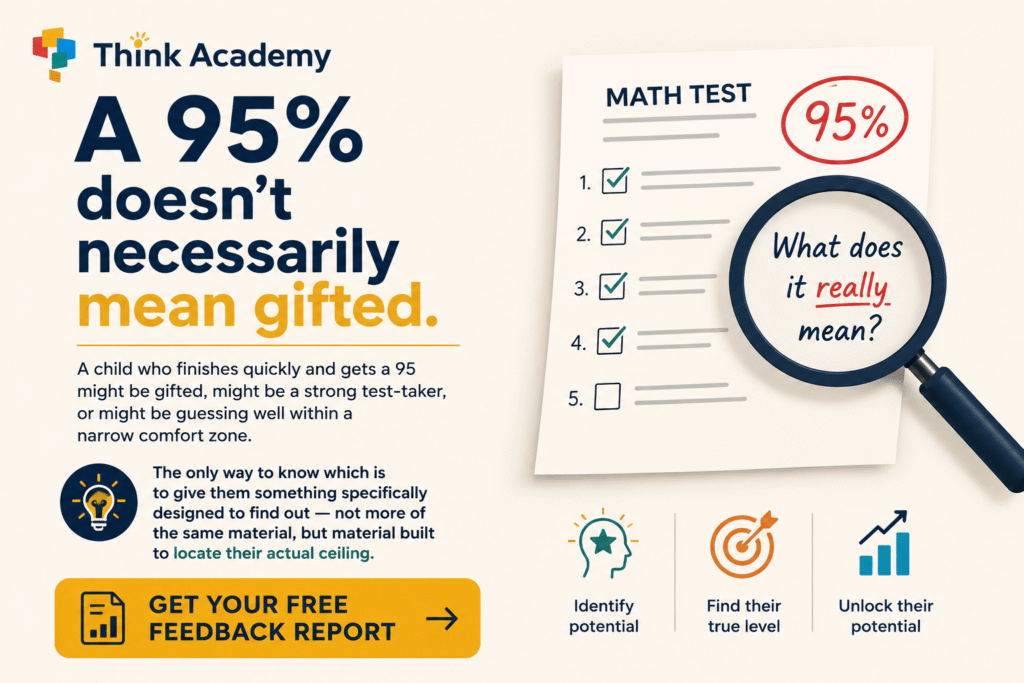
A 95% on a test tells you a child met the bar. It doesn’t tell you whether they were genuinely stretched to get there, or whether the bar was simply too low to find out. Mathematical giftedness has real, observable signs that most parents have noticed without realising what they were looking at — and there’s a fast, concrete way to find out for certain, rather than wondering.
The signs of mathematical giftedness
Researchers and educators who work specifically with gifted students consistently point to the same cluster of traits. None of these requires a child to already be in an advanced programme or carrying a “gifted” label — most parents notice these before any school ever flags them.
Non-procedural reasoning. This is the single clearest signal. A child who finishes a test quickly and scores well may simply be a fast, careful worker. A child who arrives at the correct answer by a route nobody taught them — skipping steps, finding a shortcut, solving it “the wrong way” that happens to work — is doing something different. They’re reasoning about the structure of the problem itself, not following a memorised procedure.
Early, strong number sense. A grasp of what numbers and quantities actually mean, often appearing before formal instruction has even covered it. Some gifted children notice relationships between numbers — prices, scores, patterns — well ahead of when school introduces those concepts.
Pattern recognition that starts young and generalises quickly. Noticing repetition isn’t unusual in young children. What’s distinctive is when a child starts finding relationships between ideas, objects, or facts that aren’t obviously connected — applying a pattern noticed in one place to a completely different context.
Curiosity that goes past the question that was asked. A child who asks what would happen to a formula if a constant changed, or wonders aloud about a case the lesson didn’t cover, is engaging with the underlying structure of the math — not just completing the assigned task.
Constructing their own explanations, not just producing the right answer. A genuinely gifted child can usually explain their reasoning in their own words, often in a way that reveals real understanding rather than memorised steps. If you ask “how would you explain this to someone younger,” and they can build that explanation from scratch, that’s a meaningful signal.
Disengagement or boredom specifically with repetitive practice. Many gifted children aren’t difficult or disruptive — they’re simply unstimulated. A child who is otherwise capable and curious but seems to switch off during repetitive drill work is often signalling that the material isn’t asking enough of them, not that they lack ability.
Why school performance alone can’t answer this question
This is the part most parents don’t expect: strong grades and mathematical giftedness are not the same thing, and a child can have one without the other being obvious.
A standard classroom test is built to measure whether a student has met the grade-level standard. It was never designed to measure how far above that standard a specific child could go — there’s no mechanism in a regular test for a gifted child to demonstrate a ceiling the test wasn’t built to find. This is exactly why a child can be quietly gifted for years without anyone — including the child — realising it. The signs are there, but a 92% doesn’t distinguish between “this was genuinely hard and I got there” and “this asked nothing of me.”
It’s also why some of the clearest giftedness signals (non-procedural reasoning, generalising a pattern across contexts, constructing original explanations) often go completely unmeasured by standard testing, which mostly rewards correctly following the expected procedure.
The honest version of the question most parents are really asking isn’t “are my child’s grades good” — it’s “is my child working anywhere near their actual capability, or just clearing a bar that was never set very high to begin with.”
What giftedness in math is not
A few common misconceptions worth clearing up, because they cause both false alarms and missed signals.
It’s not the same as being a fast worker. Speed alone, without the non-procedural reasoning underneath it, is often just strong test-taking skill — valuable, but a different thing.
It doesn’t require straight A’s. Giftedness and high achievement aren’t the same thing. Some gifted children, particularly those who are bored or unchallenged, underperform relative to their actual ability — coasting through with adequate-but-unremarkable grades precisely because the material has never asked enough of them to reveal what they’re capable of.
It isn’t always loud or obvious. Some gifted children are quiet, even withdrawn in a classroom setting, and their giftedness shows up far more clearly in how they approach an unfamiliar problem one-on-one than in how they perform in a group setting.
How to actually find out
Watching for the signs above is a useful starting point, but it leaves most parents in the same place: noticing something, without a concrete way to confirm it.
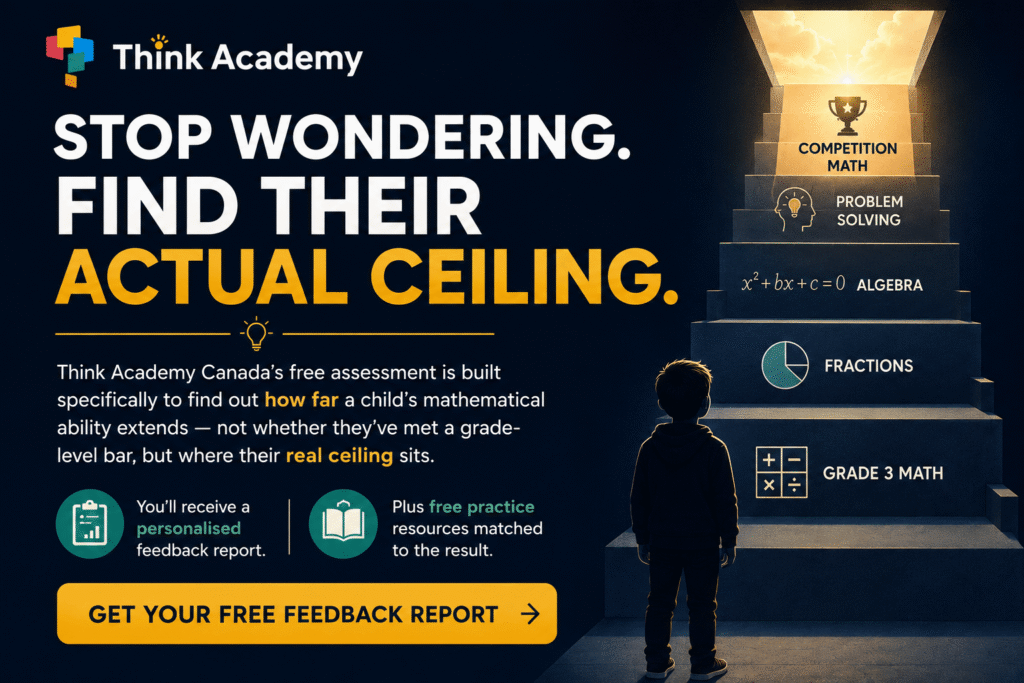
The only reliable way to find a child’s actual mathematical ceiling is to give them material specifically built to locate it — not more of the same grade-level content, but problems designed to differentiate between a student who has mastered the standard curriculum and one who is capable of considerably more. This is the entire premise behind competition mathematics as a category: contests like the CEMC series (Gauss, Pascal, Cayley, Fermat, Euclid) and the AMC don’t test whether a student met the curriculum bar — they’re built specifically to find out how far past it a student can go.
A proper diagnostic assessment works on the same principle. It’s not asking “did this child pass” — it’s asking “where, specifically, does this child’s ability actually run out.”
How Think Academy Canada helps
Think Academy Canada works exclusively with motivated, high-performing students across Canada from Grade 1 through Grade 12. We are not a remediation service — our entire programme exists for families asking exactly the question this page is about: is my child capable of more than their current environment is asking of them.
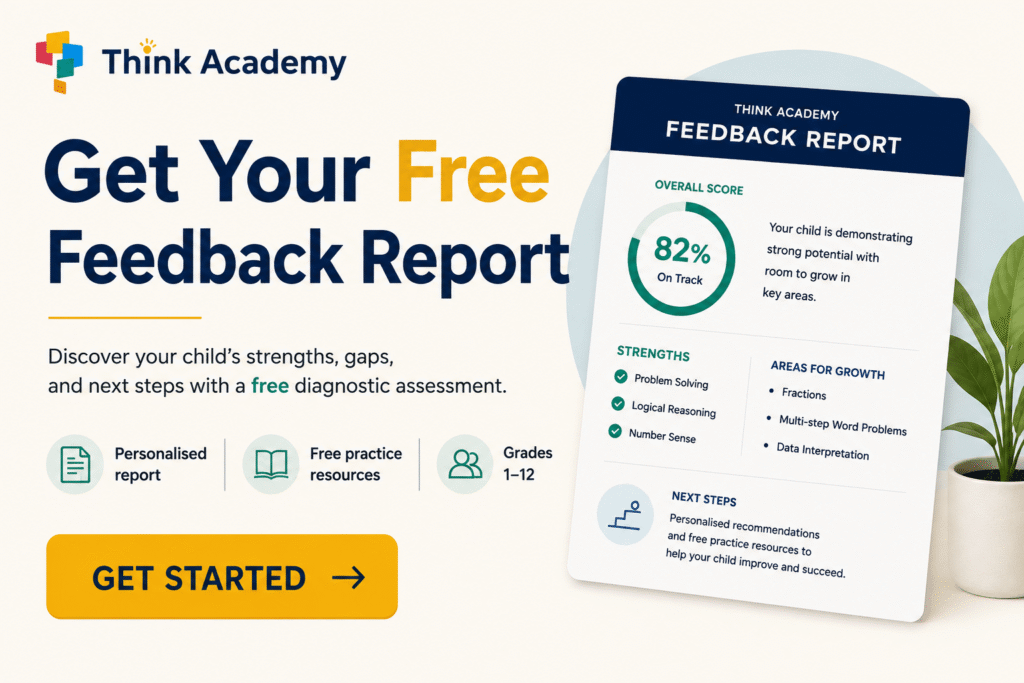
Every new student starts with a free diagnostic assessment, built specifically to find a child’s actual ceiling rather than confirm they’ve met a grade-level standard. You’ll receive a personalised feedback report showing precisely where that ceiling currently sits, plus free practice resources matched to the result. From there, many families book a free trial class to see what genuinely matched challenge looks like for their child in practice — often the first time a parent gets to watch their child actually work at the edge of their ability, rather than comfortably inside it.
If you’ve noticed any of the signs above and found yourself wondering, that instinct is usually worth trusting. The fastest way to know for certain is to find out directly.
FAQ
What are the signs my child is gifted in math?
Key signs include non-procedural reasoning (finding correct answers through unconventional routes), strong number sense ahead of formal instruction, pattern recognition that generalises across different contexts, curiosity that extends past the question being asked, the ability to construct original explanations rather than just produce answers, and disengagement specifically during repetitive practice.
Can a child be gifted in math without getting top grades?
Yes. Giftedness and high achievement are not the same thing. Some gifted children, especially those who are under-stimulated, underperform relative to their actual ability because school material has never asked enough of them to reveal it.
How is mathematical giftedness different from being good at math?
Being good at math often means reliably following procedures correctly. Mathematical giftedness typically shows up as non-procedural reasoning — finding a path to the answer that wasn’t taught, recognising structure and patterns independently, and generalising ideas across unrelated contexts.
How can I tell if my child is gifted or just a fast test-taker?
Speed alone isn’t a reliable signal. The clearer indicator is whether a child can explain their reasoning in their own words, in a way that shows genuine understanding of why an answer works, rather than recalling a memorised step.
Why doesn’t my child’s report card tell me if they’re gifted?
A standard classroom test is built to measure whether a student met the grade-level standard. It has no built-in way to measure how far past that standard a specific student could go, since it was never designed to find a ceiling — only to confirm a floor has been cleared.
What should I do if I think my child is gifted in math?
Start with an assessment specifically designed to find a child’s actual ability ceiling, rather than confirm grade-level competency. From there, appropriately matched challenge — through enrichment or competition mathematics — is what allows a genuinely capable child to keep developing rather than coasting.
Is competition math only for already-identified gifted students?
No. Competition mathematics, including the CEMC series (Gauss, Pascal, Cayley, Fermat, Euclid) and the AMC, is specifically designed to differentiate among students who have already mastered the standard curriculum. It’s often the first time a capable child’s actual ceiling becomes visible.
At what age can mathematical giftedness be identified?
Signs can appear quite early — some parents notice unusual interest in numbers or early pattern recognition in preschool-aged children. Formal identification is often recommended once a child is around 5 or 6, though the underlying signs are frequently observable well before any formal assessment.
Does Think Academy Canada work with students who aren’t already identified as gifted?
Yes. Many families come to us simply suspecting their child is capable of more, without any formal identification. Our free assessment is designed to find out, regardless of whether a child has ever been formally tested or labelled.
What happens after the free assessment?
You’ll receive a personalised feedback report showing exactly where your child’s mathematical ability currently sits, along with free practice resources matched to the results. Families who want to go further can book a free trial class to see appropriately matched challenge in action.
About Think Academy Canada Think Academy Canada is a K-12 mathematics tutoring programme, part of TAL Education Group, working exclusively with motivated, high-performing students across Canada from Grade 1 through Grade 12. We focus on curriculum enrichment and competition mathematics, including CEMC contests and AMC. All lessons are delivered online. Follow us on Instagram at @thinkacademyca.

