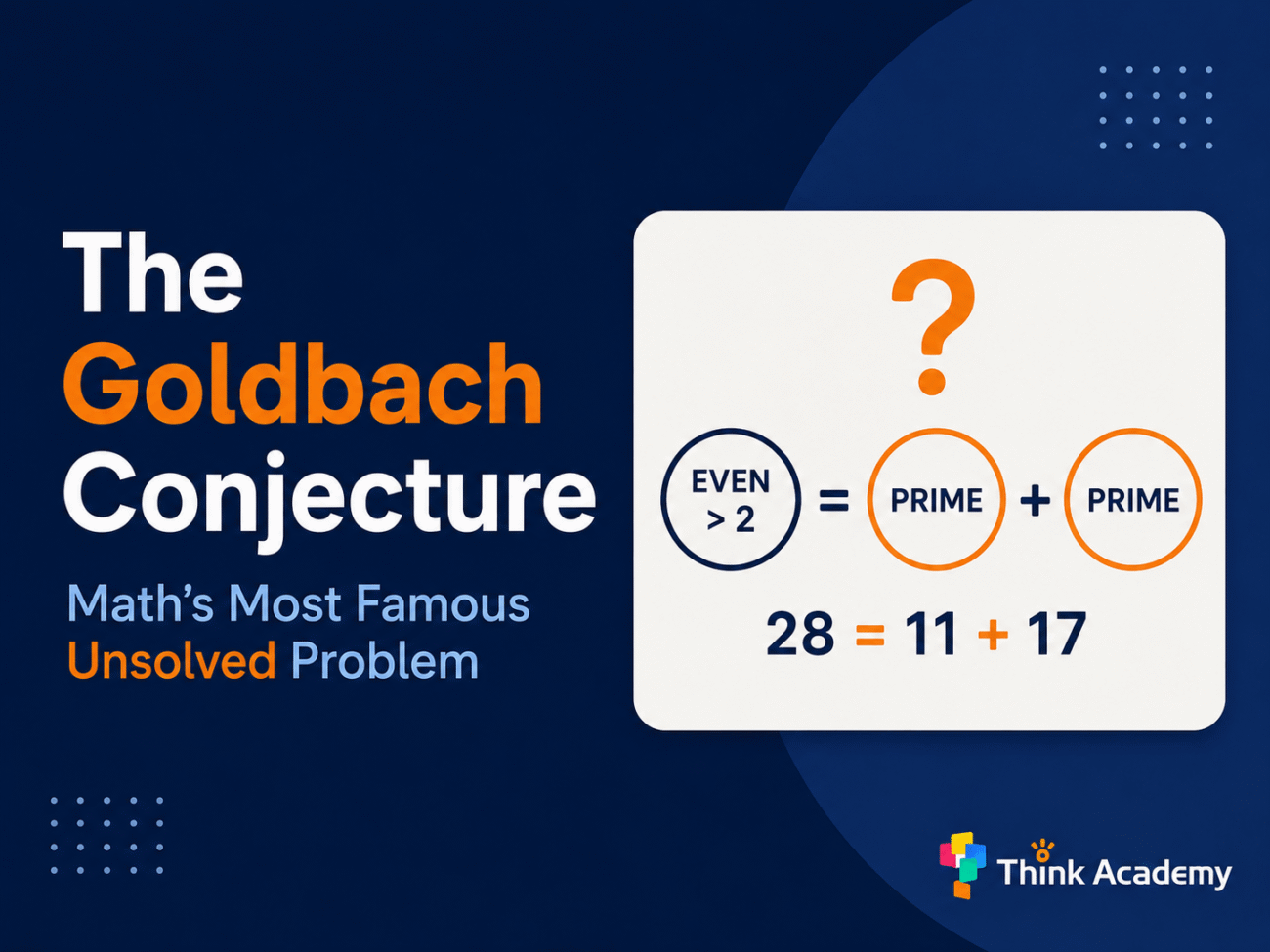
In 1742, the mathematician Christian Goldbach wrote a letter to Leonhard Euler — widely regarded as the greatest mathematician of the 18th century — proposing a conjecture so simple that a child could understand it and so deep that no one has proved it in nearly 300 years.
The Goldbach conjecture states:
Every even integer greater than 2 can be expressed as the sum of two prime numbers.
That’s it. The entire conjecture fits in one sentence. And yet it remains unproved — making it one of the most famous open problems in all of mathematics.
What the Goldbach Conjecture Actually Says
A prime number is a positive integer greater than 1 that has no positive divisors other than 1 and itself: 2, 3, 5, 7, 11, 13, 17, 19, 23…
The Goldbach conjecture claims that every even integer greater than 2 can be written as the sum of exactly two primes.
Checking the first several cases:
| Even Number | Goldbach Representation(s) |
|---|---|
| 4 | 2 + 2 |
| 6 | 3 + 3 |
| 8 | 3 + 5 |
| 10 | 3 + 7 = 5 + 5 |
| 12 | 5 + 7 |
| 14 | 3 + 11 = 7 + 7 |
| 16 | 3 + 13 = 5 + 11 |
| 18 | 5 + 13 = 7 + 11 |
| 20 | 3 + 17 = 7 + 13 |
| 28 | 5 + 23 = 11 + 17 |
| 48 | 5 + 43 = 7 + 41 = 11 + 37 = 17 + 31 = 19 + 29 |
| 100 | 3 + 97 = 11 + 89 = 17 + 83 = 29 + 71 = 41 + 59 = 47 + 53 |
The pattern holds. It has been verified by computers for every even number up to 4 × 10¹⁸ (four quintillion). Not a single counterexample has ever been found.
And yet — this is not a proof. Verifying a statement for the first four quintillion cases does not prove it for all even numbers. There are infinitely many even numbers. The conjecture might fail at 10¹⁰⁰, or 10¹⁰⁰⁰, or at some incomprehensibly large number no computer will ever check.
This is the essence of what makes the Goldbach conjecture so interesting: the gap between “it seems true” and “it is provably true” is, in mathematics, unbridgeable by any finite amount of evidence.

A Brief History
1742 — Goldbach’s letter to Euler
Christian Goldbach first proposed the conjecture in a letter to Euler on June 7, 1742. Goldbach’s original formulation was slightly different — he included 1 as a prime (a convention no longer used) — but the modern form, refined by Euler, is the one stated above.
Euler believed the conjecture was certainly true but admitted he could not prove it. In his reply, he called it “a completely certain theorem, although I cannot prove it.”
1900 — Hilbert’s Problems
When David Hilbert presented his famous list of 23 unsolved mathematical problems in 1900 — arguably the most influential list in the history of mathematics — the Goldbach conjecture was not included. This was not because it was considered unimportant, but because Hilbert considered it likely to yield to existing methods. He was wrong.
1937 — Vinogradov’s Theorem
The Russian mathematician Ivan Vinogradov proved that every sufficiently large odd integer can be expressed as the sum of three primes. This is the “ternary Goldbach conjecture” — a related but different statement. Vinogradov’s result was a major breakthrough and is the deepest result in the direction of Goldbach’s conjecture to this day.
2013 — Weak Goldbach Conjecture Proved
Harald Helfgott proved the weak Goldbach conjecture: every odd integer greater than 5 can be expressed as the sum of three primes. This was a landmark result — the first complete proof of any Goldbach-type statement for all integers above a certain bound.
The strong Goldbach conjecture — the original statement about even numbers and two primes — remains open.
2000 — The Million Dollar Prize
Publisher Faber and Faber offered a $1,000,000 prize for a proof of the Goldbach conjecture, as part of the publicity for the novel Uncle Petros and Goldbach’s Conjecture by Apostolos Doxiadis. The prize period expired in 2002 unclaimed. No such prize is currently offered, but the conjecture remains unsolved.
Why Is the Goldbach Conjecture So Hard to Prove?
The Goldbach conjecture is easy to state, seems obviously true, and yet has resisted proof for nearly three centuries. Why?
The fundamental problem: primes are irregular.
Primes are not distributed according to any simple pattern. The gaps between primes grow, on average, as numbers get larger — but in irregular, seemingly unpredictable ways. Two primes might be very close together (twin primes like 17 and 19, or 1,000,000,007 and 1,000,000,009) or very far apart. This irregularity makes it extremely difficult to make precise statements about when a specific even number can be expressed as a sum of two primes.
Additive number theory is hard.
The Goldbach conjecture belongs to the branch of mathematics called additive number theory — the study of how integers can be expressed as sums of other integers with specific properties. This area is notoriously difficult. Many of the deepest unsolved problems in mathematics are additive number theory problems.
Most proof techniques are multiplicative, not additive.
The most powerful tools in analytic number theory — the ones that produced the prime number theorem and Vinogradov’s theorem — are essentially multiplicative. They work well for statements about products and divisibility of primes. Statements about sums of primes require different, often more delicate, techniques.
No known method generalises.
The approaches that prove Goldbach-type results for “sufficiently large” numbers (like Vinogradov’s) leave a finite but unimaginably large gap of smaller numbers that must be handled separately. Closing that gap — as Helfgott did for the weak conjecture in 2013 — required enormous computational effort combined with refined theoretical bounds. For the strong conjecture, the gap is far larger and the techniques far more demanding.
What Progress Has Been Made?
While the Goldbach conjecture itself remains unproved, mathematicians have proved several related results that represent genuine progress.
Chen’s Theorem (1966): The Chinese mathematician Jingrun Chen proved that every sufficiently large even integer can be expressed as the sum of a prime and a “semiprime” — a number that is either prime or the product of exactly two primes. Written formally: every large enough even integer N = p + q where p is prime and q is either prime or a product of two primes. This is sometimes stated as “every large even integer is the sum of a prime and a product of at most two primes.” It is the closest proven result to the original Goldbach conjecture.
Helfgott’s Proof of the Weak Goldbach Conjecture (2013): As noted above, Helfgott proved that every odd integer greater than 5 is the sum of three primes. This is the weak Goldbach conjecture and its proof is complete. The strong conjecture — sums of exactly two primes for even integers — remains open.
Computational Verification: The conjecture has been computationally verified for all even integers up to 4 × 10¹⁸. This is evidence, not proof — but it is very strong evidence.
Conditional results: Under the assumption of the Generalised Riemann Hypothesis (itself one of the most famous unproved conjectures in mathematics), stronger Goldbach-type results can be proved. Mathematics is full of “if X then Y” results where X is itself unproved — this is how the subject makes progress even when foundational questions remain open.
The Goldbach Conjecture and Mathematical Thinking
The Goldbach conjecture is interesting not just as an open problem but as a window into what mathematics actually is.
Mathematics is not the same as calculation.
A student who has verified the conjecture for even numbers up to 100 has done something useful and educational. But they have not done mathematics in the deepest sense — they have computed. A proof of the Goldbach conjecture, when it comes, will not be a longer computation. It will be an argument — a sequence of logical steps that establishes the result with certainty for all even numbers simultaneously, in a way that no finite computation can.
This distinction between computation (checking cases) and proof (establishing universal truth by argument) is one of the most important ideas in mathematics. It is the reason that unsolved problems like the Goldbach conjecture exist at all: there is no algorithm that, for every true mathematical statement, produces a proof. Some true statements are simply hard to prove.
Why mathematicians care about hard problems.
Working on a problem like the Goldbach conjecture — even without solving it — forces the development of new mathematical tools. The techniques developed in the pursuit of Goldbach-type results (the Hardy-Littlewood circle method, sieve methods, analytic number theory) have found applications throughout mathematics. The value of an unsolved problem is not only in its eventual solution. It is in what the pursuit produces.
The feeling of not knowing.
There is a particular quality of mind that is cultivated by sitting with an unsolved problem: the ability to hold genuine uncertainty, to generate and test approaches without guarantee of success, and to find this engaging rather than frustrating. This is the mathematical attitude that competition mathematics develops — not the ability to follow procedures, but the ability to reason in new situations. The Goldbach conjecture, understood this way, is a lesson in what mathematical thought actually involves.

Where This Kind of Thinking Shows Up
The Goldbach conjecture itself does not appear on mathematics competition problems — it is an unsolved research problem, not an exercise. But the mathematical ideas it involves are deeply connected to competition mathematics.
Prime numbers are among the most frequently tested topics in competition mathematics at every level. Divisibility, prime factorisation, modular arithmetic, and properties of primes underpin dozens of problem types in the Gauss Contest, AMC 8, AMC 10, and the full CEMC series through to the Euclid Contest.
Proof techniques used in the pursuit of Goldbach-type results — mathematical induction, modular arithmetic arguments, and parity reasoning — are the same techniques tested in Euclid and COMC Part C questions. A student who finds the Goldbach conjecture genuinely interesting is showing the kind of mathematical curiosity that, properly developed, leads to strong results in these competitions.
The Canadian Mathematical Olympiad — Canada’s most elite high school competition — includes number theory problems at every sitting. The depth of number-theoretic thinking required at the CMO level is in the same spirit as the thinking the Goldbach conjecture has inspired in professional mathematics.
If your child finds the Goldbach conjecture fascinating — the way it is so easy to state and so hard to crack, the way it sits at the boundary of what is known — that instinct is worth developing. Think Academy’s competition mathematics programmes are built around exactly this kind of mathematical curiosity. Find out what structured competition training looks like →
Can You Try It Yourself?
The Goldbach conjecture is one of the rare mathematical problems where anyone — with no advanced training — can engage with the actual question. Here are some things to try:
Verify it for the first 20 even numbers. Write each even number from 4 to 40 as a sum of two primes. Can you always find one? (You can — but trying it builds a concrete sense of what the conjecture is claiming.)
Find even numbers with many Goldbach representations. 100 has six: 3+97, 11+89, 17+83, 29+71, 41+59, 47+53. Can you find an even number with more than six representations? This connects to the Goldbach comet — a visualisation of how many Goldbach representations each even number has, which forms a striking comet shape when graphed.
Explore near-prime numbers. What properties make a prime a “good” partner for Goldbach representations? If p is a prime and N is even, when is N − p also prime?
Investigate odd numbers. The Goldbach conjecture concerns even numbers, but you can ask an analogous question: is every odd number greater than 5 the sum of three primes? (Yes — this is the proved weak Goldbach conjecture.)
None of these explorations will prove the conjecture. But they will give you a genuine feel for why it is both plausible and elusive — which is what it feels like to engage with real mathematical research.
Frequently Asked Questions
What is the Goldbach conjecture? The Goldbach conjecture states that every even integer greater than 2 can be expressed as the sum of two prime numbers. It was proposed by Christian Goldbach in a 1742 letter to Leonhard Euler and remains unproved.
Has the Goldbach conjecture been proved? No. It has been verified computationally for all even integers up to 4 × 10¹⁸, and significant related results have been proved (Chen’s Theorem, Helfgott’s proof of the weak Goldbach conjecture for odd numbers), but the original conjecture — two primes for every even number — remains an open problem in mathematics.
What is the weak Goldbach conjecture? The weak Goldbach conjecture states that every odd integer greater than 5 is the sum of three primes. This was proved by Harald Helfgott in 2013. The “strong” Goldbach conjecture (two primes for even integers) is the original and remains unproved.
How many Goldbach representations does a number have? Most even numbers have multiple representations. 100 = 3+97 = 11+89 = 17+83 = 29+71 = 41+59 = 47+53 — six representations. As even numbers get larger, the expected number of representations grows — which is one of the reasons mathematicians believe the conjecture is true, even without a proof.
Is there a prize for proving the Goldbach conjecture? No active prize. A $1,000,000 prize was offered by Faber and Faber in 2000 as a publicity stunt for a novel, but expired unclaimed in 2002. The Clay Mathematics Institute’s Millennium Prize Problems (each worth $1,000,000) do not include the Goldbach conjecture, though several related problems (the Riemann Hypothesis) are included.
What is Chen’s Theorem? Proved by Chinese mathematician Jingrun Chen in 1966, Chen’s Theorem states that every sufficiently large even integer can be written as the sum of a prime and a number that is the product of at most two primes. It is the closest proved result to the Goldbach conjecture.
See our related guides: Canadian Mathematical Olympiad guide · math induction proof guide · proof by contradiction guide · contrapositive math guide · Euclid math contest guide · COMC math contest guide · AMC 8 guide · Gauss math contest guide · math enrichment guide