School math is designed to bring every student to a standard. Math enrichment is designed for students who have already reached it — and need something harder. For a capable student whose grades are strong but whose class time is mostly spent waiting, enrichment is not an optional extra. It’s the difference between a child who develops real mathematical thinking and one who learns to coast on natural ability until the material eventually catches up with them.
This guide explains what math enrichment actually is, how to tell if your child needs it, and what the right starting point looks like.

What math enrichment actually is
Math enrichment is structured mathematical learning that goes beyond grade-level curriculum. It is not tutoring — tutoring fills gaps, enrichment extends ability. It is not homework help. It is not extra worksheets at the same level.
Genuine math enrichment does two things school curriculum rarely does for high-performing students:
It introduces non-routine problems. Problems that cannot be solved by applying a memorised procedure — where a student has to reason through an unfamiliar structure, find a pattern nobody pointed them to, or construct an argument from first principles. This is the kind of mathematical thinking that school tests rarely demand and that separates students who genuinely understand mathematics from those who are very good at following instructions.
It provides appropriately matched challenge. A student working in a class where every concept clicks immediately is not being stretched. The research on this is clear: students develop mathematical resilience — the ability to persist through difficulty — only when they regularly encounter material that doesn’t come easily. A student who has never struggled with a math problem hasn’t had the chance to build that resilience yet, regardless of how strong their grades are.
The three types of students who benefit from math enrichment
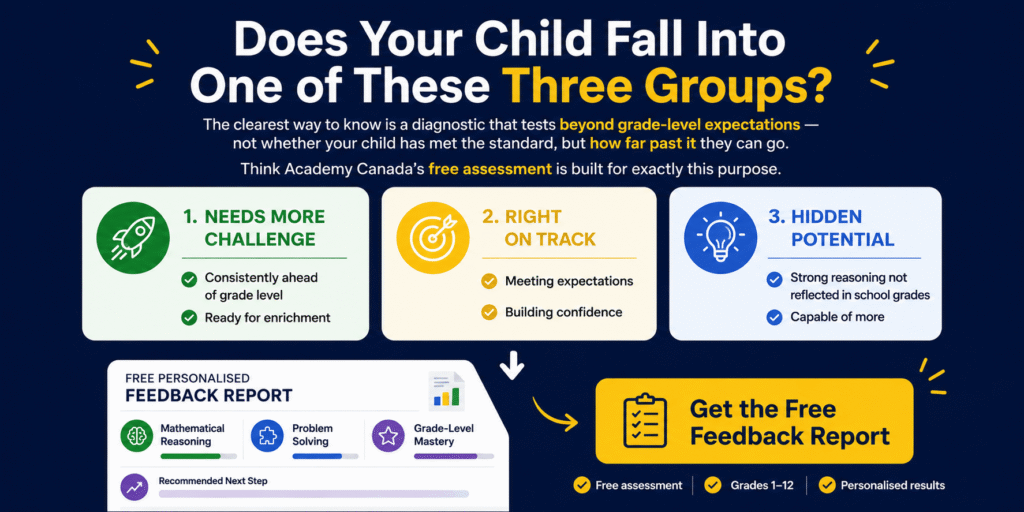
The student who is clearly ahead
Some students are visibly working above grade level — finishing work first, finding class repetitive, asking questions the curriculum doesn’t cover. For these students, enrichment is obvious and urgent. Without it, the most common outcome is quiet disengagement: the student stops paying full attention because they don’t need to, and the habits that come from never being challenged become harder to reverse later.
The student with strong grades but no real stretch
This is the most commonly missed group. A student with consistent high marks who has never written a competition problem, never encountered a question that stumped them for more than a minute, and whose score doesn’t really move regardless of effort level — this student may be performing well within a ceiling that school is simply not asking them to exceed. Their grades look fine. Their trajectory looks fine. But they are not developing the mathematical depth their ability makes possible. If you’re asking whether your child might be gifted in math specifically, see our guide to the signs of mathematical giftedness
The student preparing for competition mathematics
The CEMC contest series (Gauss, Pascal, Cayley, Fermat, Euclid) and the AMC series test mathematical reasoning that school curriculum does not teach. Number theory, combinatorics, proof-based geometry, non-routine algebra — none of these appear meaningfully in a standard school year, but all of them appear on competition papers. For a student with ambitions in this direction, enrichment that specifically targets competition mathematics is the only preparation that works.
What good math enrichment looks like
Not all enrichment programmes are the same. The distinction that matters most is between programmes that go deeper and programmes that just go faster.
Going faster — completing Grade 5 content in Grade 4, skipping a grade level — accelerates the curriculum but doesn’t necessarily develop the kind of non-routine reasoning that distinguishes a genuinely strong mathematician. A student who arrives at Grade 9 algebra having skipped Grade 6 curriculum may have covered more ground, but if every step came easily, they’ve developed neither the depth nor the resilience that genuine mathematical challenge builds.
Going deeper — working on problems that require real thought, introducing topics like combinatorics and number theory that school never covers, asking students to construct explanations and arguments rather than just produce answers — builds the mathematical maturity that both competition performance and long-term academic success depend on.
The best enrichment programmes do both: they extend beyond grade level and they do it through genuinely harder problems, not just faster content delivery. Ability grouping matters here too — a student working alongside peers at a similar level is pushed in a way that a student who is always the strongest in the room is not.
Math enrichment and competition mathematics in Canada
For Canadian families, the most structured and widely recognised pathway for mathematical enrichment is the CEMC contest series run by the University of Waterloo — Gauss (Grades 7–8), Pascal (Grade 9), Cayley (Grade 10), Fermat (Grade 11), and Euclid (Grade 12). These contests test exactly the kind of non-routine, creative mathematical reasoning that enrichment programmes develop, and they provide an external benchmark that school grades cannot.
The AMC series (AMC 8, AMC 10, AMC 12) offers a parallel pathway, particularly for students with ambitions beyond Canada, and is recognised by North American universities as a meaningful indicator of mathematical ability.
For a student in Grade 7 or 8 who is strong in math, beginning the CEMC pathway with the Gauss contest while simultaneously building competition-specific skills through structured enrichment is the most effective long-term strategy. A student who starts this pathway in Grade 7 and builds steadily through each contest level arrives at the Euclid in Grade 12 with a depth of mathematical reasoning that students who begin in Grade 10 or 11 cannot replicate in time.
When to start
Earlier is almost always better, for one specific reason: mathematical enrichment works cumulatively. The problem-solving habits, the pattern recognition, the tolerance for difficulty — these are built gradually over years, not installed quickly before a contest or an application. A student who has been working on challenging mathematics since Grade 4 has something that cannot be compressed into a single year of intensive preparation, however well-structured.
A rough guide:
| Stage | What enrichment typically looks like |
|---|---|
| Grades 1–4 | Number sense, early logic, pattern reasoning; foundation-building |
| Grades 5–6 | Introduction to competition-style problems; AMC 8 preparation |
| Grades 7–8 | CEMC Gauss preparation; number theory, counting, geometry |
| Grades 9–10 | Pascal/Cayley level; algebra, analytic geometry, more advanced combinatorics |
| Grades 11–12 | Fermat/Euclid level; functions, proofs, senior competition mathematics |
There is no grade at which enrichment becomes irrelevant. A student who begins structured competition preparation in Grade 9 can still develop meaningfully before the Euclid — but the trajectory is steeper and the ceiling lower than for a student who started earlier.
How Think Academy Canada approaches math enrichment
Think Academy Canada works exclusively with motivated, high-performing students across Canada from Grade 1 through Grade 12. We are not a remediation or catch-up service — our entire programme is built for students who are ready to go beyond what their current school environment is asking of them.
Our approach is structured around competition mathematics — the CEMC series and AMC pathway — because these provide the most rigorous, externally validated framework for developing genuine mathematical depth. Our instructors work through the specific topics that competition problems demand: number theory, combinatorics, algebraic reasoning, and proof-based geometry — none of which appear adequately in school curricula, and all of which separate students who genuinely understand mathematics from those who are very good at school math.
Every student starts with a free diagnostic assessment. This is not a grade-level test — it is designed to find a student’s actual current ceiling, not confirm they’ve met a standard. You’ll receive a personalised feedback report showing exactly where your child’s ability currently sits, alongside free practice resources matched to the result. For families who want to go further, a free trial class shows what genuinely matched challenge looks like in practice.

FAQs
What is math enrichment?
Math enrichment is structured mathematical learning that extends beyond grade-level curriculum. It is designed for students who have already mastered standard content and need harder, non-routine problems to develop genuine mathematical depth. It is distinct from tutoring, which fills gaps, and from homework help, which supports existing schoolwork.
How is math enrichment different from tutoring?
Tutoring is designed for students who are struggling — it fills gaps in existing knowledge. Math enrichment is designed for students who are strong — it extends their ability beyond what their current curriculum asks of them. A student who needs enrichment typically has no academic problems; the issue is the opposite.
How do I know if my child needs math enrichment?
Key signals include: finishing class work significantly ahead of peers, strong grades that don’t move much regardless of effort, boredom specifically with math, reluctance to attempt genuinely hard problems, and a score on a competition paper that is much lower than school performance would predict. A diagnostic assessment is the most reliable way to know.
What age should a child start math enrichment?
There is no fixed age — it depends entirely on the individual student. Some families start as early as Grade 1 or 2; others identify the need later, often around the Grade 5–7 transition when competition mathematics becomes a realistic goal. Earlier generally produces a stronger foundation, but meaningful enrichment is possible at any grade.
What is the difference between math enrichment and acceleration?
Acceleration means moving through curriculum content faster — completing Grade 6 content in Grade 5, for example. Enrichment means going deeper into mathematical reasoning rather than just covering more content. The best programmes combine both, but depth tends to produce more durable mathematical development than pace alone.
Does math enrichment help with university admissions in Canada?
Indirectly, yes. Strong performance on the CEMC contest series — particularly the Euclid Contest in Grade 12 — is directly considered by the University of Waterloo in admissions and scholarship decisions for mathematics, computer science, and engineering. Competition performance also provides an external benchmark that transcript grades cannot.
What is the CEMC and why does it matter for enrichment?
The CEMC (Centre for Education in Mathematics and Computing) at the University of Waterloo runs Canada’s most widely recognised mathematics contest series — Gauss, Pascal, Cayley, Fermat, and Euclid. These contests test exactly the kind of non-routine reasoning that enrichment develops, providing an external benchmark and a structured multi-year development pathway.
Is Think Academy Canada a math enrichment programme?
Yes. Think Academy Canada works exclusively with motivated, high-performing students, with a specific focus on competition mathematics including the CEMC series and AMC. Our programmes are enrichment-focused, not remediation — we work with students who are ready to go beyond what their current school environment is asking of them.
How does the free assessment work?
Your child completes a short diagnostic test designed to find their actual current ability level, not just confirm grade-level competency. You receive a personalised feedback report showing exactly where their mathematical ceiling currently sits, along with free practice resources matched to the result.
Does Think Academy Canada offer a free trial class?
Yes. Alongside the free diagnostic assessment and personalised feedback report, families can book a free trial class to see what appropriately matched mathematical enrichment looks like in practice before committing to a programme.
About Think Academy Canada Think Academy Canada is a K-12 mathematics tutoring programme, part of TAL Education Group, working exclusively with motivated, high-performing students across Canada from Grade 1 through Grade 12. Our focus is mathematical enrichment and competition mathematics, including the CEMC contest series and AMC. All lessons are delivered online. Follow us on Instagram at @thinkacademyca.