The Euclid math contest is the flagship competition in the University of Waterloo’s CEMC series and the most important mathematics contest available to Canadian high school students. Unlike every other CEMC contest, the Euclid requires full written solutions — students must construct and communicate complete mathematical arguments, not just select the right answer from a multiple-choice list. A strong Euclid math contest result carries direct weight in University of Waterloo admissions and scholarship decisions for mathematics, computer science, and engineering programmes, making it one of the most valuable academic credentials a Grade 12 student in Canada can hold. This guide covers everything you need to know about Euclid math contest preparation: what the contest tests, how it is scored, what topics appear most frequently, what the Euclid Math Contest 2025 looked like, and how to build a systematic preparation plan from wherever your child currently stands.
What is the Euclid math contest?
The Euclid math contest is a senior-level mathematics competition for Grade 12 students, run by the Centre for Education in Mathematics and Computing at the University of Waterloo. It is the final and most advanced contest in the CEMC series — the same series that begins with the Gauss in Grade 7 and runs through Pascal, Cayley, and Fermat in Grades 9 to 11.
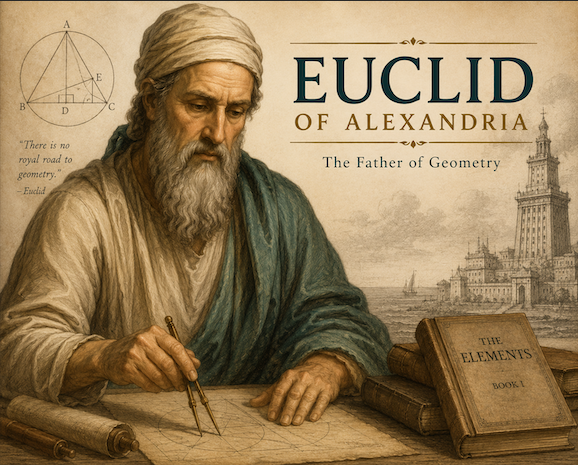
The contest is named after Euclid of Alexandria, the ancient Greek mathematician whose systematic approach to proof and logical argument in geometry established the model for mathematical reasoning that the contest is designed to test.
What distinguishes the Euclid math contest from every other competition in the CEMC series is the format. While the Gauss, Pascal, Cayley, and Fermat are all multiple choice, the Euclid requires students to write out complete solutions. Partial marks are awarded for correct reasoning even when the final answer is wrong. This means the contest rewards the ability to construct, organise, and communicate mathematical arguments — a skill that no other pre-university mathematics assessment in Canada develops and tests as rigorously.
Who sits the Euclid math contest?
The Euclid is designed for Grade 12 students. Some exceptional Grade 11 students take it as a stretch goal, but the mathematical content — which includes advanced functions, trigonometry, combinatorics, and proof-based geometry — assumes a near-complete high school mathematics background.
Students who have worked through the CEMC series from Gauss onward and performed consistently in the top 25% at each level are the most naturally prepared for the Euclid. Students who are sitting the Euclid without prior CEMC contest experience need to build both the mathematical content and the full-solution communication skill simultaneously — a significantly harder preparation challenge.
Where the Euclid fits in the CEMC contest ladder
| Contest | Grade | Format | Stakes |
|---|---|---|---|
| Gauss | Grade 7 and 8 | Multiple choice | Developmental |
| Pascal | Grade 9 | Multiple choice | Developmental |
| Cayley | Grade 10 | Multiple choice | Developmental |
| Fermat | Grade 11 | Multiple choice | Developmental |
| Euclid | Grade 12 | Full written solutions | University admissions |
The Euclid is the only contest in the series where the result directly affects a student’s academic future. Every contest below it is developmental preparation for this one.
For a complete overview of the CEMC series, check out: Waterloo Math Competition: A Canadian Parent’s Complete Guide to CEMC Contests.
Euclid math contest format and scoring
Exam structure
| Feature | Detail |
|---|---|
| Number of questions | 10 questions, each with multiple parts |
| Time allowed | 150 minutes (2.5 hours) |
| Format | Full written solutions — no multiple choice |
| Calculator | Not permitted |
| When | April each year |
| Where | At school through registered centres |
| Partial marks | Yes — correct reasoning scores marks even with wrong final answer |
The 150-minute time limit and 10-question format makes the Euclid significantly longer and harder per question than any of the preceding CEMC contests. Each question has multiple parts — typically labelled (a), (b), and (c) — where part (a) is accessible, part (b) requires more sustained reasoning, and part (c) is designed to challenge even the strongest students nationally.
How Euclid math contest scoring works
Unlike the multiple choice contests below it, the Euclid awards marks for the quality of mathematical reasoning rather than just the final answer. A student who sets up the correct approach but makes an arithmetic error in the final step may still receive most of the marks for that question.
This has a direct implication for preparation: writing clearly and showing every step of reasoning is not just good practice — it is how marks are earned. A correct answer with no working shown scores less than a partially correct solution with clear, logical steps.
What is a good score on the Euclid math contest?
The Euclid is genuinely hard. Average scores across the full cohort are typically well below 50% of available marks. Students in the top 25% nationally earn a Certificate of Distinction. Students in the top few percent nationally earn higher recognition.
For university admissions purposes, a score in the top 25% is a meaningful credential. A score in the top 10% is a significant academic achievement. The CEMC publishes full score distributions after results are released, allowing students to see exactly where they sit relative to the national cohort.
Euclid math contest topics
The Waterloo Euclid Math Contest covers the most advanced mathematical content of any CEMC contest. Students need to be comfortable across a wide range of topics and, critically, able to combine them within single problems.
Primary topic areas
| Topic | What it includes | Euclid emphasis |
|---|---|---|
| Algebra and functions | Equations, inequalities, function notation, composition, inverses | Very high |
| Geometry | Euclidean proof, circles, triangles, coordinate geometry | Very high |
| Trigonometry | Identities, equations, applications in geometry | High |
| Sequences and series | Arithmetic and geometric sequences, sigma notation, sums | High |
| Number theory | Divisibility, modular arithmetic, Diophantine equations, primes | High |
| Combinatorics | Permutations, combinations, counting principles | Moderate |
| Logarithms and exponents | Laws of logarithms, exponential equations | Moderate |
| Proof and logical reasoning | Direct proof, contradiction, clear mathematical argument | Throughout |
What makes Euclid problems different from every other contest
The most important distinction in Euclid math contest preparation is understanding that the contest is not testing whether you know more mathematics than the preceding contests — it is testing whether you can communicate mathematics as a logical argument.
A student who knows how to solve a problem but writes only the final answer will score poorly on the Euclid. A student who constructs a clear, complete solution showing every logical step — even if that solution is not the most elegant approach — will score well.
This means that alongside mathematical content preparation, students preparing for the Euclid must specifically practise writing complete mathematical solutions. Reading official CEMC solutions and comparing them to your own working is one of the most effective preparation activities because it develops the standard of solution writing the markers expect.
Euclid Math Contest 2025 — what happened
The Euclid Math Contest 2025 took place in April 2025. The paper followed the standard format — 10 questions with multiple parts, 150 minutes, full written solutions required.
Results from the Euclid Math Contest 2025 were distributed to schools in the weeks following the April sitting. The CEMC published official solutions and score distributions after all results were processed. Students who sat the Euclid Math Contest 2025 and want to review their performance can access the official solutions at cemc.uwaterloo.ca to work through questions they found difficult.
For students preparing for the 2026 Euclid, the Euclid Math Contest 2025 paper is one of the most valuable preparation resources available — it represents the most current version of the contest’s style, difficulty, and question types. Working through it under timed conditions and then comparing your solutions to the official solutions is one of the highest-value activities in any preparation plan.
Why the Euclid math contest matters for university admissions
University of Waterloo
The Euclid math contest result is used directly by the University of Waterloo in its admissions and scholarship decision-making for mathematics, computer science, and engineering programmes. Waterloo’s Faculty of Mathematics — which includes computer science — is one of the most competitive programme destinations in Canada. A strong Euclid result distinguishes an applicant from peers who have not competed.
Waterloo does not publish a specific score that guarantees admission or scholarship. The Euclid result is one input among several, including grades, the Waterloo AIF (Admission Information Form), and other achievements. However, for students applying to the most competitive Waterloo programmes, a strong Euclid result can be the differentiating factor between two otherwise similar applicants.
University of Toronto and beyond
UofT also considers competition mathematics performance for its most competitive STEM programmes. Beyond Canada, the Euclid is less directly recognised than AMC and AIME performance for American and international universities, but it demonstrates the same depth of mathematical ability that those competitions measure.
Students with both Canadian and international university ambitions benefit from doing both — the Euclid for Canadian domestic admissions relevance and the AMC series for international recognition.
The AMC 10, which is internationally recognised, is sometimes taken before the Euclid. For more on this, check out: AMC 10 Math Competition: The Complete Guide for Canadian Students.
The broader value beyond admissions
Students who prepare seriously for the Euclid and sit it in Grade 12 arrive at university mathematics with a fundamentally different preparation than students who only followed the school curriculum. The Euclid develops the ability to construct logical mathematical arguments, persist through genuinely difficult problems, and communicate mathematical reasoning clearly — skills that distinguish successful university mathematics students from those who struggle despite strong school grades.
Euclid math contest preparation — a complete approach
Euclid math contest preparation is most effective when it is structured and begins early — not the week before the April sitting. Students who begin preparation in September of Grade 12 have seven months. Students who have been building through the CEMC ladder since Grade 7 have years of compounding preparation behind them.
The non-negotiable foundation
Before beginning Euclid-specific preparation, students should be comfortable with:
Advanced functions including composition, inverses, and transformations. Trigonometry including identities, equations, and applications. Sequences and series including arithmetic, geometric, and sigma notation. Logarithms and exponential functions. Euclidean geometry including circle theorems and proof techniques. Combinatorics at a level beyond basic permutations and combinations.
Students who identify gaps in any of these areas should address them before attempting Euclid past papers. Attempting the Euclid without these foundations in place produces frustration rather than improvement.
Past papers — the most important preparation resource
Free past Euclid math contest papers and complete solutions are available at cemc.uwaterloo.ca going back many years. These are the most valuable preparation resource available and they cost nothing.
The critical difference between Euclid past paper practice and practice for the multiple choice contests is how you use them. For multiple choice contests, completing a paper and checking answers is the core activity. For the Euclid, comparing your written solutions to the official solutions is the core activity.
For every question, after writing your solution, read the official solution and ask: Is my reasoning complete? Does each step follow logically from the previous one? Would a marker following only my written work be able to verify my reasoning? Where my solution differs from the official one, is my approach valid even if different?
This comparison process develops the solution-writing standard that the Euclid rewards. Students who skip it and only check whether they got the right answer miss the most important aspect of Euclid preparation.
A six to eight week preparation plan
| Weeks | Focus | What to do |
|---|---|---|
| 1 to 2 | Baseline and style | Attempt 2 to 3 Euclid questions (a) parts only, untimed. Read official solutions carefully. Focus on understanding what a complete solution looks like. |
| 3 to 4 | Topic repair and solution writing | Identify the topic areas where your working does not match the official solutions. Work through targeted topic practice. Practise writing solutions with full reasoning. |
| 5 to 6 | Mixed sets and timing | Attempt full questions (a), (b), and (c) parts under timed conditions. Focus on managing the 15 minutes per question average. |
| 7 to 8 | Full paper practice | Complete one full past paper under strict conditions (150 minutes). Compare every solution to the official. Review the two or three questions that produced the most difficulty. |
The partial marks strategy
Because the Euclid awards partial marks, strategic thinking about where to invest time produces better results than trying to fully complete every question.
A student who completes parts (a) and (b) of eight questions and leaves parts (c) blank will score higher than a student who completes all parts of five questions and leaves five questions entirely blank — because partial credit accumulates significantly across a full paper.
In the final weeks of preparation, practise the habit of always writing something for part (b) even when you cannot fully solve it. Setting up the correct algebraic framework or correctly identifying the geometric relationship — even without completing the calculation — often earns partial marks.
Common errors to watch for
Rushing into calculations before defining variables. Every Euclid solution should begin by clearly defining what each variable represents. Markers look for this and its absence costs marks even when the mathematics is correct.
Not drawing diagrams for geometry questions. A labelled diagram makes geometric reasoning clearer and is itself worth marks in many geometry solutions.
Losing marks from unclear steps. Writing “therefore” or “it follows that” between steps is not just style — it signals to the marker that you understand why each step follows from the previous one.
Spending too long on part (c) of the first question at the expense of easier marks later in the paper. Part (c) questions are designed to be genuinely hard. A correct part (a) and part (b) on question 8 is worth more than an attempted but incomplete part (c) on question 1.
How to build toward the Euclid from earlier grades
The most effective Euclid preparation does not begin in Grade 12. It begins in Grade 7 with the Gauss and builds consistently through the CEMC ladder.
Students who have sat the Gauss, Pascal, Cayley, and Fermat in successive years and prepared seriously for each one arrive at the Euclid with several compounding advantages. They have developed the habit of approaching unfamiliar problems without a given procedure. They have built a repertoire of problem-solving approaches across every topic area the Euclid tests. They have experienced increasing levels of mathematical difficulty and know what it feels like to persist through genuinely challenging problems. And they have developed at least some familiarity with mathematical communication through the Fermat’s harder questions.
A student who sits the Euclid having done only school mathematics is attempting to build in one year what the contest ladder builds over six.
This is not to discourage late starters — a capable and motivated Grade 12 student who begins serious Euclid preparation in September can still achieve a meaningful result. But the preparation intensity required is significantly higher and the risk of hitting content gaps that take weeks to fill is real.
Frequently Asked Questions
What is the Euclid math contest? The Euclid math contest is a senior-level mathematics competition for Grade 12 students run by the CEMC at the University of Waterloo. It is the final and most advanced contest in the Waterloo CEMC series. Unlike the preceding multiple choice contests, the Euclid requires full written solutions and awards partial marks for correct reasoning. A strong result carries direct weight in University of Waterloo admissions and scholarship decisions.
How hard is the Euclid math contest? The Euclid is significantly harder than any other CEMC contest and considerably harder than the Grade 12 school curriculum. Average scores across the full cohort are typically well below 50% of available marks. Part (c) questions are designed to challenge the strongest students nationally. Students who have built through the full CEMC ladder from Gauss onward are substantially better prepared than those approaching it without prior competition experience.
When does the Euclid math contest take place? The Euclid takes place in April each year, approximately one month before the other CEMC spring contests. The earlier timing reflects its importance for university admissions — results need to be available in time for Waterloo’s admissions process. Check cemc.uwaterloo.ca for the current year’s exact date.
What happened at the Euclid Math Contest 2025? The Euclid Math Contest 2025 took place in April 2025 in the standard format — 10 questions with multiple parts, 150 minutes, full written solutions. Results were distributed to schools in the weeks following the sitting. Official solutions are available at cemc.uwaterloo.ca. Students preparing for the 2026 Euclid should work through the 2025 paper as one of their primary preparation resources.
How does the Euclid math contest affect university admissions? The University of Waterloo uses Euclid results in admissions and scholarship decisions for mathematics, computer science, and engineering programmes. A score in the top 25% is a meaningful credential. A score in the top 10% is a significant academic achievement that distinguishes applicants in competitive admissions processes. UofT also considers competition performance for its most competitive STEM programmes.
Where can I find Euclid math contest past papers? Free past papers and complete solutions for the Waterloo Euclid Math Contest are available at cemc.uwaterloo.ca going back many years. The official solutions are the most important preparation resource for the Euclid specifically — comparing your written solutions to them develops the solution-writing standard the contest rewards.
How do I register for the Euclid math contest? Registration goes through schools. Ask your child’s math teacher or department head whether the school is registered for the Euclid. If not, ask them to register — any school can join the CEMC programme. If school registration is not possible, contact the CEMC directly to find a registered independent centre.
What is different about the Euclid compared to other Waterloo math contests? The critical difference is the format. The Gauss, Pascal, Cayley, and Fermat are all 25-question multiple choice contests scored out of 150. The Euclid is 10 full-solution questions over 150 minutes where partial marks are awarded for correct reasoning. This format change means that solution writing skill — constructing and communicating complete mathematical arguments — is as important as mathematical knowledge in Euclid preparation.