If you are tired of repeating “Did you finish your homework?” every evening, you are already doing the hardest part: noticing the pattern. The right study planners and goal-setting templates can turn homework from a daily negotiation into a predictable routine your child understands. However, planners only work when they fit a child’s age, attention span, and real after-school energy. This article shows you how to set goals, choose formats, and keep the plan going without power struggles.
Intro: Why planning feels harder for ages 4–12
Many children can explain what they need to do, yet they still struggle to start. That is normal, because “executive function” (the brain skills that help with planning, starting tasks, and self-control) is still developing throughout childhood and adolescence. Research groups that track child development, such as the Harvard University Center on the Developing Child, explain that these skills build gradually with practice and supportive routines.
Therefore, the goal is not a perfect schedule. Instead, you are building a simple system that makes the next step obvious, so your child can begin with less stress. Over time, that repetition becomes a habit.
How to choose study planners and goal-setting templates that fit your child
A good planner does two jobs at once: it reminds, and it reduces decisions. However, the “best” format depends on how your child reads time and handles transitions. Before you download anything, watch one week of homework and note when things break down: starting, staying focused, or finishing.
Use the table below to match the planner style to the most common challenge.
| Child’s common struggle | Planner feature that helps | What it looks like at home |
|---|---|---|
| Forgets what to do | One clear daily checklist | “Math page 12, Reading 10 minutes” on a fridge sheet |
| Overwhelmed by big tasks | Task broken into 3–5 mini steps | “Plan → draft → check → pack” for a short project |
| Starts late and rushes | Time blocks with a start time | 4:10–4:25 math, 4:25–4:30 break |
| Gets stuck on perfection | “Good enough” finishing rule | One self-check, then stop and submit |
| Loses papers | Single “home base” spot + pack checklist | Backpack check beside the door every night |
For younger children (about ages 4–7), keep it visual and immediate. For example, a two-step plan (“Do 10 minutes, then show me”) often works better than a full-page weekly layout. For ages 8–12, a weekly view can work well, as long as each day still lists the next action clearly.
Set goals kids can actually follow (without pressure)
Many families hear about SMART goals (Specific, Measurable, Achievable, Relevant, Time-bound), which is a common goal-setting framework. You can keep the spirit of it without making it feel like a business meeting. For most kids, “achievable” is the missing piece, so start smaller than you think you need.
A practical approach is to set two kinds of goals: a process goal and a product goal. A process goal focuses on the routine (“I start at 4:10”), while a product goal focuses on output (“I finish question 1–8”). Process goals often reduce conflict, because they reward starting, not perfection.
- Ages 4–6: One daily routine goal (example: “I sit at the table when the timer starts.”)
- Ages 7–9: One routine goal plus one skill goal (example: “I practise subtraction for 10 minutes.”)
- Ages 10–12: One weekly routine goal plus one school-based target (example: “I finish assignments the day they are given.”)
However, avoid tying goals only to grades. Provinces across Canada outline learning expectations by grade in curriculum documents, but those expectations are broad and skill-focused. If you want to check what “on grade level” generally means, start with your province’s curriculum hub, such as the Ontario government’s education pages or the BC curriculum website.
A simple weekly planning routine (10 minutes, parent-led at first)
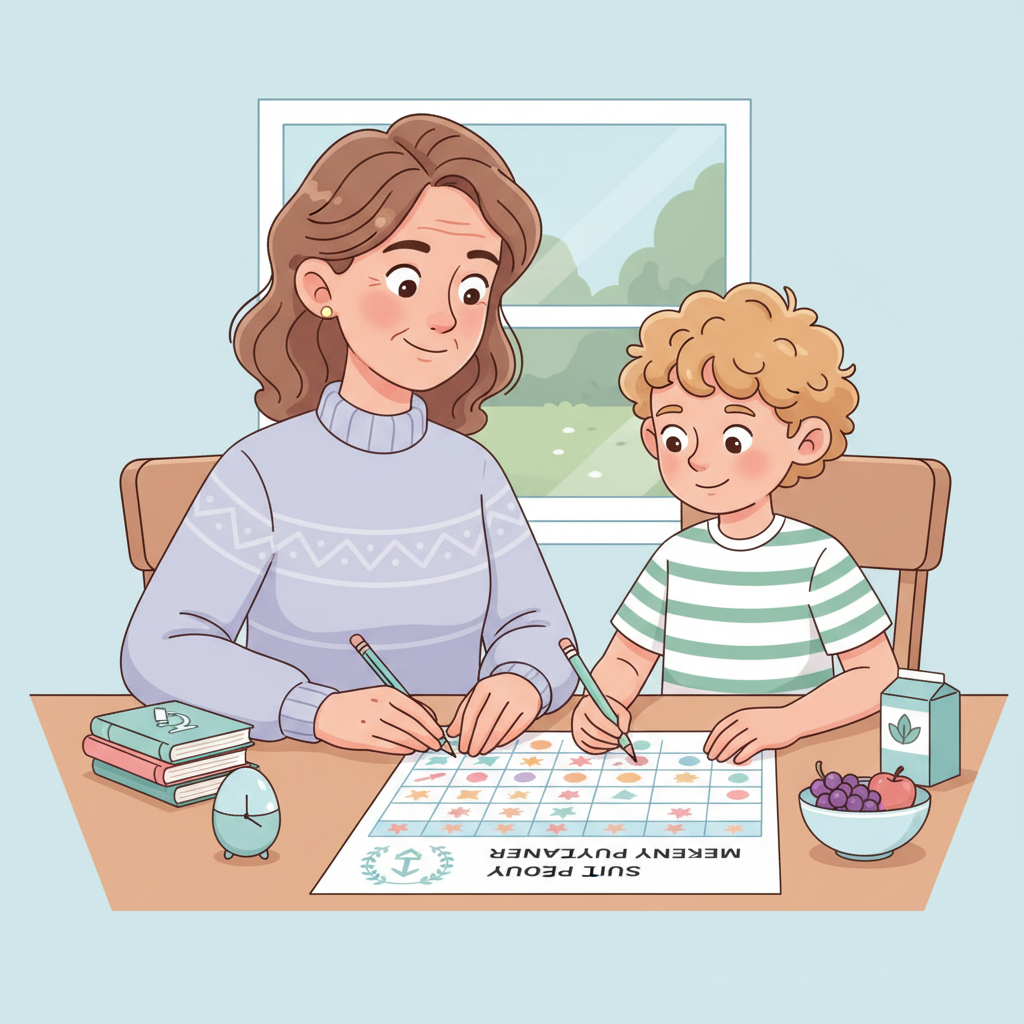
Weekly planning works best when it is short, predictable, and calm. Therefore, pick one time that is not already rushed, such as Sunday afternoon or right after dinner on Monday. Sit with your child, keep the tone practical, and write together.
Use this repeatable routine:
- List fixed commitments first (sports, music, family plans).
- Add school tasks next (homework, reading, studying).
- Choose one weekly goal and one daily habit to practise.
- Circle the hardest day and plan a shorter homework block that day.
- End by choosing a “reset action” (example: pack the backpack at 7:30 p.m.).
If your child pushes back, keep the choice small. For example, offer “Do you want to plan with markers or pencil?” instead of “Do you want to plan?” Small control often increases cooperation.
Daily use: turn the planner into a cue, not a debate
A planner only helps if it gets used at the same moment each day. Therefore, attach it to a daily trigger: snack time, right after changing out of school clothes, or after 10 minutes of downtime. Consistency matters more than the exact hour.
Try this simple home structure:
- Preview (1 minute): Point to the first task only.
- Focus sprint (10–20 minutes): Use a timer and remove extra materials.
- Micro-break (3–5 minutes): Water, stretch, quick movement.
- Check off and reset (2 minutes): Put materials back in the same place.
This is similar to timeboxing (working in short, planned blocks). It supports attention and reduces the “forever homework” feeling. If you want a quick, kid-friendly overview of time management ideas, the KidsHealth by Nemours parent resources are a reliable starting point.
Printable template ideas you can recreate in minutes
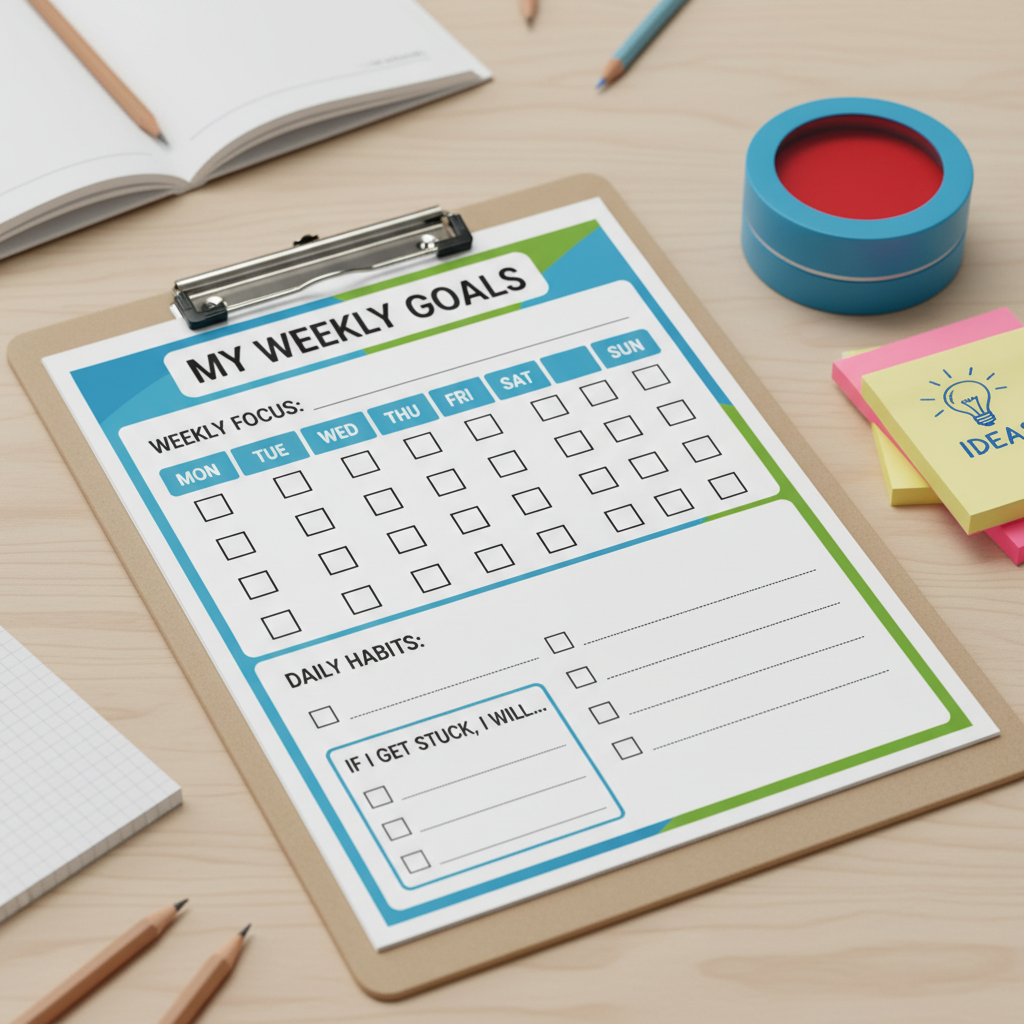
You do not need a fancy design. In fact, simpler pages get used more often, especially for younger children. Choose one template type for two weeks before switching, so your child learns the routine.
- One-page weekly view: 5 rows (Mon–Fri), 2–3 lines per day, plus a weekend “catch-up” box.
- Daily checklist card: 3 tasks only, with a “done” box for each.
- Project step ladder: 4–6 small steps, each with a date and a quick check.
- Goal and reflection page: “My goal,” “What helped,” and “What I will try next week.”
Keep language concrete. For example, “Read pages 10–15” is clearer than “Read more.” If you want to explain goal-setting to your child in a simple, factual way, you can also lean on general references like Britannica for definitions and background reading you can adapt into child-friendly wording.
Tools & resources (official sites)
Digital tools can help, especially if your child likes checking items off on a screen. However, choose tools that support planning, not constant notifications. Start with one tool, and keep parent controls and privacy settings in mind.
- Google Calendar: Good for family time blocks and shared routines.
- Microsoft To Do: Simple checklists that work well for daily tasks.
- Canva: Easy way to create printable planner pages with clear layouts.
- Apple Reminders: Helpful for older kids with a phone or tablet, using short task lists.
If you want a neutral explanation of templates (pre-made formats you fill in) and how they are used across settings, Wikipedia can be a basic reference. Still, treat it as a starting point and rely on official education sources for school expectations.
Information sources (what this article is based on)
This guide focuses on practical routines aligned with well-established child development and Canadian curriculum transparency. Key references include the Harvard University Center on the Developing Child on executive function, provincial curriculum hubs such as the Government of Ontario education pages and the BC Curriculum, and parent-facing health and development guidance from KidsHealth by Nemours.
Concluding Paragraph
The biggest win is not a perfect week. Instead, it is a calmer start, fewer reminders, and a child who can say, “I know what to do next.” When you keep goals small and routines predictable, study planners and goal-setting templates become a support your child can actually use, even on tired days. This week, choose one planner page, set one process goal, and practise it for five school days.
About Think Academy
Think Academy, part of TAL Education Group, helps K–12 students succeed in school today by building strong math foundations and critical thinking skills. At the same time, we focus on the bigger picture—developing learning ability, curiosity, and healthy study habits that inspire a lifelong love of learning. With expert teachers, proven methods, and innovative AI tools, we support every child’s journey from classroom confidence to long-term growth.
Want more insights into math learning and parenting? Subscribe to our newsletter for weekly tips and the latest resources.