The SSAT test math section tests concepts well above what most students cover in school. If your child is preparing for private school admissions, understanding the test format — and specifically what the math section demands — is the right place to start.
What Is the SSAT Test?
The SSAT — Secondary School Admissions Test — is a standardised admissions test used by independent schools across North America to assess applicants’ academic readiness. It is one of the two primary admissions tests for private school entry (alongside the ISEE), and is the more widely used of the two at Canadian independent schools.
The SSAT is produced by the Enrollment Management Association (EMA), formerly known as the Secondary School Admission Test Board. It is not a curriculum test — it does not assess whether a student has covered particular Ontario, BC, or Alberta curriculum content. Instead, it measures verbal reasoning, quantitative reasoning, and reading comprehension: the underlying academic skills that predict a student’s ability to handle the demands of a rigorous independent school programme.
This distinction matters for preparation. A student who has strong grades in a public school curriculum but has not developed the problem-solving fluency and verbal reasoning the SSAT requires will often underperform relative to their expectations on the first sitting — and improve significantly with targeted preparation once they understand what the test is actually measuring.
For a full overview of how the SSAT is used in Canadian private school admissions, see our complete SSAT Guide for Canadian students.
Who Takes the SSAT Test?
The SSAT is taken by students applying to independent (private) schools for Grades 5 through 12. In Canada, it is most commonly used for applications at Grade 7, Grade 9, and — at some schools — Grade 11 entry points, though some schools ask for SSAT results at other entry grades as well.
The test is taken by students applying to independent schools across Canada, the United States, and internationally. Many of Canada’s most selective independent schools — in Toronto, Vancouver, Victoria, and Calgary in particular — require or accept SSAT scores as part of their admissions process.
Not all Canadian independent schools require the SSAT. Some use their own internally developed assessments, some use the ISEE, and some use a combination of transcript review, interview, and informal testing without a standardised component. It is always worth confirming directly with the specific school what they require before choosing which test to prepare for.
SSAT Test Format and Sections
The SSAT is a paper-based test administered in a single sitting. The format includes five sections, though only three are scored — verbal, quantitative (two sections combined into one score), and reading comprehension. There is also an experimental section that does not count toward the score, and an unscored writing sample.
| Section | Content | Questions | Time |
|---|---|---|---|
| Writing Sample (unscored) | Essay prompt (creative or expository) | 1 prompt | 25 minutes |
| Quantitative 1 | Mathematics | 25 questions | 30 minutes |
| Reading Comprehension | Passage-based questions | 40 questions | 40 minutes |
| Verbal | Synonyms and analogies | 60 questions | 30 minutes |
| Quantitative 2 | Mathematics | 25 questions | 30 minutes |
| Experimental (unscored) | Mixed | 16 questions | 15 minutes |
Total test time including breaks is approximately three hours. The writing sample is seen by the admissions teams at the schools applied to but is not scored by EMA — schools assess it independently.
The two quantitative sections are scored together, producing a single quantitative score. The test is the same format for both Middle Level and Upper Level, with the content difficulty adjusted for the relevant age group.
What Does the SSAT Math Section Cover?
The SSAT quantitative section is consistently the area where preparation makes the most measurable difference — and the area most likely to surprise students who have strong school grades but have not encountered problem-solving style questions.
Middle Level SSAT Math (Grades 5–7)
The Middle Level quantitative section covers:
- Number concepts and operations: whole numbers, fractions, decimals, percentages, ratios, and proportions
- Algebra: patterns, sequences, basic equations, and expressions
- Geometry: area, perimeter, volume, angles, and coordinate geometry
- Data analysis: reading graphs, tables, mean, median, and mode
- Word problems requiring multi-step reasoning
The emphasis is on applying mathematical concepts to novel problems — not recalling formulas, but reasoning through unfamiliar situations using mathematical tools. A student who can solve standard textbook problems but has not practised working through new problem types will find the harder questions in this section challenging even if their curriculum knowledge is solid.
Upper Level SSAT Math (Grades 8–11)
The Upper Level quantitative section covers all Middle Level content plus:
- More complex algebra: systems of equations, inequalities, quadratics
- Number theory: prime factorisation, divisibility, integer properties
- Advanced geometry: similar triangles, Pythagorean theorem applications, three-dimensional shapes
- Functions and sequences
- Probability and combinatorics
Upper Level questions demand both conceptual understanding and mathematical fluency — the ability to move efficiently through calculations without losing time, while applying reasoning to multi-step problems.
Think Academy’s structured math programme builds exactly the skills the SSAT quantitative section tests — problem-solving fluency, above-grade-level reasoning, and the mathematical confidence to handle questions that don’t look like anything a student has seen in a standard classroom.
How Is the SSAT Test Scored?
The SSAT uses a three-stage scoring process that many parents and students find confusing on first encounter. Understanding it properly matters, because the percentile rank — not the scaled score — is what admissions teams actually use.
Stage 1 — Raw score. The raw score is calculated by awarding one point for each correct answer and deducting ¼ point for each incorrect answer. Omitted questions score zero. This penalty-for-guessing structure means that random guessing on questions a student cannot narrow down is typically counterproductive. If a student can eliminate one or two wrong answers and make an educated guess, the expected value shifts in their favour.
Stage 2 — Scaled score. The raw score converts to a scaled score on a fixed scale. For Middle Level, the scale runs from 440 to 710 per section. For Upper Level, it runs from 500 to 800 per section. This conversion accounts for minor variation in difficulty between different test forms.
Stage 3 — Percentile rank. The scaled score maps to a percentile rank based on a norm group of students who have taken the SSAT over the past three years. This percentile is the number most admissions teams look at: it tells them where an applicant sits relative to the actual competitive population of private school applicants, not just whether they answered questions correctly.
The norm group for the SSAT is notably competitive — it consists of students actively applying to independent schools, not a general student population. A 50th percentile on the SSAT is not average among all students of that age; it is average among students who have chosen to pursue private school admissions. This is worth explaining to students whose first mock test results are lower than expected, and to parents comparing SSAT percentiles to school assessment results.
SSAT Test Levels: Elementary, Middle and Upper
The SSAT is offered at three levels, determined by the grade a student is currently in (not the grade they are applying to enter).
Elementary Level is for students currently in Grade 3 or 4, applying to schools for Grade 4 or 5 entry. Less commonly used in Canada than the Middle and Upper levels.
Middle Level is for students currently in Grades 5, 6, or 7, typically applying to schools for Grade 6, 7, or 8 entry. This is the level most commonly taken for the Grade 7 and Grade 8 private school entry cohorts — the most competitive application cycles at many Canadian independent schools.
Upper Level is for students currently in Grades 8 through 11, typically applying for Grade 9, 10, 11, or 12 entry. Grade 9 entry at most Canadian private schools, particularly in Ontario and BC, uses Upper Level SSAT.
Students should confirm with each target school which level they require — schools specify this in their admissions requirements, and getting this wrong means preparing for the wrong test.
SSAT vs ISEE: Which Test Should Your Child Take?
The ISEE (Independent School Entrance Exam) is the other major private school admissions test, also widely accepted at Canadian independent schools. Families often ask which test to choose when both are accepted.
The SSAT is more commonly required or preferred at Canadian independent schools, particularly in Ontario and BC. Its verbal section relies heavily on vocabulary synonyms and analogies; its quantitative section is generally considered more straightforward in structure but with harder individual problems. The guessing penalty applies.
The ISEE uses a different verbal format (sentence completion rather than analogies) and does not penalise for wrong answers — meaning guessing is a neutral rather than potentially negative strategy. Some students find the ISEE format more manageable.
The practical answer for most Canadian families is: check the specific requirements of every school on the application list. If all of them require the SSAT, prepare for the SSAT. If they accept either, and a diagnostic suggests the student is significantly stronger on one format, it may be worth sitting a practice version of both before committing.
How to Prepare for the SSAT Test
Start earlier than the month before the test. The SSAT tests reasoning skills that build over months of deliberate practice — vocabulary, mathematical problem-solving fluency, and reading comprehension developed through sustained reading. These cannot be adequately developed in a short pre-test sprint.
Diagnose before you prepare. A diagnostic assessment that identifies specifically where a student’s current performance sits relative to SSAT-level expectations allows preparation to be targeted at real gaps rather than generic content review. Knowing that quantitative performance is strong but verbal is significantly weaker changes the preparation plan fundamentally.
Practise under real test conditions. Timed, full-length practice under realistic conditions — no interruptions, paper-based, strict section timing — is the only way to develop the pacing and stamina the actual test requires. For a detailed guide to running mock tests effectively, see our SSAT Mock Test guide.
Build vocabulary deliberately, not passively. The verbal section requires a level of vocabulary breadth that most students have not encountered in school. Daily reading at above-comfort-level difficulty, combined with structured study of high-frequency SSAT vocabulary, is the most reliable path to improvement on this section.
Address mathematical problem-solving, not just curriculum content. Students who prepare for the SSAT quantitative section by reviewing school curriculum are only partly preparing. The test emphasises novel problem-solving — applying mathematical reasoning to unfamiliar question types. Structured practice on problem-solving across a range of question types is necessary alongside curriculum review.
For comprehensive guidance on practice resources and preparation strategy, see our SSAT Practice Test guide.
Frequently Asked Questions
What is the SSAT test used for?
The SSAT is used by independent (private) schools as a standardised measure of academic readiness for admissions decisions. It is one of the primary admissions tests for private school entry in Canada and the United States, alongside the ISEE.
How long is the SSAT test?
The full test takes approximately three hours including breaks. It includes five sections — two quantitative, one reading comprehension, one verbal, and one unscored experimental section — plus an unscored writing sample.
Is the SSAT test difficult?
It is challenging relative to standard school assessments, for two reasons: it is normed against a competitive group of private school applicants rather than a general student population, and it emphasises reasoning and problem-solving over curriculum recall. Strong school grades do not automatically translate into strong SSAT performance without specific preparation.
What is a good SSAT score for Canadian private schools?
Varies significantly by school. The most selective schools in Toronto and Vancouver typically see competitive applicants in the 75th percentile and above on each section. Less selective schools may admit students in the 50th–65th percentile range. Check the specific score expectations or historical admitted student profiles for each school on your list.
How often can my child take the SSAT?
The SSAT can be taken multiple times. Most admissions teams look at the highest score across sittings, though policies vary — confirm with each target school. EMA recommends spacing sittings with meaningful preparation in between rather than sitting the test repeatedly without targeted work.
Is the SSAT the same as the SAT?
No. Despite the similar name, the SSAT (Secondary School Admissions Test) is a completely separate test from the SAT (Scholastic Assessment Test). The SAT is a US university admissions test for Grade 12 students; the SSAT is a private school admissions test for younger students (Grades 3–11).
See our related guides: complete SSAT Guide for Canadian students · SSAT Practice Test guide · SSAT Mock Test guide · Toronto private schools · best private schools in Ontario
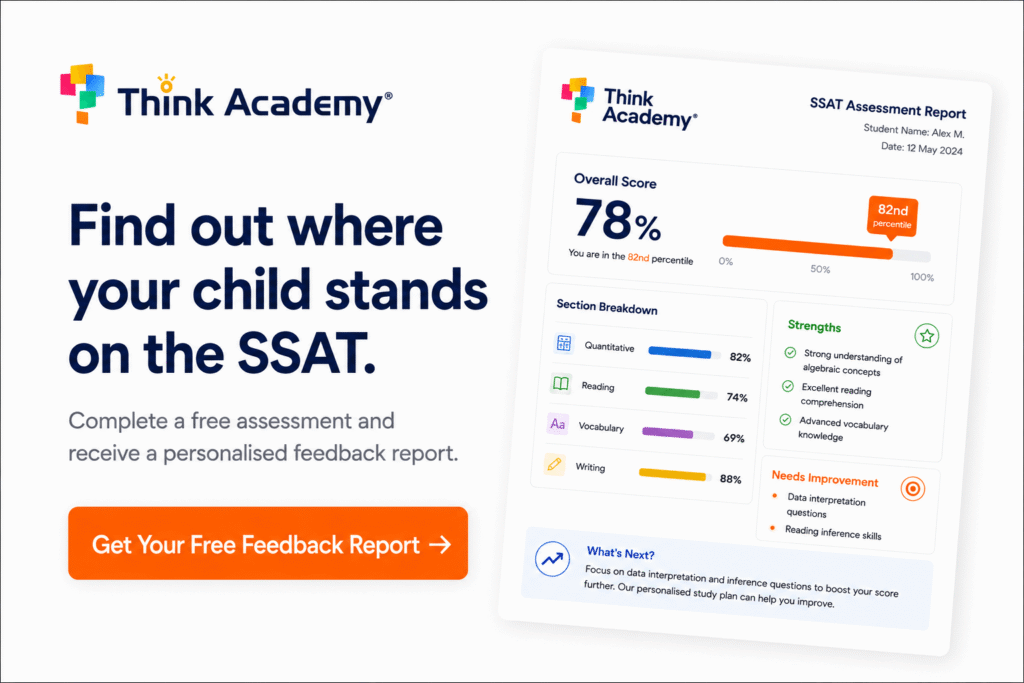
Your child’s SSAT preparation should start with a clear picture of where they stand.