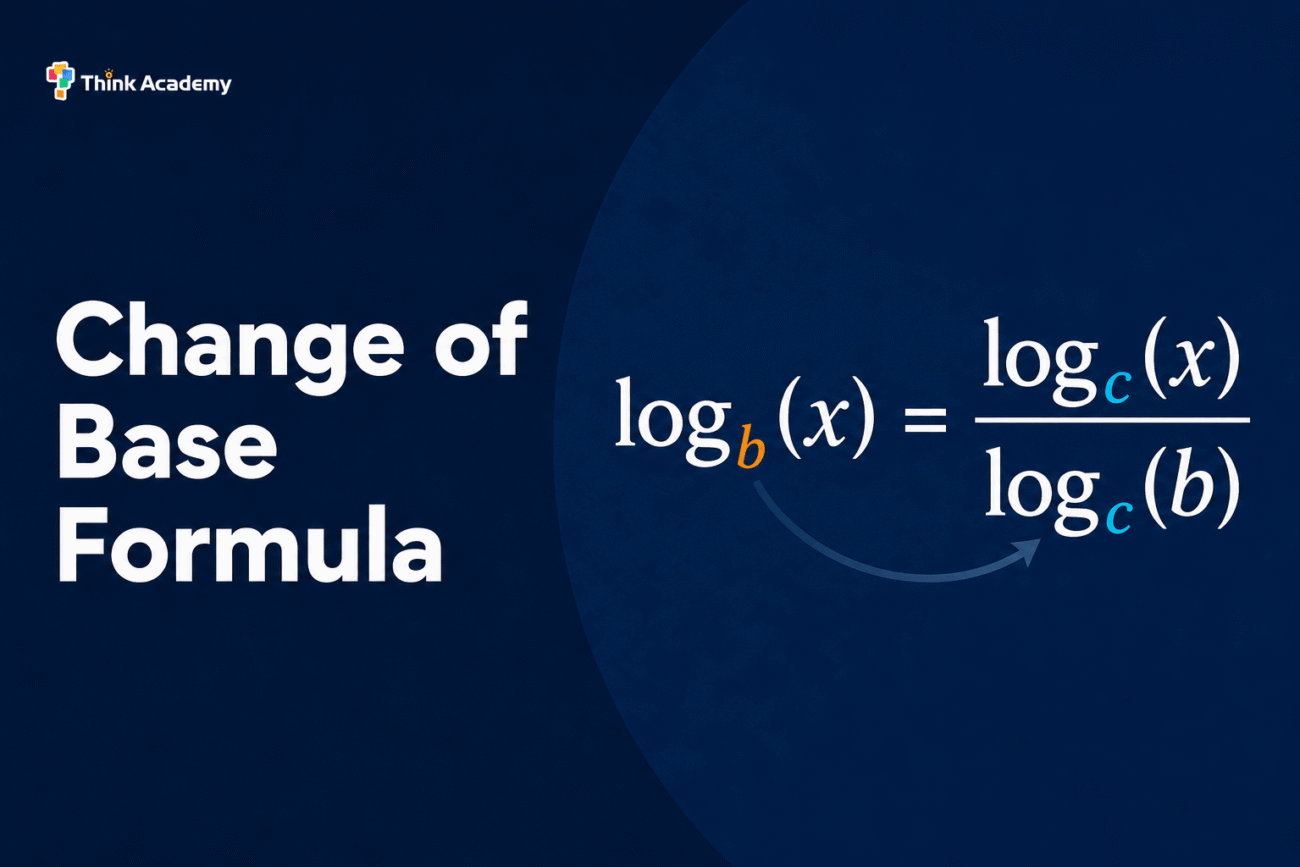
The change of base formula is one of the most practically useful tools in logarithm algebra. Calculators only have buttons for log (base 10) and ln (base e) — but logarithms appear with all kinds of bases in mathematics. The formula converts any logarithm into one that a calculator can evaluate, and it is used throughout the logarithm units of MCR3U and MHF4U as well as in competition problems where logarithms appear in unexpected bases.
This guide explains the change of base formula precisely, proves it, works through examples at every level of difficulty, and shows where it appears in the Ontario curriculum and Canadian competitions.
What Is the Change of Base Formula?
For any positive numbers a and x with a=1, and any valid base c with c>0, c=1:loga(x)=logc(a)logc(x)
The most common forms in practice:loga(x)=log(a)log(x)=ln(a)ln(x)
where log denotes log10 (common logarithm) and ln denotes loge (natural logarithm).
In plain English: To evaluate loga(x) using a standard calculator, divide log(x) by log(a) (or ln(x) by ln(a) — both give the same result).
A first example:
log2(8): we know 23=8, so log2(8)=3.
Using the change of base formula: log2(8)=log(2)log(8)=0.30103…0.90309…=3. ✓
The formula gives the exact same answer — it is not an approximation, it is an identity.
Proof
The proof follows directly from the definition of logarithm and basic exponent properties.
Claim: loga(x)=logc(a)logc(x)
Proof:
Let y=loga(x). By the definition of logarithm, this means:ay=x
Apply logc to both sides:logc(ay)=logc(x)
By the power law of logarithms (logc(ay)=ylogc(a)):ylogc(a)=logc(x)
Divide both sides by logc(a) (valid since a=1 means logc(a)=0):y=logc(a)logc(x)
Substituting back y=loga(x):loga(x)=logc(a)logc(x)□
Why the proof matters for students:
The proof uses only the definition of logarithm and the power law — both of which students learn in MCR3U Unit 4. Knowing the proof means the formula never needs to be memorised separately — it can be re-derived in under 30 seconds. This is the standard of understanding that MCR3U and MHF4U reward.
The Logarithm Laws: Context
The change of base formula works alongside the standard logarithm laws. For completeness:
| Law | Formula | Example |
|---|---|---|
| Product | logb(MN)=logbM+logbN | log2(8×4)=log28+log24=3+2=5 |
| Quotient | logb(M/N)=logbM−logbN | log3(81/9)=log381−log39=4−2=2 |
| Power | logb(Mp)=plogbM | log2(82)=2log28=6 |
| Change of base | loga(x)=logc(x)/logc(a) | log4(32)=log(32)/log(4) |
| Special values | logb(b)=1; logb(1)=0 | log5(5)=1; log7(1)=0 |
The change of base formula is distinguished from the others because it changes the base of the logarithm itself — not just the argument. This makes it the bridge between different bases, and the tool that makes any logarithm calculator-evaluable.
Change of Base Formula: Worked Examples
Example 1 — Direct Calculator Evaluation (MCR3U Level)
Evaluate log3(50)\log_3(50) log3(50) to 4 decimal places.log3(50)=log(3)log(50)=0.47712…1.69897…=3.5609…
Answer: log3(50)≈3.5609\log_3(50) \approx 3.5609 log3(50)≈3.5609
Check: 33.5609≈50. ✓
Example 2 — Exact Values Using the Formula
Evaluate log4(32)\log_4(32) log4(32) without a calculator.log4(32)=log(4)log(32)=log(22)log(25)=2log25log2=25
Answer: log4(32)=52\log_4(32) = \frac{5}{2} log4(32)=25
This works because both 32 and 4 are powers of 2 — the change of base formula with base 10 (or any base) reduces to a ratio of powers of 2.
Key insight: When both the argument and the base can be expressed as powers of the same number, the change of base formula gives an exact rational answer.
Example 3 — Expressing in Terms of a Given Logarithm
If log3(2)=k\log_3(2) = k log3(2)=k, express log9(8)\log_9(8) log9(8) in terms of kk k.log9(8)=log(9)log(8)=log(32)log(23)=2log33log2
Now use the change of base formula: log3(2)=log3log2=k, so log3log2=k.log9(8)=2log33log2=23⋅log3log2=23k
Answer: log9(8)=3k2\log_9(8) = \dfrac{3k}{2} log9(8)=23k
This problem type — expressing a logarithm in terms of a given value — is standard in MCR3U and MHF4U assessments.
Using a formula is one thing. Recognising how logarithm laws connect is harder. Our free assessment shows how confidently your child applies Grade 11–12 math concepts and identifies the skills that need more work.
Get your child’s free feedback report →
Example 4 — Solving a Logarithmic Equation
Solve logx(81)=4\log_x(81) = 4 logx(81)=4.
By definition: x4=81=34, so x=3.
Using the change of base formula as a check:
logx(81)=log(x)log(81)=4⟹log(x)=4log(81)=44log3=log3⟹x=3. ✓
Example 5 — Comparing Logarithms (MHF4U Level)
Without a calculator, determine which is larger: log3(7)\log_3(7) log3(7) or log5(11)\log_5(11) log5(11).
Both expressions are between 1 and 2 (since 31=3<7<9=32 and 51=5<11<25=52).
To compare precisely, use the change of base formula with base 10:log3(7)=log3log7≈0.47710.8451≈1.7712 log5(11)=log5log11≈0.69901.0414≈1.4899
log3(7)>log5(11)\log_3(7) > \log_5(11) log3(7)>log5(11).
Example 6 — Simplifying an Expression (Competition Level)
Simplify: 1log26+1log36\dfrac{1}{\log_2 6} + \dfrac{1}{\log_3 6} log261+log361
Using the change of base formula: loga61=log6a (reciprocal property).log261+log361=log62+log63=log6(2×3)=log66=1
Answer: 1
This problem combines the change of base formula with the product rule and is the kind of elegant simplification that appears in Euclid Part A and AMC 10 problems.
Example 7 — The Reciprocal Property
A direct consequence of the change of base formula:loga(b)=logb(a)1
Proof: loga(b)=logalogb and logb(a)=logbloga. These are reciprocals. □
This property is frequently used in competition problems — whenever a sum of reciprocals of logarithms appears, the change of base formula converts it into a sum of logarithms with a common base.
Natural Logarithms
The change of base formula also explains the relationship between log (base 10) and ln (base e):ln(x)=log(e)log(x)=0.43429…log(x)
Or equivalently:log(x)=ln(10)ln(x)=2.30259…ln(x)
These conversion factors appear in applied mathematics and engineering — but for pure mathematics competitions, the formula is most useful for converting between arbitrary bases, not specifically between base 10 and base e.
Where the Formula Appears in Contests and Curriculum
MCR3U (Ontario Grade 11, Unit 4: Logarithmic Functions): The change of base formula is explicitly taught as part of the logarithm unit and is tested on unit assessments and final exams. The most common problem types: evaluating non-standard bases on a calculator (Example 1), finding exact values when both argument and base share a common factor (Example 2), and expressing logarithms in terms of given values (Example 3). See our MCR3U complete guide.
MHF4U (Ontario Grade 12): MHF4U extends logarithm work with more complex expressions, logarithmic equations requiring the change of base formula, and applications in exponential modelling. The reciprocal property (Example 7) and the comparison of logarithms in different bases (Example 5) are MHF4U-level applications. See our MHF4U Advanced Functions guide.
Math 30-1 (Alberta Grade 12): The change of base formula is part of the Math 30-1 logarithm and exponential functions unit and is explicitly tested on the Alberta Diploma Examination. See our Math 30-1 complete guide and Math 30-1 formula sheet.
Euclid Contest and AMC 10/12:The change of base formula enables elegant solutions to logarithm simplification problems (like Example 6) that would be slow or impossible by direct computation. The reciprocal property in particular — logab1=logba — appears frequently in competition logarithm problems as a simplification tool. See our Euclid math contest guide.
For the full competition landscape, see our math competitions in Canada guide.

Logarithms appear throughout MCR3U, MHF4U and Math 30-1. A free online assessment identifies whether your child can evaluate, simplify and solve logarithmic expressions independently—before gaps affect their exam performance.
Assess their Grade 11–12 math skills →
Common Mistakes with the Formula
Mistake 1: Inverting the fraction.loga(x)=logalogx, not logxloga. The argument (x) goes in the numerator; the base (a) goes in the denominator. A useful mnemonic: “argument over base” — the thing you are taking the log of (the argument) over the base you are converting from.
Mistake 2: Using different bases in numerator and denominator.loga(x)=logc(a)logc(x) requires the same base c in both the numerator and denominator. Mixing log10 in the numerator and loge in the denominator does not give loga(x) — it gives a different quantity entirely.
Mistake 3: Applying the formula when an exact value is available.log4(16) can be evaluated exactly as 2 (since 42=16) without the change of base formula. Reaching for the formula first — and getting a decimal approximation — when an exact integer answer is available is wasteful and produces rounding errors.
Mistake 4: Forgetting the domain restriction.The formula requires x>0 and a>0, a=1 (and c>0, c=1). When solving equations using the formula, check that solutions satisfy these conditions.
Mistake 5: Misapplying to sums of logarithms.loga(x)+loga(y)=loga+logalogx+logy. The change of base formula applies to each individual logarithm separately: loga(x)+loga(y)=logalogx+logalogy. Or more usefully: use the product law first — loga(x)+loga(y)=loga(xy) — then change base if needed.
Practice Problems
Set A — Direct evaluation
Use the formula to evaluate each (to 4 decimal places where appropriate):
- log2(50)
- log3(20)
- log5(100)
- log7(200)
- log4(64) (exact value)
- log9(27) (exact value)
Set B — Exact values and expressions
- If log2(3)=p, express log4(9) in terms of p.
- If log5(2)=k, express log25(8) in terms of k.
- Simplify: log3121+log4121
- Simplify: log2(3)⋅log3(4)⋅log4(8)
Set C — Equations and inequalities
- Solve: logx(125)=3
- Solve: log2(x)=log4(x+6)
- Solve: log3(x)+log9(x)=4
- For which values of x is log2(x)>log3(x)?
Answers:
Set A:
- log(50)/log(2)≈1.6990/0.3010≈ 5.6439
- log(20)/log(3)≈1.3010/0.4771≈ 2.7268
- log(100)/log(5)=2/0.6990≈ 2.8614
- log(200)/log(7)≈2.3010/0.8451≈ 2.7227
- log4(64)=log(26)/log(22)=6log2/2log2= 3 (exact)
- log9(27)=log(33)/log(32)=3log3/2log3= 3/2 (exact)
Set B: 7) log4(9)=log(32)/log(22)=2log3/2log2=log2(3)= p8) log25(8)=log(23)/log(52)=3log2/2log5=(3/2)(log2/log5)=(3/2)log5(2)= 3k/29) log3121+log4121=log123+log124=log12(3×4)=log1212= 110) log2(3)⋅log3(4)⋅log4(8)=log2log3⋅log3log4⋅log4log8=log2log8=log23log2= 3
Set C: 11) x3=125=53, so x= 512) Change base: log4(x+6)=log24log2(x+6)=2log2(x+6). So log2x=2log2(x+6). Let u=log2x: 2u=log2(x+6), so x2=x+6, giving x2−x−6=0, (x−3)(x+2)=0. Check: x>0 and x+6>0, so x= 313) log9(x)=2log3x. So log3x+2log3x=4, giving 23log3x=4, log3x=8/3, x=38/3= 383=65613\sqrt[3]{3^8} = \sqrt[3]{6561} 338=3656114) log2(x)>log3(x): for x>1, both are positive; log2logx>log3logx iff log21>log31 iff log3>log2 ✓. For 0<x<1, both are negative; inequality reverses. Therefore: log2(x)>log3(x) when x>1x > 1 x>1.
Frequently Asked Questions
What is the change of base formula?
loga(x)=logc(a)logc(x) for any valid base c. Most commonly used with c=10 (common log) or c=e (natural log): loga(x)=logalogx=lnalnx.
Why do we need the change of base formula?
Calculators only compute log10 and ln directly. The change of base formula converts any other base into one of these, allowing calculation. It is also used algebraically to simplify expressions and compare logarithms with different bases.
Does it matter which base you use?
No — as long as you use the same base in both numerator and denominator, the result is the same. logalogx=lnalnx=log2alog2x all give identical values.
What is the reciprocal property of logarithms?
loga(b)=logb(a)1. This follows directly from the change of base formula and is frequently useful in competition mathematics.
Is the change of base formula on the Math 30-1 formula sheet?
No — the Alberta Diploma Examination does not provide a formula sheet. All formulas including the change of base formula must be memorised. See our Math 30-1 formula sheet guide.
How do I remember the change of base formula?
“Log of the argument over log of the base” — loga(x)=logalogx. The argument (x, the thing inside) goes on top; the base (a, the subscript) goes on the bottom.
See our related guides: MCR3U complete guide · MHF4U Advanced Functions guide · Math 30-1 complete guide · Math 30-1 formula sheet · Math 30-1 textbook guide · Euclid math contest guide · types of function in math guide · parent functions math guide · math competitions in Canada

If logarithm laws feel like a collection of formulas to memorise, guided teaching can help connect them into one clear system. Book a free online trial lesson and see how Think Academy builds confident, independent problem-solving.