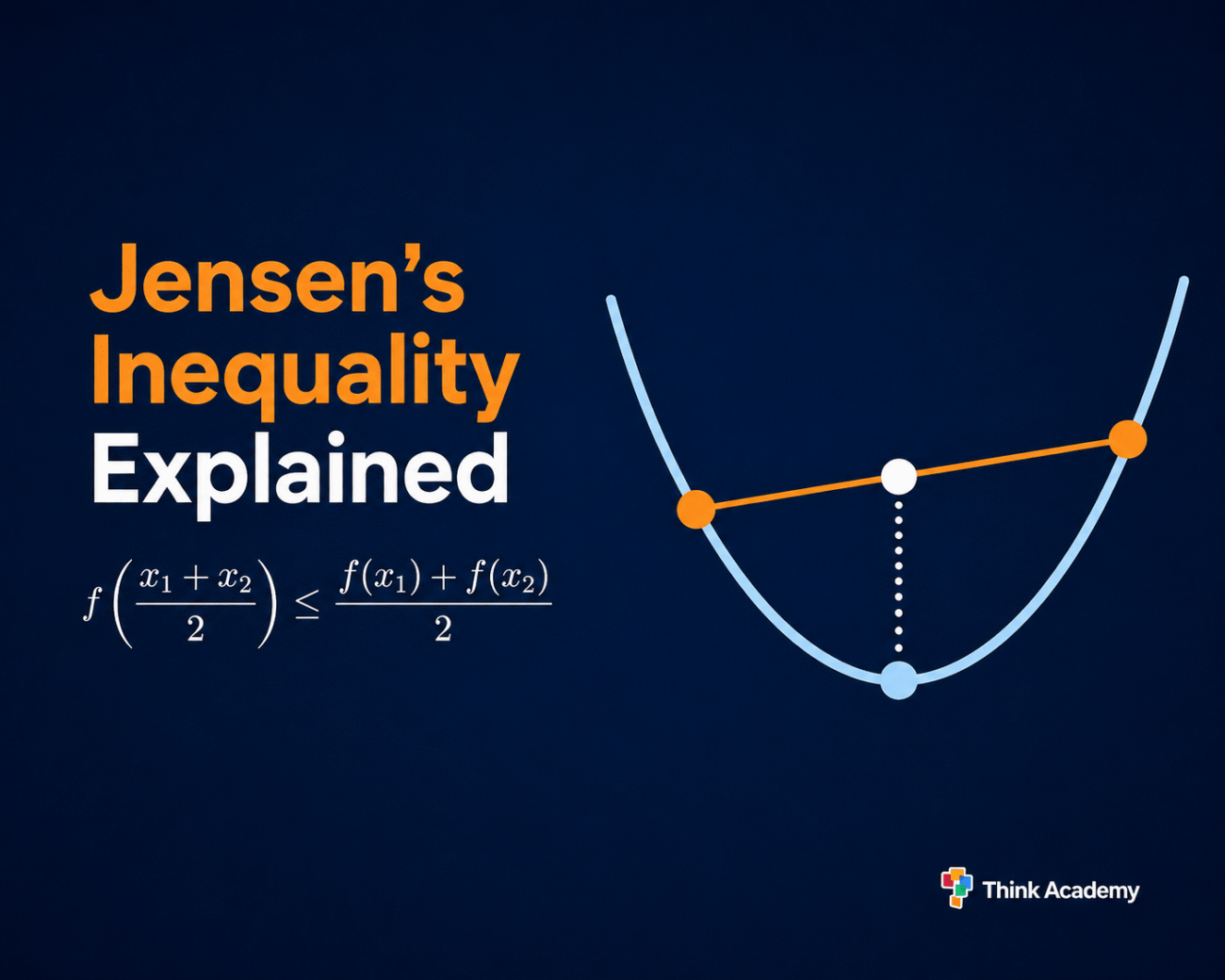
Jensen’s inequality is one of the most important and widely applicable inequalities in mathematics. It generalises the AM-GM inequality, underlies key results in probability and statistics, and provides one of the most powerful tools available for olympiad inequality problems at the Euclid, COMC, and CMO level. Understanding Jensen’s inequality — and knowing how to recognise when it applies — is a mark of sophisticated mathematical preparation.
This guide explains the theorem precisely, develops the convexity condition that makes it work, proves it, works through examples at increasing difficulty, and connects it to the broader inequality toolkit.
Convexity: The Foundation
Jensen’s inequality is a statement about convex functions. Understanding convexity is the prerequisite.
Definition: Convex function
A function f is convex on an interval I if for all x1,x2∈I and all λ∈[0,1]:f(λx1+(1−λ)x2)≤λf(x1)+(1−λ)f(x2)
Geometric meaning: The function is convex if every chord connecting two points on its graph lies above or on the graph.
Equivalent condition (for twice-differentiable functions):
f is convex on I if and only if f′′(x)≥0 for all x∈I.
This is the most practical test for convexity — compute the second derivative and check its sign.
A function is concave if −f is convex — equivalently, if f′′≤0 everywhere, or if every chord lies below or on the graph.
Common convex functions:
- f(x)=x2 (convex everywhere, f′′=2>0)
- f(x)=ex (convex everywhere, f′′=ex>0)
- f(x)=xp for p≥1 or p≤0 on (0,∞)
- f(x)=−lnx on (0,∞) (f′′=1/x2>0)
Common concave functions:
- f(x)=lnx on (0,∞) (f′′=−1/x2<0)
- f(x)=x on (0,∞) (f′′=−1/(4×3/2)<0)
- f(x)=sinx on (0,π) (f′′=−sinx<0)
What Is Jensen’s Inequality?
Jensen’s inequality states:
If f is a convex function on an interval I, and x1,x2,…,xn∈I with positive weights w1,w2,…,wn satisfying w1+w2+⋯+wn=1, then:f(i=1∑nwixi)≤i=1∑nwif(xi)
The unweighted form (all weights equal 1/n):f(nx1+x2+⋯+xn)≤nf(x1)+f(x2)+⋯+f(xn)
In plain English: For a convex function, the function value at the average of the inputs is at most the average of the function values at the inputs.
For concave functions: Both inequalities reverse — f convex becomes f concave, and ≤ becomes ≥.
The equality condition: Equality holds if and only if all xi are equal (for strictly convex functions) — or when the function is linear on the interval containing all xi.

Proof of Jensen’s Inequality
Proof for n=2 (Two Points, Equal Weights)
This is the base case and the geometric core of the result.
Claim: If f is convex on I, then for all x1,x2∈I:f(2×1+x2)≤2f(x1)+f(x2)
Proof: Setting λ=1/2 in the definition of convexity:f(21x1+21x2)≤21f(x1)+21f(x2)
This is exactly the claim. □
Proof for General n (by Mathematical Induction)
Claim: For convex f and x1,…,xn∈I:f(nx1+⋯+xn)≤nf(x1)+⋯+f(xn)
Proof sketch (induction on nn n):
*Base case n=2:* Proved above.
Inductive step: Assume the result for n=k. Let xˉ=k+1×1+⋯+xk+1.
Write xk+1′=kx1+⋯+xk (the mean of the first k values). Then:xˉ=k+1k⋅xk+1′+xk+1=k+1kxk+1′+k+11xk+1
By convexity (two-point case):f(xˉ)≤k+1kf(xk+1′)+k+11f(xk+1)
By the inductive hypothesis:f(xk+1′)≤kf(x1)+⋯+f(xk)
Combining:f(xˉ)≤k+1k⋅kf(x1)+⋯+f(xk)+k+1f(xk+1)=k+1f(x1)+⋯+f(xk+1)□
For the full technique on proofs by induction, see our math induction proof guide.
Jensen’s Inequality and AM-GM
The AM-GM inequality is a special case of Jensen’s inequality. This is one of the most important connections in competition mathematics.
AM-GM: For positive reals x1,…,xn:nx1+⋯+xn≥nx1⋯xn
Derivation from Jensen’s inequality:
Apply Jensen’s with the concave function f(x)=lnx (concave since f′′=−1/x2<0):f(nx1+⋯+xn)≥nf(x1)+⋯+f(xn) ln(nx1+⋯+xn)≥nlnx1+⋯+lnxn=lnnx1⋯xn
Exponentiating:nx1+⋯+xn≥nx1⋯xn□
AM-GM falls out of Jensen’s inequality applied to the logarithm. This means Jensen’s inequality is strictly more powerful — it proves AM-GM as a special case rather than the other way around.
Worked Examples
Example 1 — Direct Application
Prove that for positive reals a,b,ca, b, c a,b,c with a+b+c=1a + b + c = 1 a+b+c=1: a2+b2+c2≥13a^2 + b^2 + c^2 \geq \frac{1}{3} a2+b2+c2≥31
Apply Jensen’s inequality with the convex function f(x)=x2 (f′′=2>0):3a2+b2+c2≥(3a+b+c)2=(31)2=91 a2+b2+c2≥93=31□
Equality when a=b=c=31.
Example 2 — Logarithm (Concave Direction)
Prove that for positive reals a,b,ca, b, c a,b,c: lna+lnb+lnc≤3ln(a+b+c3)\ln a + \ln b + \ln c \leq 3\ln\left(\frac{a+b+c}{3}\right) lna+lnb+lnc≤3ln(3a+b+c)
Apply Jensen’s with the concave function f(x)=lnx. For concave functions, Jensen’s reverses:3lna+lnb+lnc≤ln(3a+b+c)
Multiplying both sides by 3:lna+lnb+lnc≤3ln(3a+b+c)□
This is equivalent to AM-GM: ln(abc)≤ln(3a+b+c)3 implies abc≤(3a+b+c)3.
Example 3 — Trigonometric Application (Euclid/CMO Level)
Prove that in any triangle with angles AA A, BB B, CC C (in radians, A+B+C=πA+B+C=\pi A+B+C=π): sinA+sinB+sinC≤332\sin A + \sin B + \sin C \leq \frac{3\sqrt{3}}{2} sinA+sinB+sinC≤233
On (0,π), f(x)=sinx is concave (since f′′=−sinx<0 on (0,π)).
By Jensen’s inequality (concave direction):3sinA+sinB+sinC≤sin(3A+B+C)=sin(3π)=23 sinA+sinB+sinC≤233□
Equality when A=B=C=π/3 — the equilateral triangle.
This is a competition classic. The proof is two lines with Jensen’s; without it, the derivation is significantly longer.
Example 4 — Weighted Jensen’s
Prove that for positive reals xx x and yy y with λ+(1−λ)=1\lambda + (1-\lambda) = 1 λ+(1−λ)=1, 0<λ<10 < \lambda < 1 0<λ<1:xλy1−λ≤λx+(1−λ)y
This is the weighted AM-GM inequality.
Apply Jensen’s with the concave function f(t)=lnt:f(λx+(1−λ)y)≥λf(x)+(1−λ)f(y) ln(λx+(1−λ)y)≥λlnx+(1−λ)lny=ln(xλy1−λ)
Exponentiating:λx+(1−λ)y≥xλy1−λ□
Example 5 — Power Mean Application (CMO Level)
Prove that for positive reals x1,…,xnx_1, \ldots, x_n x1,…,xn: x12+⋯+xn2n≥(x1+⋯+xnn)2\frac{x_1^2 + \cdots + x_n^2}{n} \geq \left(\frac{x_1 + \cdots + x_n}{n}\right)^2 nx12+⋯+xn2≥(nx1+⋯+xn)2
Apply Jensen’s with the convex function f(x)=x2:f(n∑xi)≤n∑f(xi) (n∑xi)2≤n∑xi2□
This says the quadratic mean is at least the arithmetic mean — a standard power mean inequality proved in two lines from Jensen’s.
Example 6 — Identifying the Right Function (Key Competition Skill)
For positive reals a,b,ca, b, c a,b,c with a+b+c=3a+b+c=3 a+b+c=3: prove a3+b3+c3≥3a^3 + b^3 + c^3 \geq 3 a3+b3+c3≥3.
f(x)=x3 on (0,∞): f′′=6x>0, so convex.
By Jensen’s:3a3+b3+c3≥(3a+b+c)3=1 a3+b3+c3≥3□
Equality when a=b=c=1.
The Strategy: Choosing the Right Function for Jensen’s Inequality
The key skill in applying Jensen’s inequality in competitions is choosing the right function f and verifying its convexity. A systematic approach:
Step 1: Identify the structure. Is the inequality of the form “function of an average ≤/≥ average of function values”? Or can it be rewritten in this form?
Step 2: Identify the candidate function ff f. The expression inside the inequality should be f(xi) for some f. Common choices: xp, lnx, ex, sinx, cosx.
Step 3: Verify convexity or concavity. Compute f′′. If f′′≥0: convex, Jensen gives f(avg)≤avg of f. If f′′≤0: concave, inequality reverses.
Step 4: Check the equality condition. For strictly convex/concave functions, equality requires all xi equal. This should match the constraint of the problem (e.g., a=b=c when a+b+c is given).
Step 5: Write the proof. State what f is, verify its convexity, apply Jensen’s, simplify. Competition markers award marks for each step — writing this explicitly earns partial credit even if a later step goes wrong.
Where Jensen’s Inequality Appears in Contests
COMC Part C and Euclid Part C: Inequality problems at the full-proof level appear in both contests. Jensen’s inequality provides clean, short proofs for problems that would require much longer algebraic arguments without it — particularly when trigonometric or logarithmic expressions are involved. A two-line Jensen’s proof earns full marks where a three-page algebraic expansion would be incomplete. See our COMC math contest guide and Euclid math contest guide.
Canadian Mathematical Olympiad: The CMO tests inequality technique at the deepest level. Jensen’s inequality appears regularly — sometimes directly, sometimes as a lemma within a larger argument, sometimes disguised in a problem that requires identifying the right convex function. Students who have genuinely mastered Jensen’s — including the weighted version and the skill of choosing the right function — arrive at the CMO with one of the most powerful inequality tools available. See our Canadian Mathematical Olympiad guide.
AMC 12: Power mean inequalities and certain optimisation problems on the AMC 12 yield most cleanly to Jensen’s inequality — particularly problems asking for the maximum or minimum of a sum of function values subject to a constraint on the inputs.
The inequality toolkit at competition level: Jensen’s inequality sits alongside AM-GM and the Cauchy-Schwarz inequality as the three most important inequality tools for senior competition mathematics. For Cauchy-Schwarz, see our Cauchy-Schwarz inequality guide. For the full competition landscape, see our math competitions in Canada guide.

Jensen’s Inequality in Probability and Statistics
Jensen’s inequality has a natural probabilistic interpretation that makes it foundational in statistics, machine learning, and information theory — and that appears in the background of some competition problems.
Probabilistic form:
If X is a random variable and f is a convex function:f(E[X])≤E[f(X)]
The function value at the expected value is at most the expected function value.
Applications beyond competition mathematics:
- Variance: Var(X)=E[X2]−(E[X])2≥0 follows from Jensen’s with f(x)=x2.
- Information theory: The concavity of entropy is a consequence of Jensen’s inequality applied to the logarithm.
- Machine learning: Jensen’s inequality underlies the EM algorithm and variational inference.
At the competition level, recognising Jensen’s inequality in a probabilistic setting — where “average” is replaced by “expected value” — is an advanced skill that occasionally appears in CMO-level problems.
Common Mistakes
Mistake 1: Applying Jensen’s to a non-convex function.Jensen’s inequality requires convexity (or concavity). Always verify f′′≥0 (or ≤0) on the relevant interval before applying the result. A student who applies Jensen’s to f(x)=sinx without checking the interval — sinx is concave on (0,π) but convex on (π,2π) — will produce incorrect results.
Mistake 2: Getting the direction wrong for concave functions.For convex f: f(avg)≤avg of f. For concave f: f(avg)≥avg of f. Students who always write ≤ regardless of concavity apply Jensen’s in the wrong direction half the time.
Mistake 3: Forgetting to check the equality condition.For a problem that requires finding when equality holds, the equality condition of Jensen’s (all xi equal, for strictly convex/concave functions) must be explicitly verified. Competition markers expect this.
Mistake 4: Choosing the wrong function ff f.Jensen’s gives the correct inequality only when the function matches the expression in the problem. A poor choice of f gives a true but useless inequality. Practice with varied examples is the only reliable way to develop intuition for function choice.
Mistake 5: Using Jensen’s when a simpler tool works. Jensen’s is powerful but not always necessary. If AM-GM or Cauchy-Schwarz gives a cleaner proof, use them. Over-relying on Jensen’s for problems where a more elementary approach exists can slow you down in competition settings.
Practice Problems
Set A — Direct application
- For positive reals a,b,c with a+b+c=3: prove ea+eb+ec≥3e.
- For angles A,B,C in a triangle: prove cosA+cosB+cosC≤23.
- For positive reals x1,…,xn with ∑xi=1: prove ∑xi2≥n1.
- For positive reals a,b with a+b=2: prove a4+b4≥2.
Set B — Identifying convexity
For each function, state whether it is convex, concave, or neither on the given domain, and justify with f′′:
- f(x)=x3 on (0,∞)
- f(x)=lnx on (0,∞)
- f(x)=e−x on R
- f(x)=cosx on (0,π/2)
Set C — Competition level
- For positive a,b,c with abc=1: prove 1+a+b1+1+b+c1+1+c+a1≤1.
- Prove that for x1,…,xn>0: nx1+⋯+xn≥nx1⋯xn using Jensen’s inequality with f(x)=−lnx.
- For angles A,B,C of a triangle: prove sin2A+sin2B+sin2C≤23.
Answers/outlines:
Set A:
- f(x)=ex is convex (f′′=ex>0). Jensen’s: 3ea+eb+ec≥e(a+b+c)/3=e1. So ea+eb+ec≥3e. Equality at a=b=c=1.
- f(x)=cosx on (0,π): f′′=−cosx. Sign varies — but on (0,π/2): f′′<0 (concave). This approach needs care: since A,B,C∈(0,π) with A+B+C=π, each angle is less than π. On (0,π), cosx is not uniformly concave. Alternative approach: use the fact that cos is concave on (0,π) — actually f′′(x)=−cosx≥0 on (π/2,π) (convex there). Better to prove this via the identity cosA+cosB+cosC=1+r/R where r,R are inradius and circumradius, and use r≤R/2.
- f(x)=x2 convex. Jensen’s: n∑xi2≥(n∑xi)2=n21. So ∑xi2≥n1.
- f(x)=x4 convex (f′′=12×2≥0). Jensen’s: 2a4+b4≥(2a+b)4=1. So a4+b4≥2.
Set B: 5. f′′(x)=6x>0 on (0,∞). Convex.6. f′′(x)=−1/x2<0. Concave.7. f′′(x)=e−x>0. Convex.8. f′′(x)=−cosx. On (0,π/2): cosx>0, so f′′<0. Concave.
Set C: 9. Since abc=1, by AM-GM 1+a+b≥1+2ab and similar. Use Jensen’s or direct algebraic manipulation with substitution a=x/y, b=y/z, c=z/x (Schur/SOS method — this is CMO level and multiple approaches work). 10. f(x)=−lnx is convex (f′′=1/x2>0). Jensen’s: n−lnx1⋯−lnxn≥−ln(n∑xi). Rearranging: ln(n∑xi)≥n∑lnxi=lnn∏xi. Exponentiating gives AM-GM. 11. A/2,B/2,C/2∈(0,π/2), summing to π/2. sin is concave on (0,π/2) (f′′=−sinx<0). Jensen’s: 3sin(A/2)+sin(B/2)+sin(C/2)≤sin(3A/2+B/2+C/2)=sin(π/6)=1/2. So sum ≤3/2.
Frequently Asked Questions
What is Jensen’s inequality?For a convex function f and values x1,…,xn: f(n∑xi)≤n∑f(xi). For concave functions, the inequality reverses. It says the function value at the average is at most the average of the function values (for convex functions).
What is convexity and how do I check it?A function is convex if its graph curves upward — every chord lies above the graph. For differentiable functions: f is convex if f′′≥0. It is concave if f′′≤0. Checking f′′ is the standard competition method.
What is the relationship between Jensen’s inequality and AM-GM?AM-GM is a special case of Jensen’s inequality applied to the concave function f(x)=lnx. Jensen’s is strictly more general — it proves AM-GM as a consequence and applies to a much wider range of functions.
When does equality hold in Jensen’s inequality?For strictly convex or concave functions, equality holds if and only if all xi are equal. This is the equality condition that competition solutions must verify.
What is the hardest part of using Jensen’s inequality in competition problems?Choosing the right function f and verifying its convexity. The application of the theorem itself is mechanical once f is identified — the mathematical insight is in the function choice.
Does Jensen’s inequality appear in the Euclid Contest? Yes — in inequality proof problems in Euclid Part C and COMC Part C. It provides short, elegant proofs for problems involving sums of convex function values, particularly trigonometric and exponential expressions. Students who know Jensen’s inequality solve these problems much faster than those who attempt algebraic expansion.
See our related guides: Cauchy-Schwarz inequality guide · Canadian Mathematical Olympiad guide · Euclid math contest guide · Euclid past contests guide · COMC math contest guide · math induction proof guide · proof by contradiction guide · pigeonhole principle guide · math competitions in Canada
Jensen’s inequality is two lines when you know it, a page of algebra when you don’t. Build the toolkit before the contest.