Introduction
AMC 8 Counting and Probability is a major topic in the contest and often challenges students who are not yet confident with formulas. These questions include everything from basic counting principles to advanced probability word problems and permutations and combinations. In this guide, we explain the essential rules, show how they work, and highlight AMC 8 past problems that demonstrate each formula. Practicing with worksheets and real contest examples will help students strengthen their problem-solving skills.
This article focuses on AMC 8 Counting and Probability. For a full study plan, also check out our guides on AMC 8 Algebra Formulas and AMC 8 Geometry Formula. For a complete overview of the AMC 8 competition including format, scoring, and registration for Canadian students, see our AMC 8 Math Competition: The Complete Guide for Canadian Students!

| Rule or formula | When to use it | AMC 8 example year |
|---|---|---|
| Sum rule | Counting mutually exclusive cases | 2015 Problem 4 |
| Product rule | Counting independent sequential steps | 2019 Problem 14 |
| Basic probability | Finding likelihood of a single event | 2014 Problem 16 |
| Permutations | Ordered arrangements with restrictions | 2018 Problem 16 |
| Combinations | Unordered selections from a group | 2018 Problem 16 |
| Complementary counting | Subtracting unwanted outcomes from total | Various |
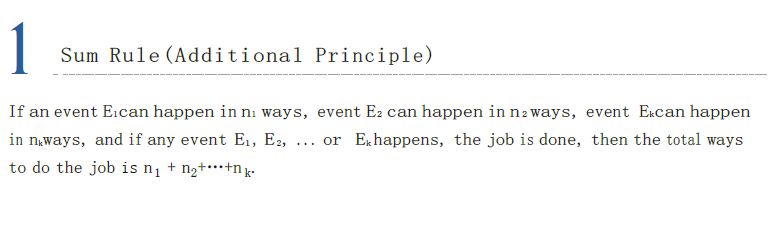
The Sum Rule: When to Add in AMC 8 Counting Problems
AMC 8 Example (2015, Problem 4) – applying the sum rule

The Centerville Middle School chess team has 2 boys and 3 girls. A photographer wants them in a row with a boy at each end and the girls in the middle.
- Case 1: Boy A left, Boy B right → 3! = 63! = 63! =6 ways
- Case 2: Boy B left, Boy A right → 3! = 63! = 63! = 6 ways
- Total = 6 + 6 = 126 + 6 = 126 + 6 = 12
This is a straightforward AMC 8 counting problem where the Sum Rule is applied by splitting cases and adding the results.
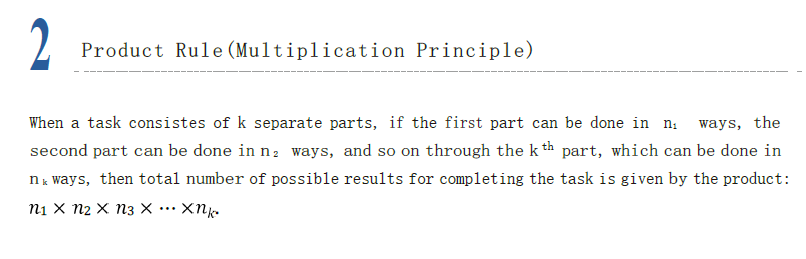
The Product Rule: When to Multiply in AMC 8 Counting Problems
When a process has independent steps, the total number of ways is:
AMC 8 Example (2019, Problem 14) – applying the product rule
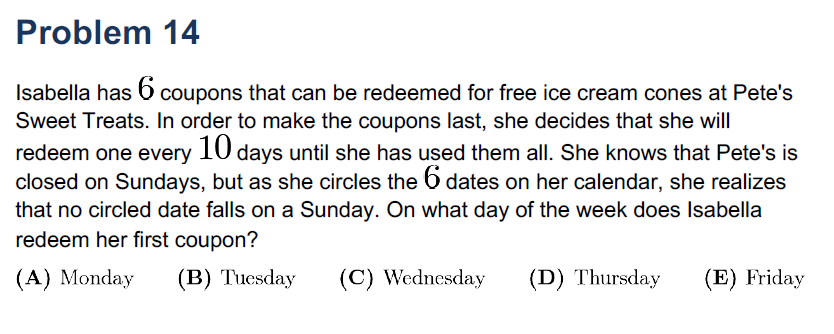
Isabella redeems coupons every 10 days. Pete’s shop is closed on Sundays. After circling six redemption days, none lands on Sunday. What day of the week did she start?
- Each step shifts 3 days forward (10≡3(mod7)10 \equiv 3 \pmod{7}10≡3(mod7))
- Sequence cycles: Start → +3 → +6 → +2 → +5 → +1
- Only Tuesday avoids Sunday
This is a classic AMC 8 probability word problem that combines modular arithmetic with the Product Rule.
Probability Properties: Key Rules for AMC 8
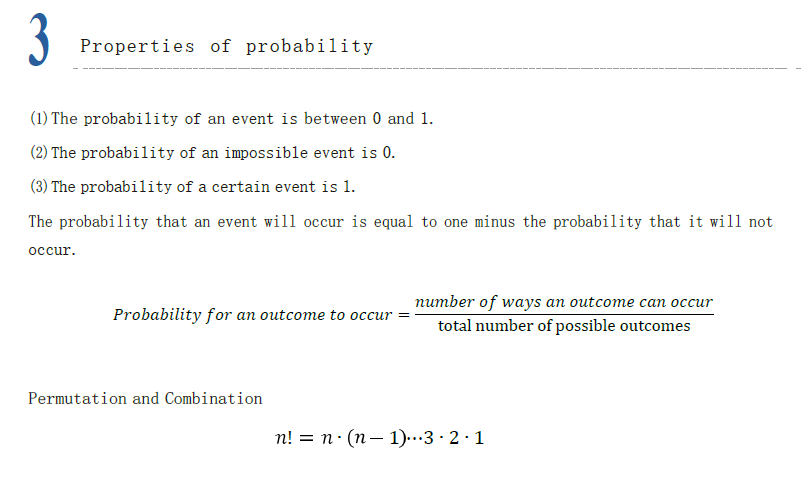
AMC 8 Example (2016, Problem 21) – using properties of probability
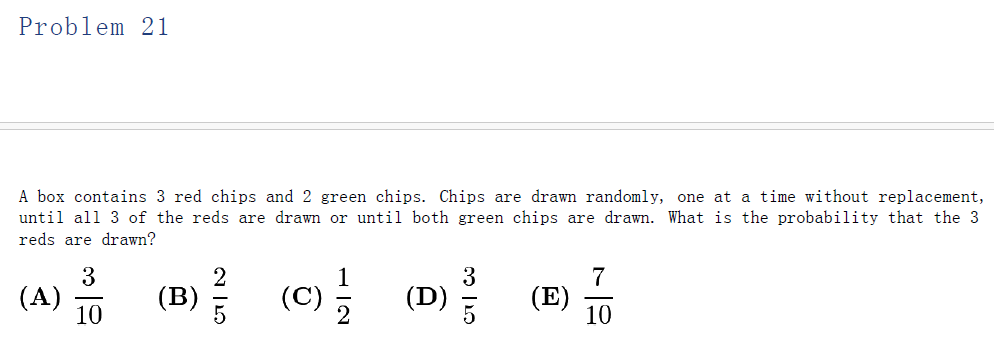
A box has 3 red chips and 2 green chips. Chips are drawn without replacement until either all 3 reds or both greens appear. What is the probability that all reds are drawn?
- Success happens if the 3rd red comes before the 2nd green
- Probability = 3/5
Students practicing with probability worksheets will often see problems like this, which test their understanding of basic probability rules.
Permutations and Combinations in AMC 8
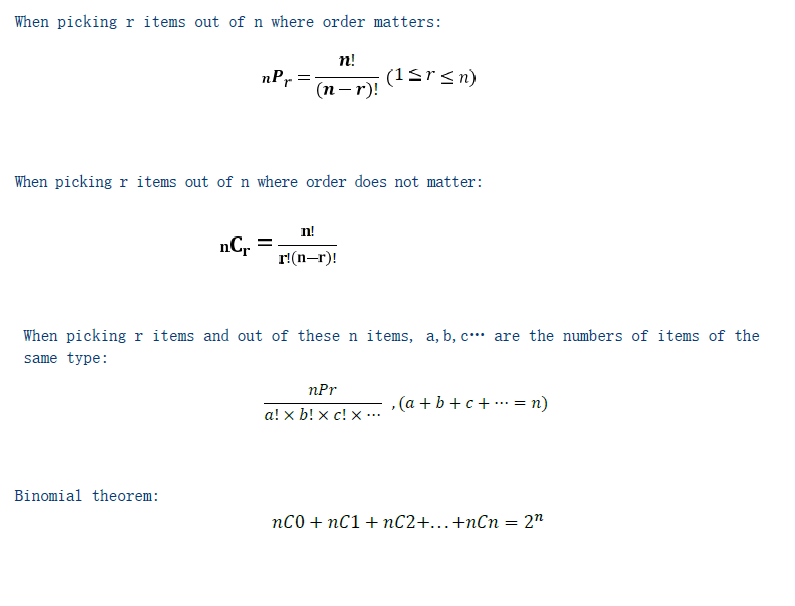
AMC 8 Example (2018, Problem 16)

Professor Chang has 9 books: 2 Arabic, 3 German, 4 Spanish. Arabic must stay together, and Spanish must stay together.
- Treat Arabic and Spanish each as a single block → 7 objects
- Arrange 7 blocks: 7!7!7!
- Internal arrangements: 2!×4!2! \times 4!2!×4!
- Total = 2880
This is a good example of AMC 8 permutations and combinations problems, where grouping restrictions make the problem more challenging.
Basic Probability Formulas for AMC 8 Contest Problems
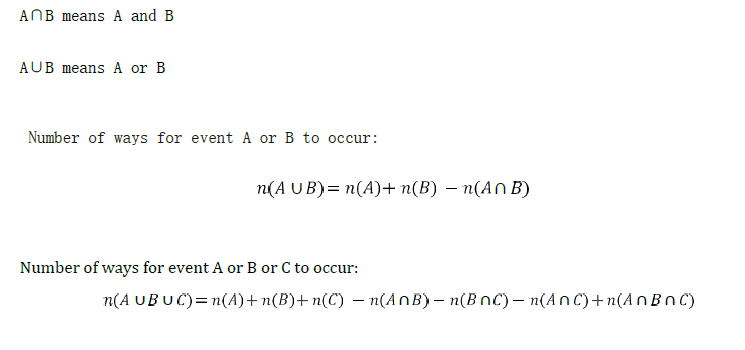
AMC 8 Example (2014, Problem 16)

The “Middle School Eight” basketball conference has 8 teams. Each team plays every other twice plus 4 extra non-conference games.
- Internal games: (82) × 2 = 56{8 \choose 2} \times 2 = 56 (28) × 2 = 56
- Non-conference games: 8 × 4 = 328 \times 4 = 328 × 4 = 32
- Total = 88
This type of AMC 8 probability problem is solved by applying union/intersection-style counting formulas.
Why counting and probability matters on the AMC 8
Counting and probability questions appear on every AMC 8 paper without exception. In recent years they have made up between four and six of the 25 questions, which means they represent roughly 20% of a student’s total score. Students who are confident with the sum rule, product rule, and basic probability formulas going into the contest have a meaningful advantage — these questions are consistently more accessible than geometry or number theory problems for well-prepared students.
The most common mistake students make is treating each question as a completely new problem rather than recognising which rule or formula applies. The examples in this guide each demonstrate a specific technique. Practising with AMC 8 past contest problems — particularly from 2014 to 2025 — and being able to identify the technique before working through the solution is the most effective preparation approach.
For a full overview of all AMC 8 topics and how to structure your child’s preparation, see our complete AMC 8 guide: AMC 8 Math Competition: The Complete Guide for Canadian Students.