


Looking for an EQAO practice test? Whether your child is in Grade 3, Grade 6, or Grade 9, EQAO publishes free official sample tests that use the exact same computer-based interface as the real assessment — and they’re the single most useful preparation resource available. This guide covers everything Ontario parents need: what EQAO testing actually is, where to find the official EQAO practice tests for each grade, what’s covered at each level, and how to use practice tests effectively without turning the spring into a stressful sprint. We’ll also point you to detailed grade-specific guides so you can go deeper on whichever assessment your child is writing. If you’ve ever wondered “what is EQAO?” and “how do I help my child prepare?”, this is the place to start.
What is EQAO?
EQAO stands for the Education Quality and Accountability Office, an independent agency of the Government of Ontario established in 1996. It runs Ontario’s province-wide standardised assessments — the tests that every public school student writes at four points in their school career.
EQAO assessments measure whether students have met the Ontario curriculum expectations at key stages. The results give parents, schools, boards, and the Ministry of Education a consistent, independent benchmark of student achievement that doesn’t depend on individual teacher grading standards.
When do students write EQAO?
EQAO testing happens at four checkpoints:
| Assessment | Grade | Subjects | When |
|---|---|---|---|
| EQAO Grade 3 | Grade 3 | Math + language | Late May / early June |
| EQAO Grade 6 | Grade 6 | Math + language | Late May / early June |
| EQAO Grade 9 | Grade 9 | Math only | January or June |
| OSSLT | Grade 10 | Literacy only | Spring (graduation requirement) |
The Grade 3 and Grade 6 assessments cover both mathematics and language. The Grade 9 assessment covers only mathematics and is the only one that counts toward a report card mark. The Grade 10 OSSLT is a literacy test that students must pass to graduate.
Why does EQAO testing matter?
For most grades, EQAO is a low-stakes diagnostic — it doesn’t appear on report cards and doesn’t affect placement. The Grade 9 EQAO is the exception: it counts as 10% of the final MTH1W math mark in most school boards.
But even the low-stakes assessments are useful. They give parents an independent snapshot of how their child is doing against the provincial standard, and they help identify gaps before those gaps grow into bigger problems. Practising with an EQAO practice test helps your child feel familiar and confident on test day, regardless of the stakes.
Why use an EQAO practice test?
A practice test does three things that regular schoolwork doesn’t.
It exposes your child to the computer-based interface before test day. The EQAO platform uses drag-and-drop questions, on-screen calculators, and digital tools that look different from regular schoolwork. One practice session removes the surprise factor.
It identifies specific topic gaps before they get baked in. If your child consistently struggles with a particular type of question, you can address it in the weeks before the assessment rather than discovering the gap when results come back months later.
It builds familiarity and reduces anxiety. Most test stress comes from the unknown. A calm walkthrough of the practice test turns “what is this going to be like?” into “I’ve done this before.”
What a practice test does NOT do — especially at the elementary level — is dramatically improve scores through repetition. One or two well-analysed practice tests beat six rushed ones every time. The value is in the analysis afterward, not the number completed.
Where to find official EQAO practice tests
The best resource is always the one EQAO produces itself, because it uses the exact interface, question types, and difficulty calibration of the real assessment.
The official EQAO sample tests
EQAO publishes free, full-length EQAO practice tests for each grade on eqao.com. Each includes:
- A complete practice version matching the real assessment
- The same computer-based interface
- The on-screen calculator and reference materials students get on test day
- All question types: multiple choice, open response, and drag-and-drop
There’s no login, no fee, and no time limit. The platform works best on Chrome or Edge on a laptop or desktop — the closest match to the school testing environment.
Released items and framework documents
Beyond the full sample tests, EQAO also publishes:
- Released items — individual past questions with answer keys, organised by strand, available as free PDFs
- Framework documents — detailed explanations of what each strand tests and how it’s weighted
- Annual results reports — aggregate data with some sample questions
All free from eqao.com.
A note on EQAO practice test PDFs
Many parents search for downloadable PDF practice tests. EQAO doesn’t publish its full practice tests as single PDFs because the real assessment is computer-based — the interactive question types don’t translate to paper. However, individual released items are available as PDFs. Several third-party tutoring sites also publish unofficial practice PDFs, but quality varies, and anything dated before 2020 (2021 for Grade 9) was written for an outdated curriculum.

EQAO practice tests by grade
Each grade’s assessment is different, so the practice approach differs too. Here’s a quick overview of each, with links to detailed grade-specific guides.
Grade 3 EQAO practice test
The Grade 3 assessment is most families’ first encounter with EQAO. It covers math (number, patterns, data, geometry) and language (reading and writing), spread across multiple short sittings over one or two days.
At Grade 3, the goal of practice is familiarity and calm — not intensive preparation. One walkthrough of the official sample test plus light topic work on any weak areas is the right dose. The most important thing parents can do at this level is keep the whole experience low-pressure.
For the full breakdown, see our EQAO practice test Grade 3 guide and our complete EQAO Grade 3 guide.
Grade 6 EQAO practice test
The Grade 6 assessment is broader and longer than Grade 3, covering all six math strands plus reading and writing. It’s still low-stakes — no report card impact, no Grade 7 placement effect — but it’s a useful checkpoint before the transition to intermediate school.
Practice should focus on the strands where your child is weakest. For most Grade 6 students, that’s fractions/decimals and geometry/measurement in math, and writing organisation in language.
For the full breakdown, see our EQAO practice test Grade 6 guide and our complete EQAO Grade 6 guide.
Grade 9 EQAO practice test
The Grade 9 assessment is the only one that counts toward a report card mark — 10% of the final MTH1W grade in most boards. It covers math only, across six strands, and it matters more for university-bound students because it’s the foundation for senior math.
Practice should be more structured here than at the elementary levels: a diagnostic, targeted work on weak strands, and timed full practice tests in the weeks before. Linear relationships (slope), surface area and volume, and financial literacy are the most heavily tested topics.
For the full breakdown, see our EQAO Grade 9 practice test guide and our complete EQAO Grade 9 guide.
How EQAO is scored (all grades)
Every EQAO assessment uses the same four-level scale, matched to the Ontario report card achievement levels.
| Level | Description | Approximate report card equivalent |
|---|---|---|
| Level 4 | Surpasses the provincial standard | A (80%+) |
| Level 3 | Meets the provincial standard | B (70–79%) |
| Level 2 | Approaching the provincial standard | C (60–69%) |
| Level 1 | Below the provincial standard | D (50–59%) |
| NE1 | Insufficient evidence | Below 50% |
The provincial standard is Level 3 across all grades — the benchmark for a student who has met curriculum expectations and is ready for the next stage.
When do EQAO results come out?
For Grade 3 and 6 (written in spring), individual results are released to schools in October or November of the following school year. For Grade 9, results follow a few months after each testing window. School-level and board-level results are published publicly on the EQAO website each fall.
Note that practice tests don’t generate an official “level” score — EQAO scoring is done by trained markers using detailed rubrics. A practice test gives you a useful sense of strengths and gaps, but not a precise level prediction.
How to use an EQAO practice test effectively
The method matters more than the number of tests. Here’s the approach that turns a practice test into genuine improvement.
Step 1 — sit one full practice test under realistic conditions
Use the official EQAO sample test for your child’s grade. Set it up to mirror the real thing: quiet space, timed (loosely for younger children), no help during the test itself. For elementary students, break it into the same short sittings the real assessment uses rather than one long marathon.
Step 2 — mark it together the same day
Mark it while the questions are fresh, using the official answer key. Don’t just record a score — that number alone is nearly useless.
Step 3 — analyse the mistakes
This is where the value is. For every question your child got wrong, identify why:
- Concept gap — they don’t understand the topic
- Careless error — they understand it but made an arithmetic or reading slip
- Time pressure — they ran out of time
- Misread — they answered a different question than the one asked
Look for patterns. Three wrong questions all on the same topic is a real gap to address. Three wrong questions scattered across topics is usually just normal variation.
Step 4 — target the patterns
Spend the weeks before the assessment working on the specific patterns the practice test revealed — not on everything, and not on what your child is already good at. Twenty focused minutes a day on a weak topic beats hours of unfocused review.
Step 5 — rehearse once more, then rest
Do one more practice test a week or two before the assessment to confirm improvement. Then, in the final few days, stop practising. Rest, good sleep, and a calm mindset matter more than last-minute cramming — which backfires at every grade level.
Common EQAO practice mistakes to avoid
After working with thousands of Ontario families through EQAO season, the same mistakes come up repeatedly across every grade.
Practising without timing. A child who can solve every problem given unlimited time will still struggle on a timed assessment. Use a timer (loosely for younger children).
Skipping the analysis. Doing a practice test and only looking at the score wastes most of its value. The improvement comes from understanding the mistakes.
Doing too many practice tests. Diminishing returns kick in fast, especially at the elementary level. One or two well-analysed tests beat six rushed ones.
Using outdated practice material. Anything pre-2020 (pre-2021 for Grade 9) was written for an old curriculum. Check the date on any third-party resource.
Treating low-stakes assessments as high-stakes. For Grade 3 and 6, stress at home creates stress in the test, which produces worse results. Keep it calm.
Focusing only on math. For Grade 3 and 6, half the assessment is language. A strong math student with weak reading comprehension often scores lower overall.
Cramming the week before. The curriculum is broad and can’t be crammed in seven days. If your child isn’t ready by the final week, focus on confidence over content.
Beyond practice tests — building real math fluency
Practice tests are a useful tool, but they’re a snapshot, not a strategy. The students who consistently reach Level 3 and Level 4 aren’t the ones who did the most practice tests — they’re the ones with genuine, year-round fluency in the underlying skills.
That’s the difference between cramming for EQAO and being ready for EQAO. A practice test in May can reveal gaps, but it can’t close large ones in three weeks. Real readiness comes from consistent engagement with math throughout the year.
This is especially true at Grade 9, where the EQAO result counts toward the report card and the topics tested are the foundation for all of senior math. A student who’s genuinely fluent in linear relationships and slope, surface area and volume, and integer operations doesn’t need to cram — the EQAO is just a Tuesday for them.
How Think Academy Canada supports EQAO preparation
Think Academy is the international arm of TAL Education Group, one of the largest education companies in the world. Our Canadian programs are built around a carefully paced math curriculum, an online interactive platform built specifically for math, and gamified rewards that keep students engaged across the full school year — not just in a panic before the test.
For EQAO preparation across all grades:
Our curriculum runs ahead of the Ontario standard. Students meet next-grade content before their classmates do, which turns EQAO topics into review rather than new learning.
Our practice problem library includes hundreds of Ontario-curriculum-aligned questions written in EQAO question style, organised by grade, strand, and difficulty.
Our teachers mark every homework set personally, with written feedback on the types of mistakes a student is making — the same pattern-analysis approach that makes practice tests valuable, applied all year long.
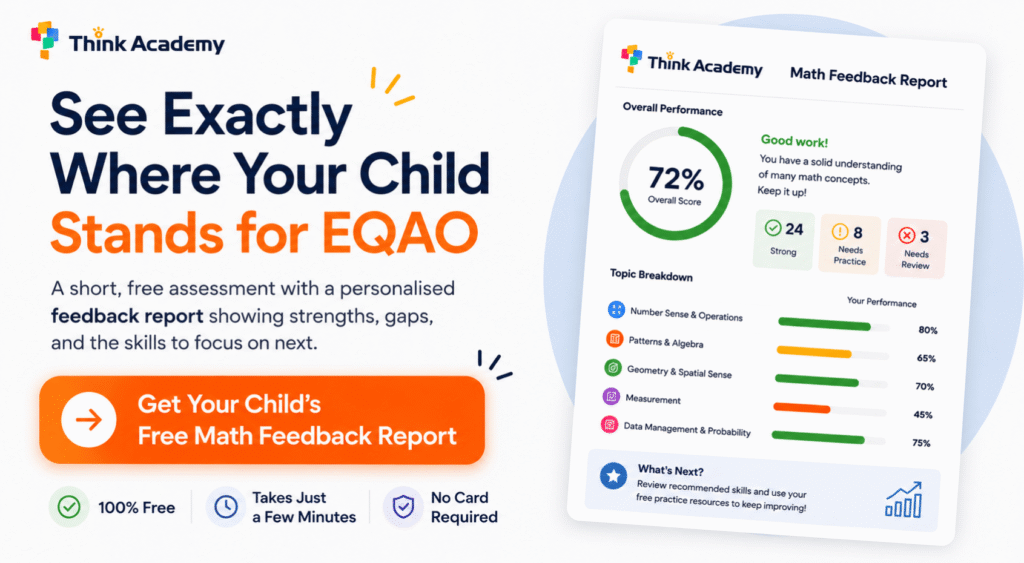
Our free math assessment is the fastest way to find out where your child stands. They complete a short online test aligned to the Ontario curriculum, and you get a detailed feedback report on strengths and gaps by topic, plus free practice resources tailored to their level. It’s quicker than a full EQAO practice test and gives you the same diagnostic information — without the 3-hour sitting. No commitment, no sales pressure.
Frequently asked questions
What is an EQAO practice test?
An EQAO practice test is a free official sample version of the real EQAO assessment, published by EQAO on eqao.com. It uses the same computer-based interface, question types, and difficulty as the real test, and is available for Grade 3, Grade 6, and Grade 9.
Where can I find free EQAO practice tests?
The official EQAO practice tests are free at eqao.com, with separate versions for each grade. EQAO also publishes individual released items and framework documents as free PDF resources.
What is EQAO?
EQAO is the Education Quality and Accountability Office, an independent Ontario government agency that runs province-wide assessments in Grade 3, Grade 6, Grade 9, and Grade 10 (the OSSLT literacy test). It measures whether students have met the Ontario curriculum expectations.
Is there an EQAO practice test PDF?
EQAO doesn’t publish full practice tests as single downloadable PDFs because the real assessment is computer-based. However, individual past questions are available as free PDFs on eqao.com. Some third-party sites publish unofficial PDF practice tests, but check that they match the current curriculum (post-2020).
How many EQAO practice tests should my child do?
One or two well-analysed practice tests are enough for most students. The value is in analysing the mistakes afterward, not in repetition. Doing six practice tests doesn’t produce six times the benefit, especially at the elementary level.
Does EQAO count toward my child’s mark?
Only the Grade 9 EQAO counts toward a report card mark — 10% of the final MTH1W math grade in most boards. The Grade 3 and Grade 6 assessments are low-stakes diagnostics that don’t appear on report cards.
When is EQAO testing?
Grade 3 and Grade 6 EQAO are written in late May or early June. Grade 9 EQAO is written in January or June, depending on when the student takes the MTH1W course. The Grade 10 OSSLT is written in the spring.
How is the EQAO practice test scored?
Practice tests don’t generate an official level score — EQAO uses trained markers and detailed rubrics for the real assessment. A practice test is best used to identify strengths and gaps, not to predict an exact level. The official scale runs Level 1 (below standard) to Level 4 (surpasses standard), with Level 3 as the provincial benchmark.
What’s the difference between an EQAO practice test and a sample test?
There’s no meaningful difference — EQAO uses both terms for the same free, full-length practice version of the assessment.
How should my child practise for EQAO?
Sit one official practice test, mark it together, analyse the mistakes by type, target the weak patterns with short daily practice in the weeks before, then rehearse once more and rest. The method matters more than the number of tests.
Can my child use a calculator on EQAO?
Yes — an on-screen calculator is built into the EQAO platform for the relevant math sections at each grade. Students should practise with this calculator rather than a physical one so the interface is familiar.
About Think Academy Canada
Think Academy Canada, part of TAL Education Group, supports K–12 students with structured math programs built around an online interactive platform, gamified learning, and teachers who personally mark every homework set. Our curriculum runs ahead of the provincial standards and is designed to prepare students for both school excellence and Canadian math competitions, including the Gauss, Pascal, Cayley, Fermat, and Euclid contests.


This is really helpful, thanks for compiling all this information about the EQAO tests. I’m definitely going to check out the guide for Grade 6 – it’s a stressful time for parents!