The Pythagorean theorem is one of the most important concepts in geometry and one of the most consistently tested topics across every level of the AMC math competition. This Pythagorean theorem worksheet gives AMC 8 students a complete set of practice problems — from straightforward calculations finding missing side lengths, through Pythagorean theorem word problems set in real contexts, to multi-step competition geometry questions of the kind that appear in AMC 8 past papers. Every problem comes with a full worked solution and explanation so students understand not just the answer but the reasoning behind it.

What is the Pythagorean theorem?
The Pythagorean theorem states that in any right-angled triangle, the square of the length of the hypotenuse equals the sum of the squares of the other two sides.
Written as a formula:
a² + b² = c²
Where a and b are the two shorter sides (called legs) and c is the hypotenuse — the longest side, always opposite the right angle.
This means:
- If you know two sides of a right triangle you can always find the third
- If a² + b² = c² is satisfied by three numbers, those numbers form a right triangle
- The hypotenuse is always the longest side
Why the Pythagorean theorem matters for AMC 8
Geometry questions make up a significant portion of every AMC 8 paper. The Pythagorean theorem appears directly — in problems asking for a missing side length — and indirectly, embedded in problems about areas, diagonals of rectangles, distances between points, and three-dimensional figures. Students who can apply the theorem quickly and accurately, and who recognise when a problem requires it without being told explicitly, have a meaningful advantage in competition conditions.
Pythagorean triples — the shortcuts worth memorising
A Pythagorean triple is a set of three whole numbers that satisfy a² + b² = c². Recognising common triples saves significant time in AMC 8 problems because you can identify the missing side instantly without any calculation.
| Triple | Multiples to know |
|---|---|
| 3, 4, 5 | 6-8-10, 9-12-15, 12-16-20 |
| 5, 12, 13 | 10-24-26 |
| 8, 15, 17 | 16-30-34 |
| 7, 24, 25 | 14-48-50 |
The 3-4-5 triple and its multiples appear more frequently in AMC 8 problems than any other. Students who recognise a 3-4-5 triangle immediately — without needing to calculate — solve these problems in seconds rather than minutes.
Pythagorean theorem worksheet practice problems — Level 1
These problems test direct application of the theorem to find a missing side. They are equivalent in difficulty to questions 1 to 10 on the AMC 8.
Problem 1
A right triangle has legs of length 6 and 8. What is the length of the hypotenuse?
Solution: a² + b² = c²
6² + 8² = c²
36 + 64 = c²
100 = c²
c = ?
Answer:
10
Key insight: Recognise this as a 3-4-5 triple scaled by 2. Once you have seen enough Pythagorean triples, 6-8 immediately suggests the hypotenuse is 10 without any calculation.
Problem 2
A right triangle has a hypotenuse of 13 and one leg of length 5. What is the length of the other leg?
Solution: a² + b² = c²
5² + b² = 13²
25 + b² = 169
b² = 144
b = ?
Answer:
12
Key insight: This is the 5-12-13 Pythagorean triple. Recognising it immediately is faster than using the formula. Memorising the common triples in the table above pays dividends throughout competition preparation.
Problem 3
A right triangle has legs of length 9 and 12. What is the length of the hypotenuse?
Solution: a² + b² = c²
9² + 12² = c²
81 + 144 = c²
225 = c²
c = ?
Answer:
15
Key insight: This is a 3-4-5 triple scaled by 3. 9 = 3 x 3, 12 = 4 x 3, so the hypotenuse is 5 x 3 = 15.
Problem 4
A right triangle has a hypotenuse of 17 and one leg of length 8. What is the length of the other leg?
Solution: a² + b² = c²
8² + b² = 17²
64 + b² = 289
b² = 225
b = ?
Answer:
15
Key insight: This is the 8-15-17 Pythagorean triple. If you recognise it you can write the answer immediately. If not, the calculation is straightforward — the key is making sure you subtract correctly: 289 minus 64 equals 225, and the square root of 225 is 15.
Problem 5
A right triangle has legs of length 7 and 24. What is the length of the hypotenuse?
Solution: 7² + 24² = c²
49 + 576 = c²
625 = c²
c = ?
Answer:
25
Key insight: This is the 7-24-25 Pythagorean triple — less well known than 3-4-5 but worth memorising since it appears in AMC 8 past papers. The square root of 625 is 25 — knowing that 25² = 625 is a useful number fact.
Pythagorean theorem worksheet practice problems — Level 2
These problems require applying the theorem in a geometric context — finding diagonals, heights, and distances. They are equivalent in difficulty to questions 10 to 18 on the AMC 8.
Problem 6 — Diagonal of a rectangle
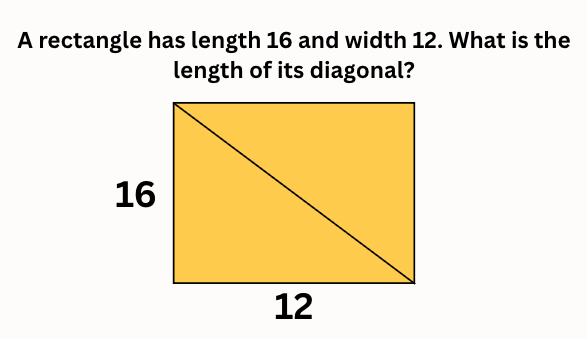
A rectangle has length 16 and width 12. What is the length of its diagonal?
Solution: The diagonal of a rectangle divides it into two right triangles. The diagonal is the hypotenuse and the sides are the legs.
a² + b² = c²
12² + 16² = c²
144 + 256 = c²
400 = c²
c = ?
Answer:
20
Key insight: Recognise this as a 3-4-5 triple scaled by 4. 12 = 3 x 4, 16 = 4 x 4, diagonal = 5 x 4 = 20. Rectangle diagonal problems are a standard AMC 8 geometry type — expect to see them regularly in past papers.
Problem 7 — Height of an isosceles triangle
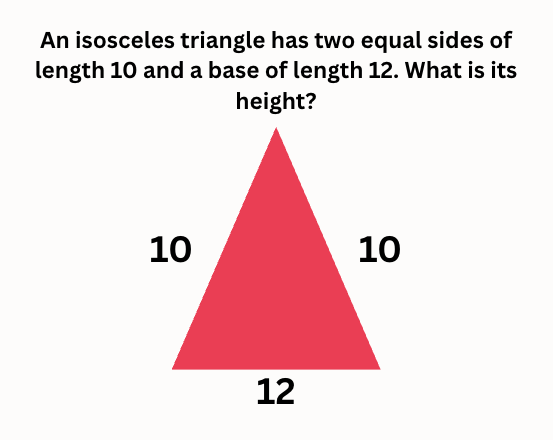
An isosceles triangle has two equal sides of length 10 and a base of length 12. What is its height?
Solution: Drop a perpendicular from the apex to the base. This creates two right triangles. The height is the vertical leg, half the base (6) is the horizontal leg, and the equal side (10) is the hypotenuse.
a² + b² = c²
6² + h² = 10²
36 + h² = 100
h² = 64
h = ?
Answer:
8
Key insight: When a problem involves an isosceles triangle and asks for the height, always drop the perpendicular to the base first. This splits the triangle into two right triangles and the Pythagorean theorem becomes applicable. This technique appears frequently in AMC 8 geometry.
Problem 8 — Distance between two points
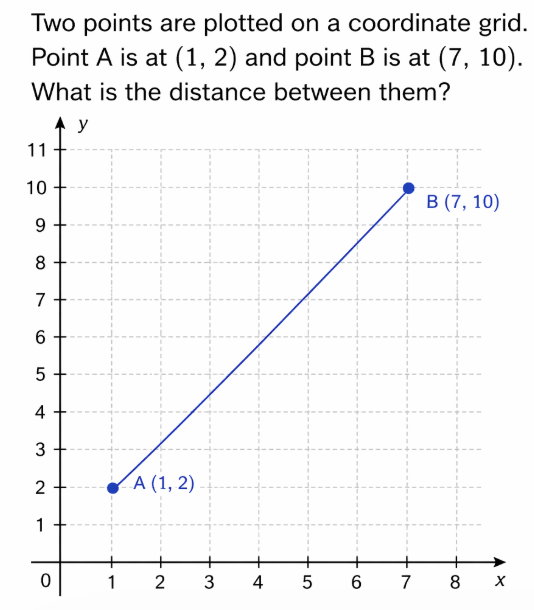
Two points are plotted on a coordinate grid. Point A is at (1, 2) and point B is at (7, 10). What is the distance between them?
Solution: The horizontal distance between the points is 7 minus 1 equals 6. The vertical distance is 10 minus 2 equals 8. These form the legs of a right triangle and the distance between the points is the hypotenuse.
6² + 8² = c²
36 + 64 = c²
100 = c²
c = ?
Answer:
10
Key insight: Distance between two points on a coordinate grid is always a Pythagorean theorem problem. The horizontal and vertical differences are the legs. Recognise this immediately rather than trying to use the distance formula — it is the same thing and understanding why it works is more useful than memorising a formula.
Problem 9 — Ladder against a wall
A ladder 15 metres long leans against a vertical wall. The base of the ladder is 9 metres from the wall. How high up the wall does the ladder reach?
Solution: The ladder is the hypotenuse, the distance from the wall is one leg, and the height up the wall is the other leg.
9² + h² = 15²
81 + h² = 225
h² = 144
h = ?
Answer:
12 metres
Key insight: This is the 3-4-5 triple scaled by 3. 9 = 3 x 3, 15 = 5 x 3, height = 4 x 3 = 12. Ladder problems are a classic Pythagorean theorem word problem type and appear across many AMC 8 past papers in slightly different forms.
Problem 10 — Diagonal of a square
A square has side length 5. What is the length of its diagonal? Give your answer in simplest radical form.
Solution: The diagonal divides the square into two right isosceles triangles. Both legs have length 5.
5² + 5² = c²
25 + 25 = c²
50 = c²
c = √50 = √(25 x 2) = ?
Answer:
5√2
Key insight: The diagonal of any square with side length s is s√2. This result is worth memorising directly for AMC 8 purposes. Deriving it once from the Pythagorean theorem gives you the formula, and from then on you can apply it immediately.
Pythagorean theorem worksheet word problems — Level 3
These Pythagorean theorem word problems require identifying that the theorem is needed without being told explicitly, then setting up and solving the problem correctly. They are equivalent in difficulty to questions 15 to 22 on the AMC 8.
Problem 11 — Area of a triangle
A triangle has sides of length 10, 10, and 12. What is its area?
Solution: This is an isosceles triangle. Drop a perpendicular from the apex to the base to find the height.
Half the base = 12 divided by 2 = 6 One equal side = 10 = hypotenuse
6² + h² = 10²
36 + h² = 100
h² = 64
h = 8
Area = half base times height = (1/2) x 12 x 8 = ?
Answer:
48
Key insight: Finding the area of an isosceles triangle almost always requires finding the height first using the Pythagorean theorem. The process is always the same: drop the perpendicular, identify the right triangle formed, apply the theorem.
Problem 12 — Perimeter after finding a missing side
A right triangle has one leg of length 5 and a hypotenuse of length 13. What is the perimeter of the triangle?
Solution: Find the missing leg first.
5² + b² = 13²
25 + b² = 169
b² = 144
b = 12
Perimeter = 5 + 12 + 13 = ?
Answer:
30
Key insight: Two-step problems like this are common on the AMC 8. The first step finds the missing side, the second step uses it to answer the actual question. Students who only find the missing side and stop have done the harder part but missed the final step — always re-read the question before writing down the answer.
Problem 13 — Three-dimensional distance
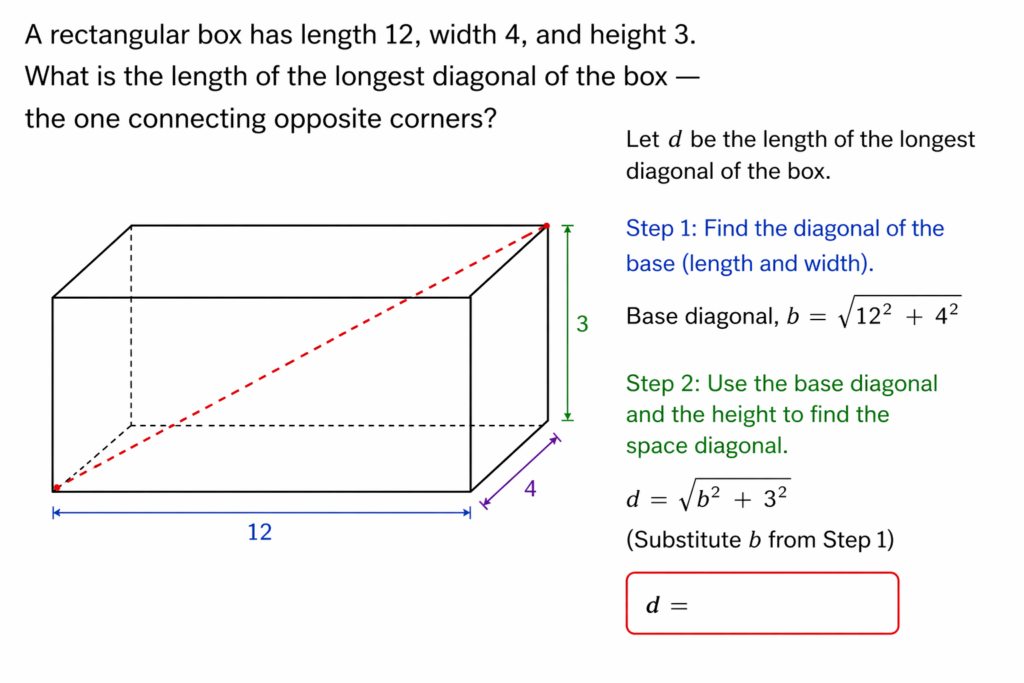
A rectangular box has length 12, width 4, and height 3. What is the length of the longest diagonal of the box — the one connecting opposite corners?
Solution: Use the Pythagorean theorem twice.
Step one: find the diagonal of the base rectangle. Base diagonal² = 12² + 4² = 144 + 16 = 160 Base diagonal = √160 = 4√10
Step two: use this diagonal as one leg of a new right triangle with the height as the other leg. Longest diagonal² = (4√10)² + 3² = 160 + 9 = 169 Longest diagonal = √169 = ?
Answer:
13
Key insight: Three-dimensional diagonal problems require applying the Pythagorean theorem twice — once to find the diagonal of the base, then again to find the space diagonal. The formula for the space diagonal of a rectangular box is √(l² + w² + h²). Recognising this pattern across different problems is a valuable AMC skill.
Problem 14 — Finding area using an embedded right triangle
A circle has a chord of length 16. The chord is 6 units from the centre of the circle. What is the radius of the circle?
Solution: Draw a line from the centre perpendicular to the chord. This line bisects the chord, creating a right triangle with:
- Half the chord length = 8 as one leg
- Distance from centre to chord = 6 as the other leg
- Radius = hypotenuse
6² + 8² = r²
36 + 64 = r²
100 = r²
r = ?
Answer:
10
Key insight: The perpendicular from the centre of a circle to a chord always bisects the chord. Knowing this geometric fact turns what appears to be a circles problem into a straightforward Pythagorean theorem calculation. Many AMC 8 problems combine one geometric theorem with the Pythagorean theorem in exactly this way.
Problem 15 — Multi-step word problem
A rectangular field measures 40 metres by 30 metres. A path runs diagonally across the field from one corner to the opposite corner. How much shorter is the diagonal path than walking around two sides of the field?
Solution: Step one: find the diagonal. 40² + 30² = c² 1600 + 900 = c² 2500 = c² c = 50 metres
Step two: find the distance walking around two sides. 40 + 30 = 70 metres
Step three: find the difference. 70 minus 50 = ? metres
Answer:
The diagonal path is 20 metres shorter
Key insight: This is a 3-4-5 triple scaled by 10. 30 = 3 x 10, 40 = 4 x 10, diagonal = 5 x 10 = 50. Real-world context word problems like this are common on the AMC 8 — the mathematics is the same as the direct problems above but students must first extract the relevant numbers and structure from the context.

Pythagorean theorem worksheet questions — AMC 8 past contest style
These problems are written in the style of actual AMC 8 past contest questions. They are harder than the problems above and require recognising which geometric technique to use without being guided.
Problem 16 — AMC 8 style
The base of a right triangle is 24 and the hypotenuse is 26. What is the area of the triangle?
Solution: Find the height (the other leg) using the Pythagorean theorem.
a² + 24² = 26²
a² + 576 = 676
a² = 100
a = 10
Area = (1/2) x base x height = (1/2) x 24 x 10 = ?
Answer:
120
Key insight: This is the 5-12-13 triple scaled by 2. 24 = 12 x 2, 26 = 13 x 2, missing leg = 5 x 2 = 10. Once the missing side is found, area is straightforward.
Problem 17 — AMC 8 style
Square ABCD has side length 6. Point E is the midpoint of side CD. What is the length of AE?
Solution: Place the square on a coordinate grid. Let A be at (0, 6), B at (6, 6), C at (6, 0), D at (0, 0). Point E is the midpoint of CD so E is at (3, 0).
AE² = (6-3)² + (6-0)²
AE² = 9 + 36
AE² = 45
AE = √45 = ?
Answer:
3√5
Key insight: Placing geometric figures on a coordinate grid and using the Pythagorean theorem to find distances is a powerful and flexible technique. When a problem involves a distance inside a square, rectangle, or other figure and no obvious right triangle is drawn, create one by adding a horizontal and vertical line.
Problem 18 — AMC 8 style
A right triangle has legs in the ratio 3:4. The hypotenuse has length 20. What is the area of the triangle?
Solution: Let the legs be 3k and 4k for some value k.
(3k)² + (4k)² = 20²
9k² + 16k² = 400
25k² = 400
k² = 16
k = 4
Legs are 3 x 4 = 12 and 4 x 4 = 16.
Area = (1/2) x 12 x 16 = ?
Answer:
96
Key insight: When sides are given in ratio form, introduce a variable k and set up the equation using the Pythagorean theorem. This technique works for any ratio and any given side. Solving for k first, then finding the actual side lengths, keeps the working organised.
Problem 19 — AMC 8 style
An equilateral triangle has side length 8. What is its area?
Solution: Drop a perpendicular from the apex to the base. This creates two right triangles with:
- Hypotenuse = 8 (the equal side)
- One leg = 4 (half the base)
- Other leg = height h
4² + h² = 8² 16 + h² = 64 h² = 48 h = √48 = 4√3
Area = (1/2) x base x height = (1/2) x 8 x 4√3 = 16√3
Answer: 16√3
Key insight: The area of any equilateral triangle with side length s is (s² √3)/4. This formula is worth memorising directly for AMC 8 — it comes up regularly. Understanding that it derives from the Pythagorean theorem applied to the height is more valuable than memorising it blindly.
Problem 20 — AMC 8 style (hardest)
Inside a rectangle with length 15 and width 9, a point P is located such that it is 12 units from one corner and 9 units from the adjacent corner. How far is P from the corner diagonally opposite to the first corner?
Solution: Place the rectangle with corner A at the origin (0,0), B at (15,0), C at (15,9), D at (0,9). Let P be at coordinates (x, y).
From corner A: x² + y² = 144 (distance 12 from A)
From corner B: (x-15)² + y² = 81 (distance 9 from B)
Expand the second equation: x² – 30x + 225 + y² = 81
Substitute x² + y² = 144:
144 – 30x + 225 = 81
369 – 30x = 81
30x = 288 x = 9.6
Find y:
9.6² + y² = 144
92.16 + y² = 144
y² = 51.84 y = 7.2
Distance from P to corner C at (15, 9):
PC² = (15 – 9.6)² + (9 – 7.2)²
PC² = 5.4² + 1.8²
PC² = 29.16 + 3.24
PC² = 32.4
PC = √32.4 = ?
Answer:
1.8√10
Key insight: This problem requires setting up a coordinate system, writing simultaneous equations, and applying the Pythagorean theorem three times. It is deliberately harder than most AMC 8 questions — it is closer to AMC 10 level. If your student can follow and reproduce this solution they are very well prepared for competition geometry.
Pythagorean theorem worksheet reference sheet
Use this as a quick reference when working through the practice problems above.
| Concept | Formula or fact |
|---|---|
| Pythagorean theorem | a² + b² = c² |
| Finding the hypotenuse | c = √(a² + b²) |
| Finding a leg | a = √(c² – b²) |
| 3-4-5 triple | And all multiples: 6-8-10, 9-12-15, 12-16-20 |
| 5-12-13 triple | And multiples: 10-24-26 |
| 8-15-17 triple | And multiples: 16-30-34 |
| 7-24-25 triple | And multiples: 14-48-50 |
| Diagonal of a square | d = s√2 |
| Height of equilateral triangle | h = (s√3)/2 |
| Area of equilateral triangle | A = (s²√3)/4 |
| Space diagonal of a box | d = √(l² + w² + h²) |
How to use the worksheet effectively
Working through practice problems without a plan produces slower improvement than deliberate practice. Here is how to get the most from this Pythagorean theorem worksheet.
Attempt every problem before reading the solution. Even if you are not sure of the approach, writing down what you do know — the theorem, the known values, what you are looking for — is more useful than reading the solution immediately. The struggle of attempting a problem first is what builds problem-solving intuition.
Identify which Pythagorean triple is involved before calculating. For every problem in this worksheet, check whether the numbers are a multiple of 3-4-5, 5-12-13, 8-15-17, or 7-24-25 before starting any calculation. Students who build the habit of checking for Pythagorean triples first develop significantly faster problem-solving speed over time.
Draw a diagram for every word problem. Pythagorean theorem word problems become significantly easier once you have drawn the right triangle that the problem describes. Label the known sides and the unknown side before setting up the equation.
Review every problem you got wrong until you can reproduce the solution without looking. Getting a problem wrong is only useful if you understand why and can solve it correctly next time. For each incorrect answer read the solution, put it away, and try to reproduce the working from scratch. If you cannot, read it again and try once more.
This Pythagorean theorem worksheet is designed to be worked through in stages rather than all at once. Start with the Level 1 problems in one session, move to Level 2 in the next, and save the AMC 8 style questions for when the earlier problems feel comfortable. Students who return to this Pythagorean theorem worksheet regularly — rather than completing it once and moving on — build the kind of fluency that competition conditions demand. You can also use this Pythagorean theorem worksheet alongside AMC 8 past papers, treating the two as complementary resources: the past papers show you the exact question style, and this Pythagorean theorem worksheet gives you the focused practice on the specific skill those questions test.
Bookmark this worksheet and come back to it as your child’s AMC 8 preparation progresses. A problem that feels difficult at the start of preparation often feels straightforward three months later — working through this Pythagorean theorem worksheet at different stages is a useful way to measure how much your child’s geometry skills have developed. If your child is working with a Think Academy teacher, share this Pythagorean theorem worksheet with them so they can identify which problem types still need work and adjust the course focus accordingly.
AMC 8 Math Competition: The Complete Guide for Canadian Students
Factors of 24 and 45: How to Find All Factors AMC 8 Guide
What is a Broken Line Graph? Examples, How to Read One and AMC Practice
Frequently Asked Questions
What is the Pythagorean theorem? The Pythagorean theorem states that in any right-angled triangle, the square of the hypotenuse equals the sum of the squares of the other two sides: a² + b² = c², where c is the hypotenuse. It is used to find any missing side of a right triangle when the other two sides are known.
What are the most common Pythagorean theorem problems? The most common types are: finding a missing side given the other two, finding the diagonal of a rectangle, finding the height of an isosceles or equilateral triangle, calculating distance between two points on a grid, and word problems involving ladders, ramps, or paths across rectangular areas.
What Pythagorean triples should I memorise for AMC 8? The four most important are 3-4-5, 5-12-13, 8-15-17, and 7-24-25, along with their multiples. The 3-4-5 triple and its multiples appear most frequently. Recognising these instantly without calculation saves significant time in competition conditions.
How does the Pythagorean theorem appear in AMC 8 problems? It appears directly in questions asking for a missing side, and indirectly in problems about diagonals of rectangles and squares, heights of triangles, distances between points on a grid, circle chord problems, and three-dimensional box diagonals. Recognising when to apply the theorem without being told is the key skill.
What is a Pythagorean triple? A Pythagorean triple is a set of three whole numbers that satisfy a² + b² = c². The simplest is 3-4-5 because 9 + 16 = 25. Any multiple of a Pythagorean triple is also a Pythagorean triple — so 6-8-10, 9-12-15, and 12-16-20 are all valid triples derived from 3-4-5.
How do I solve Pythagorean theorem word problems? Draw the right triangle described in the problem first. Label the known sides and the unknown side. Identify which value is the hypotenuse (always the longest side, opposite the right angle). Substitute into a² + b² = c² and solve. Check whether the numbers form a recognisable Pythagorean triple before calculating — this often makes the arithmetic unnecessary.
What is the Pythagorean theorem used for in real life? The Pythagorean theorem is used in construction (finding diagonal measurements), navigation (calculating straight-line distances), architecture (designing roof angles), and computer graphics (calculating distances between points). In mathematics it extends into trigonometry, coordinate geometry, and vector calculations at higher levels.
How hard are AMC 8 Pythagorean theorem questions? AMC 8 Pythagorean theorem questions range from straightforward missing side calculations in the first ten questions to multi-step geometry problems in questions 18 to 25. The harder problems embed the theorem inside a larger geometric context — finding the height of a triangle before calculating area, or applying the theorem twice to find a three-dimensional diagonal. Regular practice with problems at increasing difficulty levels is the most effective preparation.