
The greatest common factor, or GCF, is the largest number that divides evenly into two or more numbers with no remainder. Finding the GCF of numbers like 75 and 30, 18 and 24, or 24 and 36 is one of the most tested skills in middle school mathematics and appears regularly in AMC 8 competition problems. This guide explains three reliable methods for finding the GCF of any pair of numbers, works through the most commonly searched examples step by step, and shows how GCF problems appear in AMC 8 past contests with full solutions.

What is the GCF?
The greatest common factor of two or more numbers is the largest whole number that divides into all of them exactly. It is sometimes called the greatest common divisor or GCD — the two terms mean exactly the same thing.
To understand what this means in practice: the factors of 12 are 1, 2, 3, 4, 6, and 12. The factors of 18 are 1, 2, 3, 6, 9, and 18. The numbers that appear in both lists — the common factors — are 1, 2, 3, and 6. The greatest of these is 6, so the GCF of 12 and 18 is 6.
GCF is used in many areas of mathematics: simplifying fractions, solving word problems about dividing quantities into equal groups, and finding least common multiples. In competition math it appears in number theory problems across every level of the AMC series.
Why does the GCF matter in AMC 8?
Number theory is one of the most consistently tested topics in the AMC 8. Problems involving GCF appear directly — asking for the GCF of two numbers — and indirectly, through word problems about equal groups, simplifying fractions, or finding the largest tile size that fits a rectangular floor. Students who know multiple methods for finding the GCF and can choose the most efficient one for a given problem save significant time under competition conditions.
Three methods for finding the GCF
There are three standard methods for finding the GCF of two numbers. Each has advantages depending on the size of the numbers and the context of the problem.
| Method | Best for | Speed |
|---|---|---|
| Listing factors | Small numbers with few factors | Slow but reliable |
| Prime factorisation | Any numbers, especially larger ones | Fast once learned |
| Euclidean algorithm | Very large numbers | Fastest for large numbers |
Method one — listing all factors
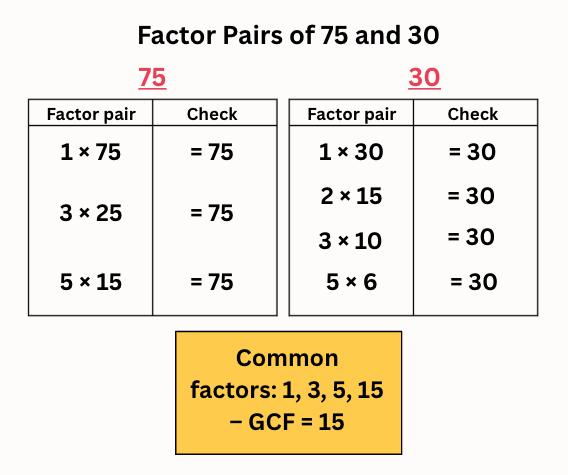
The most straightforward method is to list all factors of each number, identify the common factors, and pick the largest one.
How to list factors systematically
Use the factor pair method: starting from 1, find pairs of numbers that multiply to give the original number, working upward until the pairs start repeating.
For any number n, test each whole number from 1 up to the square root of n. Every time you find a factor, its pair is also a factor.
Example — GCF of 12 and 18 by listing factors
Factors of 12: 1, 2, 3, 4, 6, 12 Factors of 18: 1, 2, 3, 6, 9, 18
Common factors: 1, 2, 3, 6 GCF of 12 and 18 = 6
When to use this method
Listing factors works well for small numbers — anything under 50. For larger numbers the list becomes long and errors creep in. For AMC 8 problems involving numbers up to about 100, listing factors is reliable as long as you are systematic and do not skip any.
Method two — prime factorisation
Prime factorisation is the most versatile method and the one most useful for AMC 8 competition math. It works reliably for numbers of any size and connects directly to other number theory concepts.
How to find GCF using prime factorisation
Step one: find the prime factorisation of each number by dividing repeatedly by the smallest prime that divides exactly.
Step two: identify the prime factors that appear in both factorisations.
Step three: for each shared prime factor, use the lowest exponent that appears in either factorisation.
Step four: multiply these together to get the GCF.
Example — GCF of 75 and 30 using prime factorisation
This is one of the most commonly searched GCF problems and a good illustration of the method.
Prime factorisation of 75:
75 divided by 3 = 25
25 divided by 5 = 5
5 divided by 5 = 1 75 = 3 x 5²
Prime factorisation of 30:
30 divided by 2 = 15
15 divided by 3 = 5
5 divided by 5 = 1
30 = 2 x 3 x 5
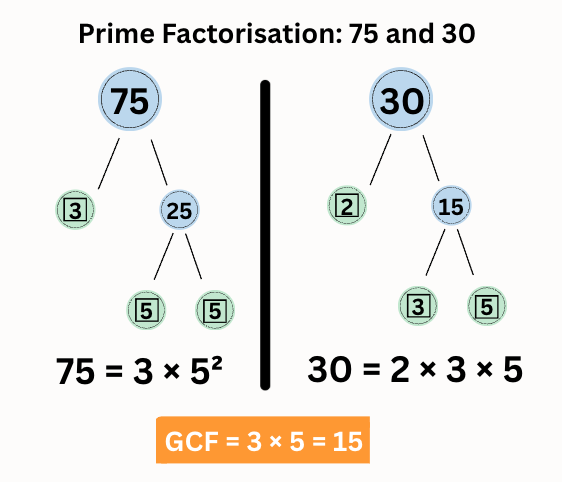
Shared prime factors: 3 and 5
Lowest exponent of 3: 3¹ (appears as 3¹ in both)
Lowest exponent of 5: 5¹ (appears as 5² in 75 and 5¹ in 30 — use the lower one)
GCF = 3 x 5 = 15
Verification: 75 divided by 15 = 5 exactly. 30 divided by 15 = 2 exactly. Both divide with no remainder, confirming the answer.
Example — GCF of 18 and 24 using prime factorisation
Prime factorisation of 18:
18 divided by 2 = 9
9 divided by 3 = 3
3 divided by 3 = 1
18 = 2 x 3²
Prime factorisation of 24:
24 divided by 2 = 12
12 divided by 2 = 6
6 divided by 2 = 3
3 divided by 3 = 1
24 = 2³ x 3
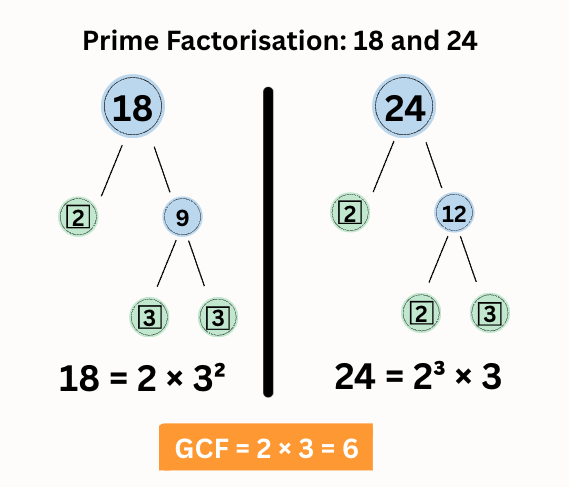
Shared prime factors: 2 and 3
Lowest exponent of 2: 2¹ (appears as 2¹ in 18 and 2³ in 24)
Lowest exponent of 3: 3¹ (appears as 3² in 18 and 3¹ in 24)
GCF = 2 x 3 = 6
Example — GCF of 24 and 36 using prime factorisation
Prime factorisation of 24: 2³ x 3
Prime factorisation of 36:
36 divided by 2 = 18
18 divided by 2 = 9
9 divided by 3 = 3
3 divided by 3 = 1
36 = 2² x 3²
Shared prime factors: 2 and 3
Lowest exponent of 2: 2² (appears as 2³ in 24 and 2² in 36)
Lowest exponent of 3: 3¹ (appears as 3¹ in 24 and 3² in 36)
GCF = 2² x 3 = 4 x 3 = 12
Example — GCF of 18 and 48 using prime factorisation
Prime factorisation of 18: 2 x 3² Prime factorisation of 48: 48 divided by 2 = 24 24 divided by 2 = 12 12 divided by 2 = 6 6 divided by 2 = 3 3 divided by 3 = 1 48 = 2⁴ x 3
Shared prime factors: 2 and 3 Lowest exponent of 2: 2¹ Lowest exponent of 3: 3¹
GCF = 2 x 3 = 6
Method three — the Euclidean algorithm
The Euclidean algorithm is the fastest method for finding the GCF of large numbers. It uses repeated division rather than factorisation and is particularly useful in AMC 10 and AMC 12 problems involving larger numbers.
How the Euclidean algorithm works
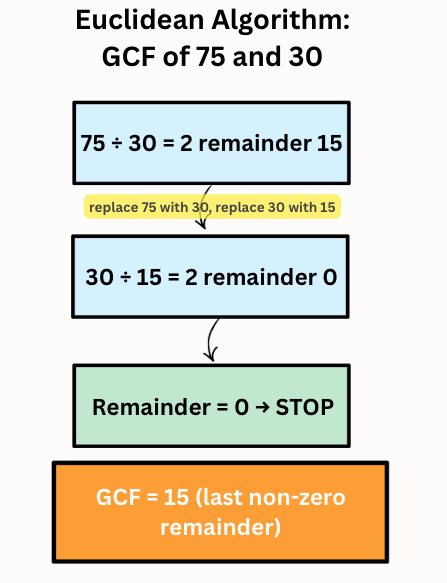
The algorithm is based on one key observation: the GCF of two numbers is the same as the GCF of the smaller number and the remainder when the larger number is divided by the smaller.
Keep applying this rule until the remainder is 0. The last non-zero remainder is the GCF.
Example — GCF of 75 and 30 using the Euclidean algorithm
75 divided by 30 = 2 remainder 15 30 divided by 15 = 2 remainder 0
The last non-zero remainder is 15. GCF of 75 and 30 = 15
This matches the answer found using prime factorisation above and is significantly faster for large numbers.
Example — GCF of 18 and 48 using the Euclidean algorithm
48 divided by 18 = 2 remainder 12 18 divided by 12 = 1 remainder 6 12 divided by 6 = 2 remainder 0
GCF of 18 and 48 = 6
Again matching the prime factorisation result.
Quick reference: GCF results for common number pairs
| GCF of | Answer | Method used |
|---|---|---|
| 75 and 30 | 15 | Prime factorisation: 3 x 5 |
| 18 and 24 | 6 | Prime factorisation: 2 x 3 |
| 24 and 36 | 12 | Prime factorisation: 2² x 3 |
| 18 and 48 | 6 | Prime factorisation: 2 x 3 |
| 12 and 18 | 6 | Listing factors |
| 30 and 45 | 15 | Prime factorisation: 3 x 5 |
| 36 and 48 | 12 | Prime factorisation: 2² x 3 |
| 24 and 60 | 12 | Prime factorisation: 2² x 3 |
GCF in AMC 8 problems — worked examples
Understanding the GCF method is only half the preparation. The other half is recognising when a problem is asking for the GCF even when the words “greatest common factor” do not appear directly.
AMC 8 example — direct GCF question
Problem type: What is the greatest common factor of 75 and 30?
Solution: Prime factorisation of 75 = 3 x 5²
Prime factorisation of 30 = 2 x 3 x 5
Shared factors at lowest exponent: 3¹ x 5¹ = 15
Answer: 15
Key insight: For a direct GCF question prime factorisation is the fastest and most reliable method. Students who try to find the GCF by guessing and checking often miss the correct answer or waste time. A systematic approach is always faster under competition conditions.
AMC 8 example — GCF disguised as an equal groups problem
Problem type: A teacher has 30 red pencils and 75 blue pencils. She wants to divide them into identical groups with no pencils left over, with each group containing the same number of red pencils and the same number of blue pencils. What is the largest number of groups she can make?
Solution: This is a GCF problem in disguise. The largest number of identical groups is the GCF of 30 and 75.
GCF of 30 and 75 = 15 (from the worked example above)
The teacher can make 15 groups, each with 2 red pencils (30 divided by 15) and 5 blue pencils (75 divided by 15).
Answer: 15 groups
Key insight: Word problems about dividing into equal groups with nothing left over are almost always GCF problems. The phrase “largest number of groups” or “largest possible group size” is a signal to find the GCF. Students who recognise this pattern in AMC 8 past papers solve these problems significantly faster than students who set up equations from scratch.
AMC 8 example — GCF in a geometry context
Problem type: A rectangular floor measures 24 cm by 36 cm. What is the side length of the largest square tile that can cover the floor exactly with no tiles cut?
Solution: The largest tile size that works is the GCF of the two dimensions.
GCF of 24 and 36:
Prime factorisation of 24 = 2³ x 3
Prime factorisation of 36 = 2² x 3²
Shared factors at lowest exponent: 2² x 3 = 12
The largest square tile has side length 12 cm.
Verification: 24 divided by 12 = 2 tiles across.
36 divided by 12 = 3 tiles down.
2 x 3 = 6 tiles total with no cuts needed.
Key insight: Tiling problems in the AMC 8 are GCF problems. The largest square that tiles a rectangle exactly has side length equal to the GCF of the two dimensions. This pattern appears across multiple years of AMC 8 past papers in slightly different forms. Students who have practised recognising it save significant time.
AMC 8 example — GCF with three numbers
Problem type: What is the greatest common factor of 18, 24, and 48?
Solution:
Prime factorisation of 18 = 2 x 3²
Prime factorisation of 24 = 2³ x 3
Prime factorisation of 48 = 2⁴ x 3
Shared prime factors across all three: 2 and 3
Lowest exponent of 2 across all three: 2¹
Lowest exponent of 3 across all three: 3¹
GCF = 2 x 3 = 6
Key insight: The prime factorisation method extends naturally to three or more numbers — just find the shared prime factors across all numbers and use the lowest exponent in each case. Listing factors becomes unwieldy with three numbers, which is why prime factorisation is the recommended method for competition math.
Curious about the AMC? Find out more at AMC Math: What It Is, How to Prepare & Why It Matters for University.

GCF and LCM — how they connect
The GCF and the least common multiple, or LCM, are closely related and often appear together in AMC 8 problems. Understanding how they connect deepens number theory understanding and helps with problems that ask for both.
The GCF times LCM relationship
For any two positive integers a and b, the following relationship always holds:
GCF(a, b) x LCM(a, b) = a x b
This means that once you know the GCF of two numbers you can find the LCM without listing multiples.
Example: GCF of 18 and 24 is 6. So LCM of 18 and 24 = (18 x 24) divided by 6 = 432 divided by 6 = 72.
Verification: Multiples of 18: 18, 36, 54, 72. Multiples of 24: 24, 48, 72. The first common multiple is 72. Confirmed.
When AMC problems use both GCF and LCM
Some AMC 8 problems give you the GCF and LCM of two numbers and ask you to find the numbers themselves, or give you one number and the GCF and ask for the other. The relationship above is the key to solving these problems efficiently.
For more on factors, read Factors of 24 and 45: How to Find All Factors AMC 8 Guide.
GCF worksheets and practice problems
Working through GCF problems systematically is the best way to build speed and accuracy. Here is a set of practice problems at increasing difficulty, followed by answers.
Basic GCF practice — listing factors method
- GCF of 12 and 18
- GCF of 20 and 30
- GCF of 15 and 25
- GCF of 16 and 24
- GCF of 14 and 21
Answers: 6, 10, 5, 8, 7
Intermediate GCF practice — prime factorisation method
- GCF of 75 and 30
- GCF of 18 and 48
- GCF of 24 and 36
- GCF of 45 and 60
- GCF of 36 and 84
Answers: 15, 6, 12, 15, 12
AMC-style GCF word problems
- A garden measures 18 metres by 24 metres. What is the side length of the largest square section that divides the garden exactly?
- Two cyclists complete a lap every 18 minutes and 24 minutes respectively. After how many minutes will they first be at the starting point together? (Hint: this is an LCM problem — use the GCF to find it.)
- A shop has 75 apples and 30 oranges. The owner wants to make identical fruit bags with no fruit left over, using as many bags as possible. How many bags can she make and what goes in each?
Answers:
- GCF of 18 and 24 = 6 metres
- LCM of 18 and 24 = (18 x 24) / GCF(18,24) = 432 / 6 = 72 minutes
- GCF of 75 and 30 = 15 bags, each with 5 apples and 2 oranges
Common mistakes when finding the GCF
Understanding where errors occur is as useful as knowing the correct method.
Using the highest exponent instead of the lowest in prime factorisation is the most frequent mistake. When finding the GCF, always use the lowest exponent of each shared prime factor — not the highest. The highest exponent is used when finding the LCM, not the GCF. Mixing these up produces an answer that is too large.
Missing a factor when listing is common when students do not use the factor pair method systematically. Starting from 1 and working upward in order prevents this, but students who jump around often skip factors.
Not checking the answer is an easy mistake to avoid. After finding the GCF, divide both original numbers by it and confirm both results are whole numbers. This takes five seconds and catches most errors.
Stopping at the first common factor rather than the greatest is a mistake students make when listing common factors. The GCF is the greatest of all the common factors, not just any common factor. If you identify 3 as a common factor of 18 and 24, check whether a larger common factor exists before writing down 3 as the answer.
Frequently Asked Questions
What is the GCF of 75 and 30?
The GCF of 75 and 30 is 15. Using prime factorisation: 75 = 3 x 5² and 30 = 2 x 3 x 5. The shared prime factors are 3 and 5, each at their lowest exponent. GCF = 3 x 5 = 15.
What is the GCF of 18 and 24?
The GCF of 18 and 24 is 6. Using prime factorisation: 18 = 2 x 3² and 24 = 2³ x 3. The shared prime factors are 2 and 3, each at their lowest exponent. GCF = 2 x 3 = 6.
What is the GCF of 24 and 36?
The GCF of 24 and 36 is 12. Using prime factorisation: 24 = 2³ x 3 and 36 = 2² x 3². The shared prime factors are 2 and 3. Using lowest exponents: 2² x 3 = 12.
What is the GCF of 18 and 48?
The GCF of 18 and 48 is 6. Using prime factorisation: 18 = 2 x 3² and 48 = 2⁴ x 3. The shared prime factors are 2 and 3, each at exponent 1. GCF = 2 x 3 = 6.
What is the GCF of 12 and 18?
The GCF of 12 and 18 is 6. Factors of 12 are 1, 2, 3, 4, 6, 12. Factors of 18 are 1, 2, 3, 6, 9, 18. The common factors are 1, 2, 3, and 6, and the greatest is 6.
How do you find the GCF?
There are three methods. Listing factors: write out all factors of each number, find the common ones, pick the largest. Prime factorisation: find the prime factorisation of each number, identify shared prime factors, multiply them together using the lowest exponent for each. Euclidean algorithm: divide the larger number by the smaller, replace the larger with the smaller and the smaller with the remainder, repeat until the remainder is 0 — the last non-zero remainder is the GCF.
What is the difference between GCF and LCM?
The GCF is the largest number that divides into both numbers exactly. The LCM is the smallest number that both numbers divide into exactly. For any two numbers a and b, GCF x LCM = a x b. They are related concepts and often appear together in AMC 8 number theory problems.
How does GCF appear in AMC 8 problems?
GCF appears directly in questions asking for the greatest common factor of two numbers, and indirectly in word problems about dividing quantities into equal groups, finding the largest tile that covers a floor, or simplifying fractions. Recognising these disguised GCF problems is one of the most valuable skills for AMC 8 preparation.