The EQAO Grade 3 assessment is most Ontario families’ first encounter with standardised testing — and for many parents, that’s a stressful prospect. Will my 8-year-old be okay? What if they freeze on test day? What does a “level” actually mean? Take a breath. The Grade 3 EQAO is a low-stakes diagnostic, not a high-pressure exam. It doesn’t appear on the report card, doesn’t affect Grade 4 placement, and is written over multiple short sittings in your child’s regular classroom with their regular teacher. This complete guide walks Ontario parents through exactly what the assessment covers in EQAO Grade 3 math and language, when it’s written, how it’s scored, where to find the official EQAO Grade 3 practice test, how to interpret EQAO Grade 3 results, and how to support your child without making the whole experience anxious. The right approach in Grade 3 isn’t cramming — it’s calm.
What is EQAO Grade 3?
EQAO stands for the Education Quality and Accountability Office, an independent agency of the Government of Ontario. It runs the province’s standardised assessments at four checkpoints: Grade 3, Grade 6, Grade 9, and the Grade 10 OSSLT (Ontario Secondary School Literacy Test).
The EQAO Grade 3 assessment is the first one your child will write — typically near the end of their Grade 3 year. It tests both mathematics and language (reading and writing), is administered by your child’s classroom teacher, and is designed to measure whether students have met the Ontario primary curriculum expectations. The results give parents, schools, and the province a snapshot of student achievement at the end of the primary division (Kindergarten through Grade 3).
Why does Grade 3 EQAO exist?
EQAO was created in 1996 to provide independent, province-wide data on student achievement. The Grade 3 assessment specifically helps identify whether students are ready for the junior division (Grades 4–6), where the curriculum starts to expect more independent reading and longer math problems.
For parents, the Grade 3 result is the first third-party check on whether your child is meeting curriculum expectations. It doesn’t replace what the classroom teacher tells you — but it gives a useful independent signal that doesn’t depend on individual teacher standards.
Who writes EQAO Grade 3?
Every Grade 3 student in Ontario’s publicly funded English and French school boards is expected to write the assessment. This includes:
- Students in regular classes
- Students in French immersion and extended French
- Most students in special education programs (with accommodations)
- Students in alternative learning environments under publicly funded boards
Students in private schools do not write EQAO unless their school opts in. Most private schools don’t.
Students with significant learning needs may be exempt or may write with accommodations such as extra time, a scribe, assistive technology, or extra breaks. These accommodations are arranged through the school’s special education team well before the testing window opens.
Is Grade 3 EQAO a “test”?
Officially, EQAO calls it an “assessment,” not a “test” — and the distinction matters at the Grade 3 level. The format is intentionally less stressful than a typical school test:
- It’s spread across multiple short sittings, not one long sitting
- Your child takes it in their regular classroom with their regular teacher
- There are breaks built in
- The questions look similar to schoolwork they’ve already done all year
- There’s no announcement of individual scores in class
If you’ve been worrying about an exam-style experience, that’s not what Grade 3 EQAO is.
When is the EQAO Grade 3 written?
The Grade 3 EQAO is written in late May or early June each year, near the end of the school year. EQAO publishes a testing window of several weeks, and each school chooses specific dates within that window.
Key Grade 3 EQAO dates
| Item | Typical timing |
|---|---|
| Testing window opens | Mid-May |
| Most schools’ testing days | Late May to early June |
| Testing window closes | Mid-June |
| Schools confirm specific dates with parents | 2–3 weeks before |
| Results released to schools | October–November of the following school year |
| School-level results published publicly | Fall, on the EQAO website |
Your child’s teacher will send a note home a few weeks before with the exact dates.
How long does Grade 3 EQAO take?
Roughly 2.5 to 3 hours of testing time, spread across multiple short sittings over one or two school days. Each sitting is typically 30–45 minutes, separated by breaks or normal class activities. Your child will never sit through anything close to 3 hours straight.
The breakdown is usually:
- Two math sittings of about 30–40 minutes each
- One or two language sittings totalling about 90 minutes (split between reading and writing)
Schools have flexibility in scheduling. Some run both math sittings on the same day; some spread the whole assessment across three or four days. Either approach is fine.
What does the EQAO Grade 3 assessment cover?
The assessment has two main parts: mathematics and language. Each is built directly on the Ontario primary curriculum.
EQAO Grade 3 math content
The math section tests four strands from the Ontario Grade 3 mathematics curriculum:
| Strand | What it covers |
|---|---|
| Number | Counting, place value (up to 1,000), addition, subtraction, basic multiplication and division, simple fractions |
| Algebra | Patterns (number patterns, shape patterns), simple equations, early variable thinking |
| Data | Reading simple graphs (bar graphs, pictographs), basic probability (likely vs unlikely) |
| Spatial sense | Geometry (2D shapes, 3D solids), measurement (length, area, time, money) |
The math section also tests financial literacy (basic money concepts: counting coins and bills, making change) and social-emotional learning through math thinking — though these are typically embedded across the other strands rather than appearing as standalone questions.
Questions test both can you do this (procedural fluency) and do you know when to do this (conceptual understanding). For example, a number question might ask for 47 + 28 (procedural), while a different question might give a story about buying snacks and ask the student to figure out which operation to use (conceptual).
Most heavily tested Grade 3 math topics
Across recent EQAO Grade 3 assessments, certain topics appear in almost every paper:
Addition and subtraction within 1,000. Multi-digit, often with regrouping (carrying or borrowing). This is the single largest source of lost marks at Grade 3.
Basic multiplication and division. Times tables up to 10 × 10, and simple division problems. Students who know their times tables cold have a significant advantage.
Place value. Understanding what each digit in a number represents — the 4 in 248 means 4 tens, the 2 means 2 hundreds. This underpins almost every other math skill.
Simple fractions. Recognising halves, thirds, and quarters in pictures and number lines. Comparing simple fractions (which is bigger, 1/2 or 1/4?).
Reading data. Pulling specific information from a bar graph or pictograph, then sometimes using it in a follow-up question.
Measurement. Telling time on an analog clock to the nearest 5 minutes. Calculating elapsed time. Identifying coins and bills, making change.
Geometry. Identifying 2D shapes (triangle, rectangle, hexagon) and 3D solids (cube, cylinder, cone). Describing them by their properties.
For a complete picture of what your Grade 3 child should know in math, our Ontario Math Curriculum guide for Grades 1–8 covers the full sequence.
EQAO Grade 3 language content
The language section tests two areas:
Reading. Students read short passages — both fiction (a short story) and non-fiction (an information text) — and answer questions about them. The skills tested are: finding specific information in the text, identifying the main idea, understanding vocabulary in context, and making simple inferences.
Writing. Students write short responses to prompts. At Grade 3, this is usually a paragraph or two about a personal experience or an opinion on a familiar topic. Responses are marked on clarity, organisation, spelling, grammar, and whether the student stays on topic.
The reading section uses passages roughly equivalent in difficulty to what an end-of-Grade-3 student should comfortably read. The writing section asks for one or two responses of about half a page each.
Question types
The Grade 3 EQAO uses three question formats:
- Multiple choice — four-option questions, similar to a school quiz
- Open response — students write or type a short answer
- Drag-and-drop / interactive — students match items, order steps, fill in diagrams (since the assessment is computer-based)
Students have access to a manipulative kit in person and/or on-screen tools for the math section, depending on what the school provides. They also have a reference card with basic information (place value chart, sample shapes).
Is Grade 3 EQAO on paper or computer?
As of recent years, the Grade 3 EQAO is computer-based — students complete it on a school laptop or tablet using the EQAO platform. Some schools may still offer a paper option for students who would struggle significantly with the digital interface, but the default is now digital.
Your child should be familiar with using a mouse, keyboard, or touchscreen before test day. Schools usually run short practice sessions in the weeks leading up to the assessment so students know what to expect.
How is EQAO Grade 3 scored?
EQAO reports Grade 3 results on a four-level scale matched to the Ontario report card achievement levels.
The four EQAO achievement levels
| Level | Description | Approximate report card equivalent |
|---|---|---|
| Level 4 | Surpasses the provincial standard | A (80%+) |
| Level 3 | Meets the provincial standard | B (70–79%) |
| Level 2 | Approaching the provincial standard | C (60–69%) |
| Level 1 | Below the provincial standard | D (50–59%) |
| NE1 | Insufficient evidence | Below 50% |
The provincial standard is Level 3. EQAO and the Ontario Ministry of Education consider Level 3 the benchmark for a student who has met the Grade 3 curriculum expectations and is ready for Grade 4.
Does Grade 3 EQAO count toward report cards?
No. Unlike the Grade 9 EQAO, which counts as 10% of the final MTH1W mark, the Grade 3 EQAO result:
- Does not appear on the report card
- Does not affect Grade 4 placement
- Does not factor into French immersion continuation in most boards
- Does not affect later school decisions in any direct way
- Does not appear on the child’s permanent OSR (Ontario Student Record) as an evaluative mark
What it does do is provide an independent snapshot of your child’s progress. Some boards use Grade 3 results as one of several data points when identifying students who might benefit from extra support or enrichment. But no board uses it as the deciding factor for anything major.
What’s a good Grade 3 EQAO score?
Level 3 is the appropriate target for most students. It indicates your child has met curriculum expectations and is on track for Grade 4. The Ontario Ministry of Education’s stated goal is that 75% of students reach Level 3 or higher.
Honestly, at the Grade 3 level, parents shouldn’t fixate too much on Level 4 vs Level 3. The difference between an 8-year-old who scores Level 3 and one who scores Level 4 often comes down to attention span on test day as much as actual ability. Children develop at different rates in primary school, and Grade 3 results are a snapshot of one point in time, not a verdict on long-term ability.
How recent provincial Grade 3 results have looked
Across recent years, around 70% of Ontario Grade 3 students reach Level 3 or 4 in reading and writing, and around 60–65% reach Level 3 or 4 in math. The exact numbers shift year to year and are published openly on the EQAO website each fall.
Math has consistently been the weaker subject area at Grade 3, mirroring the pattern at Grade 6 and Grade 9. If your child is stronger in language than math, that pattern is provincially average and not unusual.
When do Grade 3 EQAO results come out?
Individual student results are released to schools in October or November of the following school year — about four to five months after the test was written. Parents receive a report through their school. School-level and board-level results are published publicly on the EQAO website at the same time.
The lag exists because EQAO needs time to mark the open-response questions (especially the writing section), verify all scores, and process the entire province’s data.
Where to find the official EQAO Grade 3 practice test
The best preparation resource is the one EQAO itself produces, because it uses the same computer-based interface and question style as the real assessment.
The official EQAO Grade 3 sample test
EQAO publishes a free, full-length EQAO Grade 3 practice test on eqao.com. It includes:
- A complete practice version of both math and language sections
- The same computer-based interface as the real assessment
- The same on-screen tools and reference materials
- All three question types: multiple choice, open response, and drag-and-drop
There’s no login, no fee, and no time limit on when you can use it. The platform works on most modern browsers — EQAO recommends Chrome or Edge on a laptop for the closest match to the real test environment.
Released items and PDF resources
EQAO also publishes:
- Individual released items with answer keys, organised by strand
- Framework documents that explain exactly what each strand tests and how it’s weighted
EQAO doesn’t publish the full Grade 3 practice test as a single downloadable PDF (the real assessment is computer-based, so the practice version mirrors that). However, individual past questions are available as PDFs. Several third-party tutoring organisations also publish unofficial Grade 3 practice tests in PDF format — quality varies, and anything pre-2020 was written for the old curriculum.
For a complete walkthrough of how to use practice tests effectively at the Grade 3 level — including PDF resources — we have a dedicated supporting blog on Grade 3 practice tests coming soon as part of this cluster.
How to support your Grade 3 child for EQAO
The biggest mistake parents make is treating Grade 3 EQAO like a high-stakes exam that needs intense preparation. It really, genuinely doesn’t. A calm, low-pressure approach in the few weeks before the assessment produces better results than a stressful sprint — and protects your child from developing test anxiety that could affect later, higher-stakes assessments.
A sensible 4-week approach
Weeks 1–2: Light diagnostic and familiarisation. Sit down together with the official EQAO Grade 3 sample test on the computer. Let your child explore the interface — clicking, dragging, scrolling — so the platform is familiar by test day. Walk through a few questions together casually, the way you’d help with homework.
Try one math section under loose timed conditions (30–40 minutes, but stop if they get tired or frustrated). The point isn’t a score; it’s a comfortable rehearsal.
Weeks 3–4: Light targeted work and confidence-building. If you noticed any topics your child struggled with during the diagnostic, do 10–15 minutes a day of targeted practice. The most common Grade 3 weak areas are:
- Multi-digit addition and subtraction with regrouping
- Times tables (especially 6, 7, 8, 9)
- Telling time on an analog clock
- Reading bar graphs and pictographs carefully
For reading and writing, the best practice is just reading. Have your child read aloud to you for 10 minutes a day from a book slightly above their comfort level, and discuss what they read. This builds comprehension faster than worksheet practice.
The week of the test: rest, not cramming. Make sure your child is sleeping well, eating breakfast, and feeling calm. Don’t introduce new material. Don’t drill. Don’t say “this is really important” or “you have to do well on this.” Treat the assessment day as a normal school day — because for your child, that’s exactly what it should be.
How to talk to your child about EQAO
This matters more at Grade 3 than at any other level. The way you frame the assessment will shape how your child feels about every standardised test for the rest of their school career.
Say things like:
- “It’s a chance to show what you’ve learned this year.”
- “Just do your best — and your best is good enough.”
- “Take your time, read carefully, and don’t worry about being perfect.”
Don’t say things like:
- “This is really important for your future.”
- “If you do well, you’ll get into the good Grade 4 class.”
- “If you don’t do well, we’ll have to work harder.”
The first set frames EQAO as a normal opportunity. The second set creates pressure that backfires — and worse, it teaches your child that their worth is tied to test scores. That’s a lesson that will hurt them in Grades 6, 9, 10, and beyond.
What if my child is nervous?
Mild nerves are normal and not a problem. Significant anxiety — refusing to talk about the test, stomach aches, crying — is a signal to back off entirely. Stop all “EQAO practice” at home, even if you’d planned more. Tell your child’s teacher about the anxiety so they can support your child on the day.
Children with significant anxiety can request accommodations through the school: extra breaks, a quieter testing environment, or the option to spread sittings out further. These are reasonable requests and schools generally accommodate them.
What happens after Grade 3 EQAO?
Grade 3 EQAO is the beginning of your child’s journey through Ontario standardised assessments, not the end. The skills tested at Grade 3 form the foundation for everything that follows.
The Ontario assessment timeline
| Grade | EQAO involvement |
|---|---|
| 3 | EQAO Grade 3 assessment (math and language) |
| 4 | No EQAO |
| 5 | No EQAO |
| 6 | EQAO Grade 6 assessment (math and language) |
| 7 | No EQAO |
| 8 | No EQAO |
| 9 | EQAO Grade 9 assessment (math only, counts toward MTH1W) |
| 10 | OSSLT (literacy only, graduation requirement) |
| 11–12 | No EQAO |
Grade 3 is the first of three elementary checkpoints. The foundation skills tested here — basic number sense, simple operations, place value, reading comprehension, written communication — are what every later assessment builds on.
How Grade 3 EQAO predicts later results
Strong Grade 3 EQAO performance correlates with later success in:
- Grade 6 EQAO (most Level 4 students at Grade 3 reach Level 3 or 4 at Grade 6)
- Grade 9 EQAO and high school math marks generally
- Reading and writing across all subjects in junior and intermediate school
This isn’t deterministic. Plenty of students who score Level 2 in Grade 3 catch up by Grade 6 with the right support. And plenty of Level 4 students at Grade 3 plateau if they’re not challenged. The correlation is real but it’s a tendency, not a verdict.
The most useful way to read a Grade 3 EQAO result is as a current diagnostic — what does your child know now, and what should they work on before Grade 4 — rather than as a prediction of their future.
Looking further ahead
For families thinking about long-term math development, strong Grade 3 foundations open up early math contest opportunities. Students who reach Level 4 in math at Grade 3 are often ready to write the Gauss Math Contest by Grade 7 or 8, and the AMC 8 shortly after.
But that’s a long way away. For now, focus on Grade 3 fundamentals.
How Think Academy Canada supports Grade 3 students
Think Academy is the international arm of TAL Education Group, one of the largest education companies in the world. Our Canadian programs are built around a carefully paced math curriculum, an online interactive platform designed specifically for primary-age learners, and gamified rewards that keep children engaged across the full school year rather than burning out in a six-week sprint.
For Grade 3 students preparing for EQAO and the transition to Grade 4:
Our curriculum runs ahead of the Ontario standard. Grade 3 students at Think Academy meet Grade 4 content before their school classmates do, which turns EQAO topics into review rather than new learning.
Our practice problem library includes hundreds of Ontario-curriculum-aligned questions written in EQAO question style, organised by strand and difficulty. Children can target the specific topics they find tricky rather than working through generic worksheets.
Our teachers mark every homework set personally, with feedback that’s age-appropriate and encouraging. Auto-graded software can tell a child they got a question wrong; it can’t celebrate small wins or explain a tricky concept the way a real teacher can.
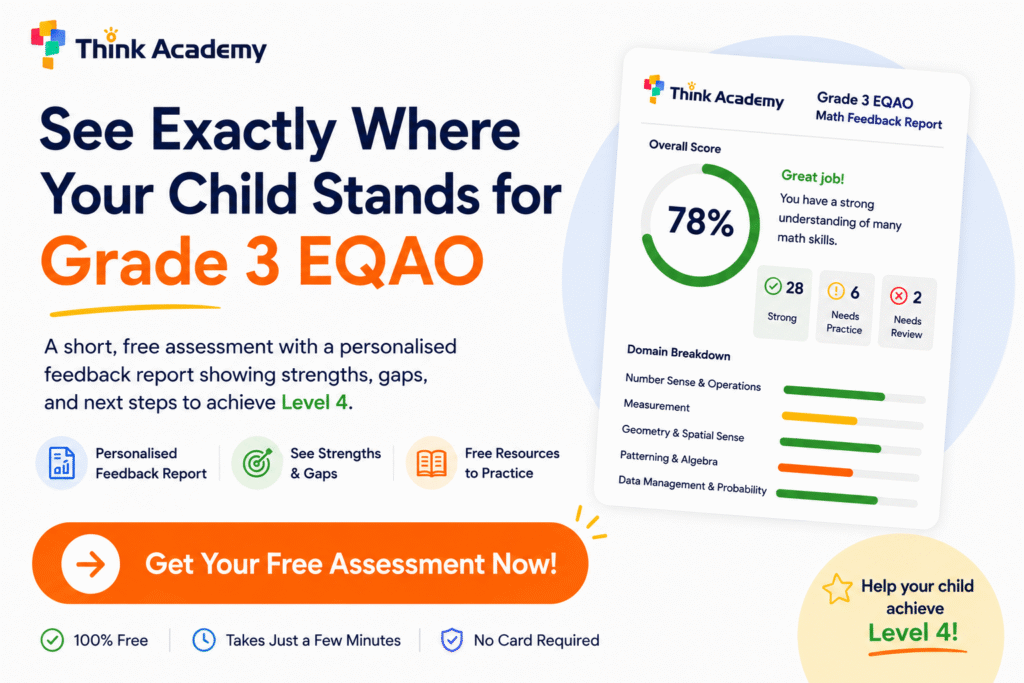
Our free Grade 3 math assessment is the fastest way to find out where your child stands. They complete a short online test aligned to the Ontario curriculum, and you get a detailed feedback report on strengths and gaps by topic, plus free practice resources tailored to their level. No commitment, no sales pressure — just a clear picture of where your child is.
Our gamified rewards keep children engaged through stickers, badges, and small in-app celebrations — the kinds of motivators that work for 8-year-olds. This matters at the Grade 3 level where attention spans are still building.
Frequently asked questions
What is the EQAO Grade 3 assessment?
The EQAO Grade 3 assessment is an Ontario province-wide test written by every Grade 3 student in publicly funded schools. It covers mathematics and language (reading and writing), takes around 2.5–3 hours across multiple short sittings, and measures whether students have met the Grade 3 curriculum expectations.
When is EQAO Grade 3 written?
In late May or early June each year, near the end of the school year. Each school chooses specific dates within the EQAO testing window. Your child’s teacher will confirm the exact dates 2–3 weeks before.
How long is EQAO Grade 3?
Around 2.5 to 3 hours of testing time total, spread across multiple short sittings of 30–45 minutes each. Your child will never sit through 3 hours straight.
Does Grade 3 EQAO count toward my child’s report card?
No. The Grade 3 EQAO result doesn’t appear on the report card, doesn’t affect Grade 4 placement, and doesn’t factor into French immersion continuation in most boards.
What does EQAO Grade 3 math cover?
The four strands of the Ontario Grade 3 math curriculum: Number (counting, place value, addition, subtraction, basic multiplication and division, simple fractions), Algebra (patterns, simple equations), Data (graphs, probability), and Spatial Sense (shapes, measurement). Financial literacy is embedded across these.
What does EQAO Grade 3 language cover?
Reading comprehension of short fiction and non-fiction passages, and short written responses to prompts (a paragraph or two about a personal experience or opinion on a familiar topic).
How is EQAO Grade 3 scored?
On a four-level scale. Level 3 meets the provincial standard, Level 4 surpasses it, Level 2 is approaching it, and Level 1 is below it. Level 3 corresponds roughly to a B grade on the report card.
What’s a good Grade 3 EQAO score?
Level 3 is the appropriate target for most students. But at age 8, parents shouldn’t fixate too much on the difference between Level 3 and Level 4 — children develop at different rates in primary school and Grade 3 is a snapshot, not a verdict.
When do EQAO Grade 3 results come out?
In October or November of the following school year, about four to five months after the assessment. Parents receive results through the school.
Where can I find an EQAO Grade 3 practice test?
The official EQAO Grade 3 practice test is free on eqao.com. It uses the same computer-based interface as the real assessment.
Can my child use tools or manipulatives during the math section?
Yes. EQAO provides on-screen tools and, in many schools, physical manipulative kits during the math section. Schools may also allow simple tools like rulers depending on the question.
Is Grade 3 EQAO on paper or computer?
Computer-based, in most cases. The Grade 3 EQAO is administered on school laptops or tablets through the EQAO platform. Some schools may offer a paper version for students who would struggle with the digital interface.
What if my child has a learning need or accommodation?
EQAO offers extra time, scribes, assistive technology, breaks during sittings, quieter testing environments, and exemptions for students with significant needs. These are arranged through your school’s special education team before the testing window.
Should I be worried if my child is anxious about EQAO?
Mild nerves are normal. Significant anxiety (refusing to talk about it, stomach aches, crying) is a signal to back off entirely and tell your child’s teacher. Children with significant anxiety can request accommodations and a more supportive testing environment.
Should I be worried if my child scores Level 2?
Pay attention but don’t panic. Level 2 indicates topic gaps that should be addressed before Grade 4. A summer of light, targeted support on the specific weak strands usually closes the gap before the new school year begins.
Will Grade 3 EQAO affect my child’s future?
Not in any direct sense. Grade 3 EQAO doesn’t appear on the report card, doesn’t follow your child to a new school, and doesn’t factor into any major academic decisions. It’s a diagnostic snapshot, not a permanent mark on their record.
Is the Grade 3 EQAO different from the Grade 6 EQAO?
Yes — Grade 6 is harder, broader, and longer. The Grade 6 curriculum covers more topics, the questions require more multi-step reasoning, and the writing section is more sophisticated. But the format is similar.
About Think Academy Canada
Think Academy Canada, part of TAL Education Group, supports K–12 students with structured math programs built around an online interactive platform, gamified learning, and teachers who personally mark every homework set. Our curriculum runs ahead of the provincial standards and is designed to prepare students for both school excellence and Canadian math competitions, including the Gauss, Pascal, Cayley, Fermat, and Euclid contests.