If you are stuck comparing day schools vs boarding schools, you are not alone. Many parents worry about the same things: Will my child be happy day to day? Will they feel safe and supported? Will our family rhythm survive the change? This guide breaks the decision into clear, practical factors you can verify on tours and in policies, so you can choose with confidence rather than pressure.
Intro: Why this choice feels so personal
In Canada, schooling is primarily governed by provinces and territories, so what you can access and what it costs may vary by location. However, the emotional questions stay similar everywhere: belonging, routine, and how much independence is appropriate for your child’s age.
Boarding is also less common for younger children, so families often consider it only after they have explored local public or private day options. For neutral background definitions, you can review what a boarding school is and how day schools are typically defined.
Day schools vs boarding schools: What actually changes for a child (4–12)
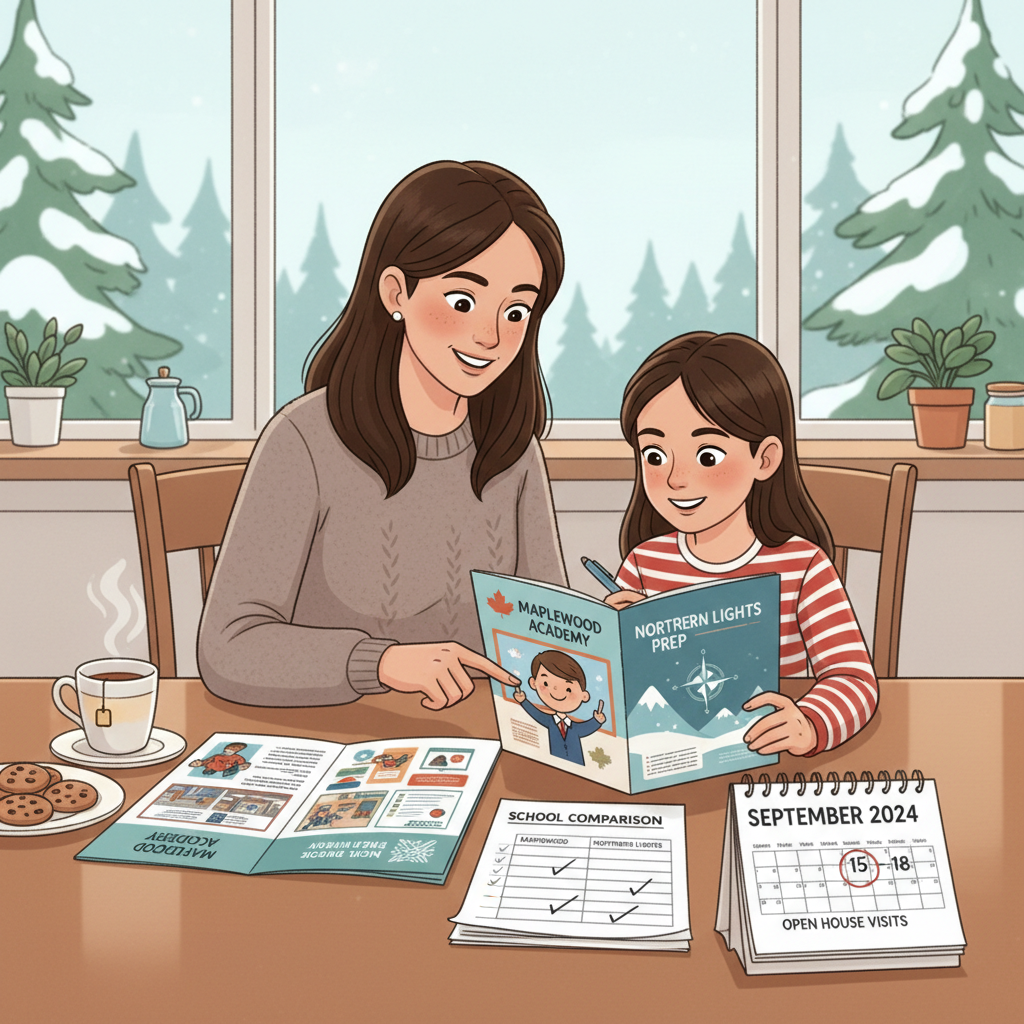
The biggest difference is not academics first, but daily life. A day student practices skills at school, then returns to their home environment each afternoon. A boarding student lives on campus for most of the week (or term), so school also becomes their primary living community.
For children aged 4–12, daily transitions matter. Therefore, you will want to look closely at routines, adult supervision, sleep, and how the school communicates with families.
Daily routine and family connection
Day programs usually allow more time with siblings, extended family, and community activities. However, they also require reliable transportation and consistent after-school supervision.
Boarding can reduce commuting stress, especially for families far from a strong-fit school. At the same time, it increases the importance of scheduled family contact, such as weekend visits or video calls, which you should confirm in writing.
Social life and belonging
In a day setting, friendships often form around classroom time plus extracurriculars. In a boarding setting, relationships can deepen through shared living, meals, and evenings. However, younger children may need more structured support to manage conflict, homesickness, or fatigue.
Ask how the school teaches social-emotional skills (skills for managing feelings, relationships, and decisions) and what adult support looks like after class hours.
Independence expectations
Many boarding schools emphasize independence: managing belongings, following schedules, and advocating for help. That can be a strength-building environment, yet it can also feel demanding for younger children who still rely on predictable family routines.
Therefore, focus less on what sounds impressive and more on what your child can realistically handle this year.
How Canadian school governance affects your options
Public education is funded and overseen provincially or territorially, while private schools operate under provincial rules but charge tuition. Some boarding schools are private, and some are affiliated with independent school associations.
Start by confirming your province’s basics for K–12 education through your ministry of education. For example, Ontario families can check the Ontario Ministry of Education, while families in British Columbia can refer to the BC Ministry of Education and Child Care K–12 hub.
If you are comparing independent schools, many are listed with membership organizations. For instance, you can browse the Canadian Accredited Independent Schools association to understand common accreditation expectations (accreditation means a school has been reviewed against defined standards).
A practical comparison table for parents
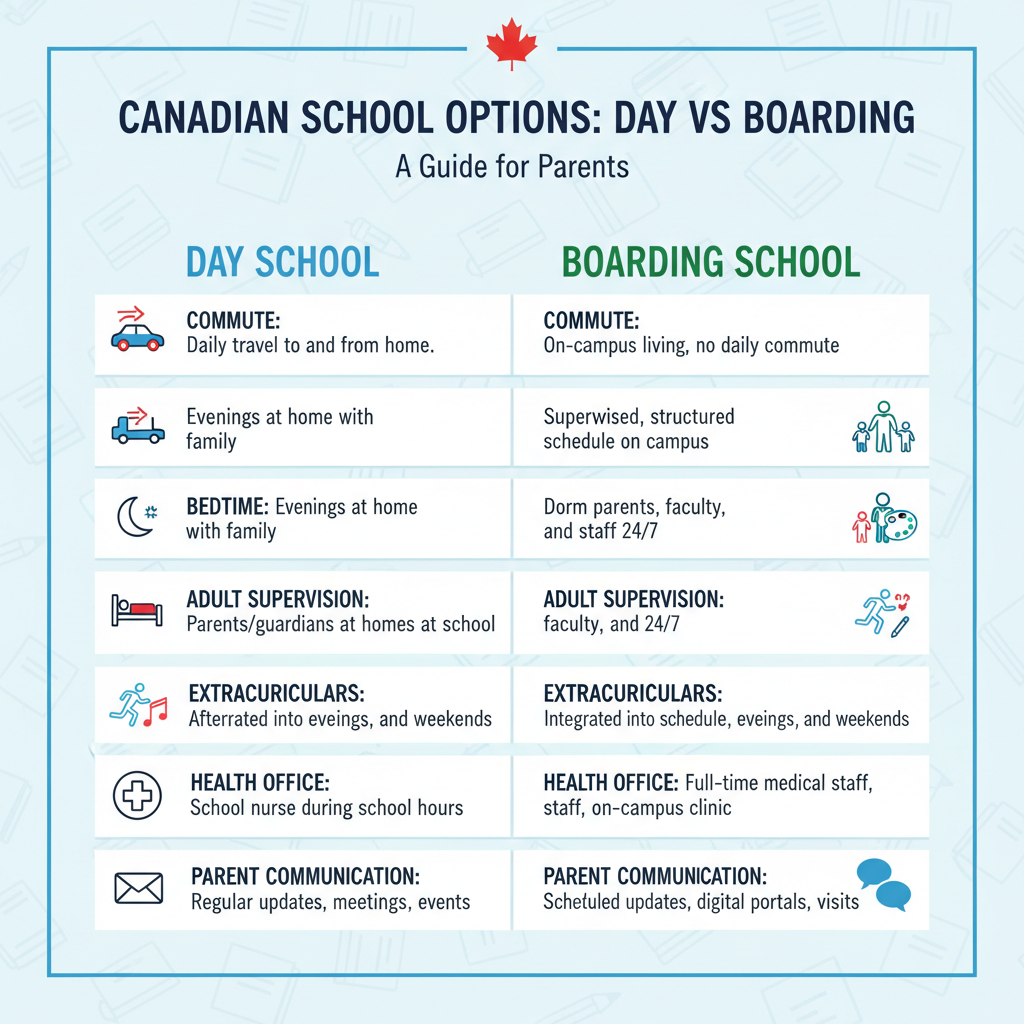
Use this table as a starting point, then verify each item with the specific school. Policies and services can vary widely, even within the same category.
| Decision factor | Day school: what to check | Boarding school: what to check |
|---|---|---|
| Cost and fees | Tuition (if private), transportation, after-school care, activity fees | Tuition plus room and board, travel home, weekend coverage, uniform and device fees |
| Supervision after class | After-school program ratios, pick-up rules, late pickup policies | Evening and overnight staffing, dorm routines, who handles illness at night |
| Communication with parents | Teacher contact norms, portals, frequency of updates | Scheduled calls, dorm updates, how behaviour and health concerns are shared |
| Health supports | Medication handling at school, sick-day process, allergies policy | On-site health office hours, medication storage, local clinic access, emergency transport plan |
| Learning support (general) | Homework expectations, class size, enrichment options | Study hall (supervised study time), tutoring access, screen-time rules in residence |
| Child temperament fit | Best for children who recharge at home and need family closeness | Best for children who enjoy structure, community living, and predictable routines |
Admissions and what you can verify without guessing
Admissions processes vary, so avoid assumptions based on reputation alone. Instead, ask for documents you can read: handbooks, fee schedules, and student support policies. Many schools also share a parent and student handbook on request.
When a school describes outcomes, ask what evidence they use. For example, do they share curriculum expectations from your province, or provide a clear outline of assessment (assessment means how learning is measured, such as projects, tests, and teacher observations)?
Questions to ask on tours (copy-and-use)
- What does a normal weekday look like for a child in this grade?
- How much homework is typical, and how is it supported at home or in residence?
- Who supervises children during transitions: arrival, lunch, after school, evenings?
- How do you handle conflicts between students, and how quickly are parents informed?
- What is your sick policy, and who contacts parents if my child feels unwell?
- What are the rules for devices and screen time?
- What does parent-school communication look like in the first 60 days?
Common parent concerns, answered with practical next steps
Parents often worry that choosing wrong could “set back” their child socially or academically. However, most children do well when adults match the environment to the child’s needs and then monitor the fit.
Concern: “Will my child fall behind academically?”
For ages 4–12, consistency matters more than intensity. Therefore, ask how teachers coordinate learning goals, how progress is reported, and how often you can meet to adjust plans.
In publicly funded systems, you can also review general provincial expectations so you know what “on track” typically means. A practical starting point is your provincial curriculum hub, such as the Ontario curriculum and policy library.
Concern: “What about safety and supervision?”
Do not rely on vibes. Ask for written supervision policies, staff roles, and how the school trains staff for health and safety situations. For boarding, specifically ask who is present overnight and how emergencies are handled.
You can also review Canada’s general guidance on child care and safety standards as background context through the Public Health Agency of Canada child health hub, then compare it with the school’s procedures.
Concern: “Will my child get homesick?”
Homesickness is common in new settings, especially with big routine changes. However, it often improves when children have predictable contact with family and caring adults who coach coping strategies (simple steps to handle big feelings).
Ask the school exactly how they support transitions in the first weeks, and how they respond if a child asks to come home.
Tools and resources you can use right now
These reputable tools can help you compare options and organize your decision. Use them to gather facts, document questions, and reduce decision fatigue.
- Government of Canada education benefits and services (helpful for understanding broad supports and family planning)
- SchoolFinder (Canadian school directory for exploring programs and locations)
- Canadian Accredited Independent Schools (accreditation standards and member school directory)
- Ontario curriculum and policy library (official curriculum reference, if you are in Ontario)
- myBlueprint (planning tool commonly used in Canadian schools; availability varies by district)
Concluding Paragraph
When you compare day schools vs boarding schools, the best choice is the one that matches your child’s daily needs, your family logistics, and the support systems you can verify in writing. Focus on routines, adult supervision, communication, and realistic independence expectations for ages 4–12. If you tour with a checklist and request clear policies, you can make a confident decision and adjust if your child’s needs change over time.
About Think Academy
Think Academy, part of TAL Education Group, helps K–12 students succeed in school today by building strong math foundations and critical thinking skills. At the same time, we focus on the bigger picture—developing learning ability, curiosity, and healthy study habits that inspire a lifelong love of learning. With expert teachers, proven methods, and innovative AI tools, we support every child’s journey from classroom confidence to long-term growth.