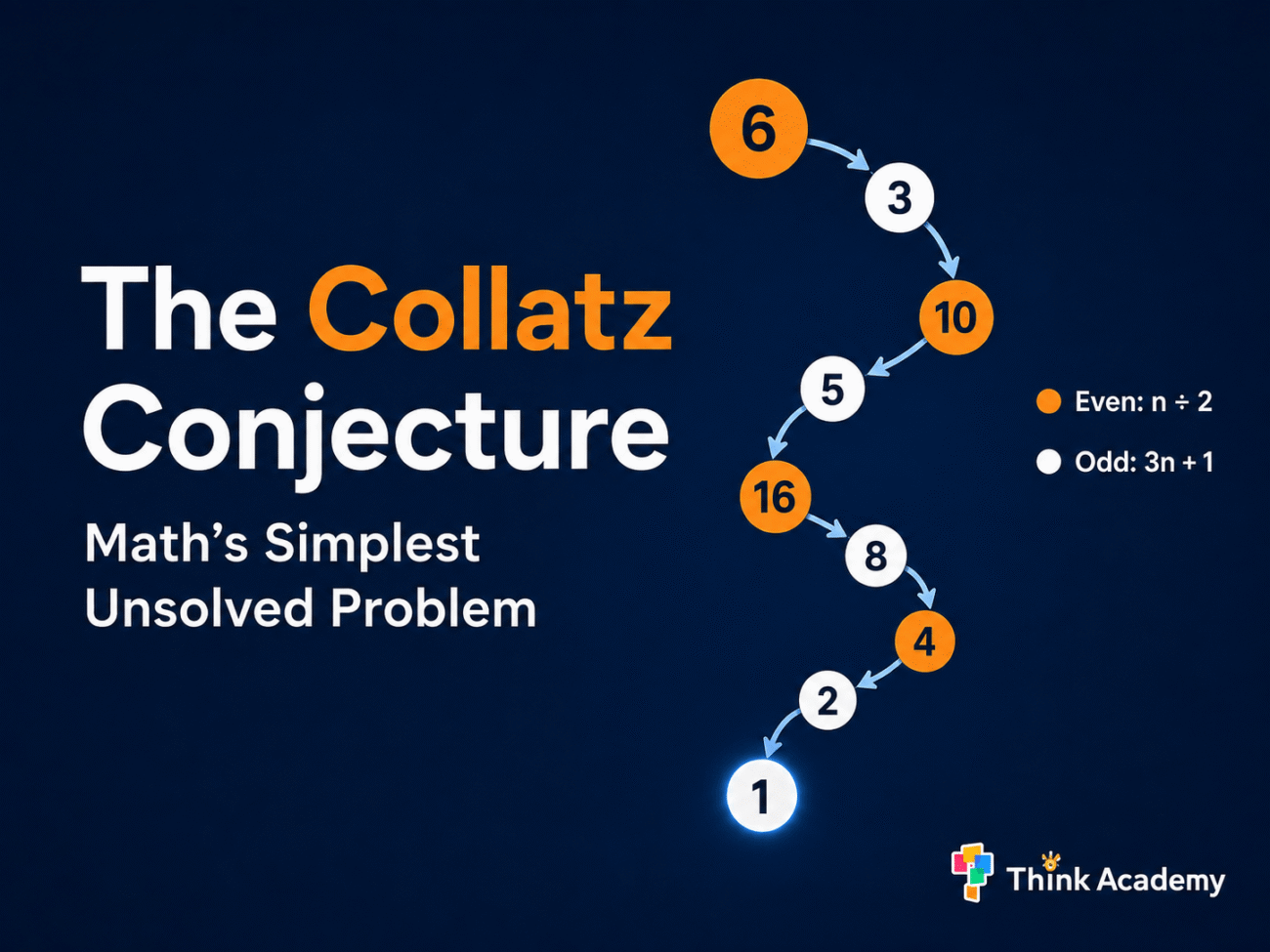
Pick any positive integer. If it is even, divide it by 2. If it is odd, multiply it by 3 and add 1. Repeat. The Collatz conjecture — also known as the Collatz problem, the 3n+1 problem, or the Syracuse problem — claims that no matter which positive integer you start with, this process will always eventually reach 1.
Try it with 6: 6 → 3 → 10 → 5 → 16 → 8 → 4 → 2 → 1. ✓
Try it with 27: the sequence takes 111 steps, reaching a peak of 9,232 before finally descending to 1.
Try it with any number you like. It will reach 1. Every number ever checked does. No one has ever found a counterexample. And no one has proved it must always happen.
The Collatz problem has been open since 1937. It is, by general consensus, the simplest statement of an unsolved mathematical problem in existence.
What Is the Collatz Problem?
The rule:
Define a function f on positive integers:f(n)={n/23n+1if n is evenif n is odd
The conjecture: For every positive integer n, repeatedly applying f will eventually produce the value 1.
Once you reach 1, the sequence cycles: 1 → 4 → 2 → 1 → 4 → 2 → 1 → … forever. So “reaching 1” is the natural stopping condition.
Terminology:
- The Collatz sequence starting from n is the sequence n,f(n),f(f(n)),… until 1 is reached
- The stopping time (or total stopping time) of n is the number of steps needed to reach 1
- The peak value of a Collatz sequence is the highest number reached before the sequence descends to 1
The Collatz Problem in Action
Small starting values:
| Start | Sequence | Steps to reach 1 |
|---|---|---|
| 1 | 1 | 0 |
| 2 | 2 → 1 | 1 |
| 3 | 3 → 10 → 5 → 16 → 8 → 4 → 2 → 1 | 7 |
| 4 | 4 → 2 → 1 | 2 |
| 5 | 5 → 16 → 8 → 4 → 2 → 1 | 5 |
| 6 | 6 → 3 → 10 → 5 → 16 → 8 → 4 → 2 → 1 | 8 |
| 7 | 7 → 22 → 11 → 34 → 17 → 52 → 26 → 13 → 40 → 20 → 10 → 5 → 16 → 8 → 4 → 2 → 1 | 16 |
The famous case of 27:
Starting from 27, the Collatz sequence takes 111 steps and reaches a maximum value of 9,232 — more than 340 times the starting value — before eventually descending to 1.
This is what makes the Collatz problem feel unreliable: a small number can have a very long, very wild sequence before settling. There is no obvious reason why 27 should behave so differently from 26 (which reaches 1 in only 10 steps).
Computational verification:
The Collatz conjecture has been verified by computer for all positive integers up to at least 268 — a number with 20 digits. That is an almost incomprehensibly large amount of checking. Every single starting value, up to numbers that dwarf anything in everyday experience, eventually reaches 1.
And yet: this is not a proof.

Strong mathematical thinking goes beyond finding a pattern—it means questioning whether that pattern must always hold. A free math assessment helps identify your child’s current problem-solving foundations and includes a personalised written feedback report.
Start the free math assessment →
Why Is the Collatz Problem So Hard to Prove?
The Collatz problem looks like it should be easy. The rule is simple. The answer (every number reaches 1) seems obvious from experiment. Why can’t mathematicians prove it?
The problem is genuinely deep, not just difficult.
The Collatz sequence is unpredictable in a fundamental way. Given a starting value n, there is no known formula that tells you how many steps it will take, what the peak value will be, or what the sequence will look like along the way. The sequence can jump up dramatically (as with 27) or descend quickly (as with powers of 2). Small differences in starting value produce wildly different behaviours.
Standard proof techniques don’t apply.
Most proofs in number theory work by exploiting structure — divisibility, modular arithmetic, algebraic relationships. The Collatz sequence has a strange hybrid structure: it alternates between division (for even numbers) and a linear transformation (for odd numbers), and the interplay between these two operations is extraordinarily difficult to control analytically.
It may require entirely new mathematics.
Paul Erdős, one of the most prolific mathematicians of the 20th century and famous for working on hard problems, said of the Collatz conjecture: “Mathematics is not yet ready for such problems.” This is not a statement of pessimism — it is a statement about where the proof would need to come from. There is no existing technique that looks like it could settle the question.
The problem might be undecidable.
This is a more unsettling possibility: it may be that the Collatz conjecture is true but cannot be proved — that it is a true statement in arithmetic that falls outside the reach of any formal mathematical proof system. This would not mean mathematics is broken; it would be a consequence of Gödel’s incompleteness theorems, which guarantee that any sufficiently powerful formal system contains true statements it cannot prove. Most mathematicians believe the Collatz conjecture is provable in principle — but the undecidability possibility cannot be fully ruled out.
What Has Been Proved?
Almost nothing — and this itself is informative.
What we know:
- The conjecture holds for all positive integers up to at least 268 (computational verification)
- Almost all positive integers (in a precise density sense) have finite stopping time — but “almost all” is not “all,” and that gap is the entire problem
- The average behaviour of Collatz sequences is well understood probabilistically — the sequence tends to decrease by a factor of roughly (3/4)1/k per step in the long run — but probabilistic arguments cannot substitute for a proof
- There is no counterexample with a loop other than 1 → 4 → 2 → 1, up to very large bounds
The 2019 result by Terence Tao:
In 2019, Fields Medal winner Terence Tao (widely considered one of the greatest living mathematicians) proved that the Collatz conjecture holds for “almost all” positive integers in a technically precise sense — the density of integers that might not eventually reach 1 is essentially zero. This was a landmark result and the most significant progress on the Collatz problem in decades.
But “almost all” is still not “all.” Tao’s result does not rule out the possibility of a single exotic counterexample somewhere in the infinite integers. The conjecture remains open.
A Brief History
1937: Lothar Collatz, a German mathematician, introduced the problem. He is said to have circulated it informally at mathematical conferences before publishing it — which is why the exact origin is somewhat murky.
1950s–1970s: The problem spread through the mathematical community. Various names attached to it: the Syracuse problem, the 3n+1 problem, the Ulam conjecture. Computers allowed verification for increasing ranges of starting values.
1983: Richard Guy, in his famous book Unsolved Problems in Number Theory, included the Collatz conjecture and noted that it was “extraordinarily difficult” and “hopeless to attack.”
1985: The problem was popularised for a general audience when it was attributed — incorrectly — to a fictional character in a novel, causing a minor wave of amateur mathematical interest.
2019: Terence Tao’s partial result (described above) — the most significant theoretical progress to date.
Present: The conjecture remains open. No counterexample has been found. No proof exists.
The Collatz Problem and Mathematical Thinking
The Collatz problem is not just an unsolved question — it is a lesson in what mathematics is and is not.
Experiment is not proof.
Checking the conjecture for 268 starting values is a remarkable computational achievement. It is not mathematics in the proof sense. The integers are infinite, and no amount of finite checking can rule out a counterexample arbitrarily far along the number line. This is the same lesson as the Goldbach conjecture: the gap between “verified for a huge number of cases” and “proved for all cases” is unbridgeable by computation alone.
For more on this theme, see our Goldbach conjecture guide.
Simple rules can produce incomprehensible complexity.
The Collatz sequence is defined by two rules that a primary school student could apply. Yet the behaviour it produces — the wild oscillations of the sequence starting from 27, the unpredictability of stopping times — is beyond the reach of the most sophisticated mathematical tools available. This is a genuinely surprising fact about mathematics. Simplicity of definition does not imply simplicity of behaviour.
Open problems are invitations, not embarrassments.
The existence of an unsolved problem as simple as the Collatz conjecture is sometimes presented as a failure of mathematics. It is the opposite. It is evidence that mathematics is genuinely deep — that simple questions can point toward territory where human understanding has not yet reached. Every mathematician who has spent time on the Collatz problem has learned something, even without proving the conjecture.
Try It Yourself: The Collatz Problem as Mathematical Play
The Collatz problem is one of the very few unsolved mathematical problems where anyone — with no training beyond basic arithmetic — can engage with the actual question.
Things worth trying:
- Start from different numbers and count the steps to reach 1. Which numbers under 100 take the most steps? (Answer: 97, which takes 118 steps.)
- Find a number that reaches a higher peak than 27 before coming back down. (Try 703, which reaches 250,504.)
- Look at all starting values from 1 to 20 and graph their stopping times. What pattern do you notice? (There isn’t a clean one — and that’s the point.)
- Try to predict, before computing, whether a number will have a long sequence or a short one. (You’ll find you can’t — the behaviour is essentially unpredictable.)
- Notice what happens with powers of 2: 2, 4, 8, 16, 32, … (They always reach 1 very quickly — dividing by 2 repeatedly. Powers of 2 are the “easy” starting points.)
None of this exploration will prove the conjecture. It will give you a concrete sense of why the problem is both simple and hopeless — which is exactly what mathematicians feel when they work on it.

Curiosity is a strong starting point. Find out how your child currently approaches unfamiliar patterns, number relationships and multi-step problems—and receive personalised feedback on what to develop next.
Get a free assessment and feedback report →
Where the Collatz Problem Connects to Competition Mathematics
The Collatz conjecture itself will never appear as a competition problem — it is unsolved, so it cannot be assigned as an exercise. But the mathematical ideas surrounding it are deeply connected to competition mathematics.
Modular arithmetic and parity arguments — the core tools mathematicians use to study the Collatz sequence — are foundational to number theory problems at every competition level from the Gauss Contest through the Euclid Contest and CMO.
Recursive sequences — sequences defined by applying a rule repeatedly to the previous term — appear in the CEMC contests, the AMC series, and olympiad mathematics. Understanding how a sequence behaves under repeated application of a rule is exactly the kind of thinking the Collatz problem develops.
Proof techniques — the question of what it would even mean to prove the Collatz conjecture involves mathematical induction, proof by contradiction, and the limits of formal proof systems. These are the techniques tested at the senior competition level. See our math induction proof guide and proof by contradiction guide.
The mathematical culture that produces competition mathematicians is exactly the culture that produces the people who work on problems like the Collatz conjecture — people who find genuinely hard questions interesting rather than discouraging. If your child finds the Collatz problem fascinating — the way something so simple can be so completely out of reach — that instinct is worth cultivating. Think Academy’s competition mathematics programmes develop exactly this kind of mathematical depth. Find out what structured competition training looks like →
Frequently Asked Questions
What is the Collatz problem? Start with any positive integer. If even, divide by 2. If odd, multiply by 3 and add 1. Repeat. The Collatz conjecture states that this process always eventually reaches 1, regardless of the starting value. It has been verified computationally for an enormous range of numbers but remains unproved.
Has the Collatz conjecture been solved? No. It remains one of the most famous open problems in mathematics. Terence Tao proved in 2019 that “almost all” positive integers eventually reach 1 in a precise technical sense, but the full conjecture remains open.
Why is the Collatz problem so hard? The sequence is fundamentally unpredictable — small differences in starting value produce wildly different behaviour. Standard proof techniques in number theory do not apply well to the hybrid structure of the Collatz rule (alternating division and linear transformation). Paul Erdős said “mathematics is not yet ready for such problems.”
What is the Collatz sequence for 27? Starting from 27, the sequence takes 111 steps and reaches a maximum value of 9,232 before descending to 1. This is one of the most commonly cited examples of a small starting value producing a surprisingly long and wild sequence.
Who discovered the Collatz conjecture? Lothar Collatz, a German mathematician, introduced the problem around 1937. It has since been called the Syracuse problem, the 3n+1 problem, and the Ulam conjecture, among other names.
What did Terence Tao prove about the Collatz problem? In 2019, Tao proved that the set of integers that do not eventually reach 1 under the Collatz rule has “logarithmic density zero” — essentially, that almost all positive integers satisfy the conjecture. This was the most significant theoretical progress on the problem in decades, but it does not constitute a proof of the full conjecture.
Is the Collatz problem related to any competition mathematics? Not directly — the conjecture is unsolved and cannot be set as a competition problem. But the surrounding ideas — modular arithmetic, recursive sequences, proof by induction and contradiction — are central to competition mathematics at every level.
See our related guides: Goldbach conjecture guide · math induction proof guide · proof by contradiction guide · Fermat’s Little Theorem guide · Leonhard Euler mathematician guide · Canadian Mathematical Olympiad guide · Euclid math contest guide · Gauss math contest guide · math enrichment guide

The ideas surrounding Collatz—parity, recursive sequences and proof—appear throughout competition mathematics. Experience how Think Academy helps curious students turn interesting observations into structured mathematical reasoning.