
If you’re researching online math tutoring for your child, you are probably in one of three situations: your child is falling behind and school support isn’t enough; your child is doing fine but you want them to go further; or you’re not sure which of those two it is and you want a clear picture before deciding what to do.
All three lead to the same first step — and this guide covers it all: what online math tutoring actually looks like, how to evaluate it, what results to expect, and how Think Academy specifically approaches it.
What Is Online Math Tutoring?
Online math tutoring is one-to-one or small-group mathematics instruction delivered remotely through video, interactive whiteboards, and shared digital tools. The best online tutoring is indistinguishable from an in-person lesson in terms of instructional quality — the medium is different, the mathematics is the same.
What online tutoring is not: a video course a student watches alone, a worksheet platform, or an app that generates practice problems. These tools have their place, but they are not tutoring. Tutoring means a qualified instructor who assesses, explains, corrects, and adapts to a specific student in real time. The presence of a human instructor is what makes it work.
Online math tutoring has become the default for many Canadian families — particularly since 2020 — because it removes geographical constraints entirely. A student in Barrie, Saskatoon, or Kelowna has access to the same quality of instruction as one in downtown Toronto. For Think Academy, which operates entirely online across Canada, this means a student in any province can access the same structured, expert-led curriculum as a student in the GTA.
Is Online Math Tutoring as Effective as In-Person?
Yes — with one condition. The quality of the instruction matters far more than whether it happens on a screen or in a room.
Research on online tutoring consistently shows comparable outcomes to in-person instruction when the session involves live interaction with a qualified instructor, not passive content consumption. The variables that determine whether tutoring works are not online vs in-person — they are instructor quality, session frequency, programme structure, and whether the content matches the student’s actual level.
The practical advantages of online over in-person for most Canadian families:
No commute. A one-hour in-person tutoring session often involves 30–40 minutes of travel time each way. Online sessions happen at home, which means more usable time and less friction to maintain consistency.
Better tutor quality. In-person tutoring is geographically limited — your child gets whoever is available locally. Online, you access a national or international pool of instructors. Think Academy’s instructors are drawn from the strongest mathematics educators across Canada, not just within commuting distance of your suburb.
Consistency across holidays and disruptions. Online tutoring is easier to maintain across family schedules, school breaks, and weather. The sessions that get cancelled are the ones that don’t produce progress — online removes a significant source of cancellations.
Session recordings. Most online platforms allow sessions to be recorded, which means students can review explanations they found confusing, and parents can check in on what is being covered.
Who Needs an Online Math Tutor?
The honest answer is: more children than most parents realise, and for more varied reasons than most people assume.
Children who are falling behind. The most obvious case — a student who is struggling with the current curriculum, getting poor results on tests, or losing confidence in mathematics. For these students, the question is not whether to get help but how quickly to get started. Mathematical gaps compound: a gap left unaddressed in Grade 4 becomes a larger gap by Grade 6 and a significant problem by Grade 8. Early intervention is consistently more efficient than late remediation.
Children who are doing fine but could go further. A student with 75% in Grade 7 math is passing. They are not necessarily working to their ceiling. For a mathematically capable student who is not being challenged by the school curriculum, structured enrichment — moving beyond what the classroom covers — builds the problem-solving ability that differentiates students at the secondary and post-secondary level. Many of Think Academy’s students are not struggling; they are accelerating.
Children preparing for a specific goal. Private school admissions (SSAT), mathematics competitions (Gauss, AMC 8, CEMC), university prerequisite courses (MHF4U, MCV4U), or a specific transition (Grade 8 to Grade 9, Grade 11 to Grade 12) all benefit from structured, targeted preparation. General tutoring is less efficient for these goals than a programme specifically designed around them.
Children who have lost confidence. A student who has decided they are “not a maths person” is often a student who fell behind at some point, didn’t get the right support, and drew a conclusion about ability that isn’t accurate. Rebuilding mathematical confidence through structured, appropriately-levelled instruction is one of the most impactful things tutoring can do — and it changes a student’s relationship with mathematics in ways that affect far more than their test scores.
For more on identifying whether your child is working at, below, or above grade level — and what to do about it — see our math enrichment guide and is my child gifted in math guide.
What to Look for in an Online Math Tutor
This is where most parents spend too little time. Not all online tutoring is equal, and the difference between a good programme and a mediocre one is significant — not just in cost, but in outcomes.
Qualified instructors with subject expertise. Your child’s online math tutor should be a mathematics specialist — not a generalist tutor who covers every subject, not a university student who scored well in high school. Mathematics instruction requires subject depth, pedagogical skill, and the ability to explain the same concept in multiple ways until one lands. Ask specifically: what is the instructor’s background in mathematics? Do they have teaching experience, not just content knowledge?
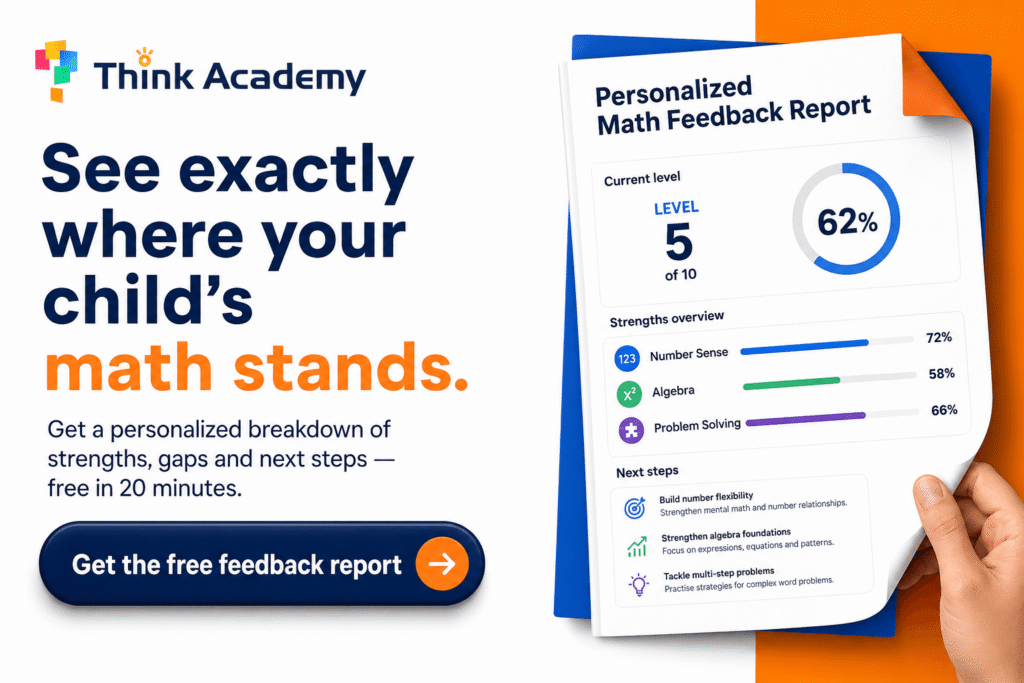
Diagnostic-led placement, not grade-level assumption. A good programme does not assume a Grade 7 student should start at Grade 7 content. It assesses where the student actually is — which may be ahead of, at, or behind grade level — and places them accordingly. Starting too low is demoralising and wasteful. Starting too high produces frustration and dropout. Diagnostic-led placement is not optional; it is the foundation of effective tutoring.
A defined curriculum, not improvised sessions. “We’ll work on whatever your child needs” sounds flexible — it is actually a warning sign. A strong tutoring programme has a structured curriculum with a defined scope and sequence, so both the instructor and the student know where they are going and how each session connects to the next. Improvised sessions produce inconsistent outcomes.
Regular, frequent sessions. A one-hour session once a fortnight is not tutoring — it is occasional review. Mathematical fluency is built through regular practice. Two to three sessions per week, consistently maintained over months, produces fundamentally different outcomes from sporadic intensive sessions. When evaluating a programme, ask what the expected session frequency is and what the dropout rate looks like.
Progress tracking and parent reporting. You should be able to see what your child is covering, what they have mastered, and where they are still working. If a tutoring programme cannot tell you specifically what progress looks like after eight weeks, it cannot tell you whether the investment is working.
Cultural fit with your child. This one matters more than parents sometimes acknowledge. A student who connects with their instructor — who feels safe to say “I don’t understand” and try again — learns more than one who feels judged or rushed. Visit a trial session with attention to how the instructor engages with your child, not just the content they cover.
How Much Does Online Math Tutoring Cost in Canada?
Costs vary significantly by provider, programme type, and session format.
| Programme Type | Typical Cost Range |
|---|---|
| Freelance individual tutor (one-to-one) | $40 – $90 per hour |
| Tutoring platform (marketplace model) | $35 – $75 per hour |
| Structured programme (small group) | $150 – $350 per month |
| Structured programme (one-to-one, premium) | $400 – $800 per month |
The cheapest option is rarely the best value. A freelance tutor at $45/hour who improvises sessions without a curriculum produces less measurable progress than a structured programme at $250/month with qualified instructors, diagnostic placement, and defined learning outcomes. The question is not what the hourly rate is — it is what outcome the programme produces per dollar invested.
Think Academy offers structured, expert-led online mathematics instruction with transparent pricing, diagnostic-led placement, and a defined curriculum mapped to Canadian provincial standards and competition mathematics. The free trial lesson is the right starting point for understanding whether it fits your child’s specific needs and level.
What to Expect in the First Eight Weeks
Parents who invest in online math tutoring often ask the same question four weeks in: “Is it working?” Knowing what to expect — and what timeline is realistic — prevents both premature dropout and unrealistic expectations.
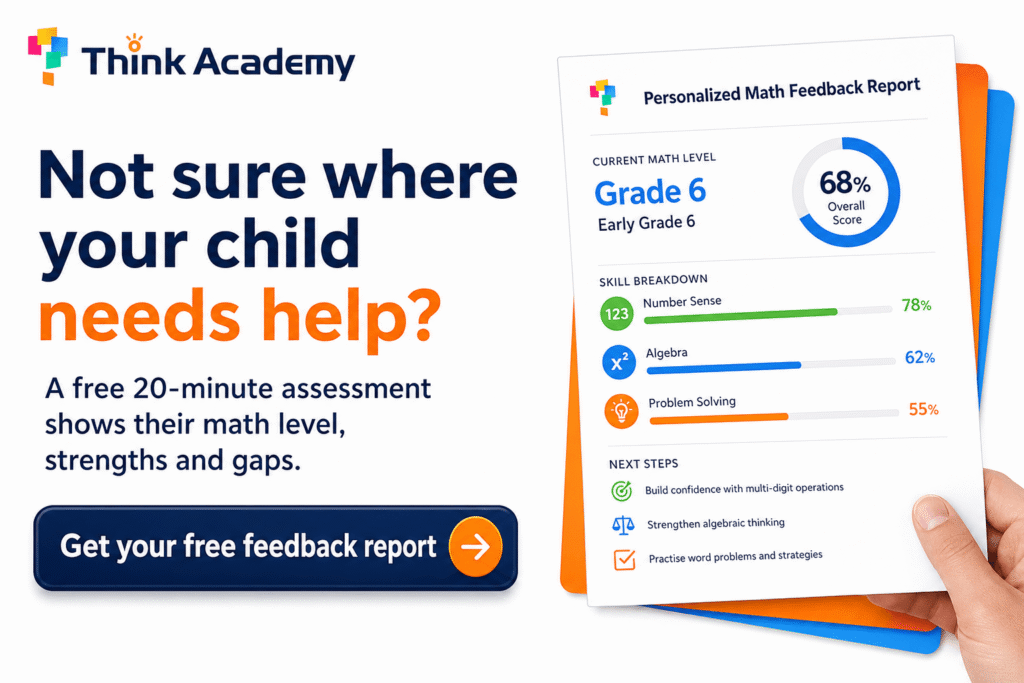
Weeks 1–2: Diagnostic and calibration. A good programme spends the first sessions confirming the student’s actual starting point and establishing a working relationship. Visible academic progress in the first two weeks is unusual and not the right benchmark.
Weeks 3–4: Foundation-building. The instructor is addressing the specific gaps identified in the diagnostic. The student may be covering content they nominally already know but actually have gaps in — this can feel like going backwards, but it is the necessary foundation for what comes next. Confidence usually starts to build in this phase.
Weeks 5–8: Measurable progress. By the end of eight weeks of consistent sessions (two to three per week), a student should be demonstrably stronger in the specific areas identified as gaps in the diagnostic. This is the point at which test results, in-class confidence, and parental observation should all show something different from week one. If they don’t, the programme is not working.
Beyond eight weeks: The students who make the most significant gains are those who maintain sessions consistently over six months or more. Mathematical fluency compounds — the foundations built in weeks 1–8 allow faster progress in weeks 9–16, which allows even faster progress beyond that. The students who start and stop, or who take extended breaks, reset much of what they have built.
Online Math Tutoring for Specific Goals
Private school admissions (SSAT) For families targeting Ontario, BC, or Alberta independent schools that use the SSAT, focused quantitative preparation over 12–18 months is significantly more effective than general tutoring. See our SSAT guide for Canadian students and SSAT mock test guide for specifics on what preparation looks like.
Mathematics competitions For students aiming at CEMC contests (Gauss, Cayley, Fermat, Euclid) or AMC (AMC 8, AMC 10), structured competition mathematics preparation is a distinct offering from curriculum tutoring. Think Academy offers competition-specific programmes across the full contest ladder. See our math competitions in Canada guide for the full landscape.
Grade 8 to Grade 9 transition The most common tutoring engagement point. The jump from elementary to secondary mathematics — specifically the introduction of abstract algebra in MTH1W — catches many capable students off guard. Summer tutoring targeting the specific Grade 8 to Grade 9 gap is the most high-leverage intervention available for students in this transition. See our Grade 9 math September preparation guide for what this looks like.
Grade 11 to Grade 12 (MHF4U and MCV4U) For students targeting university programmes in engineering, computer science, or commerce, Grade 12 mathematics results directly affect admissions averages. Structured support in MHF4U and MCV4U — both content consolidation and exam preparation — produces measurable improvements in the marks that determine university outcomes. See our MHF4U Advanced Functions guide and Grade 12 math Ontario guide.
Why Think Academy
Think Academy Canada is the online mathematics learning programme for students in Grades 1–12, operating across Canada as part of TAL Education Group — one of the largest K–12 education organisations in the world.
What makes Think Academy different from a tutoring marketplace:
- Structured curriculum, not improvised sessions — every lesson has a defined place in a coherent learning sequence
- Expert instructors with deep mathematics backgrounds, not generalist tutors
- Diagnostic-led placement that starts from where your child actually is, not their grade
- Competition mathematics integrated for students who want to go further than the curriculum
- Proven track record — 550+ competition awards, 68 AMC 8 awards in 2026, 7 perfect scores, and 70% of Canada’s AMC Distinguished Honour Roll
Think Academy is not the right fit for every student. It is specifically designed for motivated students — those who want to improve, who can engage with structured work, and whose parents are committed to the consistency that produces real results. For families who fit that description, it is the strongest online mathematics option available in Canada.
Frequently Asked Questions
How do I find a good online math tutor in Canada? The most important factors are instructor qualifications, programme structure, and diagnostic-led placement. Avoid platforms that match students with any available tutor without assessing fit. The free assessment Think Academy offers is the right starting point — it gives a clear picture of your child’s level and what they specifically need before any commitment is made.
What age can children start online math tutoring? Think Academy works with students from Grade 1 onward. For younger students (Grades 1–3), sessions are shorter and more game-like in structure. For older students (Grades 4–12), sessions are more formal. The right starting age is whenever a child can maintain focus for a 30–45 minute session, which varies by child.
How often should my child have online math tutoring sessions? Two to three sessions per week is the minimum for consistent progress. One session per week produces slower improvement and is more vulnerable to disruption — a cancelled session leaves a week-long gap. Think Academy’s standard programme is built around consistent weekly scheduling.
How do I know if online math tutoring is working? By Week 8, a student in a well-matched programme should show measurable improvement in the specific areas identified as gaps in their diagnostic. This can be observed through school test results, in-class confidence, and the student’s own reported understanding. If nothing has changed after eight weeks of consistent sessions, either the programme is wrong for the student, the frequency is too low, or the level is mismatched.
Is online math tutoring worth it? For the right student and the right programme — yes, consistently. The students who benefit most are those whose parents are committed to consistency, who are placed at the right level from the start, and who engage actively in sessions rather than passively receiving instruction. A diagnostic assessment is the most reliable way to determine whether a programme is the right fit before committing.
Can online math tutoring help with mathematics competitions? Yes, if the programme offers competition-specific instruction rather than just curriculum tutoring. Think Academy offers structured competition mathematics preparation across the full CEMC and AMC contest ladder. See our math competitions in Canada guide for specifics.
See our related guides: SSAT guide for Canadian students · math competitions in Canada · math enrichment guide · is my child gifted in math · Grade 9 math September preparation · MHF4U Advanced Functions guide · Ontario math curriculum guide · SSAT mock test guide
The first step isn’t choosing a tutor. It’s knowing where your child actually stands.