


When we ask “Who invented zero?”, we’re not just asking about a number — we’re exploring the foundation of how humans (and children) learn to think.
Zero is one of the most revolutionary concepts in mathematics. It bridges counting and reasoning, and it still shapes how students develop number sense, logical thinking, and problem-solving skills today.
1. The Origins of Zero: From Counting to Thinking
Zero’s roots trace back more than 2,000 years.
In ancient Mesopotamia, around 300 BCE, the Babylonians used a small placeholder symbol within their base-60 numeral system. It indicated “an empty position,” similar to how we use 0 in 105 — but it didn’t yet represent a true number.
The real breakthrough came in 5th-century India.
Mathematician Brahmagupta, in his work Brahmasphutasiddhanta, gave zero its identity as both a placeholder and a number.
He wrote that “a number subtracted by itself becomes zero,” and even defined rules for adding and subtracting with it. This marked a shift from memorizing symbols to understanding relationships — a skill essential for every child learning math today.
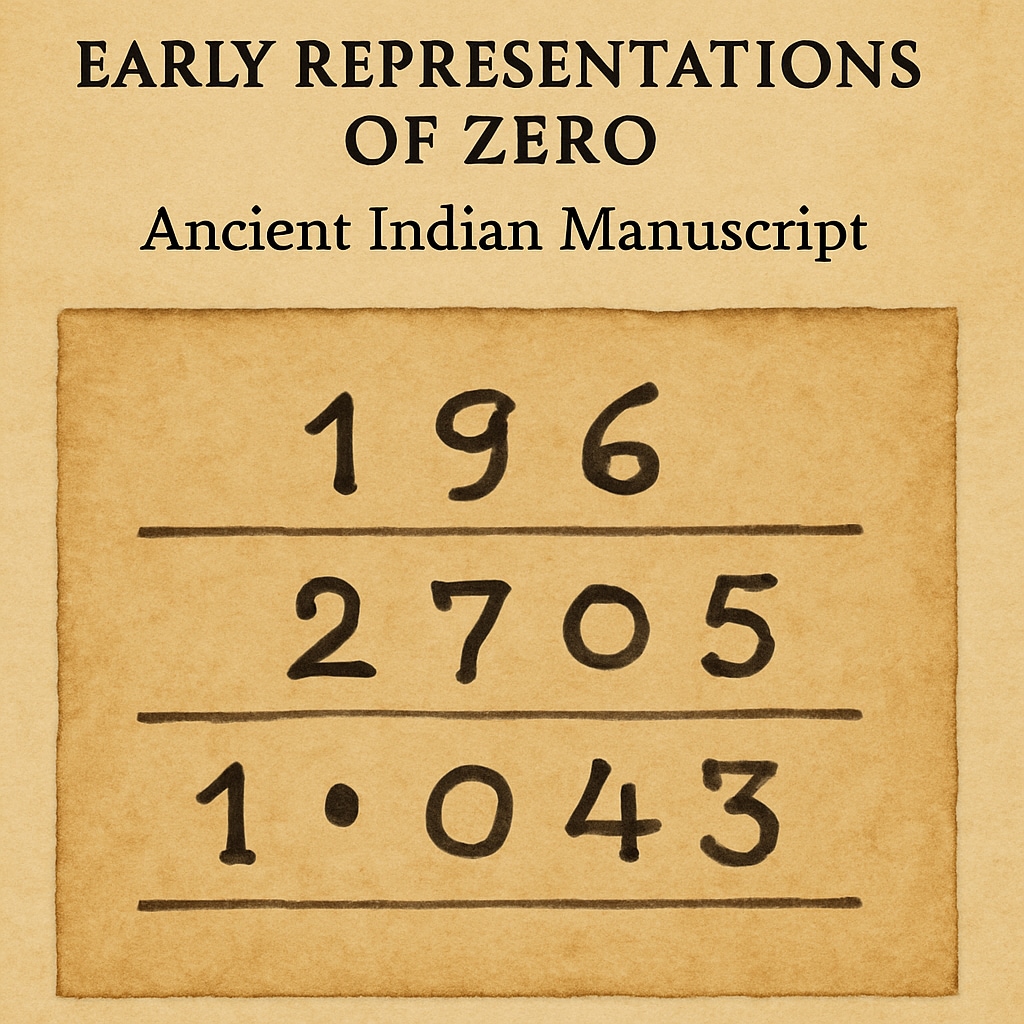
In early Indian manuscripts, zero appeared as a small dot — a symbol of both nothingness and infinite possibility.
👉 Learn how young students build similar logical leaps in From Colors And Shapes to Numbers And Logic — How Math Pattern Games Nurture Early Math Skills
2. From India to the World: How Zero Traveled and Transformed Learning
Through the Islamic Golden Age, zero’s influence spread far beyond India.
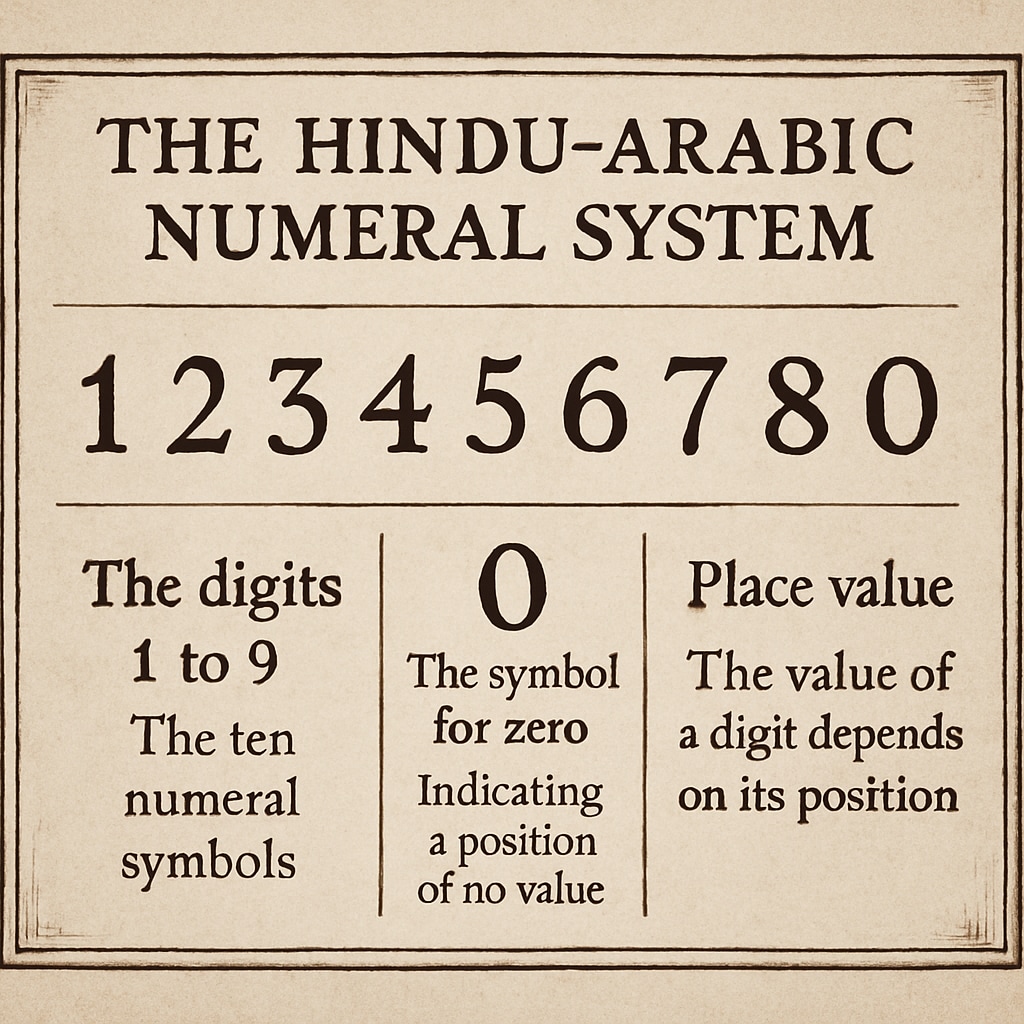
Scholars like Al-Khwarizmi translated Brahmagupta’s texts into Arabic, introducing the Hindu–Arabic numeral system — the one we still use today.
His writings also inspired the term al-jabr (algebra), the foundation of mathematical reasoning taught in modern middle schools.
By the 12th century, Italian mathematician Fibonacci introduced zero to Europe through his book Liber Abaci.
This transition from Roman numerals to the Hindu–Arabic system revolutionized trade, accounting, and science — and ultimately changed how the world learned and taught mathematics.
Medieval manuscripts show early use of zero in European calculations — a quiet but profound educational revolution.
See how modern curricula connect school math to competitions in From Curriculum to Contest: How Ontario Math Prepares Students for Gauss, AMC, and Beyond
3. Zero’s Lasting Impact on Modern Education
Zero remains at the heart of K–12 math learning today.
From place value lessons in early grades to algebra and calculus in high school, understanding zero is essential for building deeper conceptual thinking.
- In elementary school, zero helps students understand “nothing” as a measurable idea — the beginning of abstract thought.
- In middle school, it supports understanding of negative numbers and equations.
- In high school, it becomes the foundation of functions, limits, and coordinate systems.
And beyond arithmetic, zero powers the modern world: it’s the backbone of binary code (1s and 0s) — the logic behind every computer, app, and digital tool students use daily.
Discover how structured reasoning supports comprehension in Why Kids Struggle to Read Math Problems — ITA Method Insights.
4. The Deeper Meaning of Zero: A Lesson in Curiosity
In many ways, the invention of zero mirrors a student’s learning journey.
What began as “nothing” became the seed for infinite discovery — just as every child begins by asking questions that lead to understanding.
In ancient India, Shunya meant “the void” — an idea of emptiness filled with potential.
In classrooms today, zero still represents that same spark of curiosity: the point where imagination meets logic, and learning truly begins.
5. Conclusion: Why Zero Still Matters in K–12 Math Learning
The story of zero is not just about numbers. It’s about how people learn to think.
From Brahmagupta’s ancient equations to the lessons children learn in today’s classrooms, zero has always stood for curiosity — the need to understand what lies behind the symbols.
When we help students grasp what “nothing” means, we’re actually teaching them how to reason.
They start to see how numbers relate to one another, how balance works in equations, and how ideas can grow from simple patterns into larger systems.
That’s the bridge between number sense and mathematical structure, the same thinking that leads students toward algebra, problem solving, and logical reasoning.
This connection continues naturally into the world of number formulas.
Once students understand what zero represents, they’re ready to explore how numbers interact through patterns and rules — the true language of mathematics.
It’s through this kind of discovery that learners begin to think like mathematicians, not just memorize facts.
You can read more about this transition in AMC 8 Math Formulas + Real Problems: Master Number Theory.
Zero may stand for “nothing,” but it’s where every idea begins — a small symbol that opened the door to infinite ways of thinking.

