


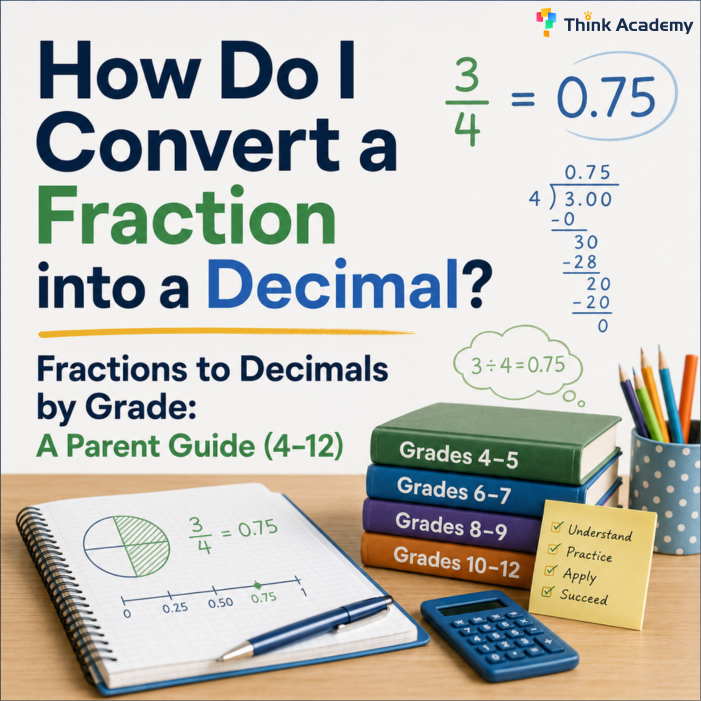
When kids start learning fractions and decimals, the first question is “How do I convert a fraction into a decimal?” Many parents see confidence dip fast: “Why is 1/4 bigger than 1/8?” or “Why does 0.6 beat 0.57?” However, these skills grow step by step across the elementary years, and small gaps can snowball. This guide walks you through what children typically learn by grade, the most common misunderstandings, and practical ways to help at home without turning every evening into a battle.
How number sense grows from sharing to measuring
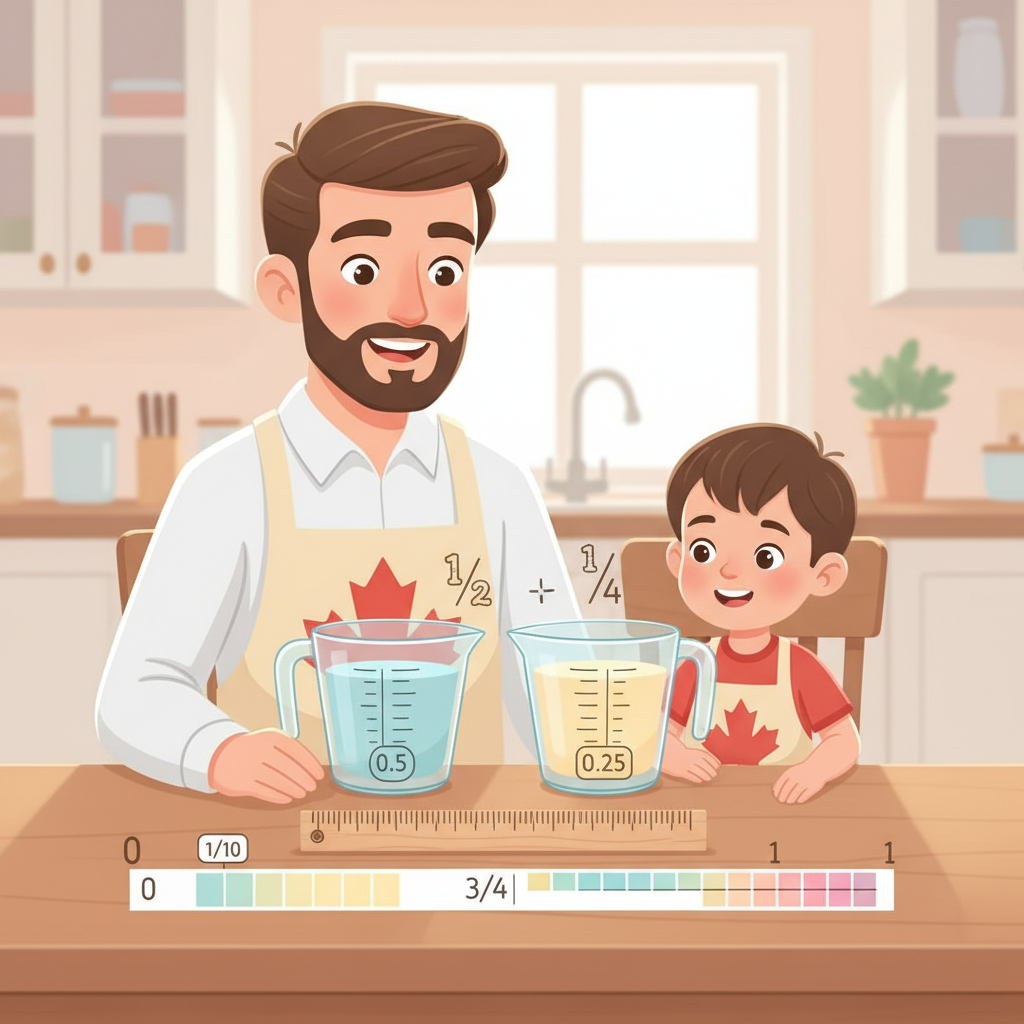
In Canadian classrooms, fraction and decimal learning usually follows a real-life path: sharing food, measuring lengths, and reading money. Therefore, your child’s early experiences matter as much as worksheets.
It also helps to know the language teachers use. For example, “equivalent” means the same value (like 1/2 and 2/4). “Place value” means what a digit is worth based on position (like 0.5 versus 0.05).
What Canadian kids learn about fractions and decimals by grade
Curriculum details vary by province, but the overall progression is consistent: children build fraction ideas first, then connect them to decimals through place value and measurement. To see official expectations in your province, start with your ministry’s curriculum hub, such as the Ontario curriculum overview or the BC curriculum portal.
A simple grade-by-grade map (typical progression)
| Age/Grade band | Typical fraction focus | Typical decimal focus | What parents often notice |
|---|---|---|---|
| Kindergarten–Grade 1 | Sharing equally; halves in real life | Informal talk only (money may appear) | Kids use words (half) before symbols (1/2) |
| Grade 2–3 | Equal parts; thirds/quarters; simple fraction models | Money as decimals (dollars and cents) in many classrooms | Confusion when parts are not equal size |
| Grade 4 | Comparing fractions; equivalent fractions; number lines | Tenths/hundredths appear more clearly | “Bigger denominator means bigger number” mistake |
| Grade 5 | Adding/subtracting fractions (often like denominators first) | Comparing/ordering decimals; basic operations begin. The question “How do I convert a fraction into a decimal?” becomes more important. | Place-value errors (0.4 vs 0.35) |
| Grade 6 | Operations deepen; mixed numbers; links to ratios | Converting between forms; applying to measurement | Speed drops if foundational meaning is shaky |
If you want a neutral refresher on key terms, the reference entries for fractions and decimals can help you quickly check definitions before you explain them at home.
How do I convert a fraction into a decimal? Where it gets harder: the “meaning” behind the symbols
Children can memorize steps without understanding. However, fractions are about relationships (part-to-whole), while decimals are about place value (base-ten). Therefore, when kids treat them like random rules, errors spike.
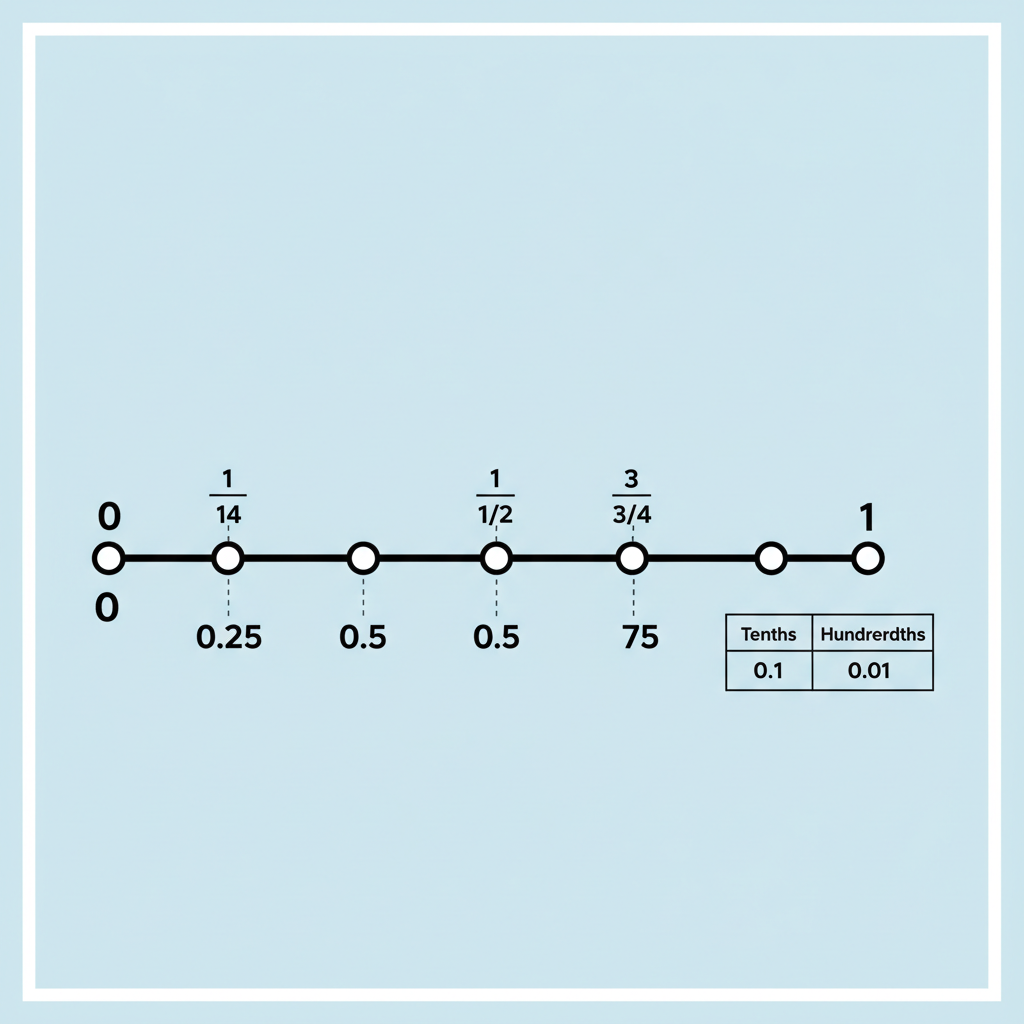
A strong sign of real understanding is flexibility. For example, if your child can show 0.5 on a number line, explain that it is the same as 1/2, and use it to solve a simple measurement problem, they are building durable skills.
Common parent-reported stumbling blocks (and what’s really happening)
Most struggles come from predictable misconceptions, not lack of effort. Therefore, fixing the idea usually works better than adding more pages of practice.
- Denominator confusion: Kids may think 1/8 is bigger than 1/4 because 8 is bigger than 4. However, the denominator tells how many equal parts the whole is split into.
- Unequal parts: If a “fraction pizza” drawing has uneven slices, your child learns the wrong lesson. Therefore, accurate visuals matter early.
- Decimal length myth: Some kids assume 0.57 is bigger than 0.6 because it has more digits. Instead, compare place by place: tenths first, then hundredths.
- Skipping the number line: Without a number line, fractions and decimals feel like separate topics. With a number line, they become positions on the same scale.
If your child brings home province-wide assessment language (like “number sense” or “mathematical reasoning”), those phrases point to explaining thinking, not only getting answers. “Mathematical reasoning” means using clear steps that show why an answer makes sense.
At-home support that matches what teachers expect
You do not need advanced math to help. Instead, you need short, repeatable routines that connect symbols to real meaning. Here are parent-friendly strategies that fit ages 4–12.
1) Use quick visuals before procedures
When a question looks abstract, start with a model. For example, draw a rectangle split into equal parts, or use a number line from 0 to 1.
Then, connect it back to the written form. However, keep it short: one clear picture beats five rushed ones.
2) Compare using benchmarks kids remember
Benchmarks are “anchor” values (easy reference points). Therefore, they make comparisons calmer and faster.
- 0, 1/2 (0.5), and 1 are strong fraction and decimal anchors.
- 1/4 (0.25) and 3/4 (0.75) help once Grade 4–5 content appears.
3) Make conversions meaningful, not magical
Converting is not only a trick; it is a translation. For example, 0.3 means 3 tenths, and 3/10 means the same thing: 3 parts out of 10 equal parts.
However, avoid pushing complex conversions too early. Therefore, stick to tenths and hundredths first, then expand as your child’s grade requires.
4) Practise “explain it two ways” in 2 minutes
Ask one extra prompt after a correct answer. For example: “Show it on a number line” or “Explain using money.” This supports transfer (using a skill in a new setting).
However, if your child gets frustrated, scale down the prompt. Therefore, you might say, “Tell me which is closer to one-half, and why.”
5) Keep practice short, then mix it
Kids build fluency (accurate speed) with short practice, not marathon sessions. Therefore, aim for 10–15 minutes, then stop.
After your child learns a skill, mix question types. For example, combine comparing, ordering, and simple addition, so they learn to choose a method.
Mini checklists: what to look for at each stage
If you want to spot gaps early, use these quick “can-do” checks. However, treat them as guidance, not a test.
Grades 1–3 readiness
- Can split a snack into equal halves or quarters and explain “equal parts.”
- Can recognize that two quarters make a half using pictures.
- Can count money values sensibly (for example, $1.25 as 1 dollar and 25 cents).
- 3rd grade is when equivalent fractions are formally taught.
For more on fractions, including equivalent fractions practice questions and solutions, check out: Equivalent Fractions Worksheet: Practice Problems and Examples.
Grades 4–6 readiness
- Can place 1/2, 1/4, 3/4 on a number line between 0 and 1.
- Can compare 0.6 and 0.57 using tenths and hundredths.
- Can explain why 2/4 equals 1/2 using a model.
- Can connect a simple fraction to a decimal for tenths and quarters.
Tools & resources (official and reputable)
Use resources that show concepts clearly and match classroom expectations. Therefore, start with these well-known, open-access options:
- Khan Academy for structured practice with visual explanations and mastery checks.
- Desmos for free interactive number lines and visual math activities.
- GeoGebra for manipulatives (interactive math tools) that model fractions, decimals, and number lines.
- National Council of Teachers of Mathematics (NCTM) for parent-friendly articles and tasks grounded in research.
- Government of Canada education and learning hub for a safe starting point when you want broader learning supports.
This article provided an answer to the question “How do I convert a fraction into a decimal?” When children understand the meaning behind fractions and decimals, they usually become calmer problem-solvers, not just faster calculators. However, the key is steady progress: models first, clear benchmarks, and short mixed practice that matches what they see in class. If you focus on one small gap at a time, you can rebuild confidence quickly and make future topics like percent and ratio feel far more manageable.
About Think Academy
Think Academy, part of TAL Education Group, helps K–12 students succeed in school today by building strong math foundations and critical thinking skills. At the same time, we focus on the bigger picture—developing learning ability, curiosity, and healthy study habits that inspire a lifelong love of learning. With expert teachers, proven methods, and innovative AI tools, we support every child’s journey from classroom confidence to long-term growth.

