


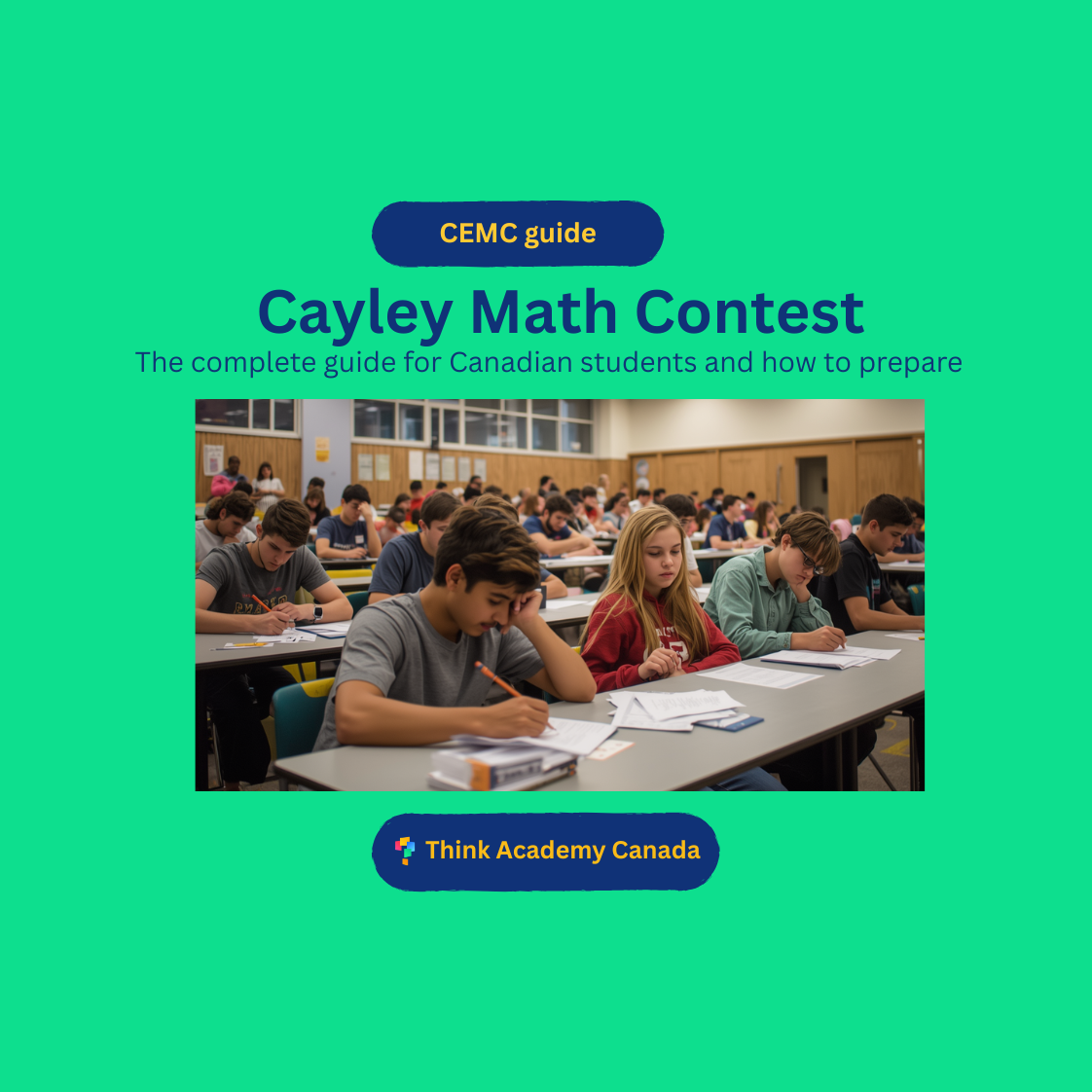
The Cayley Math Contest is one of Canada’s most respected mathematics competitions, written each February by Grade 10 students (and ambitious younger students) at thousands of schools across the country. Run by the University of Waterloo’s Centre for Education in Mathematics and Computing (CEMC), the contest is a 60-minute, 25-question challenge that rewards careful problem-solving rather than memorisation. This guide walks Canadian parents through everything that matters: the format, the difficulty, registration deadlines, past papers (including the Cayley Math Contest 2024 and Cayley Math Contest 2023), and a structured Cayley Math Contest practice plan that actually works.
What is the Cayley Math Contest?
The Cayley Contest is the middle contest in the CEMC’s Pascal–Cayley–Fermat (PCF) series. It targets students in Grade 10 or below, sitting between the Pascal Contest (Grade 9) and the Fermat Contest (Grade 11). Each year, over 80,000 students worldwide write one of the three contests, and Canadian high schools treat strong Cayley results as a clear marker of mathematical promise.
Unlike a school exam, the Cayley is not designed to test what students have memorised from the curriculum. It rewards the ability to think mathematically: to break a problem into pieces, spot a useful pattern, and reason carefully under time pressure. For many Canadian students, it is the first time they encounter problems that look unfamiliar but turn out to be solvable with the tools they already have.
Who is eligible to write the Cayley?
| Contest | Eligible grade | Typical age |
| Pascal | Grade 9 or below | 13–14 |
| Cayley | Grade 10 or below | 14–15 |
| Fermat | Grade 11 or below | 15–16 |
A student can write only one of the three PCF contests in a given school year. Younger students who are working ahead may write a higher contest, but only one per year.
Cayley Math Contest format and scoring (2025/2026 update)
The CEMC updated the PCF format recently, so a lot of older guides online are out of date. Here is what the contest actually looks like today.
Structure
- 25 questions total, split into three parts of increasing difficulty
- Parts A and B: traditional multiple choice (A, B, C, D, or E)
- Part C: each answer is a whole number from 0 to 99 (newer format, no longer multiple choice)
- 60 minutes of working time
- Score out of 150
- Written at school, on paper or online through the CEMC Contests Online platform
- Some calculators permitted (no internet access, no CAS, no communication features)
Scoring breakdown
| Section | Questions | Points per correct answer | Total available |
| Part A | 10 | 5 | 50 |
| Part B | 10 | 6 | 60 |
| Part C | 5 | 8 | 40 |
| Total | 25 | — | 150 |
There is no penalty for a wrong answer, but each unanswered question is worth 2 points, to a maximum of 10 unanswered questions (20 points). This rule changes the strategy: a student who is genuinely stuck on a question is sometimes better off leaving it blank than guessing, but only up to 10 blanks.
What topics show up?
The Cayley draws on curriculum content common to all Canadian provinces. The most frequent areas are:
- Number sense and operations: ratios, percentages, divisibility, prime factorisation
- Algebra: linear equations, systems, sequences, basic functions
- Geometry: angles, triangles, circles, area, perimeter, volume, similar triangles
- Counting and probability: simple casework, basic combinatorial reasoning
- Logical reasoning: word problems that combine two or more of the above
Part C is where the contest gets genuinely hard. Questions there often combine domains, for example pairing geometric reasoning with algebraic equations, or number theory with casework.
Cayley Math Contest 2026 dates and registration
The 2026 Cayley Contest was written on Wednesday, 25 February 2026 in North and South America. The CEMC has published the tentative 2027 date as Wednesday, 24 February 2027, with the practice contest opening earlier in the month.
Key deadlines for Canadian schools
| Item | Typical timing |
| Registration deadline | Late January |
| Practice contest opens | Early February |
| Contest day | Last Wednesday of February |
| Results published | March (preliminary), then mid-March (final) |
| Solutions posted publicly | By mid-May on the CEMC website |
Students cannot register directly. Schools register them through the CEMC Contest Supervisor Portal. If a child’s school does not participate, parents can ask a nearby school to host the student as a guest writer. The current contest fee is set by each school; CEMC charges schools roughly $5–$10 per participant, depending on the contest year and order size.
Cayley Math Contest 2024: what to learn from it
The Cayley Math Contest 2024 was written on Tuesday, 27 February 2024, and it is one of the most useful papers for current preparation because the format and difficulty calibration are very close to what students see today.
A few observations from the 2024 paper:
- Part A opened with two warm-ups that almost every student should get: an arithmetic evaluation and a simple expression. Confidence-builders by design.
- Part B introduced classic geometry casework, including a problem about an isosceles triangle with equal segments on its sides, requiring careful angle chasing.
- Part C reached its hardest point with a problem about a race between two runners, where one increases speed by an unknown percentage. The set-up is plain English, the algebra is gnarly, and it took most strong students 8 to 10 minutes.
Themes that repeated in 2024:
| Topic | Approximate number of questions |
| Geometry (angles, area, similar figures) | 7 |
| Algebra and equations | 6 |
| Number theory and divisibility | 4 |
| Counting and probability | 4 |
| Logic and pattern recognition | 4 |
Students preparing for the next Cayley should work through the 2024 official paper and solutions on the CEMC website. The official write-ups are excellent: they often show two distinct solution methods, which is where most of the real learning happens.
Cayley Math Contest 2023: a tougher Part C
The Cayley Math Contest 2023 is interesting for a different reason: it was one of the first years to use the new Part C format where answers are integers from 0 to 99 rather than multiple choice. That change matters because it removes the option to back-solve from the answer choices, which used to be a powerful tactic on the old papers.
Standout questions from 2023 included:
- A robotic grasshopper that jumps east, north, west, south in a repeating cycle. Students had to find how many total jumps led to a specific final position, which required spotting the four-jump cycle and reasoning about modular arithmetic.
- A five-digit product in the form AB0AB made from five different odd positive integers, all greater than 2. The answer involved counting the number of valid sets and was the hardest question on the paper.
- A geometry problem involving angles where ∠ABC = 90° and ∠ACD = 150°, with points B, C, and D on a line. Solvable in under three minutes if a student spots the exterior angle relationship.
Working through the 2023 paper alongside the 2024 paper gives students a clear picture of how Part C has evolved and where the CEMC is calibrating its difficulty.
Cayley Math Contest practice: a 12-week preparation plan
This is the section most parents come to a guide like this for. A vague “do past papers” suggestion is not enough. Here is the structured Cayley Math Contest practice plan we recommend at Think Academy Canada, broken down by week.
Weeks 1–2: Diagnose and benchmark
- Sit one past paper under timed conditions (60 minutes, no help, calculator on the desk but used sparingly). The 2022 or 2023 paper works well as a baseline.
- Mark it using the official solutions and record three numbers: total score, score by Part (A/B/C), and topics where mistakes clustered.
- Decide: is the goal to reach Certificate of Distinction (top 25%), or to break into the top 10%? The plan changes.
Weeks 3–6: Build topic foundations
Spend two weeks each on the two weakest topics from the diagnostic. Rotate through:
- Number theory and divisibility
- Geometry (angles, triangles, circles)
- Algebraic manipulation and word problems
- Counting and probability
Use a mix of CEMC’s free Problem Set Generator (which builds custom sets from past PCF problems by topic) and the CEMC Courseware modules. Twenty minutes a day beats two hours on Sunday.
Weeks 7–10: Past paper rotation
Aim for one full past paper per week, starting easier and getting harder.
| Week | Paper to attempt | Why |
| 7 | 2019 Cayley | Pre-format-change; gentler Part C |
| 8 | 2022 Cayley | Newer Part C format introduction |
| 9 | Cayley Math Contest 2023 | Hardest Part C in recent memory |
| 10 | Cayley Math Contest 2024 | Closest to current difficulty |
After each paper, spend at least 90 minutes on the post-mortem: redo every question missed, write a one-line “lesson” for each, and tag the type of mistake (concept gap, careless arithmetic, time pressure, misread).
Weeks 11–12: Refine and rehearse
- Two more past papers in full timed conditions.
- Build a personal “cheat sheet” of the formulas and tricks the student keeps forgetting (not allowed in the contest, but the act of building it cements them).
- Practise the blank-answer strategy: every paper, decide which 1–3 questions to leave blank to bank those 2-point unanswered marks.
Where to find Cayley practice problems
- CEMC Past Contests and Solutions — official archive, last 10+ years
- CEMC Problem Set Generator — custom problem sets by topic
- CEMC Math Courseware — free, structured lessons
- Think Academy’s Cayley problem library — curated by difficulty and topic for our students
Why the Cayley matters for Canadian students
Strong Cayley results carry weight in three concrete ways:
- University admissions in Canada and the US. Waterloo’s own undergraduate math and computer science programs explicitly track CEMC contest performance. A Certificate of Distinction (top 25%) is a meaningful signal on a Canadian application; a top-school ranking lifts it further.
- Invitation to follow-on contests. Top Cayley scorers can be invited to the Canadian Open Mathematics Challenge (COMC) and other invitationals, which feed into the Canadian Mathematical Olympiad pipeline.
- Transferable skills. The thinking habits the Cayley builds — careful reading, structured casework, knowing when to abandon an approach — apply directly to physics, computer science, and any subject that rewards problem-solving.
For students who plan to write the AMC 10 or AMC 12 the same year, Cayley preparation overlaps significantly. The geometry and number-theory toolkits are nearly identical. For more on the American contests, see our AMC 10 pillar guide for Canadian students and our overview of what the AMC is.
How the Cayley fits in the broader Waterloo contest family
The CEMC runs the country’s largest network of math contests. The Cayley is one stop on a longer journey.
| Grade | Recommended contest | Notes |
| 7 | Gauss 7 | Friendly entry point; multiple choice, online |
| 8 | Gauss 8 | Same format, one step harder |
| 9 | Pascal | First of the PCF series |
| 10 | Cayley | This guide |
| 11 | Fermat | Last of the multiple-choice contests |
| 11–12 | Euclid | Full-solution contest; matters for Waterloo admissions |
For deeper dives, see our complete Waterloo Math Competitions guide, our Gauss Math Contest pillar, our Pascal Math Contest guide, and our Euclid Math Contest preparation guide.
How Think Academy Canada supports Cayley preparation
Think Academy is the international arm of TAL Education Group, one of the largest education companies in the world. Our Canadian programs are built around the same philosophy: a carefully paced math curriculum, an online interactive platform built for math (not bolted on), and gamified rewards that keep students engaged week after week.
For Cayley preparation specifically, our offering covers:
- A curriculum that runs ahead of the Ontario and BC standards. Most provinces give students five years of high school math to reach the level the Cayley tests. Think Academy students reach the same level a year or more earlier, which is why our Grade 9 students regularly write the Cayley and our Grade 10 students sit comfortably in the top quartile.
- Online-first delivery. Unlike in-person providers, our students learn from anywhere in Canada with the same teachers and the same curriculum. This matters in a country where in-person centres cluster in a handful of cities.
- A built-in interactive system. Lessons, homework, replays, and feedback all live in one app. Parents see what was taught, what was marked, and where their child stood that week.
- Free resources before you commit. Cayley past papers, a free math evaluation, and access to our problem library are available before signing up for a paid program.
- Teachers who mark homework personally. Every homework set is reviewed by the teaching team, not auto-graded by software.
We charge for the package, not for individual lessons, and we expect families to stay with us for years. That long arc is what produces durable mathematical skill, not a six-week sprint before the contest.
Frequently asked questions
What is the Cayley Math Contest?
The Cayley Math Contest is a 60-minute, 25-question mathematics competition for students in Grade 10 or below, run annually by the University of Waterloo’s CEMC. It is the middle contest in the Pascal–Cayley–Fermat series and is written by tens of thousands of students worldwide each February.
When is the Cayley Math Contest written?
The contest is held on the last Wednesday of February. The 2026 contest was on 25 February 2026; the tentative date for the 2027 contest is 24 February 2027.
How is the Cayley Math Contest scored?
It is scored out of 150. Part A questions are worth 5 points each, Part B questions 6 points each, and Part C questions 8 points each. There is no penalty for wrong answers, and each unanswered question is worth 2 points up to a maximum of 10 blanks.
How hard is the Cayley Math Contest?
Part A is accessible to any motivated Grade 10 student. Part B starts to require real problem-solving. Part C is genuinely difficult and is where the top scorers separate from the rest. The median score is usually around 60–70 out of 150.
What’s the difference between the Cayley Math Contest 2024 and 2023 papers?
Both papers use the current format (Part C as integer answers 0–99 rather than multiple choice). The 2023 Part C is generally considered harder than 2024’s, particularly questions 24 and 25. The 2024 paper has stronger algebra-heavy problems in Part B.
How should my child practise for the Cayley?
The most effective approach is structured: 4–6 weeks of topic-by-topic foundation work using the CEMC Problem Set Generator, followed by 4–6 weeks of timed past papers with detailed post-mortems on every mistake. Our 12-week plan above breaks this down week by week.
What calculator can my child use?
A basic scientific calculator is allowed. Calculators with internet access, communication features, or computer algebra system (CAS) capabilities — for example, the Casio ClassPad 300, HP Prime, or TI-Nspire CAS — are not permitted.
Can my child write the Cayley if they’re in Grade 9 or earlier?
Yes. The Cayley is open to any student in Grade 10 or below. Strong Grade 9 students often write the Cayley instead of the Pascal, but they can only write one of the three PCF contests in a given year.
Does my child need a tutor to do well?
No, but a structured program meaningfully shortens the path. The CEMC’s free resources are enough for a disciplined student with strong fundamentals. Students with topic gaps, or those targeting top 5% rather than top 25%, benefit most from a paced program with teacher feedback.
Where can I find Cayley past papers?
The full archive is on the CEMC Past Contests page, with problems, solutions, and results for the last decade. The Cayley Math Contest 2024and 2023 papers are particularly worth working through.
About Think Academy Canada
Think Academy Canada, part of TAL Education Group, supports K–12 students with structured math programs built around an online interactive platform, gamified learning, and teachers who personally mark every homework set. Our curriculum runs ahead of the provincial standards and is designed to prepare students for both school excellence and Canadian math competitions, including the Gauss, Pascal, Cayley, Fermat, and Euclid contests.
Recommended reading
- Waterloo Math Competitions: A Canadian Parent’s Complete Guide to CEMC Contests
- Pascal Math Contest: The Complete Guide for Canadian Students
- Euclid Math Contest: How to Prepare
- Gauss Math Contest: The Complete Guide
- Math Contests Canadian Teens Can Enter
- Canadian Math Contests Dates: A Parent Planning Guide
- How to Get Over Math Anxiety: Easing Math Contest Nerves
- How to Make a Study Schedule for Math Competitions

