
Finding the factors of a number is one of the most fundamental skills in number theory — and number theory is one of the most consistently tested topic areas across every level of the AMC math competition. This guide explains exactly how to find all factors of 24 and 45 using systematic methods that work for any number, covers factor pairs, common factors, and prime factorisation, and shows how these concepts appear in real AMC 8 problems with worked examples and full explanations.

What is a factor?
A factor of a number is any whole number that divides into it exactly with no remainder. If you divide a number by one of its factors, the result is always a whole number.
For example, 3 is a factor of 24 because 24 divided by 3 equals 8 exactly. There is no remainder. But 5 is not a factor of 24 because 24 divided by 5 equals 4.8 — not a whole number.
Every number has at least two factors: 1 and itself. A number whose only factors are 1 and itself is called a prime number. Numbers with more than two factors are called composite numbers. Both 24 and 45 are composite numbers with several factors each.
Why do factors matter in AMC 8 math?
Factors appear throughout AMC 8 number theory problems. A student who can quickly and accurately find the factors of a number has a significant advantage on these problems because many AMC 8 questions are built around factor relationships — divisibility, common factors, least common multiples, and prime factorisation all depend on the same foundational skill.
Students who learn a systematic method for finding factors — rather than guessing and checking randomly — solve these problems faster and make fewer errors under competition conditions.
All factors of 24
The number 24 is a highly composite number, meaning it has more factors than most numbers of similar size. This makes it one of the most commonly used numbers in factor problems at every level of competition math.
How to find factors using factor pairs
The most reliable method for finding all factors of any number is the factor pair method. You find pairs of numbers that multiply together to give the original number, starting from 1 and working upward until the two numbers in the pair meet or cross.
For 24, work through each whole number starting from 1:
- 1 times 24 equals 24 — so 1 and 24 are both factors
- 2 times 12 equals 24 — so 2 and 12 are both factors
- 3 times 8 equals 24 — so 3 and 8 are both factors
- 4 times 6 equals 24 — so 4 and 6 are both factors
- 5 does not divide 24 exactly — not a factor
- 6 times 4 equals 24 — but we already have this pair, so stop here
Once the pairs start repeating you have found all the factors. The complete list of factors of 24 is:
1, 2, 3, 4, 6, 8, 12, 24
That is eight factors in total.
Factor pairs
Writing factors as pairs makes it easy to confirm you have found all of them and helps with problems that ask about factor pairs specifically.
| Factor pair | Multiplication check |
|---|---|
| 1 and 24 | 1 x 24 = 24 |
| 2 and 12 | 2 x 12 = 24 |
| 3 and 8 | 3 x 8 = 24 |
| 4 and 6 | 4 x 6 = 24 |
There are four factor pairs of 24, giving eight individual factors total.
Prime factorisation
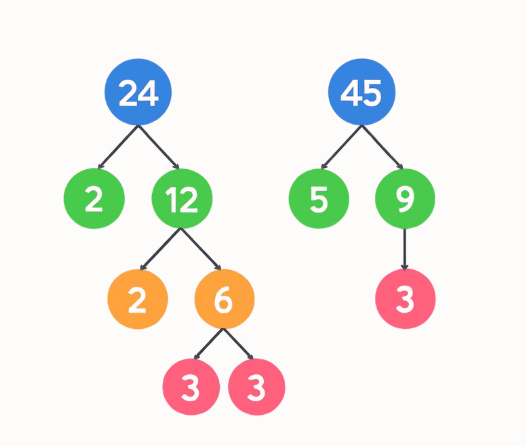
Prime factorisation breaks a number down into a product of prime numbers. It is a powerful tool in competition math because it reveals the structure of a number and makes finding factors, common factors, and multiples much faster.
To find the prime factorisation of 24, divide repeatedly by the smallest prime that goes in exactly:
24 divided by 2 equals 12 12 divided by 2 equals 6 6 divided by 2 equals 3 3 divided by 3 equals 1
So the prime factorisation of 24 is 2 x 2 x 2 x 3, written as 2³ x 3.
This is useful for AMC problems because the total number of factors of any number can be calculated directly from its prime factorisation. For 2³ x 3¹, add 1 to each exponent and multiply: (3+1) x (1+1) equals 4 x 2 equals 8. This confirms there are exactly 8 factors — matching the list above.
This method works for any number and is significantly faster than listing factors individually when dealing with larger numbers in competition problems.
Factors of 45
The number 45 is frequently used in factor problems because it has a different factor structure from 24 — it is odd, which means 2 is not a factor, and it has fewer total factors despite being larger.
How to find all factors of 45 using factor pairs
Apply the same factor pair method used for 24:
- 1 times 45 equals 45 — so 1 and 45 are both factors
- 2 does not divide 45 exactly — 45 is odd, so no even numbers are factors
- 3 times 15 equals 45 — so 3 and 15 are both factors
- 4 does not divide 45 exactly
- 5 times 9 equals 45 — so 5 and 9 are both factors
- 6 does not divide 45 exactly
- 7 does not divide 45 exactly
- 8 does not divide 45 exactly
- 9 times 5 equals 45 — but we already have this pair, so stop here
The complete list of all factors of 45 is:
1, 3, 5, 9, 15, 45
That is six factors in total.
Factor pairs of 45
| Factor pair | Multiplication check |
|---|---|
| 1 and 45 | 1 x 45 = 45 |
| 3 and 15 | 3 x 15 = 45 |
| 5 and 9 | 5 x 9 = 45 |
There are three factor pairs of 45, giving six individual factors total.
Prime factorisation of 45
Divide 45 repeatedly by the smallest prime that divides it exactly:
45 divided by 3 equals 15 15 divided by 3 equals 5 5 divided by 5 equals 1
So the prime factorisation of 45 is 3 x 3 x 5, written as 3² x 5.
Using the exponent method to count factors: (2+1) x (1+1) equals 3 x 2 equals 6. This confirms there are exactly 6 factors of 45.
Comparing the factors of 24 and 45
Comparing two numbers’ factors is a common task in AMC 8 problems and understanding the relationship between them — particularly common factors — is essential for problems involving greatest common factor and least common multiple.
Common factors
A common factor is a number that appears in the factor list of both numbers. To find common factors, compare the two lists:
Factors of 24: 1, 2, 3, 4, 6, 8, 12, 24
Factors of 45: 1, 3, 5, 9, 15, 45
The numbers that appear in both lists are 1 and 3.
The common factors of 24 and 45 are 1 and 3.
Greatest common factor of 24 and 45
The greatest common factor, often written as GCF, is the largest number that divides both numbers exactly. From the common factors found above, the GCF of 24 and 45 is 3.
This can also be found using prime factorisations:
24 = 2³ x 3 45 = 3² x 5
The GCF is the product of all prime factors that appear in both factorisations, using the lowest exponent. The only shared prime factor is 3, with the lowest exponent being 3¹. So GCF equals 3.
Summary comparison table
| Property | 24 | 45 |
|---|---|---|
| All factors | 1, 2, 3, 4, 6, 8, 12, 24 | 1, 3, 5, 9, 15, 45 |
| Number of factors | 8 | 6 |
| Prime factorisation | 2³ x 3 | 3² x 5 |
| Even or odd | Even | Odd |
| Common factors | 1, 3 | 1, 3 |
| Greatest common factor | 3 | 3 |
How to find factors of any number — a systematic method
The methods used above for 24 and 45 work for any number. Here is the complete process in a form that can be applied to any factor problem in AMC 8 or elsewhere.
Step one — check divisibility by small primes in order
Always start with 2, then 3, then 5, then 7. Use divisibility rules to check quickly:
- Divisible by 2 if the number is even (last digit is 0, 2, 4, 6, or 8)
- Divisible by 3 if the sum of digits is divisible by 3
- Divisible by 5 if the last digit is 0 or 5
- Divisible by 7 requires division — no simple rule
Step two — list factor pairs systematically
Starting from 1 and working upward, find pairs of numbers that multiply to give the original number. Stop when the two numbers in a pair meet or cross.
Step three — write out the complete factor list in order
List all factors from smallest to largest. This makes it easy to check for completeness and to identify common factors when comparing two numbers.
Step four — verify using prime factorisation
Find the prime factorisation and use the exponent method to count the total number of factors. If your count matches the number of factors you listed, you have found them all.
Factors in AMC 8 problems — worked examples
Number theory problems involving factors appear in almost every AMC 8 past paper. The following examples show how factor knowledge is tested and what a clear AMC 8 solution looks like.
AMC 8 example — counting factors
Problem type: How many positive integers are factors of both 24 and 45?
Solution: Factors of 24: 1, 2, 3, 4, 6, 8, 12, 24 Factors of 45: 1, 3, 5, 9, 15, 45 Common factors: 1 and 3 Answer: 2
Key insight: The question asks how many, not what they are. A student who lists both factor sets completely and compares them systematically will answer this correctly and quickly. A student who tries to spot common factors without a complete list will often miss one.
AMC 8 example — factor counting with prime factorisation
Problem type: How many positive integer factors does 24 have?
Solution using prime factorisation: 24 = 2³ x 3¹ Number of factors = (3+1) x (1+1) = 4 x 2 = 8
Answer: 8
Key insight: For small numbers like 24 you can list factors directly and count them. For larger numbers in AMC 8 problems, prime factorisation and the exponent counting method is faster and less error-prone. Learning both methods and knowing when to use each is important for competition performance.
AMC 8 example — greatest common factor
Problem type: What is the greatest common factor of 24 and 45?
Solution using prime factorisation: 24 = 2³ x 3 45 = 3² x 5 Shared prime factors: only 3, with lowest exponent 1 GCF = 3¹ = 3
Answer: 3
Key insight: The prime factorisation method for finding GCF is faster than listing all factors of both numbers and comparing, particularly when the numbers are larger. In AMC 8 problems where time management matters, using the most efficient method for each question type is a meaningful advantage.
AMC 8 example — factors in a word problem
Problem type: A teacher wants to divide 24 students into equal groups, with each group having more than 1 student and fewer than 24 students. How many different group sizes are possible?
Solution: The possible group sizes are the factors of 24 that are greater than 1 and less than 24. Factors of 24: 1, 2, 3, 4, 6, 8, 12, 24 Excluding 1 and 24: 2, 3, 4, 6, 8, 12 Answer: 6 different group sizes are possible
Key insight: The question is really asking for the number of factors of 24 between 1 and 24 exclusive. Recognising that a word problem about dividing into equal groups is a factor problem is the key skill. Students who have practised identifying disguised factor problems in AMC 8 past papers will see the connection quickly.

Divisibility rules — quick reference for factor finding
Knowing divisibility rules by heart speeds up factor finding significantly in timed AMC conditions.
| Divisor | Divisibility rule | Example with 24 | Example with 45 |
|---|---|---|---|
| 2 | Last digit is even | 24 ends in 4 — divisible | 45 ends in 5 — not divisible |
| 3 | Sum of digits divisible by 3 | 2+4=6, divisible by 3 | 4+5=9, divisible by 3 |
| 4 | Last two digits divisible by 4 | 24 divisible by 4 | 45 not divisible by 4 |
| 5 | Last digit is 0 or 5 | 24 ends in 4 — not divisible | 45 ends in 5 — divisible |
| 6 | Divisible by both 2 and 3 | Yes for 24 | No for 45 (not even) |
| 7 | No simple rule — divide directly | 24 / 7 = 3.43 — not divisible | 45 / 7 = 6.43 — not divisible |
| 8 | Last three digits divisible by 8 | 024 / 8 = 3 — divisible | 045 / 8 = 5.6 — not divisible |
| 9 | Sum of digits divisible by 9 | 2+4=6 — not divisible | 4+5=9 — divisible |
Memorising rules for 2, 3, 4, 5, 6, and 9 covers the vast majority of divisibility checks that appear in AMC 8 problems. The rule for 7 is not simple enough to memorise — just divide directly.
Extending the skill — factors of other common AMC numbers
The methods used for 24 and 45 apply directly to other numbers that appear frequently in AMC 8 problems. Here are a few quick examples to reinforce the method.
Factors of 36: 1, 2, 3, 4, 6, 9, 12, 18, 36 — nine factors. Prime factorisation: 2² x 3². Factor count: (2+1) x (2+1) = 9.
Factors of 48: 1, 2, 3, 4, 6, 8, 12, 16, 24, 48 — ten factors. Prime factorisation: 2⁴ x 3. Factor count: (4+1) x (1+1) = 10.
Factors of 60: 1, 2, 3, 4, 5, 6, 10, 12, 15, 20, 30, 60 — twelve factors. Prime factorisation: 2² x 3 x 5. Factor count: (2+1) x (1+1) x (1+1) = 12.
Practising the factor pair method and prime factorisation method on numbers like these until they feel automatic is the best preparation for number theory questions in AMC 8 past papers.
Frequently Asked Questions
What are all the factors of 24? The factors of 24 are 1, 2, 3, 4, 6, 8, 12, and 24. There are eight factors in total. The prime factorisation of 24 is 2³ x 3, and using the exponent method (3+1) x (1+1) = 8 confirms there are exactly eight factors.
What are all the factors of 45? The factors of 45 are 1, 3, 5, 9, 15, and 45. There are six factors in total. The prime factorisation of 45 is 3² x 5, and using the exponent method (2+1) x (1+1) = 6 confirms there are exactly six factors.
What are the common factors of 24 and 45? The common factors of 24 and 45 are 1 and 3. These are the only numbers that divide both 24 and 45 exactly. The greatest common factor of 24 and 45 is 3.
How do you find all factors of a number? Use the factor pair method: starting from 1, find pairs of numbers that multiply to give the original number, working upward until the pairs start repeating. List all numbers from both pairs in order from smallest to largest. Verify the count using prime factorisation — add 1 to each exponent in the prime factorisation and multiply the results.
What is the prime factorisation of 24? The prime factorisation of 24 is 2³ x 3, meaning 2 x 2 x 2 x 3 = 24. To find it, divide repeatedly by the smallest prime that divides exactly: 24 divided by 2 is 12, divided by 2 is 6, divided by 2 is 3, divided by 3 is 1.
What is the prime factorisation of 45? The prime factorisation of 45 is 3² x 5, meaning 3 x 3 x 5 = 45. To find it, divide repeatedly by the smallest prime that divides exactly: 45 divided by 3 is 15, divided by 3 is 5, divided by 5 is 1.
How do factors appear in AMC 8 problems? Factors appear in AMC 8 number theory problems in several forms: counting how many factors a number has, finding the greatest common factor of two numbers, dividing a quantity into equal groups, solving word problems about arrangements or distributions, and problems involving least common multiples. Students who can find all factors of a number quickly and accurately have a significant advantage on these questions.
What is the greatest common factor of 24 and 45? The greatest common factor of 24 and 45 is 3. This can be found by listing the factors of both numbers and identifying the largest common value, or by comparing prime factorisations — the only shared prime factor is 3 with the lowest exponent being 1.